1 / 7
Recent

My Job Responsibilities Changed Without a Conversation—What to Agree for 2027
·2226 words·11 mins
Your role grew an AI-coordination duty or another function while the old job stayed — and no one ever called it a new role. Here is how to agree what your 2027 job actually is, before planning locks it in: name the changed work, ask for a priority decision, and record a review date.

The 'Human in the Loop' Is Not a Job. It's a Liability.
·2042 words·10 mins
‘There will still be a human in the loop’ is how companies claim to govern AI. But presence is not oversight. As AI takes the execution, the 2027 job is to own the decision — with the authority to halt, the time to judge and the funded competence to be accountable, not to absorb the blame.

What the September 2026 JOLTS Report Says About 2027 Staffing Assumptions
·1859 words·9 mins
September JOLTS added 333,000 openings and only 131,000 hires. A vacancy is an intention, not a colleague. Here is how to test whether your 2027 plan depends on people who have not been hired yet.

Southeast Asia's Next Fintech Moat Is the Human Who Can Halt the Agent
·1391 words·7 mins
AI agents are learning to move money across Southeast Asia. The scarce 2027 fintech job is not building the agent — it is owning the exception: holding the mandate, reading the runtime, and being able to stop it.

How to Renegotiate Job Responsibilities for 2027 With a 3-List Scope Audit
·2257 words·11 mins
Your 2027 job is being assembled without a subtraction column. Here is the 3-list scope audit — work retained, work added, and work stopped — plus the question most priority conversations skip: who can actually approve a removal.

ExpertLinked Weekly - Ep 18 - The Calibration Quarter
·4162 words·20 mins
Episode eighteen asks the only question that survives October - not whether the market sounds better, but whether your value survives comparison.
Signals & Shifts
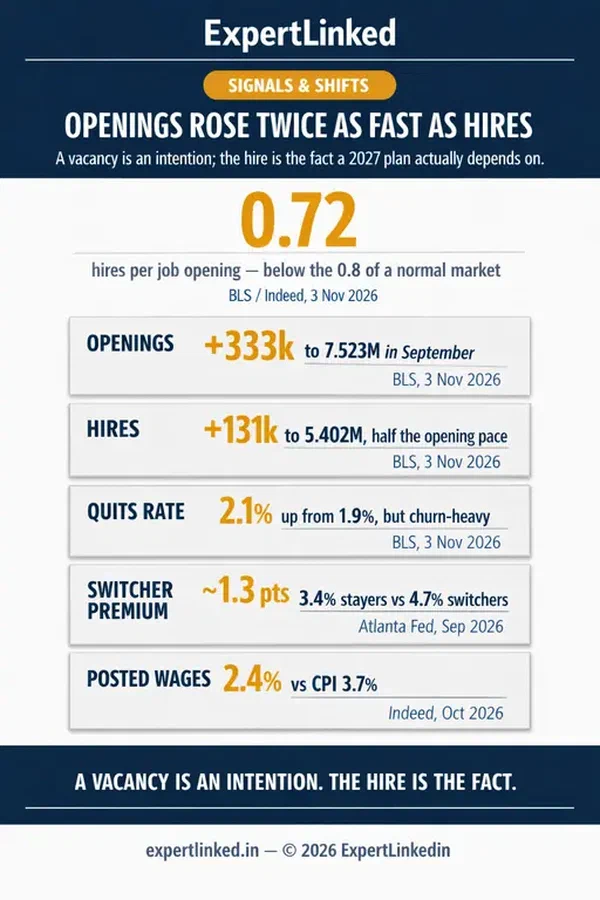
Infographic: What the September 2026 JOLTS Report Says About 2027 Staffing Assumptions
·28 words·1 min
September JOLTS added 333,000 openings and only 131,000 hires. A vacancy is an intention, not a colleague. Here is how to test whether your 2027 plan depends on people who have not been hired yet.
What the September 2026 JOLTS Report Says About 2027 Staffing Assumptions
·1859 words·9 mins
September JOLTS added 333,000 openings and only 131,000 hires. A vacancy is an intention, not a colleague. Here is how to test whether your 2027 plan depends on people who have not been hired yet.
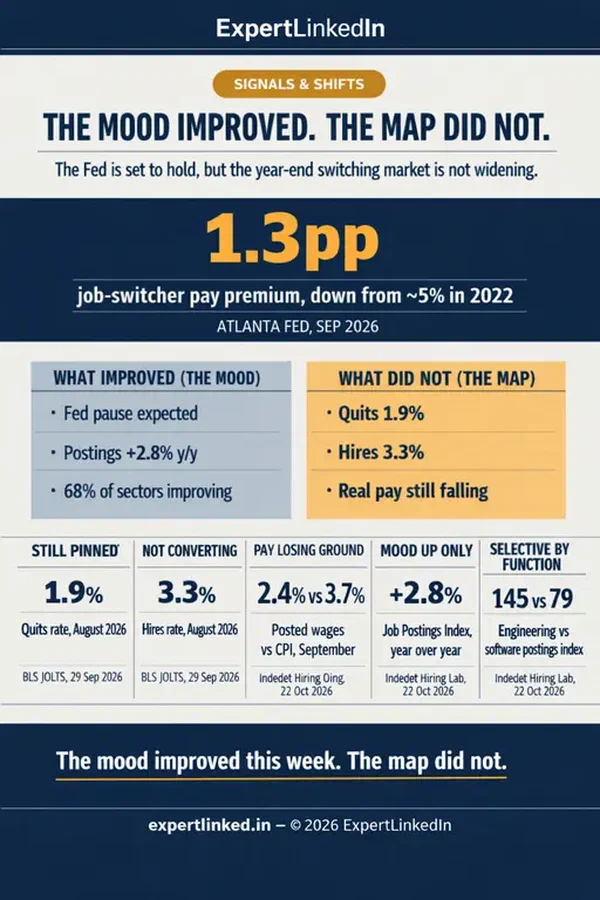
Infographic: What October's Labor and Inflation Data Says Before the Oct. 28 Fed Decision - and Why Year-End Mobility Still Looks Selective
·30 words·1 min
The Fed is expected to hold rates today — and the mood already feels better. But the numbers that actually decide whether you can change jobs have not moved. Here is how to tell relief from leverage before year-end.
Career Mechanics
How to Renegotiate Job Responsibilities for 2027 With a 3-List Scope Audit
·2257 words·11 mins
Your 2027 job is being assembled without a subtraction column. Here is the 3-list scope audit — work retained, work added, and work stopped — plus the question most priority conversations skip: who can actually approve a removal.
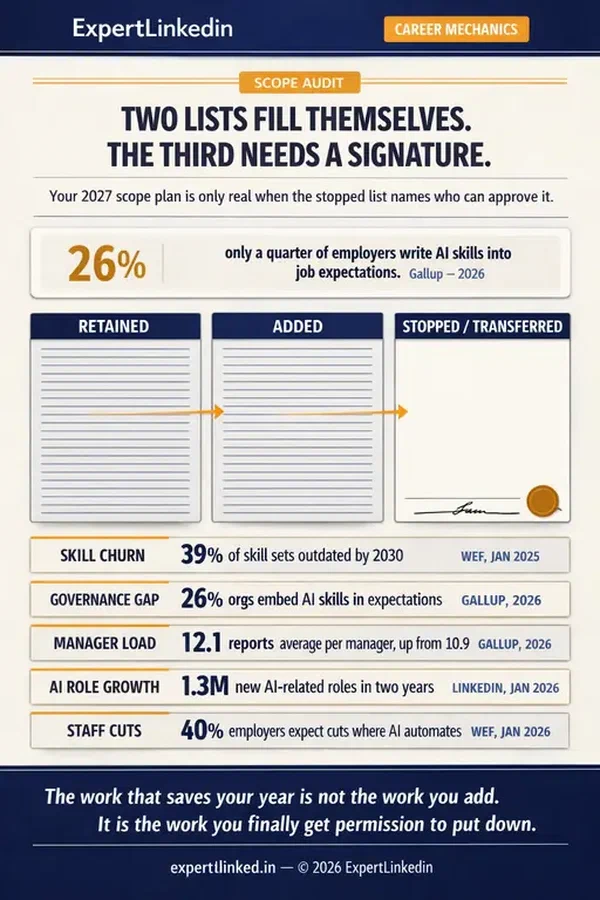
Infographic: How to Renegotiate Job Responsibilities for 2027 With a 3-List Scope Audit
·31 words·1 min
Your 2027 job is being assembled without a subtraction column. Here is the 3-list scope audit — work retained, work added, and work stopped — plus the question most priority conversations skip: who can actually approve a removal.

How to Build a Year-End Pay Ask Before the Q3 2026 Employment Cost Index Lands
·2730 words·13 mins
The merit page closed on October 16. If you are still preparing a merit ask, you are already late. Here is how to build the one-page retention exception a compensation committee can actually fund before the Q3 Employment Cost Index sets next year’s band on October 30.
Workplace Clinic
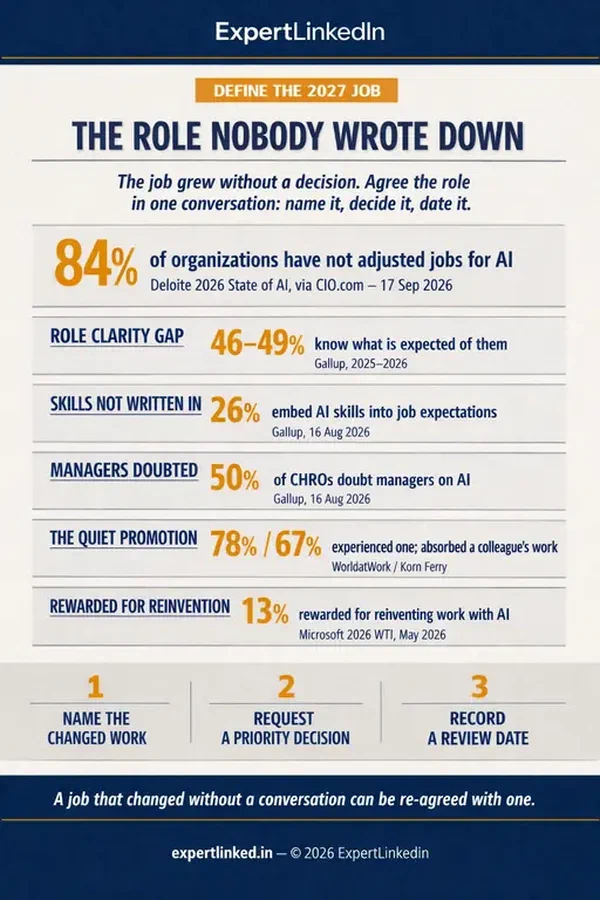
Infographic: My Job Responsibilities Changed Without a Conversation—What to Agree for 2027
·31 words·1 min
Your role grew an AI-coordination duty or another function while the old job stayed — and no one ever called it a new role. Here is how to agree what your 2027 job actually is, before planning locks it in: name the changed work, ask for a priority decision, and record a review date.
My Job Responsibilities Changed Without a Conversation—What to Agree for 2027
·2226 words·11 mins
Your role grew an AI-coordination duty or another function while the old job stayed — and no one ever called it a new role. Here is how to agree what your 2027 job actually is, before planning locks it in: name the changed work, ask for a priority decision, and record a review date.
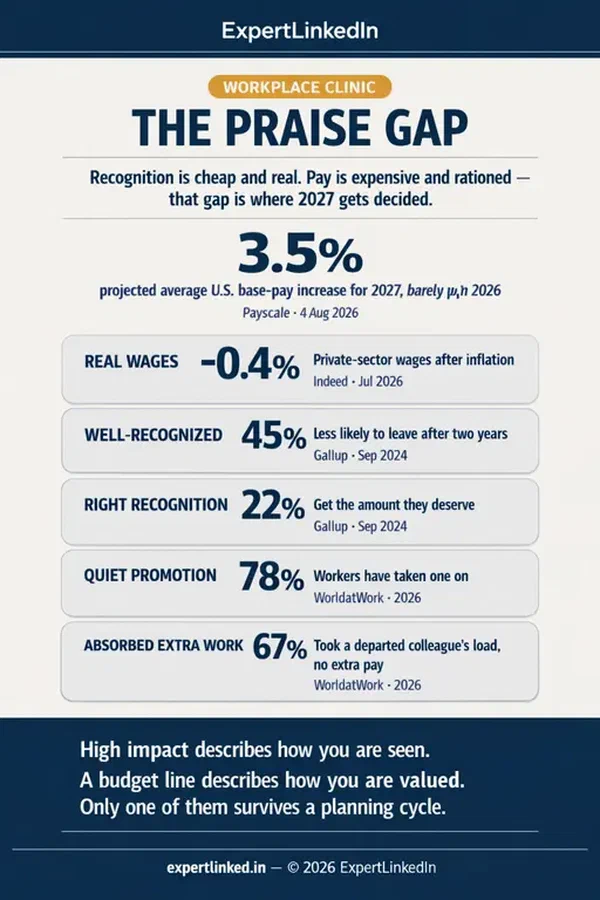
Infographic: My Review Says I'm High Impact, But My Pay Isn't Moving - and What to Do Before 2027 Planning Starts
·40 words·1 min
Your review said “high impact” and your raise said “wait until next year.” As the Q3 Employment Cost Index lands, Gallup, HBR and the 2026-27 salary-budget surveys all show why praise and pay move on different clocks — and how to tell gratitude from a retention tactic before 2027 planning locks.
AI
The 'Human in the Loop' Is Not a Job. It's a Liability.
·2042 words·10 mins
‘There will still be a human in the loop’ is how companies claim to govern AI. But presence is not oversight. As AI takes the execution, the 2027 job is to own the decision — with the authority to halt, the time to judge and the funded competence to be accountable, not to absorb the blame.
Your Next Customer Is a Machine: India's Q4 2026 Agent-Readiness Test
·1990 words·10 mins
The AI-Off Audit: Why Clinical AI Is Erasing the Judgment It Still Depends On
·2219 words·11 mins
Executive Visibility Has Two Ledgers — and Q4 Only Pays Out the One You've Been Ignoring
Your Employer Brand Is Now a Composite — and You Only Control the Weakest Input
·1992 words·10 mins
Your Next AI Feature Shouldn't Write a Word: The Quiet Rise of Decision Models
·2124 words·10 mins
Digital Economy
Southeast Asia's Next Fintech Moat Is the Human Who Can Halt the Agent
·1391 words·7 mins
AI agents are learning to move money across Southeast Asia. The scarce 2027 fintech job is not building the agent — it is owning the exception: holding the mandate, reading the runtime, and being able to stop it.
Record Festive GMV, Thinner Seller Margin: The Bill Behind India's Q4 2026 Shopping Boom
·2285 words·11 mins
Your Next Customer Is a Machine: India's Q4 2026 Agent-Readiness Test
·1990 words·10 mins
Your Employer Brand Is Now a Composite — and You Only Control the Weakest Input
·1992 words·10 mins
Paths & People
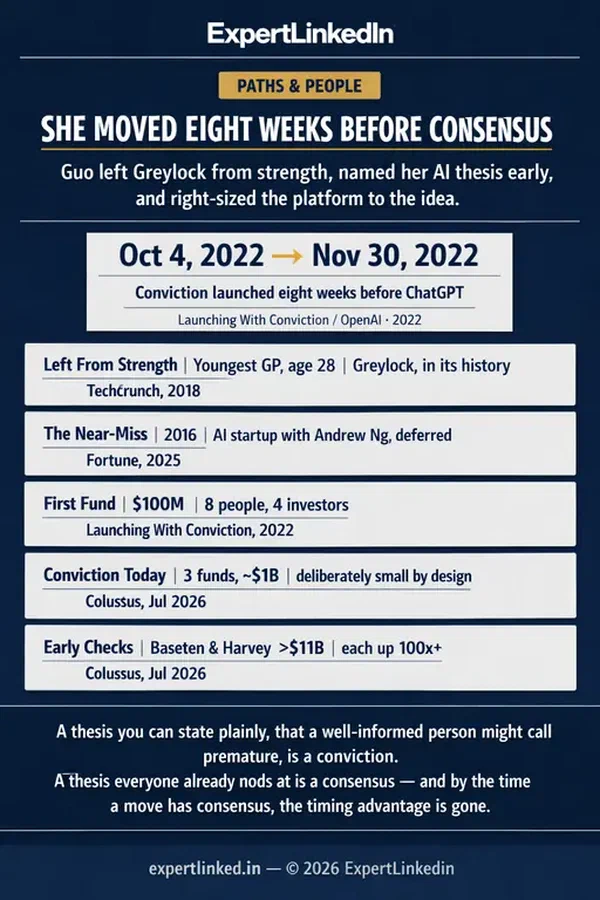
Infographic: What Sarah Guo's Move From Greylock to Conviction Teaches About Selective Career Timing in Q4 2026
·42 words·1 min
Sarah Guo left Greylock — the firm where she became its youngest-ever general partner — not because it was weak, but because she could name an AI thesis the market could not yet agree on. In Q4 2026, that is the difference between a smart move and an escape.

What Sarah Guo's Move From Greylock to Conviction Teaches About Selective Career Timing in Q4 2026
·2315 words·11 mins
Sarah Guo left Greylock — the firm where she became its youngest-ever general partner — not because it was weak, but because she could name an AI thesis the market could not yet agree on. In Q4 2026, that is the difference between a smart move and an escape.
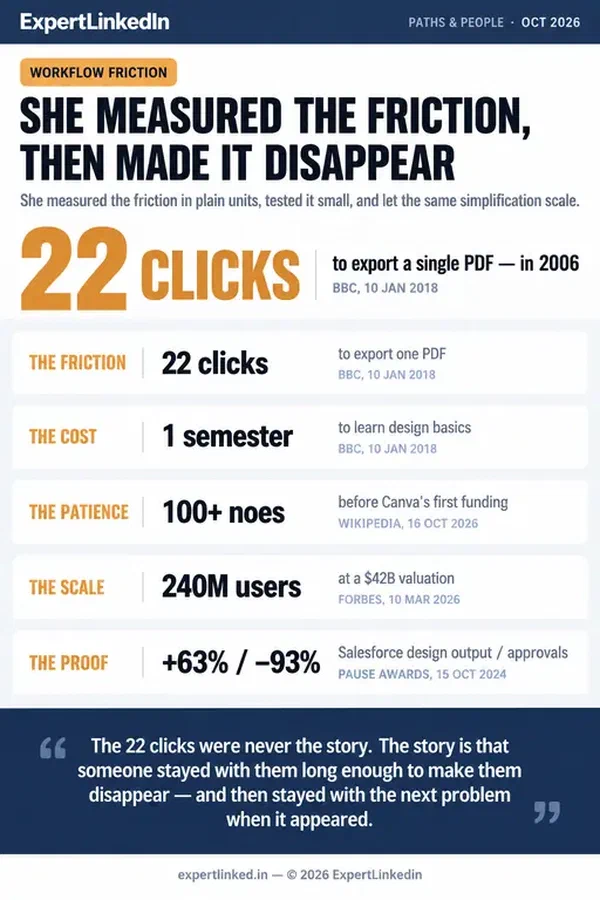
Infographic: What Melanie Perkins' Path From Fusion Books to Canva Teaches About Fixing Workflow Friction in Q4 2026
·35 words·1 min
The most valuable thing you will own this quarter is a workflow someone else can run without you. Melanie Perkins spent 15 years turning the “22 clicks” of design software into something anyone could use — and the mechanism behind it is the same one that makes work survive Q4 calibration.
Deep Dive
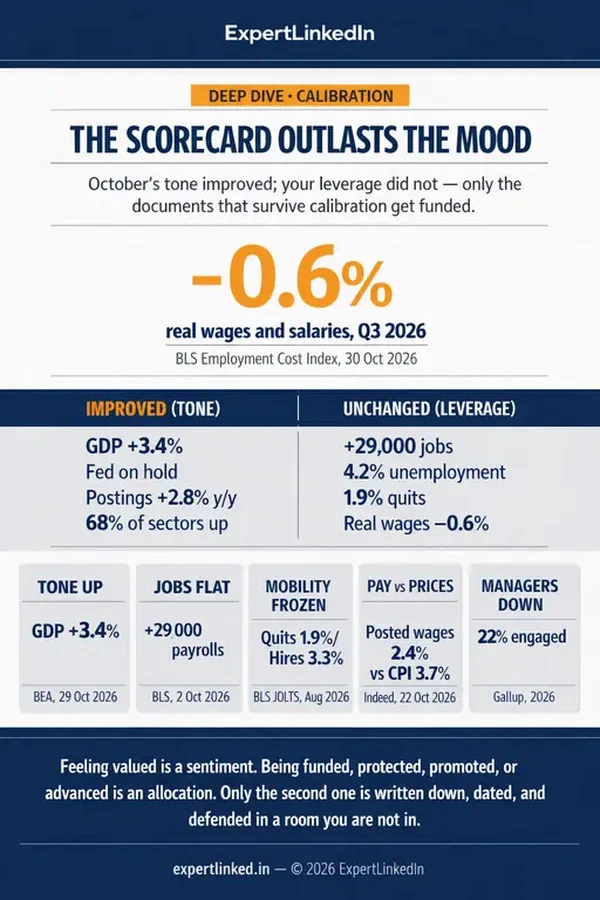
Infographic: The Calibration Quarter: How Q4 2026 Career Outcomes Get Locked by Scorecards, Not Sentiment
·32 words·1 min
October’s data finally split confidence from leverage — 3.4% GDP growth and a Fed hold, against 29,000 jobs, 1.9% quits and real wages down 0.6%. Here is why the quarter’s outcomes get locked by the five documents that survive calibration, not by how good the year feels.

The Calibration Quarter: How Q4 2026 Career Outcomes Get Locked by Scorecards, Not Sentiment
·2524 words·12 mins
October’s data finally split confidence from leverage — 3.4% GDP growth and a Fed hold, against 29,000 jobs, 1.9% quits and real wages down 0.6%. Here is why the quarter’s outcomes get locked by the five documents that survive calibration, not by how good the year feels.
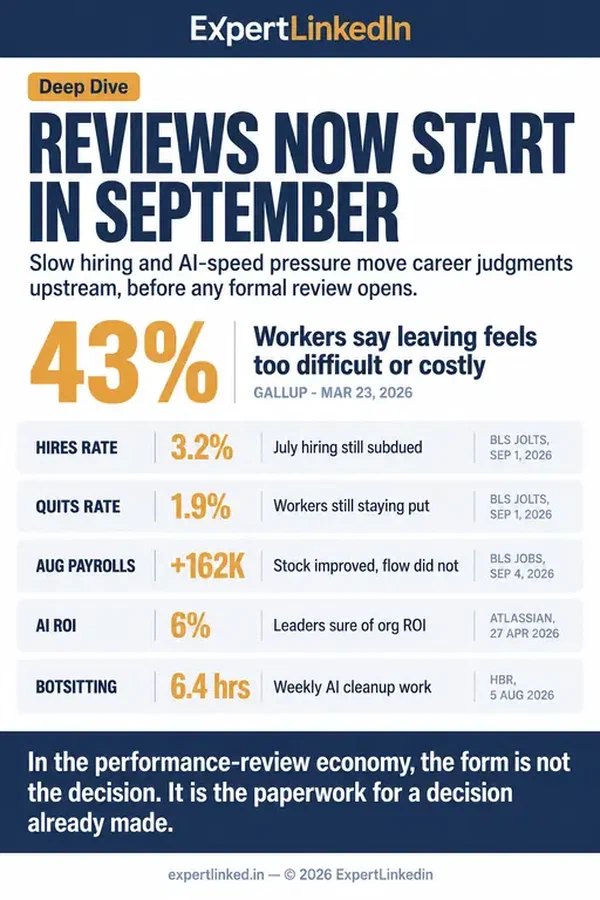
Infographic: The Performance-Review Economy: Why Q4 2026 Career Outcomes Are Being Decided Before Review Season Starts
·31 words·1 min
Most people think Q4 performance reviews reward output volume. In late 2026, they increasingly reward sponsor depth, evidence quality, market context, and role design that were set in motion before review season even opens.
Briefing Room

Briefing Room - October 2026: The Best Reporting on Calibration, Pay Pressure, and Selective Hiring
·2864 words·14 mins
October’s best reporting connects measurement to money — GDP up 3.4% and a Fed hold beside 29,000 jobs, 1.9% quits and real wages down 0.6%. Here is who got budget, patience and movement while the mood improved.
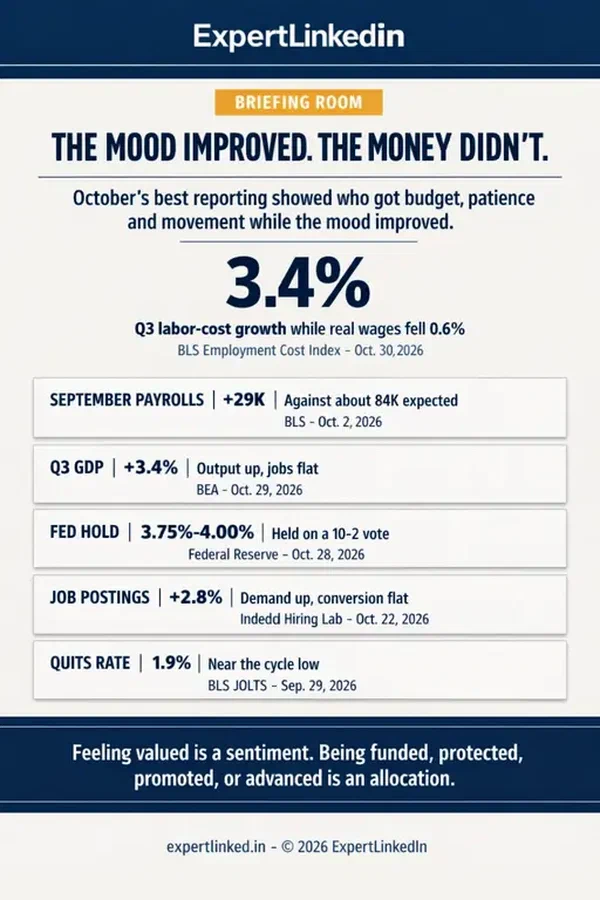
Infographic: Briefing Room - October 2026: The Best Reporting on Calibration, Pay Pressure, and Selective Hiring
·31 words·1 min
October’s best reporting connects measurement to money — GDP up 3.4% and a Fed hold beside 29,000 jobs, 1.9% quits and real wages down 0.6%. Here is who got budget, patience and movement while the mood improved.

Briefing Room - September 2026: The Best Reporting on Fall Hiring, Sponsorship, and AI Performance Pressure
·2078 words·10 mins
September’s strongest labor, Fed, management, and AI-governance reporting all pointed to one conclusion: performance pressure is being allocated through measurement, sponsorship, and workflow design before workers feel real relief.
Infographics
Infographic: My Job Responsibilities Changed Without a Conversation—What to Agree for 2027
·31 words·1 min
Your role grew an AI-coordination duty or another function while the old job stayed — and no one ever called it a new role. Here is how to agree what your 2027 job actually is, before planning locks it in: name the changed work, ask for a priority decision, and record a review date.
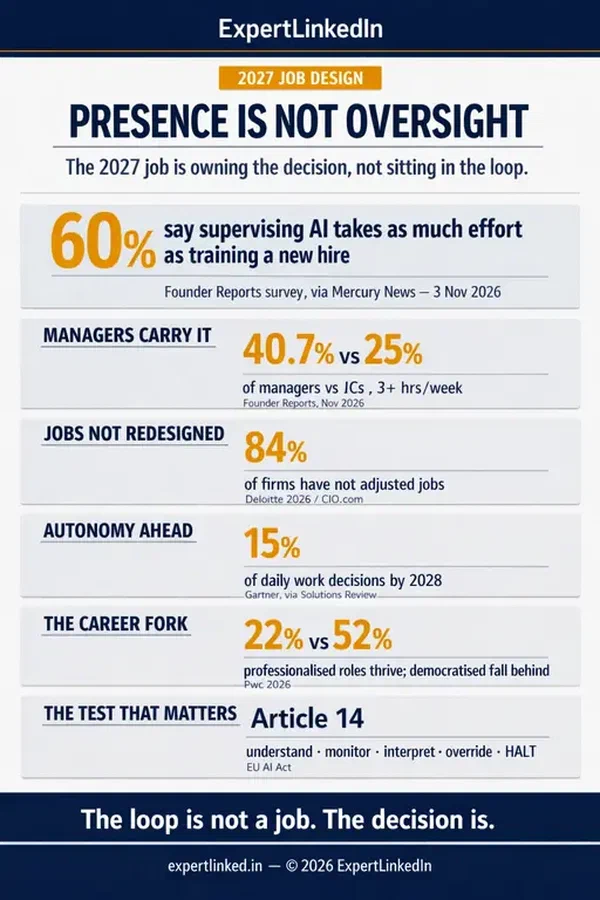
Infographic: The 'Human in the Loop' Is Not a Job. It's a Liability.
·30 words·1 min
‘There will still be a human in the loop’ is how companies claim to govern AI. But presence is not oversight. As AI takes the execution, the 2027 job is to own the decision — with the authority to halt, the time to judge and the funded competence to be accountable, not to absorb the blame.
Infographic: What the September 2026 JOLTS Report Says About 2027 Staffing Assumptions
·28 words·1 min
September JOLTS added 333,000 openings and only 131,000 hires. A vacancy is an intention, not a colleague. Here is how to test whether your 2027 plan depends on people who have not been hired yet.
SEA Weekly
SEA Weekly has moved to https://seaweekly.com - a dedication for Southeast Asia coverage across business, markets, travel, sport, podcasts, and video. SEA Weekly tracks the momentum shaping Southeast Asia with a strict editorial focus on economy, finance, industry, travel, and sport.
More articles
Briefing Room - October 2026: The Best Reporting on Calibration, Pay Pressure, and Selective Hiring
·2864 words·14 mins
October’s best reporting connects measurement to money — GDP up 3.4% and a Fed hold beside 29,000 jobs, 1.9% quits and real wages down 0.6%. Here is who got budget, patience and movement while the mood improved.
The Calibration Quarter: How Q4 2026 Career Outcomes Get Locked by Scorecards, Not Sentiment
·2524 words·12 mins
October’s data finally split confidence from leverage — 3.4% GDP growth and a Fed hold, against 29,000 jobs, 1.9% quits and real wages down 0.6%. Here is why the quarter’s outcomes get locked by the five documents that survive calibration, not by how good the year feels.

My Review Says I'm High Impact, But My Pay Isn't Moving - and What to Do Before 2027 Planning Starts
·2233 words·11 mins
Your review said “high impact” and your raise said “wait until next year.” As the Q3 Employment Cost Index lands, Gallup, HBR and the 2026-27 salary-budget surveys all show why praise and pay move on different clocks — and how to tell gratitude from a retention tactic before 2027 planning locks.
What Sarah Guo's Move From Greylock to Conviction Teaches About Selective Career Timing in Q4 2026
·2315 words·11 mins
Sarah Guo left Greylock — the firm where she became its youngest-ever general partner — not because it was weak, but because she could name an AI thesis the market could not yet agree on. In Q4 2026, that is the difference between a smart move and an escape.

Record Festive GMV, Thinner Seller Margin: The Bill Behind India's Q4 2026 Shopping Boom
·2285 words·11 mins
India’s festive season is heading for record GMV — Rs 24,200 crore in two days. But 35-45% of selling price now leaves the seller before COGS, penalties were repriced in August, and a January rule change ends discount theatre.

What October's Labor and Inflation Data Says Before the Oct. 28 Fed Decision - and Why Year-End Mobility Still Looks Selective
·1906 words·9 mins
The Fed is expected to hold rates today — and the mood already feels better. But the numbers that actually decide whether you can change jobs have not moved. Here is how to tell relief from leverage before year-end.

Your Next Customer Is a Machine: India's Q4 2026 Agent-Readiness Test
·1990 words·10 mins
Your next customer’s shortlist is now written by an AI agent. India’s festive season is the first at-scale test of whether small businesses can pass a machine’s audit — and the average Indian store scores just 43 out of 100, failing on price, delivery charges and return windows, not on creativity.
How to Build a Year-End Pay Ask Before the Q3 2026 Employment Cost Index Lands
·2730 words·13 mins
The merit page closed on October 16. If you are still preparing a merit ask, you are already late. Here is how to build the one-page retention exception a compensation committee can actually fund before the Q3 Employment Cost Index sets next year’s band on October 30.

ExpertLinked Weekly - Ep 17 - Selective Mobility
·2754 words·13 mins
Episode seventeen asks how you keep optionality in the last quarter of the year without damaging the credibility you still need for the next twelve months.