Your LinkedIn Company Page Is Not a Channel. It's a Proof Library.

The LinkedIn company page is not dead. It has been demoted.
If you are still judging the page by reach, you are asking a library to behave like a billboard.

In March, I argued in LinkedIn’s ‘Cut the Bullspend’ Has a Punchline Nobody Said Out Loud that LinkedIn had broken the old company-page bargain. In June, LinkedIn’s Spontaneity Tax: Why Professional Trust Is Becoming a Scheduled System showed the platform rewarding planned trust systems over ad hoc posting. The August update is simpler: the page still matters, just not as a broadcast channel.
Discovery is happening elsewhere first #
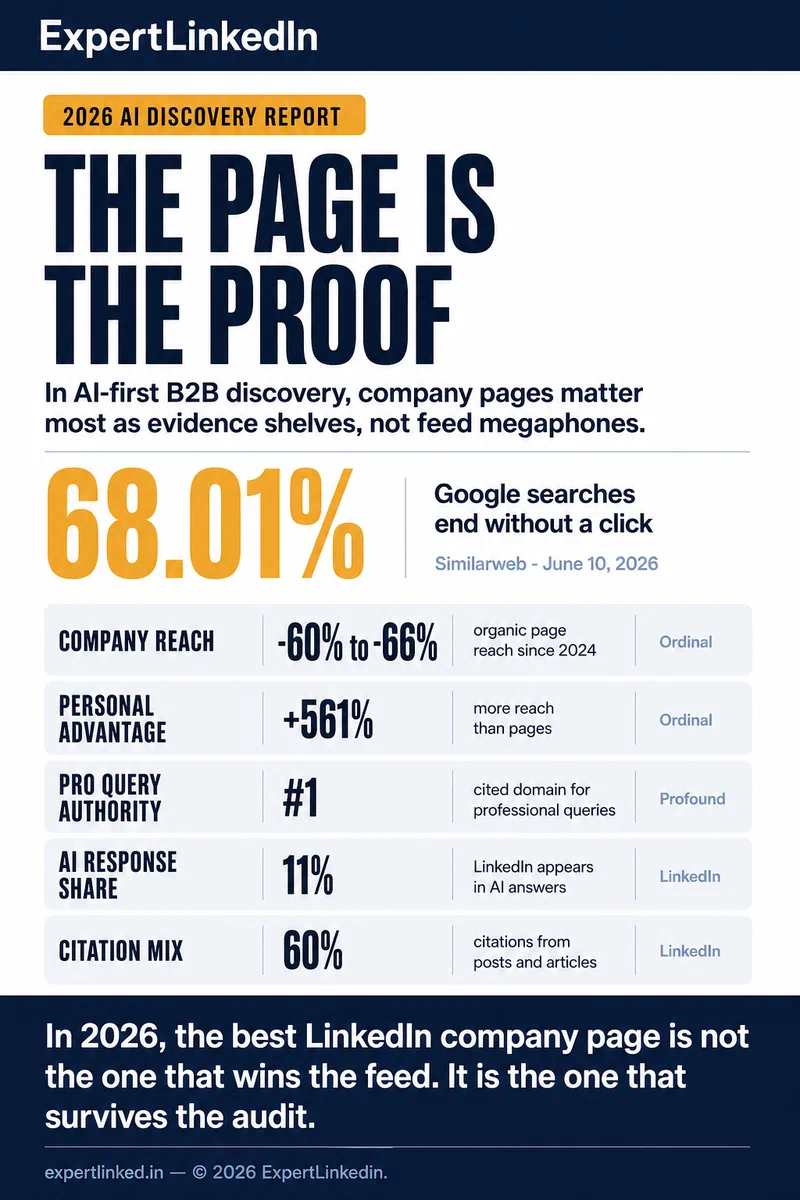
The reach evidence is blunt. Ordinal’s August analysis says organic reach for LinkedIn company pages fell 60% to 66% from 2024 to early 2026. The same piece says company posts now account for just 1% to 2% of typical feeds, while personal profiles generate 561% more reach.
But the more important context lives outside LinkedIn. Similarweb says 68.01% of Google searches now end without a click. For desktop behavior, which is much closer to how B2B buyers research vendors, only 20.4% of searches produce an external click. Pew found that users click a traditional result on just 8% of visits when an AI summary appears, versus 15% when it does not.
So the old funnel is breaking from two directions at once. The page reaches fewer people in-feed, and search sends fewer people to websites at the research moment. That does not make the page irrelevant. It changes its job.
Brainlabs’ clearest line from LinkedIn’s March NewFront was that B2B buyers are forming shortlists before they ever search for a solution. By the time someone types your category into Google or asks ChatGPT for vendors, judgment has often already started. The real question is not whether the page distributed a post. It is whether the evidence holds together when someone checks.
The proof check happens after the first encounter #
Most teams are still using the wrong mental model. Discovery now happens across employee posts, AI summaries, creator commentary, newsletters, forwarded PDFs, review sites, and dark-social conversations. The company page is where people go after that first impression to see whether your claims reconcile into something credible.
AI search behavior makes this more literal, not less. Profound found that LinkedIn became the No. 1 cited domain for professional queries across Gemini, Google AI Overviews, Google AI Mode, ChatGPT, Microsoft Copilot, and Perplexity. LinkedIn’s own June AI-search analysis says the platform appears in 11% of AI responses on average, based on 89,000 unique LinkedIn URLs cited by ChatGPT Search, Google AI Mode, and Perplexity.
AI does not experience your brand as one neat corporate asset. It encounters fragments: a founder post, an employee explanation, a document carousel, a long-form article, a company-page description, a product update. The company page becomes the reconciliation layer that tells both model and buyer whether those fragments belong to a serious company or a noisy one.
HubSpot calls the new SERP a branding arena. LinkedIn company pages are becoming proof surfaces inside that broader credibility system. They do not need to win the first interaction. They need to survive the second.
A proof library does different work from a channel #
Channels optimize for interruption. Proof libraries optimize for corroboration.
That means the best company page in 2026 is not the one publishing the highest volume of generic updates. It is the one that makes verification easy. The category language is consistent. The About section says exactly what problem the company solves. The named people, products, industries, and evidence line up with what employees say in public. The page contains real artifacts: report summaries, document carousels, customer stories, hiring signals, and executive writing that does not read like a committee press note.
LinkedIn’s own March AI-visibility guide says long-form articles, newsletters, and posts account for 60% of LinkedIn citations. The June post-level guide adds that 95% of citations come from original posts, not reshares. The advice is simple: publish educational content, answer direct questions, use specific dates, keep your structure clear, and anchor authority in original material.
Google’s documentation says there is no special AI markup required. The basics still win: textual clarity, internal links, visible structured data, and current business details. LinkedIn’s owned-content AI-search guide says much the same: use 30-80 word answer blocks, descriptive headings, and schema that matches the page. Stop looking for a secret AI hack. Build content that can be checked, parsed, and quoted without confusion.
That is exactly what a proof library is for.
Let people carry the conversation #
Calling the company page a proof library is not an argument against human distribution. It is an argument for putting human distribution in the right place.
Ordinal’s numbers are directionally blunt: personal profiles now get far more reach than company pages. LinkedIn’s June AI-search playbook adds the nuance most teams need. Perplexity cites Company Pages 59% of the time, while ChatGPT Search and Google AI Mode cite individual creators 59% of the time. That is the operating model.
People carry the conversation. The company page stabilizes the record.
Your product leader explains the problem in public. Your customer-success lead publishes a practical framework. Your founder posts the contrarian take. Your company page houses the cleaner evidence layer that makes those inputs feel coherent rather than accidental.
Employee advocacy is no longer just a distribution trick. It is part of the brand’s retrieval footprint. But employee advocacy without a strong proof layer creates noise, and a company page without human voices creates the opposite failure: a neat archive nobody encounters.
You need both.
What proof-heavy content actually looks like #
One of the most revealing benchmark findings this year came from Socialinsider’s 2026 LinkedIn Benchmarks, surfaced by Social Media Today: after analyzing 1.3 million posts from 16,645 LinkedIn business pages, the study found that native document posts generated the highest engagement of any LinkedIn content type. A good PDF carousel behaves like portable evidence: a benchmark, checklist, framework, or customer pattern report with enough structure to work in-feed and enough density to be worth citing later.
This is why the blandest company-page habits are now the least defensible ones. A stream of award graphics, event selfies, repackaged press releases, and vague “We’re excited to announce…” posts does almost nothing for proof.
Build around assets that answer quiet research questions: what exactly do you do, why should anyone believe you, what evidence do you have, who inside the company knows this topic deeply, and what language do you repeat consistently enough for buyers and models to associate with your brand.
LinkedIn’s June AI-visibility research also found that around three-quarters of cited authors were frequent posters, defined as publishing five or more posts in the previous four weeks. Consistency matters because repeated, structured signals help AI systems and human buyers recognize a pattern rather than a one-off performance.
What to change in the next 30 days #
-
Rewrite the company page like a verification document. The first screen should identify your category, problem, audience, and differentiation in plain English.
-
Publish one anchor proof asset. A benchmark, teardown, customer pattern report, operating framework, or document carousel is enough.
-
Route that asset through people, not just the brand account. Have subject-matter experts publish adjacent posts from their own perspectives while the company page holds the canonical version.
-
Standardize your vocabulary. If your employees call the category one thing, the company page another, and your website a third, you weaken both human recall and AI association.
-
Change the scorecard. Follower growth and raw impressions are too shallow on their own. Track branded search lift, AI citations, profile visits after employee posts, and which page assets prospects actually reference.
Many teams still want the company page to perform like an old publishing channel because that model feels controllable. But the market has moved toward corroboration. Buyers do not want one polished corporate voice. They want a trail of evidence that holds up across people, platforms, and moments of inquiry.
That is why the company page still matters. Not as the loudest thing you publish. As the place where your loudest claims can be checked.
In 2026, the best LinkedIn company page is not the one that wins the feed. It is the one that survives the audit.
Seeing this shift inside your own LinkedIn strategy or B2B funnel? Send me the messy version - the page, the post mix, the proof gaps, the parts that are not converting trust into pipeline.
Email me at victoria.sterling@tlnw.uk
References #
- Ordinal (August 17, 2026). “The Declining Reach of LinkedIn Company Pages.” https://www.tryordinal.com/blog/the-declining-reach-of-linkedin-company-pages (Accessed August 20, 2026)
- Similarweb (June 10, 2026). “Zero-Click Marketing: The SEO Strategy For A World Where Most Searches Skip Your Site.” https://www.similarweb.com/blog/marketing/geo/zero-click-marketing/ (Accessed August 20, 2026)
- Pew Research Center (July 22, 2025). “Google users are less likely to click on links when an AI summary appears in the results.” https://www.pewresearch.org/short-reads/2025/07/22/google-users-are-less-likely-to-click-on-links-when-an-ai-summary-appears-in-the-results/ (Accessed August 20, 2026)
- Brainlabs (March 26, 2026). “LinkedIn just rewrote its pitch to B2B marketers.” https://www.brainlabsdigital.com/linkedin-newfront-2026-b2b-marketers/ (Accessed August 20, 2026)
- Profound (March 9, 2026). “LinkedIn is the most-cited domain for professional queries in AI search.” https://www.tryprofound.com/blog/linkedin-is-the-most-cited-domain-for-professional-queries-in-ai-search (Accessed August 20, 2026)
- LinkedIn Marketing Blog (March 12, 2026). “How to Leverage LinkedIn for AI Visibility in 2026.” https://www.linkedin.com/business/marketing/blog/content-marketing/how-to-leverage-linkedin-for-ai-visibility-in-2026 (Accessed August 20, 2026)
- LinkedIn Marketing Blog (June 9, 2026). “How to Grow Your AI Search Visibility With LinkedIn Content.” https://www.linkedin.com/business/marketing/blog/ai-search/how-to-grow-your-ai-search-visibility-with-linkedin-content (Accessed August 20, 2026)
- LinkedIn Marketing Blog (June 30, 2026). “How to Maximize AI Visibility for Your LinkedIn Posts.” https://www.linkedin.com/business/marketing/blog/ai-search/how-to-maximize-ai-visibility-for-your-linkedin-posts (Accessed August 20, 2026)
- Social Media Today (April 2, 2026). “Report shows document posts on LinkedIn see more engagement.” https://www.socialmediatoday.com/news/report-shows-document-posts-on-linkedin-see-more-engagement/816551/ (Accessed August 20, 2026)
- LinkedIn Ads Resource (2026). “How to optimize your owned content for AI search.” https://business.linkedin.com/advertise/resources/how-to-optimize-your-owned-content-for-ai-search (Accessed August 20, 2026)
- Google Search Central (Updated December 10, 2025). “AI features and your website.” https://developers.google.com/search/docs/appearance/ai-features (Accessed August 20, 2026)
- LinkedIn Engineering Blog (March 12, 2026). “Engineering the next generation of LinkedIn’s Feed.” https://www.linkedin.com/blog/engineering/feed/engineering-the-next-generation-of-linkedins-feed (Accessed August 20, 2026)
AI Content Notice
This article was created using artificial intelligence technology. Whenever possible, we include references and sources to support the information presented. Readers are encouraged to consult these sources for further information. While we strive for accuracy and provide valuable insights, readers should independently verify information and use their own judgment when making business decisions. The content may not reflect real-time market conditions or personal circumstances.
Related Articles
Infographic: Your LinkedIn Company Page Is Not a Channel. It's a Proof Library.
Most B2B teams still judge LinkedIn company pages by reach. In an AI-mediated, zero-click funnel, …
LinkedIn’s Spontaneity Tax: Why Professional Trust Is Becoming a Scheduled System
LinkedIn’s newest updates reward teams that can operationalize trust through structure and proof, …
LinkedIn’s Agency Badge Is Really a Trust Tax
LinkedIn’s newest agency credential matters less as a badge and more as a signal that trust on the …