The Next Healthcare AI Safety Problem Isn't Diagnosis. It's the Patient Inbox.

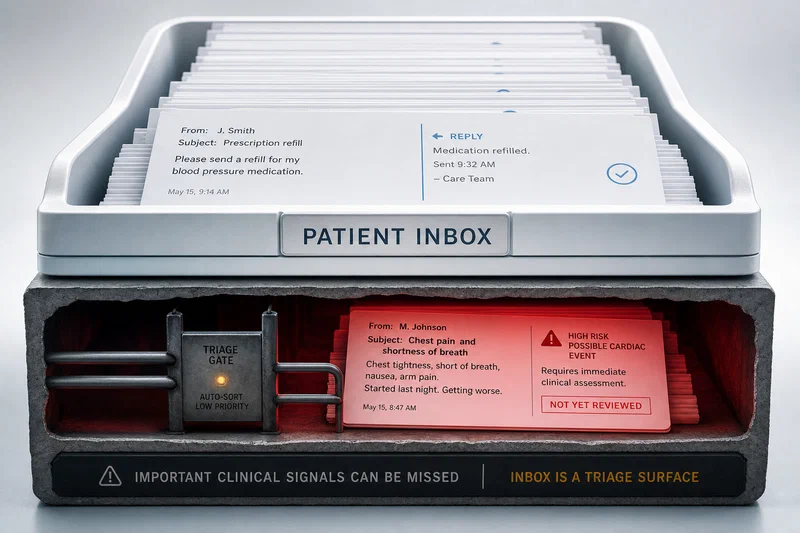
Healthcare may have chosen the wrong place to get casual about AI. The patient inbox looks administrative on the surface, but it is often where medication side effects, worsening symptoms, and quiet emergencies first show up in language messy enough to require judgment.
In July, I argued in Healthcare AI Got Its First Patient-Facing LLM Approved. The Question Nobody Will Answer. that healthcare was blurring the line between interface and decision-maker. Earlier this month, in The Real Safety Metric for AI Scribes Isn’t Time Saved. It’s Review Burden., I made a related point: when AI looks helpful, organizations often underprice the human review layer still wrapped around it. Patient-messaging AI is where those two problems meet. Health systems are using large language models to draft portal replies because clinicians are overloaded. The risk is that they may also be turning a high-volume communication channel into a lightly supervised triage surface.
The workload crisis is real, which is exactly why the shortcut is tempting #
A 2023 JAMA viewpoint on the electronic inbox framed the problem clearly: digital messaging improves patient access, but too much of the labor still lands on clinicians without a matching redesign of time, staffing, or compensation. The numbers beneath that argument are not small. At UC San Diego, a JAMA Network Open study published in November 2022 captured 1,453,245 inbasket messages from 609 physicians and found that 43.4% of all messages were patient messages. Half of surveyed physicians reported burnout.
The newer work suggests the burden has not settled into something manageable. At NYU Langone, researchers studying 1,716 ambulatory physicians found that patient medical advice request messages significantly increased after-hours work-outside-work, with specialists hit even harder than primary care physicians. That is why I do not think inbox AI should be dismissed as a gimmick. The demand is real. The overload is real. If organizations are reaching for automation here, they are responding to a legitimate pain point.
Early deployments improve sentiment faster than they save time #
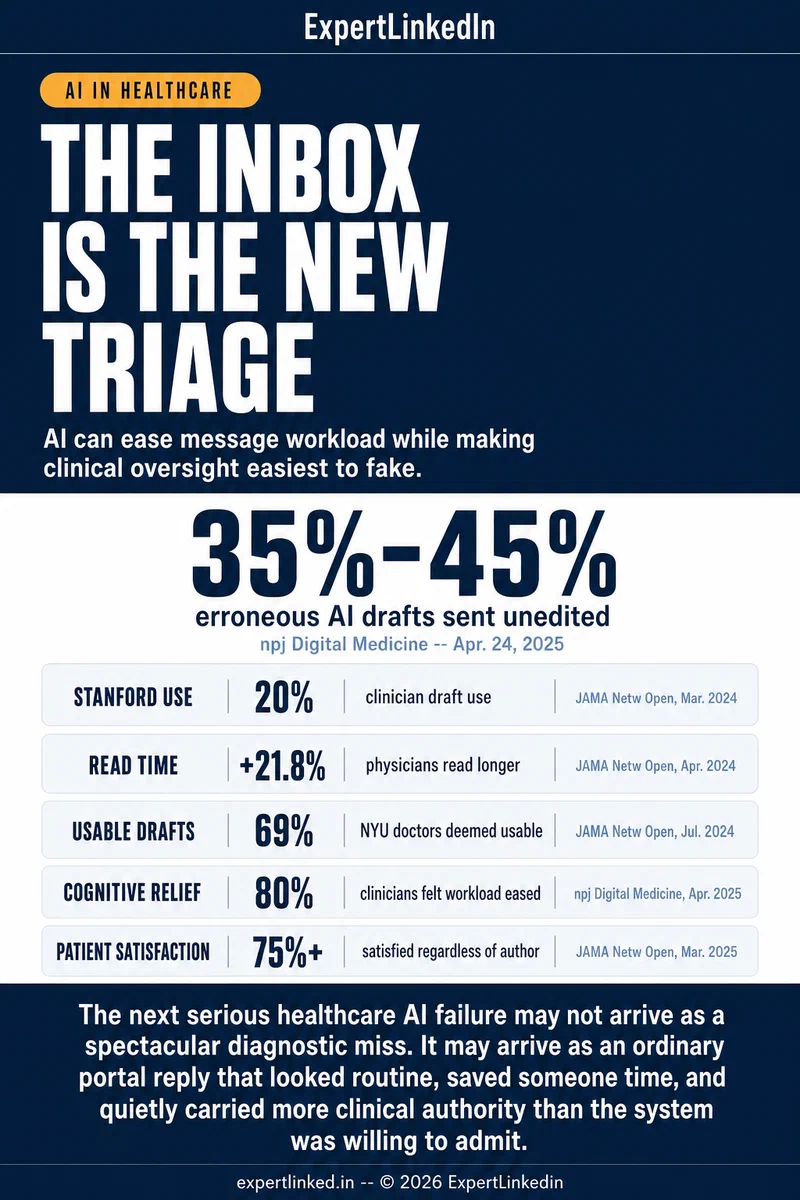
The first operational lesson is that inbox AI can feel helpful before it becomes measurably efficient. In Stanford Health Care’s five-week pilot, 162 clinicians were included in analysis and the mean AI-draft utilization rate was 20%. Task-load scores and work-exhaustion scores improved significantly. But reply action time, write time, and read time did not improve.
That is a revealing split. If clinicians feel less burdened while the clock barely moves, the technology may be buying emotional relief, not true labor removal. That still matters. Burnout is not imaginary. But leaders should be careful not to call a change in the texture of work a change in the amount of work.
The caution grows stronger in a randomized quality-improvement study from UC San Diego. There, GenAI-drafted replies were associated with a 21.8% increase in read time, no significant change in reply time, and a 17.9% increase in reply length. Read that again. The machine did not simply write faster on the clinician’s behalf. In this setting, it gave clinicians more text to assess and more opportunity to spend time validating a plausible answer.
This is the part too many implementation stories smooth over. Writing effort and supervision effort are not the same thing. A tool can reduce the strain of starting from a blank screen while still increasing the burden of deciding whether a polished reply is clinically safe.
The oversight assumption is where the safety risk concentrates #
The strongest warning I found came from a 2025 npj Digital Medicine simulation study led by researchers at MedStar and Georgetown. Twenty practicing primary care physicians reviewed 18 patient portal messages, four of which contained seeded errors. Those errors included both objective inaccuracies and potentially harmful omissions. Each error was insufficiently addressed by 13 to 15 participants, and 35% to 45% of erroneous drafts were submitted entirely unedited.
What makes that study so uncomfortable is not just the miss rate. It is the perception gap beside it. Eighty percent of participants said the drafts reduced cognitive workload. Seventy-five percent said they found the drafts safe.
That is the governance story in one frame. The drafts do not have to be wrong most of the time to create risk. They only need to be good enough, often enough, that busy clinicians begin to trust the surface. In the inbox, “human in the loop” is not a magical safety architecture. It is a person moving through asynchronous messages between other duties, with partial context and a rising temptation to accept a reply that already sounds complete.
This is why I think the patient-inbox story matters more than its branding suggests. Diagnostic AI announces itself as clinical technology. Inbox AI can smuggle clinical interpretation into a workflow still spoken about as messaging efficiency.
Better communication does not equal safer triage #
Some of the strongest evidence in favor of inbox AI is real, and ignoring it would be sloppy. At NYU Langone, primary care physicians reviewing 344 messages found that GenAI responses scored higher on communication style than human replies and similar on information content. Sixty-nine percent of GenAI drafts were considered usable. Usable AI replies were also viewed as more empathetic than usable human responses.
But the same study found the AI drafts were less readable. That matters more in medicine than many product narratives admit. A reply can sound warmer, longer, and more considerate to a physician reviewer while becoming harder for a patient with lower health literacy, lower English proficiency, or higher anxiety to interpret correctly.
Another early warning came from UC San Diego’s review of 50 negative patient messages. The authors found that LLM-generated responses sometimes diverged from care-team replies on relational connection, informational content, and recommendations for next steps. In some cases, the model could even escalate emotionally charged conversations rather than calm them. The problem, again, is not only hallucination. It is the possibility that a reply feels polished while carrying the wrong emotional weight, the wrong urgency, or the wrong recommendation.
The patient side adds another tension. In a Duke survey study, 1,455 respondents mildly preferred AI-drafted message content over human-drafted content, though satisfaction dipped slightly when people were told AI was involved. More than 75% of respondents were satisfied regardless of author or disclosure. That finding surprised me, but it should not be misread. Broad patient tolerance is not proof that the accountability model is mature. It is a warning that the market may be able to normalize under-governed deployment faster than many critics expect.
What a mature inbox-AI program would actually measure #
If a health system is serious about using AI in patient messaging, I would want to see five things before calling the program mature.
-
Message segmentation that separates routine administrative work from symptom, medication, and escalation-sensitive messages before the model drafts anything. A scheduling question and a report of worsening glucose should not enter the same automation lane.
-
Review quality metrics, not just adoption metrics. If leadership tracks utilization rate, turnaround time, and clinician satisfaction while ignoring correction rate, omission rate, escalation accuracy, and near misses, it is measuring comfort instead of safety.
-
Readability and equity testing. If AI replies are longer or linguistically denser than clinician-written replies, the system may improve physician experience while making patient understanding worse.
-
Explicit accountability language. Patients should know when AI drafted a message, but internal clarity matters even more: which clinician role owns the final decision, which message types require direct human authorship, and what happens when the draft was wrong.
-
Periodic audit against real clinical risk. The inbox is often an early-warning channel. Programs should test whether AI-assisted workflows miss chest pain, clot symptoms, worsening infection, medication interactions, hypoglycemia, or other time-sensitive clues more often than ordinary care-team handling.
These are not luxury controls. They are what it means to admit that the inbox is closer to triage than marketing copy suggests.
Healthcare leaders are right to look for relief. The digital inbox has become an unfair tax on clinical attention, and ignoring that burden is its own safety problem. But relief that depends on a weak supervision myth is not relief. It is redesign by denial.
The next serious healthcare AI failure may not arrive as a spectacular diagnostic miss. It may arrive as an ordinary portal reply that looked routine, saved someone time, and quietly carried more clinical authority than the system was willing to admit.
Working on patient messaging, clinical AI governance, or physician inbox redesign and seeing gaps between promised efficiency and real oversight? I would like to hear what those gaps look like in practice.
Email me at sophia.patel@tlnw.uk
References #
- Rotenstein, L. S., Landman, A., and Bates, D. W. (November 14, 2023). “The Electronic Inbox - Benefits, Questions, and Solutions for the Road Ahead.” https://doi.org/10.1001/jama.2023.19195 (Accessed August 27, 2026)
- Baxter, S. L., Saseendrakumar, B. R., Cheung, M., Savides, T. J., Longhurst, C. A., Sinsky, C. A., Millen, M., and Tai-Seale, M. (November 1, 2022). “Association of Electronic Health Record Inbasket Message Characteristics With Physician Burnout.” https://pmc.ncbi.nlm.nih.gov/articles/PMC9713605/ (Accessed August 27, 2026)
- Mandal, S., Wiesenfeld, B. M., Mann, D. M., Szerencsy, A. C., Iturrate, E., and Nov, O. (February 14, 2024). “Quantifying the impact of telemedicine and patient medical advice request messages on physicians’ work-outside-work.” https://pmc.ncbi.nlm.nih.gov/articles/PMC10867011/ (Accessed August 27, 2026)
- Garcia, P., Ma, S. P., Shah, S., Smith, M., Jeong, Y., Devon-Sand, A., Tai-Seale, M., Takazawa, K., Clutter, D., Vogt, K., Lugtu, C., Rojo, M., Lin, S., Shanafelt, T., Pfeffer, M. A., and Sharp, C. (March 4, 2024). “Artificial Intelligence-Generated Draft Replies to Patient Inbox Messages.” https://pmc.ncbi.nlm.nih.gov/articles/PMC10955355/ (Accessed August 27, 2026)
- Tai-Seale, M., Baxter, S. L., Vaida, F., Walker, A., Sitapati, A. M., Osborne, C., Diaz, J., Desai, N., Webb, S., Polston, G., Helsten, T., Gross, E., Thackaberry, J., Mandvi, A., Lillie, D., Li, S., Gin, G., Achar, S., Hofflich, H., Sharp, C., Millen, M., and Longhurst, C. A. (April 1, 2024). “AI-Generated Draft Replies Integrated Into Health Records and Physicians’ Electronic Communication.” https://pmc.ncbi.nlm.nih.gov/articles/PMC11019394/ (Accessed August 27, 2026)
- Baxter, S. L., Longhurst, C. A., Millen, M., Sitapati, A. M., and Tai-Seale, M. (April 10, 2024). “Generative artificial intelligence responses to patient messages in the electronic health record: early lessons learned.” https://pmc.ncbi.nlm.nih.gov/articles/PMC11006101/ (Accessed August 27, 2026)
- Small, W. R., Wiesenfeld, B., Brandfield-Harvey, B., Jonassen, Z., Mandal, S., Stevens, E. R., Major, V. J., Lostraglio, E., Szerencsy, A., Jones, S., Aphinyanaphongs, Y., Johnson, S. B., Nov, O., and Mann, D. (July 1, 2024). “Large Language Model-Based Responses to Patients’ In-Basket Messages.” https://pmc.ncbi.nlm.nih.gov/articles/PMC11252893/ (Accessed August 27, 2026)
- Biro, J. M., Handley, J. L., Malcolm McCurry, J., Visconti, A., Weinfeld, J., Gregory Trafton, J., and Ratwani, R. M. (April 24, 2025). “Opportunities and risks of artificial intelligence in patient portal messaging in primary care.” https://pmc.ncbi.nlm.nih.gov/articles/PMC12022076/ (Accessed August 27, 2026)
- Cavalier, J. S., Goldstein, B. A., Ravitsky, V., Belisle-Pipon, J. C., Bedoya, A., Maddocks, J., Klotman, S., Roman, M., Sperling, J., Xu, C., Poon, E. G., and Chowdhury, A. (March 3, 2025). “Ethics in Patient Preferences for Artificial Intelligence-Drafted Responses to Electronic Messages.” https://pmc.ncbi.nlm.nih.gov/articles/PMC11897835/ (Accessed August 27, 2026)
AI Content Notice
This article was created using artificial intelligence technology. Whenever possible, we include references and sources to support the information presented. Readers are encouraged to consult these sources for further information. While we strive for accuracy and provide valuable insights, readers should independently verify information and use their own judgment when making business decisions. The content may not reflect real-time market conditions or personal circumstances.
Related Articles
Infographic: The Next Healthcare AI Safety Problem Isn't Diagnosis. It's the Patient Inbox.
Health systems are using AI to draft patient-inbox replies to ease physician burnout. The harder …
The Real Safety Metric for AI Scribes Isn't Time Saved. It's Review Burden.
Ambient AI scribes are saving clinicians time, but the harder 2026 question is how much review, …
Infographic: The Real Safety Metric for AI Scribes Isn't Time Saved. It's Review Burden.
Ambient AI scribes are saving clinicians time, but the harder 2026 question is how much review, …