Healthcare AI Got Its First Patient-Facing LLM Approved. The Question Nobody Will Answer.

When a reporter asked UpDoc’s CEO whether the large language model at the center of his company’s diabetes management app makes clinical decisions, the answer was not yes. It was not no. It was four words: “We are FDA cleared.”
That non-answer is the most important thing that has happened in healthcare AI this week. Possibly this year.
What actually happened #
In late June 2026, UpDoc — a digital health company founded in 2023 — publicly revealed that its app for people with diabetes had received the first Food and Drug Administration clearance for medical software using “patient-facing large language models.” The clearance itself had been granted in December 2025; the announcement came six months later, alongside a push to sign health system contracts.
The product works like this: a patient with diabetes interacts with the app via voice or text. They report blood glucose readings, describe symptoms, answer structured questions. The LLM processes that input and responds with treatment instructions — guidance on insulin dosing built around a treatment plan their physician has already defined. The app also communicates back to the physician’s electronic health record, so clinicians stay nominally informed.
The FDA placed this device in the same regulatory category as drug dose calculators — systems that take numerical inputs, apply a formula, and return a dosing recommendation. The classification enabled a 510(k) clearance pathway, which requires demonstrating “substantial equivalence” to an existing device rather than full evidence of safety and efficacy.
STAT News called the clearance “historic.” On the narrow technical definition, it is: no patient-facing conversational AI had previously received FDA clearance in a clinical context. But what the coverage has largely underreported is the deliberate structural ambiguity at the product’s core — and why that ambiguity isn’t a communication fumble. It is a business strategy.
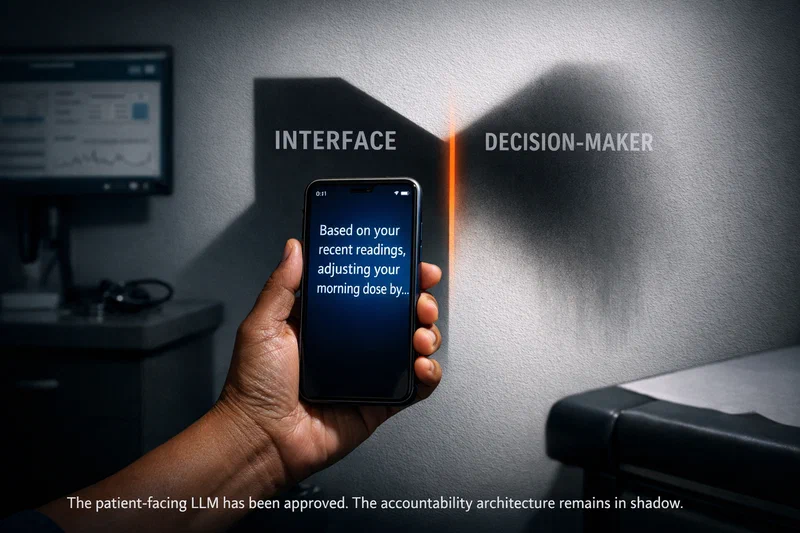
The interface or the decision-maker: why the question matters #
The distinction between a medical AI that presents options and one that makes decisions looks philosophical until it isn’t. It becomes concrete at the moment a patient asks: “My glucose has been running high for three days. Should I adjust my dose?” And the LLM responds with specific dosing guidance.
In that interaction, the physician who defined the original treatment plan is not in the room. They are not reviewing the exchange. They will see a data summary in the EHR — eventually — but not the natural language conversation that produced it. The LLM interpreted the patient’s symptoms, applied contextual judgment to their treatment parameters, and generated a clinical instruction. That is, functionally, a clinical decision.
The physician is “in the loop” in the sense that water is “in” a city’s water table: nominally connected to the system, not actively monitoring individual outputs.
Now consider what happens when that decision is wrong. If a drug dose calculator misapplies a formula, the liability rests with whoever programmed it, approved it, and failed to catch the error. If an LLM generates a dosing instruction based on its contextual interpretation of a patient’s natural language input, and that interpretation is flawed — the liability chain is genuinely unsettled. The physician authorized the treatment protocol, not the specific exchange. The app vendor provided the interface. The underlying model was trained by someone else entirely.
UpDoc’s CEO declining to answer the interface-or-decision-maker question is not evasion in the ordinary sense. It is a rational response to an accountability framework that does not yet exist.
The regulatory flexibility that cuts both ways #
On July 2, 2026, the same day UpDoc’s STAT News story ran, a different story appeared alongside it: Tala Fakhouri, who spent years writing AI policy at the FDA and is now chief AI and regulatory strategy officer at the contract research organization Parexel, told STAT that biopharma is reading FDA’s AI guidance wrong. The FDA intended its framework to be flexible and innovation-enabling, she said. But the industry is interpreting it in the most conservative way possible — adding friction, delaying deployment, treating every ambiguity as a hard stop.
The tension between these two stories deserves to be named directly: the FDA’s flexible AI framework creates two failure modes, not one.
The first is the failure Fakhouri is warning about: over-caution that delays legitimate clinical AI applications in drug development, where years of conservative interpretation compound into decades of preventable delay.
The second is the failure the UpDoc clearance represents: a deployment that moves fast precisely because the accountability question has been deferred. The regulatory flexibility meant to serve careful innovators is equally available to those who benefit from strategic ambiguity. A startup that is asked “does your AI make clinical decisions?” and answers “we are FDA cleared” has correctly identified that the current framework does not require a better answer.
The context that makes this urgent #
Two other developments in the past week make the UpDoc story more than a cautionary footnote.
On June 30, 2026, Anthropic — the AI laboratory best known for the Claude model family — announced the launch of Claude Science, an application optimized for pharmaceutical research. At the same event, the company announced it would begin developing drugs of its own. Eric Kauderer-Abrams, Anthropic’s head of life sciences, said the company needed firsthand experience using its own products to solve real scientific problems. It is the first time a major AI laboratory has crossed the line from toolmaker to potential therapeutic developer.
One week later, Anthropic CEO Dario Amodei publicly walked back one of the most ambitious claims in the history of healthcare AI: his 2024 essay “Machines of Loving Grace,” which predicted that AI could compress a century of biological research into a decade. “I don’t think that today we can make progress at a rate of 10 years per year,” he told STAT. His three reasons: models aren’t good enough yet; researchers need time to learn to use them; and infrastructure and regulatory systems need time to adapt.
That last clause — regulatory systems need time to adapt — lands differently when read alongside the UpDoc story. The regulatory system is already being adapted around a product whose fundamental nature has not been disclosed. The timeline for accountability infrastructure is not abstract. It is measured in the intervals between UpDoc interactions.
The physician-in-the-loop problem at scale #
The nominal safeguard in the UpDoc model is physician oversight: the app communicates back to the doctor’s EHR, keeping them informed. This architecture may be sufficient when deployment is small — when one physician reviews fifty patients across ten daily interactions. It becomes a fiction when those numbers scale.
A person with Type 1 diabetes may interact with a management app dozens of times a day. Blood glucose check before breakfast. Post-meal adjustment. Night-time review. A physician seeing sixty diabetes patients in a panel does not read 600 daily LLM conversations. The EHR summary they see is a distillation of an AI’s interpretation of a patient’s self-reported data. The AI’s interpretive choices are invisible.
This is not a design flaw specific to UpDoc. It is the structural reality of any AI system that sits between a patient and their care team at interaction frequency. “In the loop” was designed for decision-support AI that surfaces a recommendation once before a physician acts. It has not been redesigned for conversational AI that interacts continuously. The accountability architecture was inherited from a different category of tool.
What the next clearance will not reveal either #
UpDoc’s clearance will now function as a template. Every chronic disease management platform, every post-discharge AI companion, every telehealth chatbot with clinical functionality will look at UpDoc’s path through the 510(k) process and see a navigable route that does not require answering whether the LLM makes decisions or merely presents them.
This is not a reason to reverse the clearance or halt digital health AI. The potential for LLM-based tools to extend chronic disease management beyond what physician capacity allows is real. If a diabetes patient in a rural area gets better-informed insulin dosing guidance from an AI companion than they would from a quarterly clinic visit, that is a meaningful clinical benefit.
The reason to confront the question now is precisely because the benefits are real. Accountability architecture is built before scale, not after. The FDA cleared a product. It has not yet resolved what happens when that product is wrong, and the interaction history lives in an AI log that the physician never read, inside a device category designed for arithmetic.
The interface-or-decision-maker question will not wait for the legal system to answer it. The deployments are already running. The question is whether the people building them are willing to say — out loud, on the record — which one they built.
References #
- Aguilar, M. (July 2, 2026). “A ‘historic’ FDA clearance raises the question: Is the LLM an interface or the decision-maker?” STAT News. https://www.statnews.com/2026/07/02/fda-clearance-raises-questions-updoc-use-generative-ai-diabetes-treatment/ (Accessed July 7, 2026)
- Trang, B. (July 2, 2026). “A former AI regulator, now in industry, says biopharma is reading FDA’s guidance wrong.” STAT News. https://www.statnews.com/2026/07/02/fda-ai-guidance-pharma-industry-caution-tala-fakhouri-explains/ (Accessed July 7, 2026)
- Herper, M. & Trang, B. (June 30, 2026). “Anthropic releases Claude Science, a product aimed at researchers, the pharma industry.” STAT News. https://www.statnews.com/2026/06/30/anthropic-release-claude-science-ceo-dario-amodei/ (Accessed July 7, 2026)
- Trang, B. (June 30, 2026). “AI company Anthropic announces it will begin developing drugs of its own.” STAT News. https://www.statnews.com/2026/06/30/anthropic-ai-drug-development/ (Accessed July 7, 2026)
- Herper, M. (July 6, 2026). “I spoke to Anthropic’s CEO about how AI may affect biotech. Here’s what I learned.” STAT News. https://www.statnews.com/2026/07/06/anthropic-ai-biotech-impact/ (Accessed July 7, 2026)
AI Content Notice
This article was created using artificial intelligence technology. Whenever possible, we include references and sources to support the information presented. Readers are encouraged to consult these sources for further information. While we strive for accuracy and provide valuable insights, readers should independently verify information and use their own judgment when making business decisions. The content may not reflect real-time market conditions or personal circumstances.
Related Articles
The Fable Test: How America's First AI Safety Intervention Gets the Question Wrong
America’s first major AI governance act was not bias rules or transparency requirements. It …
The Token Capital Trap: Why Enterprise AI Costs Are Inverting the Economics of Software
Uber blew its annual AI budget in four months. Microsoft cancelled Claude Code licenses mid-year. …
The AI War Inside Your Hospital Bill
While the public debate fixates on diagnostic AI, the most consequential deployment of artificial …