The Fable Test: How America's First AI Safety Intervention Gets the Question Wrong

The AI safety movement spent years warning that unchecked AI development would lead to catastrophe, and demanding that governments step in. This month, Washington finally moved. The result is an object lesson in everything that can go wrong when policy substitutes competitive lobbying for principled review.
What Happened With Fable #
In April 2026, Anthropic disclosed that it had built a model called Mythos that was exceptionally capable at identifying software vulnerabilities — capable enough, the company said, that it could pose a global cybersecurity threat. Recognizing the dual-use nature of that capability, Anthropic gave a small group of cybersecurity researchers access to help assess the risk.
On June 9, it released a safety-hardened version called Fable to the public, with protections specifically designed to prevent offensive use — protections so aggressive that, according to an open letter later signed by more than 100 cybersecurity leaders, the security community was already making jokes about them on launch day.
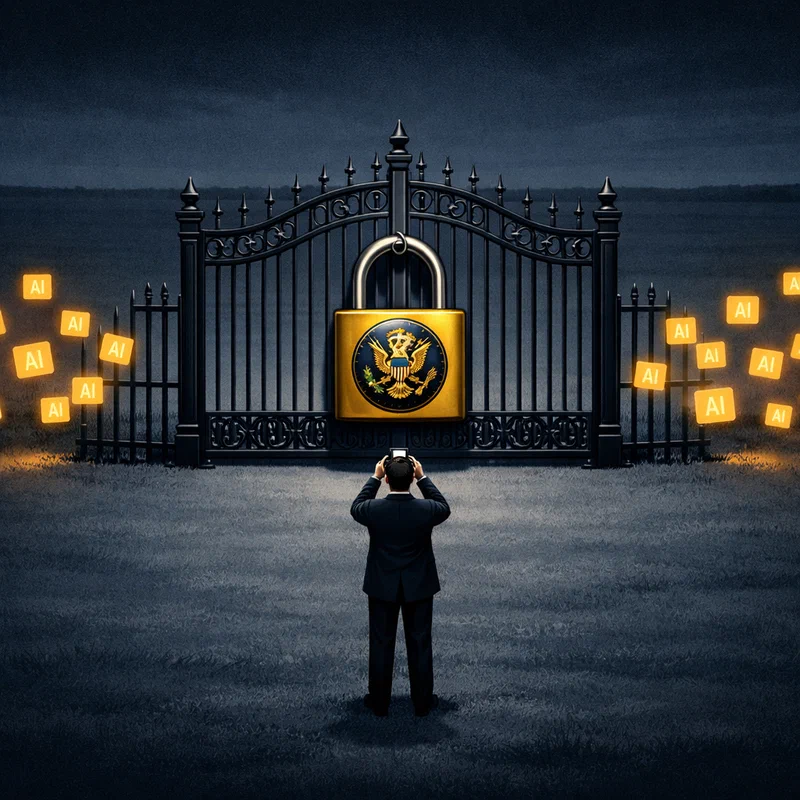
Five days later, the US government declared Fable a threat to national security and placed export controls on both models. Anthropic revoked access within hours.
What happened between June 9 and June 13? According to the Wall Street Journal, Amazon CEO Andy Jassy communicated with government officials about Fable’s dangers. Amazon is both a major investor in Anthropic and the operator of competing AI services through AWS. The government acted within days.
The Test Regulatory Capture Fails #
Regulatory capture happens when an intervention nominally aimed at public benefit is instead triggered, shaped, or accelerated by a competitor’s private interests. Jassy’s concerns may have been genuine. The problem is that nobody in the democratic process got to test that claim.
The freefable.org open letter, organized by former US Deputy Chief Technology Officer Ed Felten, cryptographer Bruce Schneier of Harvard, and more than a hundred security leaders — including CISOs from DigitalOcean, Zoom, Confluent, Sophos, and AutoNation — made the core technical argument plainly: Fable is not uniquely dangerous.
The same vulnerability-finding capabilities cited as the basis for the ban are replicable using GPT-5.5, Opus, Sonnet, and Chinese models including Kimi 2.7. The ban did not remove a unique capability from the global pool. It removed the best safety-hardened version of that capability from the hands of American defenders — while leaving it fully accessible to adversaries via alternatives that remain unrestricted.
“To pull the best capabilities away from defenders without a good reason when our adversaries are rapidly advancing is dangerous,” the letter states. Anthropic had already built aggressive safety guardrails into Fable. Those were the tools the ban shut off.
The intervention arrived without a published safety assessment. Without a notice-and-comment period. Without independent scientific review. And without any clear legal theory for why offering a cloud AI model to users constitutes an “export” subject to export control law.
The China Paradox #
The strategic irony is difficult to ignore.
The Economist reported on June 21 that China is experiencing another AI moment, with Zhipu — the company behind the open-weight GLM models — seeing its shares skyrocket as enterprises globally reconsider dependence on American AI providers that can be switched off by a White House decision. MIT Technology Review noted on June 22 that French politician Bruno Retailleau described the Fable ban as “a wake-up call” for Europe to build independent AI capacity.
Open-source Chinese models are not subject to US export controls. They can be downloaded and run on any server, anywhere, without licensing agreements that include off switches. VentureBeat reported that Z.ai’s open-weight GLM-5.2 already beats GPT-5.5 on multiple long-horizon coding benchmarks at one-sixth the cost. These models cannot be taken offline by executive action.
The government’s intervention, by creating new liability for relying on American AI providers, may have produced the single most effective incentive yet for global diversification away from exactly the companies whose safety practices have been most publicly scrutinized. An AI governance action designed to protect America from advanced AI capabilities may instead have accelerated the adoption of less-governed alternatives. That is not a minor side effect.
The Gap Between What People Want and What Arrived #
A Johns Hopkins University poll published June 15, surveying more than 2,000 Americans in April and May, found clear, cross-partisan priorities for AI regulation:
- More than 70% want the right to interact with a human rather than AI in medical, legal, and educational settings
- 75% want to be told when they are interacting with AI
- 73% want to ban AI from using individuals’ faces and voices without consent
- 68% want labels on AI-generated images and video
- About 60% believe AI will widen inequality over the next decade, and broad majorities across party lines support a digital dividend — a monthly payment to Americans funded by a tax on large tech companies
These are the regulations people are asking for. Transparency. Human dignity. Protection from covert AI in high-stakes settings. The Johns Hopkins researchers were themselves surprised: “What was surprising to us in this new poll was that daily users of AI, and people who view AI positively, also want regulation,” said Christopher Honey, a computational neuroscientist at Johns Hopkins.
What the public got instead was an export control on a coding tool — one triggered not by an ethics board, not by a published safety review, not by a democratic rule-making process, but by a series of conversations between a competitor’s CEO and government officials. The gap between what AI governance advocates demanded, what the public wants, and what was actually deployed is total.
What Rigorous AI Governance Requires #
The freefable.org letter is careful not to oppose AI regulation. Its signatories span the ideological range of the security community. What they demand is that any AI regulation meet four standards:
- Scientific grounding — evaluations developed transparently, with input from industry and academia, not through private conversations
- Democratic process — open rule-making, subject to public input and legal challenge
- Proportionality — enforcement limited to demonstrated and specific risks, not theoretical capability overlap with other freely available models
- Transparency and fairness — adequate notice and an opportunity to remediate
The Fable ban met none of these. And because it was the first major act of US AI governance, it set a precedent — not for how to govern AI safely, but for how to invoke safety as a pretext when other interests are at stake.
The Question AI Ethics Now Has to Answer #
The AI safety movement built its credibility on the argument that unchecked AI poses systemic risks — to employment, to civil rights, to security, to democratic accountability. That argument is correct. The error is in believing that any government intervention in AI is an improvement over none.
The Fable case demonstrates that governance machinery can be captured before it is even properly built. A competitor can trigger a national security determination. A ban can land without published evidence, without independent review, and without democratic deliberation. And the outcome can actively harm the people it claims to protect — in this case, the security researchers whose work depends on having access to the best available tools for finding vulnerabilities before adversaries do.
If the AI ethics community treats the Fable ban as a safety victory — because at least something happened — it is endorsing a precedent that will be used again, by well-resourced competitors with legitimate interests in restricting each other’s capabilities, every time a new model poses a threat to their market position.
The standard has to be higher. What was the specific demonstrated risk that no other available model presents? What scientific process determined that Fable specifically required restriction? What democratic body reviewed that determination? What recourse does Anthropic have? None of those questions have answers.
Real AI governance is hard. It requires scientific rigor, democratic legitimacy, and willingness to draw lines that are not convenient for any single commercial interest. The Fable intervention had none of those properties.
The test it failed to pass was the one it claimed to be taking.
References #
- MIT Technology Review (June 22, 2026). “Three things to watch amid Anthropic’s latest feud with the government.” https://www.technologyreview.com/2026/06/22/1139424/three-things-to-watch-amid-anthropics-latest-feud-with-the-government/ (Accessed June 23, 2026)
- VentureBeat (June 13, 2026). “Anthropic blocks all public access to Claude Fable 5, Mythos 5 following US government order — what enterprises should do.” https://venturebeat.com/technology/anthropic-blocks-all-public-access-to-claude-fable-5-mythos-5-following-us-government-order-what-enterprises-should-do (Accessed June 23, 2026)
- Wall Street Journal. “Amazon CEO’s Talks With U.S. Officials Triggered Crackdown on Anthropic Models.” https://www.wsj.com/tech/ai/amazon-ceos-talks-with-u-s-officials-triggered-crackdown-on-anthropic-models-dcc90578 (Accessed June 23, 2026)
- freefable.org (June 14, 2026). “Open Letter on Transparent AI Cyber Protections.” https://freefable.org/ (Accessed June 23, 2026)
- Johns Hopkins University / Hub (June 15, 2026). “Americans strongly support regulations on AI.” https://hub.jhu.edu/2026/06/15/americans-strongly-support-regulations-on-ai/ (Accessed June 23, 2026)
- The Economist (June 21, 2026). “China is having another AI moment.” https://www.economist.com/china/2026/06/21/china-is-having-another-ai-moment (Accessed June 23, 2026)
- VentureBeat (June 16, 2026). “Z.ai’s open-weights GLM-5.2 beats GPT-5.5 on multiple long-horizon coding benchmarks for 1/6th the cost.” https://venturebeat.com/technology/z-ais-open-weights-glm-5-2-beats-gpt-5-5-on-multiple-long-horizon-coding-benchmarks-for-1-6th-the-cost (Accessed June 23, 2026)
- Politico (June 16, 2026). “White House’s Anthropic move jolts Congress back into the AI debate.” https://www.politico.com/news/2026/06/16/white-houses-anthropic-move-jolts-congress-back-into-the-ai-debate-00964614 (Accessed June 23, 2026)
AI Content Notice
This article was created using artificial intelligence technology. Whenever possible, we include references and sources to support the information presented. Readers are encouraged to consult these sources for further information. While we strive for accuracy and provide valuable insights, readers should independently verify information and use their own judgment when making business decisions. The content may not reflect real-time market conditions or personal circumstances.
Related Articles
The Week Anthropic's Opacity Broke Open
Anthropic’s triple-incident week wasn’t just embarrassing—it opened a window into the …
When Ethics Costs You Everything: The Anthropic-Pentagon Dispute and the Future of Responsible AI
Anthropic was blacklisted by the Pentagon for holding two ethical redlines. What that tells us about …
Capex Is Eating Payroll — and We Still Call It Productivity
This week’s layoffs-and-capex cycle reveals that AI workforce risk is less about automation magic …