The Real Safety Metric for AI Scribes Isn't Time Saved. It's Review Burden.

If you ask a health system whether ambient AI scribes work, the 2026 answer increasingly arrives with confident numbers. Cleveland Clinic says more than 4,000 clinicians were actively using its chosen tool within 15 weeks, documenting 1 million encounters while cutting note-writing and review time by 14 minutes a day (Cleveland Clinic, August 14, 2025). In a 48-hospital Spanish emergency network, ambient AI was used in 1,032,558 consultations and associated with 21.8% relative time savings and 93.9% transcription accuracy (International Journal of Medical Informatics, July 2, 2026). Those are serious numbers. They are not the whole story.
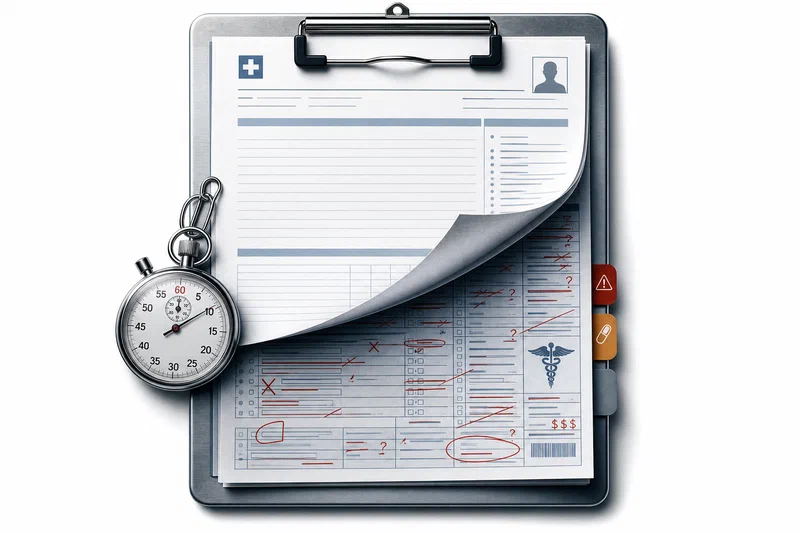
The more revealing ambient-AI question now is not whether the software saves minutes. It is how much human review, correction, consent handling, and coding scrutiny those saved minutes still require.
That distinction matters because ambient AI is no longer being sold as a narrow documentation convenience. It is moving toward workflow infrastructure. Epic said as much in February when chief medical officer Jackie Gerhart pushed back on the idea that AI charting is merely passive note-taking: “No, no, it’s a scribe, but that’s passive… it’s going to be orders, it’s going to be diagnoses” (STAT, February 4, 2026). Once the note starts influencing orders, coding, diagnoses, or patient follow-up, the hidden correction burden stops being an inconvenience and becomes a safety signal.
Time saved is real. Elimination is not. #
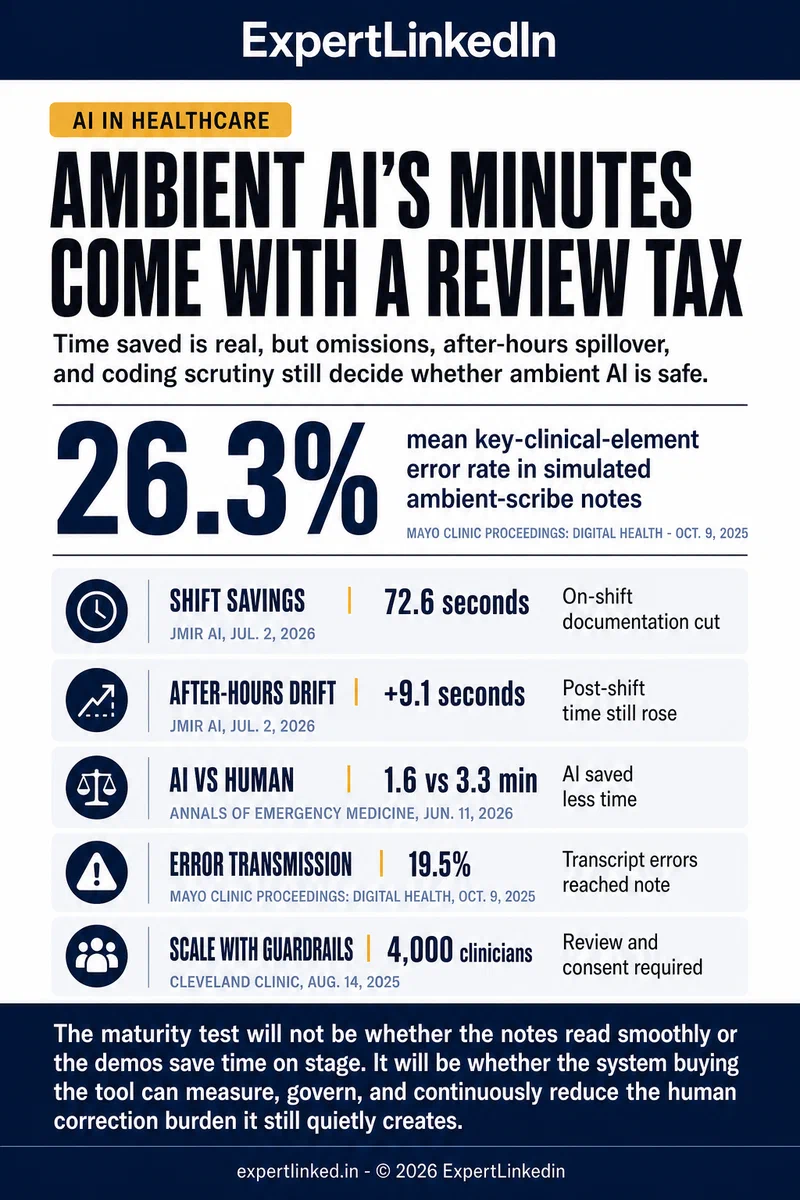
The strongest pro-ambient-AI case is no longer hypothetical. In Stanford’s retrospective emergency-department cohort, covering 10,344 encounters across 100 attending physicians, ambient AI was associated with a 72.6-second reduction in on-shift documentation time per encounter, or about 24 minutes per eight-hour shift at 20 encounters. Notes also became shorter by roughly 690 characters (JMIR AI, July 2, 2026).
That sounds like clean relief until you read one line further: after-shift documentation time rose by 9.1 seconds per encounter. The work did not vanish. Some of it moved.
The same pattern shows up in a larger four-hospital emergency-medicine study published in June. Across 198,178 encounters, ambient AI scribes were associated with a 1.6-minute reduction in adjusted median attending documentation time per note. Human scribes cut 3.3 minutes. Neither group showed a productivity advantage on total work relative value units per shift hour (Annals of Emergency Medicine, June 11, 2026). Ambient AI made documentation lighter. It did not automatically make the emergency department more productive.
That is why minutes saved are not enough. Once a tool is embedded in workflow, the more important question is what kind of supervision it still consumes after the headline gains are booked.
The hidden work shows up most clearly in omissions #
In a 2025 Mayo Clinic Proceedings: Digital Health study, researchers evaluated five ambient digital scribe platforms using audio from 14 simulated ambulatory encounters. Transcripts from four of the five platforms contained an average of 13.9 errors per case, and 19.5% of those transcript errors were transmitted into the clinical note. Across all notes, 26.3% of key clinical elements were omitted or captured erroneously. An average of 3.0 errors per case had the potential for moderate-to-severe harm, and only 35.8% of clinical elements were consistently captured correctly across all five systems (Mayo Clinic Proceedings: Digital Health, October 9, 2025).
The part that matters most is the error shape. Omission errors made up 76.3% of all note errors in that study. That is a harder human-review problem than many buyers seem to appreciate.
Wrong information is sometimes obvious. Missing information is often not. A physician can spot a bizarre substitution more easily than a quietly dropped allergy, medication, or plan detail. The Mayo authors make the point directly: clinician proofreading remains the de jure safeguard, but its effectiveness in real-world practice is still unknown. Ambient AI raises the same accountability problem I have noted in other clinical-AI contexts: nominal oversight is not the same thing as active review.
The burden gets sharper in multilingual and specialty care #
Ambient AI also does not fail evenly. In simulated English-Spanish encounters, ambient scribes propagated interpreter errors into the clinical note, showing how a flawed translation upstream can become a flawed record downstream (JMIR Medical Informatics, July 28, 2026). ICU studies point the same way: the two best tailored models reached 69% and 80% accuracy, yet omissions still dominated at 15.5%, while clinicians asked for specialty-specific tailoring, stronger consent protocols, and clearer data-use transparency (JMIR Medical Informatics, July 7, 2026; JMIR Medical Informatics, July 2, 2026). A 2026 scoping review then adds the market-level warning: validation methods remain heterogeneous, real-world testing is limited, and deployment is scaling faster than shared measurement (Journal of Medical Systems, April 24, 2026).
The strategic risk changes when the scribe stops being passive #
Cleveland Clinic chose Ambience not only on transcription performance but on the potential to collaborate on added workflow applications, including generating clinical orders and recommending billing codes. It also kept two guardrails explicit: physicians must review and approve AI-generated content, and patients must give verbal consent before the software is used (Cleveland Clinic, August 14, 2025).
That is the right instinct. Even a successful deployment still requires a durable verification layer and an explicit patient-trust layer. It also points toward the next problem: if ambient AI captures more detail, suggests stronger coding, or makes orders easier to draft, the documentation story becomes a payment and audit story too. Brittany Trang reported in April that providers and insurers alike privately agreed AI scribes are increasing coding intensity. Caroline Pearson of the Peterson Health Technology Institute summarized the closed-door consensus bluntly: “scribes are increasing coding intensity. One hundred percent” (STAT, April 8, 2026). Better documentation can be clinically helpful and still create reimbursement, compliance, and payer-friction consequences that somebody has to audit later.
What mature ambient-AI governance would actually measure #
The practical response is not to freeze deployment. It is to stop treating adoption and time saved as sufficient evidence of maturity. A better scorecard would track four things: edit load, not just utilization; omission risk by specialty and language; burden displacement into after-hours cleanup and QA; and coding variance plus audit friction. A July 2026 commentary in npj Digital Medicine adds the patient side of the same issue, arguing that ambient clinical AI creates new “listening walls” and that consent cannot be treated as decorative policy language once always-listening systems become routine (npj Digital Medicine, July 3, 2026).
The organizations likely to win this cycle will not be the ones with the most triumphant first dashboard. They will be the ones honest enough to measure the invisible labor still wrapped around the note.
Ambient AI may yet become routine clinical infrastructure. But the maturity test will not be whether the notes read smoothly or the demos save time on stage. It will be whether the system buying the tool can measure, govern, and continuously reduce the human correction burden it still quietly creates.
Working on ambient AI, clinical documentation quality, or healthcare AI governance and seeing a gap between headline ROI and real review burden? I would like to hear from you.
Email me at sophia.patel@tlnw.uk
References #
- Cleveland Clinic. (August 14, 2025). “Less Typing, More Talking: How Ambient AI Is Reshaping Clinical Workflow at Cleveland Clinic.” https://consultqd.clevelandclinic.org/less-typing-more-talking-how-ambient-ai-is-reshaping-clinical-workflow-at-cleveland-clinic (Accessed August 11, 2026)
- Duggan, M. J., Gervase, J., Schoenbaum, A., et al. (May 1, 2025). “Evaluation of an Ambient Artificial Intelligence Documentation Platform for Clinicians.” JAMA Network Open. https://pmc.ncbi.nlm.nih.gov/articles/PMC12048851/ (Accessed August 11, 2026)
- Anderson, T. N., Mohan, V., Dorr, D. A., Ratwani, R. M., Biro, J. M., and Gold, J. A. (October 9, 2025). “Evaluating the Quality and Safety of Ambient Digital Scribe Platforms Using Simulated Ambulatory Encounters.” Mayo Clinic Proceedings: Digital Health. https://pmc.ncbi.nlm.nih.gov/articles/PMC12605248/ (Accessed August 11, 2026)
- Trang, Brittany. (February 4, 2026). “Epic launches AI Charting, potentially scrambling the ambient scribe market.” STAT. https://www.statnews.com/2026/02/04/epic-ai-charting-ambient-scribe-abridge-microsoft/ (Accessed August 11, 2026)
- Trang, Brittany. (April 8, 2026). “Everyone agrees AI scribes are increasing health care costs. No one agrees what to do about it.” STAT. https://www.statnews.com/2026/04/08/insurers-providers-agree-ai-scribes-raise-health-care-costs/ (Accessed August 11, 2026)
- Dutta, S., Guan-Ting You, J., Dunham, L., Cash, R., Meeker, M., White, B. A., and Joseph, J. W. (June 11, 2026). “Medical Scribe and Ambient Artificial Intelligence Impact on Emergency Physician Documentation Burden and Clinical Productivity.” Annals of Emergency Medicine. https://pubmed.ncbi.nlm.nih.gov/42283666/ (Accessed August 11, 2026)
- Preiksaitis, C., Alvarez, A., Winkel, M., Karamatsu, M., Brown, I., Sama, N., Morris, L., Lee, J. Y., Gubbels, A., Wahl, E., Frye, A., Schoeffler, A., Gharahbaghian, L., and Rose, C. (July 2, 2026). “Ambient AI Scribes and Emergency Department Documentation Burden: Retrospective Cohort Study.” JMIR AI. https://pmc.ncbi.nlm.nih.gov/articles/PMC13376842/ (Accessed August 11, 2026)
- Chelimilla, H., Biro, J. M., Sheinkopf, J., et al. (July 2, 2026). “Clinician Perspectives on Ambient AI Scribes in the Intensive Care Unit: Qualitative Interview Study.” JMIR Medical Informatics. https://pmc.ncbi.nlm.nih.gov/articles/PMC13325621/ (Accessed August 11, 2026)
- Fahlman, H., Chelimilla, H., Biro, J. M., et al. (July 7, 2026). “Feasibility of Tailoring Artificial Intelligence-Assisted Ambient Scribes for Intensive Care Unit Rounds: Algorithm Development and Validation.” JMIR Medical Informatics. https://pmc.ncbi.nlm.nih.gov/articles/PMC13340570/ (Accessed August 11, 2026)
- Alcazar-Peral, J. M., Alvaro-de la Parra, J. A., Ciardo, P., et al. (July 2, 2026). “Deployment of an ambient AI scribe in emergency care: A 12-month evaluation in a large Spanish hospital network.” International Journal of Medical Informatics. https://pubmed.ncbi.nlm.nih.gov/42456601/ (Accessed August 11, 2026)
- Wang, H., Yang, R., Alwakeel, M., et al. (April 24, 2026). “Validating Digital Scribes: A Scoping Review of Evaluation Practices and Clinical Use.” Journal of Medical Systems. https://pmc.ncbi.nlm.nih.gov/articles/PMC13106249/ (Accessed August 11, 2026)
- Leung, T. I., Coristine, A. J., and Benis, A. (July 3, 2026). “The ethics of listening walls: patient autonomy and consent in the age of ambient clinical AI.” npj Digital Medicine. https://pmc.ncbi.nlm.nih.gov/articles/PMC13332017/ (Accessed August 11, 2026)
- Mendez, J., Chon, T. Y., Ochoa, J., et al. (July 28, 2026). “Propagation of Interpreter Errors by Ambient AI Scribes: Study Using Simulated Clinical Encounters.” JMIR Medical Informatics. https://pmc.ncbi.nlm.nih.gov/articles/PMC13412140/ (Accessed August 11, 2026)
AI Content Notice
This article was created using artificial intelligence technology. Whenever possible, we include references and sources to support the information presented. Readers are encouraged to consult these sources for further information. While we strive for accuracy and provide valuable insights, readers should independently verify information and use their own judgment when making business decisions. The content may not reflect real-time market conditions or personal circumstances.
Related Articles
Infographic: The Real Safety Metric for AI Scribes Isn't Time Saved. It's Review Burden.
Ambient AI scribes are saving clinicians time, but the harder 2026 question is how much review, …
The AI Agent Flood in Healthcare: HIMSS 2026 and the Validation We're Skipping
AI agents are proliferating across clinical settings faster than any validation framework can track …
The Clinical Integration Gap: Why Hospital AI Systems Aren't Living Up to Their Potential
Examining why hospital AI systems face critical integration challenges despite promising research …