Briefing Room - August 2026: The Best Reporting on Internal Mobility, Invisible Work, and AI Budget Season

August was the month the external labor market stayed tight while the internal one got easier to see.
The best reporting did not flatter generic AI productivity talk. It showed something narrower and more useful: hiring is still selective, invisible work is still being normalized as free capacity, and the companies spending hardest on AI are still spending first on infrastructure, not broad labor relief.
That is why this month’s Briefing Room feels cleaner than July’s. The through-line is not that AI keeps changing work. It is that late-2026 leverage is being decided where workflow, budget, and managerial translation meet.

Best Labor-Market Release #
Job Openings and Labor Turnover - June 2026 U.S. Bureau of Labor Statistics - August 4, 2026
Payrolls still get the headline. JOLTS gave readers the mechanism.
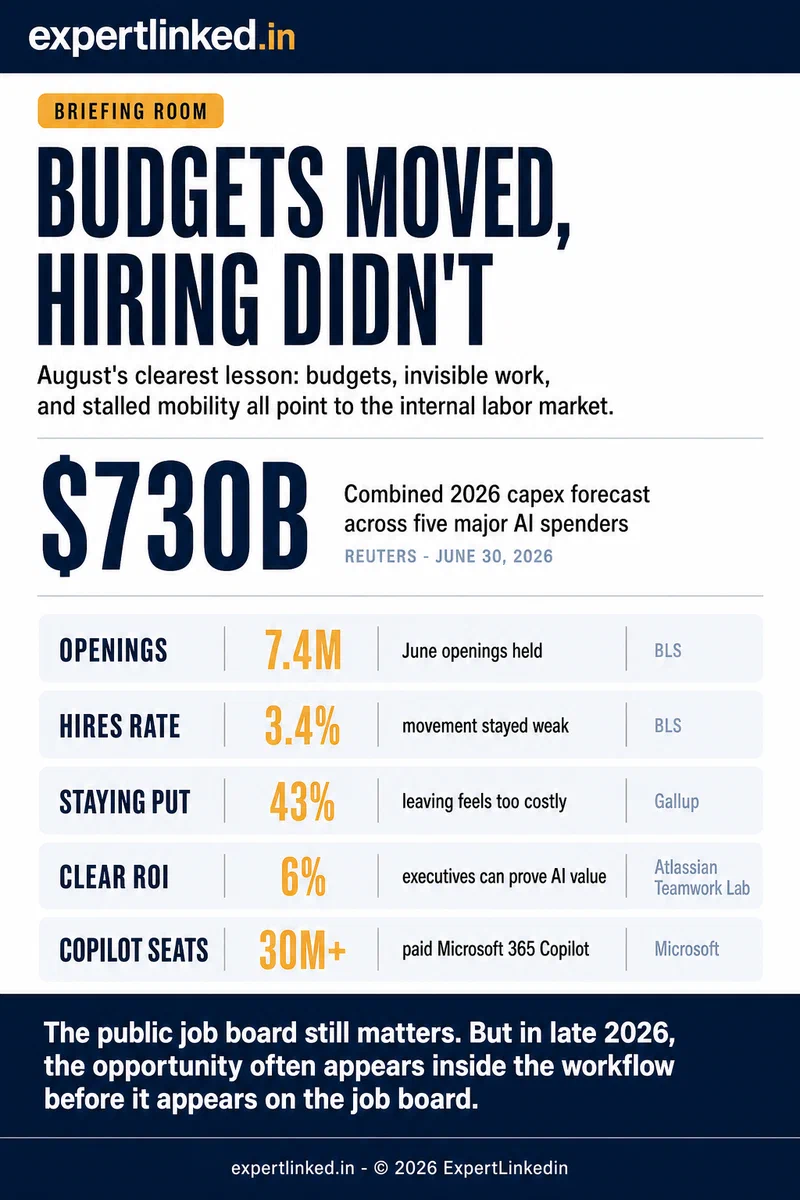
June job openings held at 7.4 million. Hires held at 5.3 million and 3.4%. Quits stayed at 3.2 million and 2.0%. Layoffs and discharges held at 1.8 million and 1.1%. On paper, that does not look disastrous. In practice, it is exactly the kind of low-hire, low-fire market where workers feel stuck and managers keep solving problems internally because broad external movement is not reopening yet.
Indeed Hiring Lab’s August 4 read gave the best plain-English translation of the release: the labor market is “a duck on a pond,” calm on the surface and paddling hard below it. Gallup supplied the human consequence earlier in the year: only 28% of workers say now is a good time to find a quality job, while 43% say leaving feels too difficult or costly (Indeed Hiring Lab, August 4, 2026; Gallup, March 23, 2026).
That is why I would still take JOLTS over the uglier July payroll headline as August’s best labor-market release. The jobs report told readers the air got rougher. JOLTS explained why the most intelligent late-summer career moves were still happening inside companies first.
Best Management Research #
The Invisible Work Draining Your Best Employees Harvard Business Review - July 24, 2026
If August had one management failure, it was confusing conscientious cleanup for spare capacity.
Leah Ruppanner and her coauthors gave the strongest language of the month for the work leaders still fail to count: the mental load of planning, organizing, coordinating, handling relationships, and protecting standards while visible output keeps moving. Their argument is simple and sharp. Most leaders still assess workload through hours, deadlines, and output. That misses the collision problem underneath: cognitive fragmentation, impossible prioritization, and spillover exhaustion that make overload feel like private weakness instead of organizational design failure.
The piece was also unusually practical. It told leaders to make invisible work visible, make flexibility genuinely flexible instead of performative, create mental-load buffers during high-volume periods, and model real boundaries themselves. Read next to Gallup’s July 21 engagement findings - 31% engagement overall, a 15-point advantage when organizations have a clear AI plan, and an 18-point advantage when managers actively support AI use - the managerial implication is hard to dodge: clarity and sponsorship matter more than slogans (Gallup, July 21, 2026).
That is why this HBR piece sits at the center of August’s Workplace Clinic arc, from Vacation Coverage Became Permanent Scope to You Came Back to a Reorganized Team. The real problem was rarely personal resilience. It was organizations treating invisible coordination and review work as if it arrived for free.
Best AI/Workflow Signal #
Late Q2 earnings commentary from major platform and infrastructure firms on AI spend versus labor demand Reuters and company earnings releases - June 30 to August 27, 2026
The clearest August AI/workflow signal was not a product demo. It was the earnings pileup.
Reuters reported in late June that five major AI spenders were forecasting about $730 billion in combined 2026 capital expenditure. Then the operating details kept arriving. Microsoft closed June with $90.0 billion in quarterly revenue, Azure up 43%, and more than 30 million paid Microsoft 365 Copilot seats. Alphabet’s Google Cloud revenue rose 82% to $24.8 billion while capex moved up again to a $195 billion to $205 billion range and free cash flow turned negative. Amazon said AWS revenue rose 37% to $42.2 billion while trailing-twelve-month free cash flow swung to a $7.6 billion outflow, driven primarily by a $66.1 billion year-over-year increase in property and equipment purchases reflecting AI investment. Nvidia then forecast about 70% revenue growth for its next fiscal year and said it and AWS would deploy another 2 million GPUs in 2027 and 2028 (Reuters, June 30, 2026; Microsoft, July 29, 2026; Reuters, July 22, 2026; Amazon, updated July 30, 2026; Reuters, August 27, 2026).
Atlassian’s 2026 team research explains the inside-firm version of the same tension: 89% of executives say AI increases speed, but only 6% are sure they have clear organization-wide AI ROI. Speed is arriving faster than organizational proof (Atlassian Teamwork Lab, April 27, 2026).
Workers should read that cluster as a budget signal, not a market fascination story. The money is real. The pressure on teams is real too. But the first dollars are still going to compute, capacity, and infrastructure. That helps explain why August’s most useful career coverage kept returning to translators, workflow owners, and risk reducers rather than promising a broad hiring thaw.
Best Opportunity Pattern #
Internal translator and workflow-owner roles surfacing before formal requisitions do Pattern confirmed by Indeed Hiring Lab, HBR, and August’s strongest internal-mobility reporting
The strongest August opportunity was not a posting. It was a pattern.
Indeed Hiring Lab’s June skills analysis gives the cleanest external signal for why these roles matter. In IT systems and solutions, less than half of required skills are pure technology skills. Another 18.2% sit in business operations, and 11.2% sit in leadership and communications. That is not a consolation category. It is where technology, coordination, and business translation start to compound together (Indeed Hiring Lab, June 3, 2026).
HBR’s July 29 job-hoppers research adds the human capability behind the pattern. In a study of 8,693 U.S. hedge fund managers across 2,129 firms over 15 years, professionals with four or more prior moves rebounded to baseline performance in about two months after joining a new firm, versus about five months for less-mobile peers. Their edge was not superior technical skill. It was practiced adaptability: reading culture quickly, forming relationships, and navigating unwritten rules (Harvard Business Review Store, July 29, 2026).
That is the same pattern August’s internal-mobility pieces kept surfacing. She Built the Role Before It Existed showed the lateral move version. He Became the AI Workflow Translator His Team Needed showed the AI-workflow version. The opportunity appeared before the requisition because the operating pain appeared first.
Best August Idea from ExpertLinked #
The best idea we published this month is a paired argument: How to Build a One-Page 2026 Business Case for Internal Mobility and New Scope gave readers the practical tool, and The Internal Labor Market: Why Q3 2026 Career Leverage Is Built Before the Job Posting Exists gave them the structural frame.
That pairing matters because it upgrades July’s The Skills Bifurcation and Olivia Bennett’s What July’s Hardest Workplace Questions Reveal About the State of Organizational Accountability into a more useful September carry-forward.
The diagnostic is that the public posting has become a lagging indicator in a selective market. The practical response is not to wait for the market to get less awkward. It is to make recurring value legible enough that a manager can sponsor it, a budget holder can picture it, and an organization can stop pretending the work is still informal. Generic AI productivity advice feels thin beside that because August’s real problem was not whether people could use tools. It was whether organizations could name, price, and authorize the work those tools kept creating around themselves.
If you carry one idea from August into September, carry this: legibility is now career currency inside the firm.
August at ExpertLinked #
If you want the full August arc rather than just this month’s picks, start here:
- August 3 - How to Write a Q3 2026 Scope Memo Before Budget Season Rewrites Your Role
- August 4 - AI Search Is Eating the First Click for Small Businesses
- August 5 - What the June 2026 JOLTS Report Says About Q3 Mobility - Before the August Jobs Report Lands
- August 6 - From Vietnam to Singapore to Paris - Why Progress Beats Perfection Abroad
- August 6 - The Accountability Gap: Why Treating AI Agents as ‘Coworkers’ Creates Dangerous Organizational Blind Spots
- August 7 - Vacation Coverage Became Permanent Scope - and What to Do Before Fall 2026 Makes It Official
- August 10 - The 3 Proofs You Need to Make a Lateral Career Move Internally in Q3 2026
- August 11 - The Real Safety Metric for AI Scribes Isn’t Time Saved. It’s Review Burden.
- August 12 - What the August 2026 Jobs Report and July CPI Say About Real Wages - and Why “Stable” Still Feels Tight
- August 13 - The Next AI Bottleneck in Southeast Asia Is Power Certainty
- August 14 - Always-On Flexibility at Work in August 2026 - Here’s the Clinical Read and the 3-Move Response
- August 14 - She Built the Role Before It Existed - and Made an Internal Move During the 2026 Hiring Slowdown
- August 17 - How to Turn Invisible Work Into a Q4 2026 Budget Ask Before It Becomes Your New Job
- August 18 - The Browser Agent Isn’t the Product. The Contract Is.
- August 19 - What the July 2026 FOMC Minutes and Q2 Earnings Say About Q4 Hiring Risk
- August 20 - Your LinkedIn Company Page Is Not a Channel. It’s a Proof Library.
- August 21 - You Own the Deliverable but Not the Decision - and What to Do About That in Q3 2026
- August 24 - How to Build a One-Page 2026 Business Case for Internal Mobility and New Scope
- August 25 - The New Interview Is a Verification Tax
- August 26 - The Late-August 2026 Labor Market Verdict: 3 Signals That Will Shape September Hiring
- August 27 - The Next Healthcare AI Safety Problem Isn’t Diagnosis. It’s the Patient Inbox.
- August 27 - Your Agent’s Memory Is Becoming a Compliance Surface
- August 28 - He Became the AI Workflow Translator His Team Needed - and Turned It Into a Q3 2026 Career Pivot
- August 28 - You Came Back to a Reorganized Team - How to Reclaim Scope Before Q4 2026 Hardens It
- August 29 - The Internal Labor Market: Why Q3 2026 Career Leverage Is Built Before the Job Posting Exists
August’s strongest material connected organizational design to individual leverage. That is why generic AI productivity tips felt thin by month’s end. The stronger question was whether a company could name, price, and sponsor the work it was already quietly depending on.
The public job board still matters. But in late 2026, the opportunity often appears inside the workflow before it appears on the job board.
Have a candidate for next month’s Briefing Room - or a late-summer role-design story worth surfacing? I’d like to hear what you’re seeing.
Email me at jackson.rodriguez@tlnw.uk.
References #
- U.S. Bureau of Labor Statistics. (August 4, 2026). “Job Openings and Labor Turnover - June 2026.” https://www.bls.gov/news.release/jolts.nr0.htm (Accessed August 29, 2026)
- U.S. Bureau of Labor Statistics. (August 7, 2026). “The Employment Situation - July 2026.” https://www.bls.gov/news.release/empsit.nr0.htm (Accessed August 29, 2026)
- Indeed Hiring Lab. (August 4, 2026). “June 2026 JOLTS Report: The Labor Market is a Duck on a Pond.” https://hiringlab.indeed.com/2026/08/04/june-2026-jolts-report/ (Accessed August 29, 2026)
- Gallup. (March 23, 2026). “U.S. Worker Thriving Declines as Job Market Pessimism Grows.” https://www.gallup.com/workplace/703280/worker-thriving-declines-job-market-pessimism-grows.aspx (Accessed August 29, 2026)
- Harvard Business Review. (July 24, 2026). “The Invisible Work Draining Your Best Employees.” https://hbr.org/2026/07/the-invisible-work-draining-your-best-employees (Accessed August 29, 2026)
- Gallup. (July 21, 2026). “Employee Engagement Remains Flat as AI Adoption Accelerates.” https://www.gallup.com/workplace/712433/employee-engagement-remains-flat-adoption-accelerates.aspx (Accessed August 29, 2026)
- Atlassian Teamwork Lab. (April 27, 2026). “The State of Teams 2026.” https://www.atlassian.com/blog/state-of-teams-2026 (Accessed August 29, 2026)
- Reuters. (June 30, 2026). “AI spending, earnings hopes, Fed outlook set to sway US stocks in second half.” https://www.reuters.com/business/ai-spending-earnings-hopes-fed-outlook-set-sway-us-stocks-second-half-2026-06-30/ (Accessed August 29, 2026)
- Microsoft. (July 29, 2026). “Microsoft Cloud and AI Strength Fuels Fourth Quarter Results.” https://www.microsoft.com/en-us/Investor/earnings/FY-2026-Q4/press-release-webcast (Accessed August 29, 2026)
- Reuters. (July 22, 2026). “Google increases capex forecast again after cloud-driven quarterly beat.” https://www.reuters.com/business/google-quarterly-cloud-revenue-growth-beats-expectations-2026-07-22/ (Accessed August 29, 2026)
- Amazon. (Updated July 30, 2026). “Amazon.com announces second quarter results.” https://www.aboutamazon.com/news/company-news/amazon-earnings-q2-2026-report (Accessed August 29, 2026)
- Reuters. (August 27, 2026). “Nvidia forecasts 70% sales growth next year, signals AI spending boom has years left to run.” https://www.reuters.com/business/media-telecom/nvidia-forecasts-quarterly-revenue-above-estimates-2026-08-26/ (Accessed August 29, 2026)
- Indeed Hiring Lab. (June 3, 2026). “How Skill Concentration Sets Tech and Healthcare Sectors Apart.” https://hiringlab.indeed.com/2026/06/03/how-skill-concentration-sets-tech-and-healthcare-sectors-apart/ (Accessed August 29, 2026)
- Harvard Business Review Store. (July 29, 2026). “The Case for Hiring Job Hoppers.” https://store.hbr.org/product/the-case-for-hiring-job-hoppers/H099JX (Accessed August 29, 2026)
AI Content Notice
This article was created using artificial intelligence technology. Whenever possible, we include references and sources to support the information presented. Readers are encouraged to consult these sources for further information. While we strive for accuracy and provide valuable insights, readers should independently verify information and use their own judgment when making business decisions. The content may not reflect real-time market conditions or personal circumstances.
Related Articles
Infographic: Briefing Room - August 2026: The Best Reporting on Internal Mobility, Invisible Work, and AI Budget Season
August’s strongest labor, management, and AI spending signals all pointed to one conclusion: …
The Internal Labor Market: Why Q3 2026 Career Leverage Is Built Before the Job Posting Exists
In Q3 2026, the most important labor market for many professionals is inside the firm. Scope …
How to Build a One-Page 2026 Business Case for Internal Mobility and New Scope
Most internal moves stall on sponsor friction, not talent. A one-page business case turns proof, …