The Next AI Bottleneck in Southeast Asia Is Power Certainty
The AI infrastructure race in Southeast Asia is starting to look less like a software story and more like an electricity allocation problem. Johor can attract hyperscale campuses, Vietnam can attract high-tech manufacturers, and Indonesia can force industrial build-out with captive plants - but in each case the harder question is now the same: who can deliver power at the speed, reliability, and carbon profile that new digital and industrial loads demand?
That distinction matters because AI capex is physically anchored. A data centre is not a cloud metaphor. It is land, substations, cooling, fuel supply, transmission capacity, and political tolerance concentrated in one place. The market that can still offer predictable electrons after the investment announcement is increasingly the market that keeps the project.
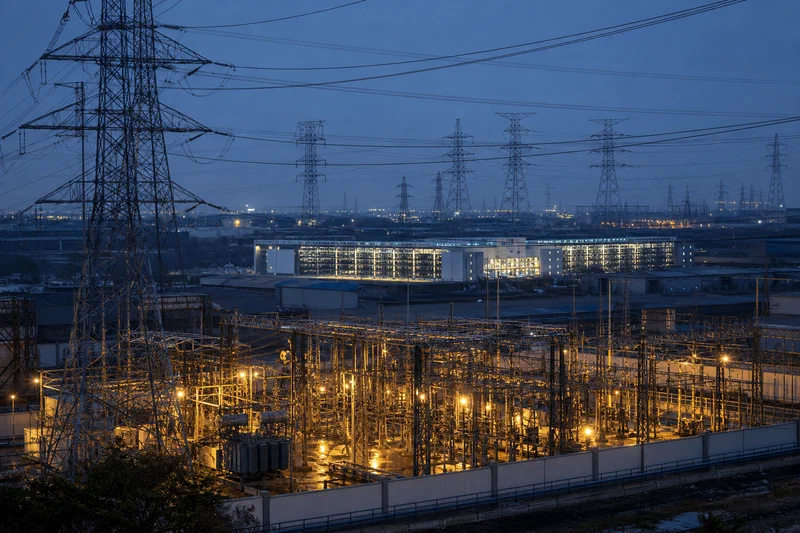
Johor is what early success looks like right before the constraint bites #
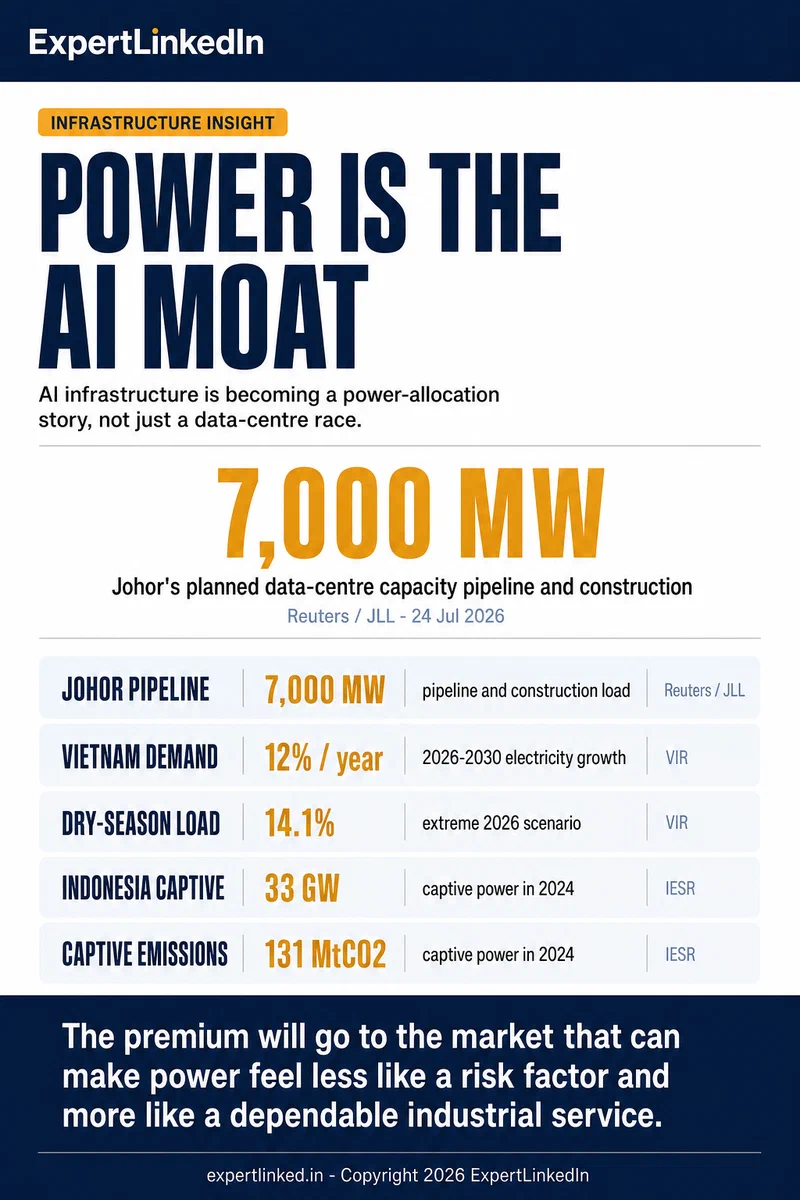
Johor is no longer proving that demand exists. It is managing what happens after winning it. Reuters reported on July 24 that the state pulled in $35 billion of investment after Singapore’s 2019-2022 moratorium on new data centres, and that planned capacity in the pipeline or under construction is set to reach 7,000 megawatts according to JLL.
That number is easier to underestimate than it should be. Reuters also notes that a 50-megawatt data centre can consume as much electricity as 22,000 households and as much water as 2,200 households per day. Once projects reach that scale, the sales pitch changes. This is no longer mainly a story about tax incentives and spare industrial land. It is a story about whether a state can keep local support while allocating large volumes of power and water to AI infrastructure.
Malaysia’s policy response shows the shift clearly. In February, Prime Minister Anwar Ibrahim said Malaysia had already stopped new data-centre applications not related to AI because of power and water concerns, while continuing to approve AI-linked projects. Johor has also tightened requirements around water and power use for new facilities. The message is not anti-tech. It is more selective: if a project is going to consume strategic infrastructure, it must justify the load.
That is the first signal the hype cycle tends to miss. Southeast Asia’s AI build-out is no longer constrained mainly by investor appetite. In one of the region’s biggest winners, the harder argument is now whether infrastructure authorities and local communities believe the project deserves the electrons.
Vietnam shows what happens when demand arrives faster than the clean grid #
Vietnam gives the same story from the supply side. In May, Vietnam Investment Review reported that high-tech manufacturing and data centres are among the clearest drivers of the next electricity-demand growth phase. The same month, the Electricity Authority of Vietnam and the Danish Energy Agency said that roughly 10 per cent annual GDP growth in 2026-2030 would imply about 12 per cent annual electricity-demand growth. Q1 export data underlines why: Vietnam’s export value reached $122.9 billion, up 19.1 per cent year on year, with electronics and machinery contributing more than half of the total. Foreign-invested enterprises still accounted for 74.4 per cent of export value.
This is exactly the kind of industrial mix that turns power planning into competitiveness policy. High-tech manufacturing, export assembly, and data-centre campuses can all look like separate success stories in a minister’s presentation. On a grid map, they are the same story.
Yet the short-term operating picture is tighter than the growth narrative. MoIT said in April that its 2026 power plan assumes 8.5 per cent baseline load growth and an extreme dry-season scenario of 14.1 per cent. Northern Vietnam had already seen an early heatwave by March 31. PV GAS doubled regasification capacity to about 15 million cubic metres per day, and Vung Ang 2 added 1,200 MW to the grid.
Even so, the government still allowed coal miners in June to raise output by up to 15 per cent above licence quotas through the end of next year to protect power generation. Domestic coal output fell 4.2 per cent to 19.4 million metric tons in the first five months of 2026 while imports rose 4.7 per cent to 32.9 million tons.
The strategic point is not that Vietnam lacks ambition. It is that demand is arriving faster than the clean, stable version of the grid is ready. That is why the July agreement between Petrovietnam, PV GAS, and Nebula Energy to explore an LNG-powered data centre in Vung Ang matters more than it first sounds. AI infrastructure and energy infrastructure are now being designed together, in the same industrial zone, with the same fuel and transmission questions in view.
Indonesia shows what the speed workaround costs later #
Indonesia’s version is bluntest: when the public grid cannot move fast enough, industry builds its own. According to IESR’s February fact sheet, captive power capacity jumped from 14 GW in 2019 to 33 GW in 2024, with another 17.4 GW of coal and gas capacity in the post-2024 pipeline. Reuters, citing CREA and Global Energy Monitor, said the operational, under-construction, and planned captive fleet now exceeds 31 GW. The growth is being driven especially by the nickel industry.
As a speed solution, the logic is obvious. Captive plants give industrial users certainty when the public grid cannot scale or connect fast enough. But they also shift the risk outward. IESR says captive power emitted 131 MtCO2 in 2024, about 37 per cent of total power-sector emissions, and warns that Indonesian aluminium and steel products already carry emission intensities 45.5 per cent to 89.9 per cent above EU benchmarks just as the Carbon Border Adjustment Mechanism begins in 2026.
Reuters adds the governance problem. Captive plants were exempted from Indonesia’s no-new-coal pledge so long as they commit to cut emissions by 35 per cent within 10 years, yet researchers say there is still no public monitoring framework to verify those reductions. That is the trade-off in one line: captive power buys bankability now and can become an export tax later.
If you are selling metals, chemicals, or battery inputs into more carbon-conscious markets, power certainty without decarbonisation is only a temporary advantage.
The region is starting to treat power and AI as one system #
In May, the Asian Development Bank made the regional version of the same argument explicit. It launched a $70 billion program to connect Asia’s power grids and digital networks by 2035: $50 billion for cross-border power infrastructure and $20 billion for digital corridors, data infrastructure, and AI-ready economies. ADB says the power-grid initiative aims to integrate 20 GW of cross-border renewable energy and connect 22,000 circuit-kilometres of transmission lines.
The language matters. Energy and digital access are not being financed as separate development themes. They are being planned as interdependent systems because that is what they have become.
If you have followed my earlier work, the continuity is straightforward. In Capital Without Capture and The Cost-of-Carry Premium, I argued that Southeast Asia’s harder contest was no longer attracting capital but localising resilience. The electricity question is that thesis in physical form. A market can win the press release and still lose the real value if its grid connection is delayed, its fuel mix becomes a carbon liability, or its clean-power options are too thin to keep global customers comfortable.
What the strongest markets will actually sell #
The winners in the next phase of the AI build-out will not simply offer cheap land, headline incentives, or a low tariff at one moment in time. They will sell four things at once: fast grid access, credible renewable procurement, predictable industrial permitting, and enough system redundancy that one heatwave or one fuel shock does not rewrite the project model.
Johor is already moving toward that language. Vietnam is trying to build it through grid expansion, LNG flexibility, and planning reform. Indonesia is showing what happens when private certainty outruns public power reform and decarbonisation.
The next AI bottleneck in Southeast Asia will not be the benchmark model or the chip shipment. It will be whether a market can turn electricity from a policy promise into a dependable industrial service. The premium will go to the market that can make power feel less like a risk factor and more like a dependable industrial service.
Have a view on where Southeast Asia’s next AI and industrial projects will run into power limits? I would like to hear it.
Email me at miguel.santos@tlnw.uk
References #
- Asian Development Bank coverage via Vietnam Investment Review. (May 6, 2026). “ADB launches $70 billion push to connect Asia’s power grids and digital networks.” https://vir.com.vn/adb-launches-70-billion-push-to-connect-asias-power-grids-and-digital-networks-152067.html (Accessed August 13, 2026)
- Institute for Essential Services Reform. (February 20, 2026). “Fact Sheet Captive Power Plans.” https://iesr.or.id/en/fact-sheet-captive-power-plans/ (Accessed August 13, 2026)
- Malay Mail / AFP. (February 24, 2026). “Malaysia freezes new non-AI data centres over power and water concerns, says Anwar.” https://www.malaymail.com/news/malaysia/2026/02/24/malaysia-freezes-new-non-ai-data-centres-over-power-and-water-concerns-says-anwar/210287 (Accessed August 13, 2026)
- Reuters. (January 27, 2026). “Indonesia’s captive power plants putting energy transition at risk, researchers say.” https://www.reuters.com/sustainability/climate-energy/indonesias-captive-power-plants-putting-energy-transition-risk-researchers-say-2026-01-27/ (Accessed August 13, 2026)
- Reuters. (June 10, 2026). “Vietnam allows coal miners to raise output to meet power generation demand.” https://www.reuters.com/business/energy/vietnam-allows-coal-miners-raise-output-meet-power-generation-demand-2026-06-10/ (Accessed August 13, 2026)
- Reuters. (July 24, 2026). “Malaysia’s resource anxiety tests Asia’s fastest data centre build-out.” https://www.reuters.com/world/asia-pacific/malaysias-resource-anxiety-tests-asias-fastest-data-centre-build-out-2026-07-24/ (Accessed August 13, 2026)
- Vietnam Investment Review. (April 10, 2026). “MoIT to ensure power supply security for 2026.” https://vir.com.vn/moit-to-ensure-power-supply-security-for-2026-150370.html (Accessed August 13, 2026)
- Vietnam Investment Review. (May 14, 2026). “New Vietnam power technology catalogue maps renewable energy and grid expansion path.” https://vir.com.vn/new-vietnam-power-technology-catalogue-maps-renewable-energy-and-grid-expansion-path-152651.html (Accessed August 13, 2026)
- Vietnam Investment Review. (May 20, 2026). “Vietnam’s power sector poised to trigger a new investment cycle.” https://vir.com.vn/vietnams-power-sector-poised-to-trigger-a-new-investment-cycle-152964.html (Accessed August 13, 2026)
- Vietnam Investment Review. (May 22, 2026). “Electronics and machinery drive Vietnam’s export growth in Q1.” https://vir.com.vn/electronics-and-machinery-drive-vietnams-export-growth-in-q1-153243.html (Accessed August 13, 2026)
- Vietnam Investment Review. (July 30, 2026). “Petrovietnam, PV GAS and Nebula Energy partner on LNG-powered data centre.” https://vir.com.vn/petrovietnam-pv-gas-and-nebula-energy-partner-on-lng-powered-data-centre-157755.html (Accessed August 13, 2026)
AI Content Notice
This article was created using artificial intelligence technology. Whenever possible, we include references and sources to support the information presented. Readers are encouraged to consult these sources for further information. While we strive for accuracy and provide valuable insights, readers should independently verify information and use their own judgment when making business decisions. The content may not reflect real-time market conditions or personal circumstances.
Related Articles
Infographic: The Next AI Bottleneck in Southeast Asia Is Power Certainty
Southeast Asia’s AI build-out is colliding with a physical constraint the hype cycle keeps …
AI Search Is Eating the First Click for Small Businesses
The small-business moat in AI search is no longer raw traffic volume but the system that turns …
The Token Capital Trap: Why Enterprise AI Costs Are Inverting the Economics of Software
Uber blew its annual AI budget in four months. Microsoft cancelled Claude Code licenses mid-year. …