AI Search Is Eating the First Click for Small Businesses

The first click used to be the handshake. Now it is becoming a luxury most small businesses can no longer afford.
Listen, I’ve spent fifteen years watching businesses fight for visibility. Back when I was running my first startup, we’d celebrate every organic visit like it was Diwali. Today? Half your potential customers are making buying decisions inside Google’s search results—and your website never gets the memo.
In March, I argued in The Blue Link Is Dying that AI search was quietly stealing website traffic. Five months later, the problem looks less like an SEO glitch and more like a structural redesign of how commerce works. Google, ChatGPT, and AI summaries are turning discovery into sampling. People are comparing, shortlisting, and sometimes even arriving ready to buy before your homepage gets a proper hello.
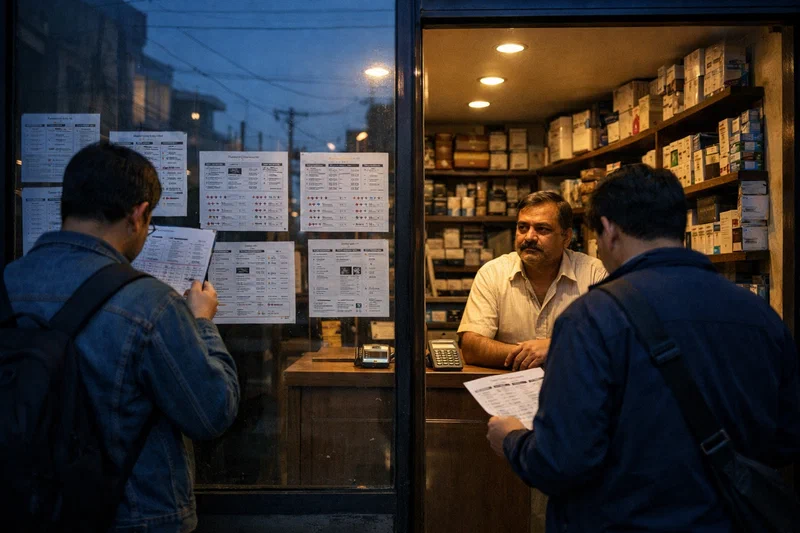
The traffic drop is real. The diagnosis is still too polite. #
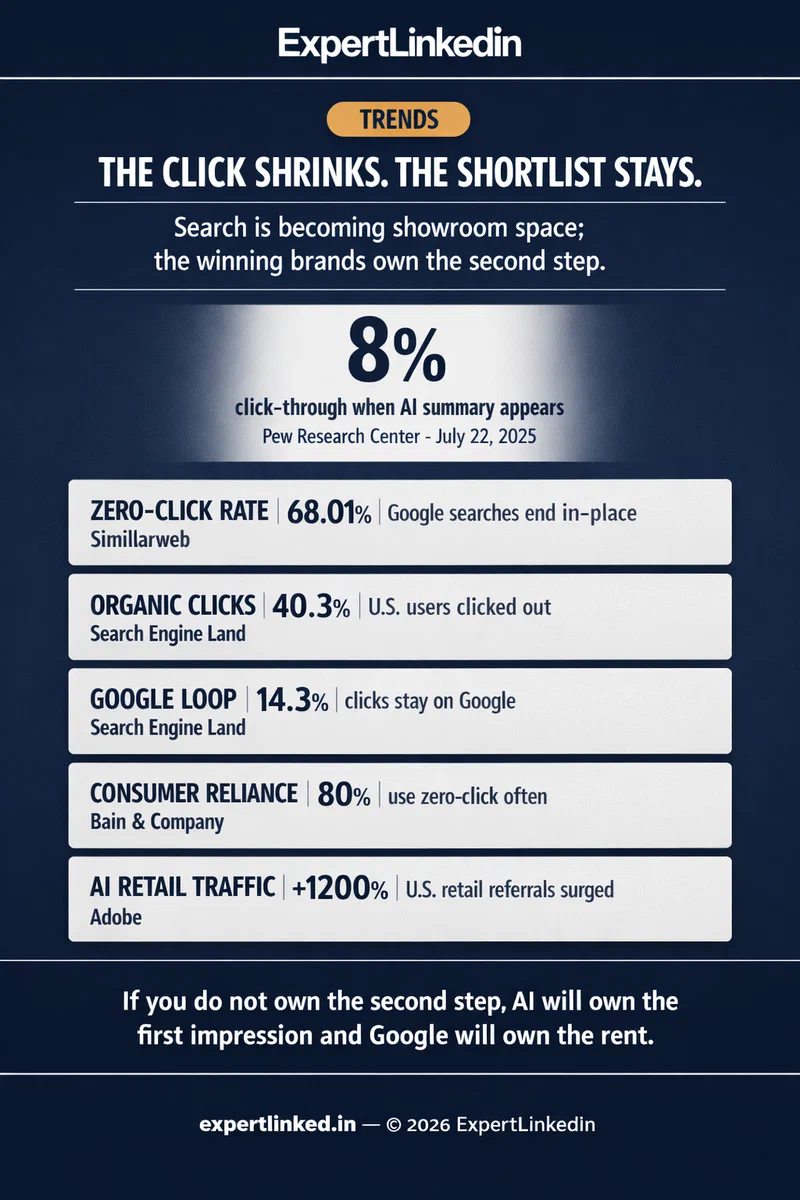
Let me be direct because soft language isn’t going to help you. Bain says about 80% of consumers now rely on zero-click results in at least 40% of their searches, which means your organic traffic is being trimmed by an estimated 15% to 25%. Search Engine Land’s Datos panel found that only 40.3% of U.S. Google searchers even clicked an organic result in March 2025—down from 44.2% just a year earlier. Meanwhile, clicks to Google’s own properties jumped to 14.3%.
Pew Research drove the nail deeper: when an AI summary appeared, users clicked a traditional result on just 8% of visits, versus 15% when no summary existed. By June 2026, Similarweb reported that 68.01% of Google searches now end without any click. That’s not a glitch. That is the new normal.
So when you call this an “SEO problem,” you are thinking too small. The results page is no longer a corridor to your shop. It is becoming the showroom itself—the comparison sheet, the price check, the review reader, and the first sales assistant, all in one place.
Google can claim victory while your dashboard shows a funeral. #
Here is the thing that confuses founders: Google is not lying when it says AI is improving search. They are just measuring a different winner.
Elizabeth Reid says AI Overviews are driving more than a 10% increase in Google usage for the queries that show them. Search Central swears those remaining clicks are “higher quality”—users stick around longer. Both statements can be true. Completely true. While your referral volume collapses.
If Google is doing more of the sorting, comparison, and filtering, yes, the shoppers who still click through may be warmer. But Google now controls the window display, the foot traffic patterns, and half the conversation that used to happen inside your store.
OpenAI’s ChatGPT search is pushing the same shift from a different angle: ask, compare, refine, decide—all inside the AI interface. Your website becomes the confirmation surface, not the discovery surface. And confirmation is cold comfort when no one is coming to confirm anything.
The real loss happens before the visit. #
Traffic loss is visible. Shortlist loss? That is invisible until it is too late.
HubSpot is right to call the search results page a “branding arena”. The entire awareness and consideration stage that used to take three or four site visits now happens directly inside AI Overviews, People Also Ask boxes, maps, review surfaces, and citations. If your brand is absent there, your analytics will never even hint at what you missed. The visit never happens, so the miss is phantom. Invisible.
For B2B businesses selling into big decisions, the picture gets brutal. Similarweb argues that desktop-heavy research can push true zero-click exposure closer to 80% than the headline 68%. That is enterprise buyers on their desks, not casual mobile searchers. Specialist brands can still outperform—Similarweb points to Bankrate, NerdWallet, Rome2Rio, and Taste of Home as over-performers. But the losing side is unforgiving: Nicolas Bouliane watched his specialist site AllAboutBerlin hemorrhage 70% of its traffic after AI Overviews rolled out. The BBC reported that DMG Media saw click-through declines of up to 89% on some search types.
But here is the part I want you to pay attention to: Reach, the publisher, is not asking Google for mercy. They are building direct newsletters and WhatsApp alerts. They are building owned channels. That is not a publisher survival strategy anymore. That is a playbook for every small business that wants to survive the next three years.
The good news: the clicks that survive are warmer. #
The AI-mediated click, when it comes, often behaves better.
Adobe found that traffic from generative AI sources to U.S. retail sites jumped 1,200% between July 2024 and February 2025. Those visitors showed 8% higher engagement, viewed 12% more pages, and bounced 23% less than visitors from non-AI channels. Similarweb’s GenAI referral data adds the same pattern: ChatGPT-referred visitors on U.S. desktop transactional sites spent 15 minutes on site versus Google’s 8, viewed 12 pages versus 9, and converted at 7% versus 5%.
That is the hidden re-pricing of search. The volume gets worse. The intent gets better. So do not demand every lost click back. Own the next action when the right click finally arrives.
What smart founders are building right now #
I have spent enough time with founders to know the script. You are either going to ignore this and hope the market corrects itself. Or you are going to lean in and rebuild your visibility architecture before your competitor does. There is no middle ground.
The playbook is not mysterious. It is just more grounded than the old SEO religion ever was.
1. Own a second step #
If the first step is increasingly rented—which it is—then the second step must be completely, unapologetically yours. Every meaningful discovery surface should funnel into something you control: an email list, a WhatsApp broadcast, a consultation request, a demo, a quote flow, a calculator, or a useful template. Not your blog. Not your homepage. Something that captures intent.
2. Publish pages AI can cite but cannot fully replace #
Generic top-of-funnel fluff is going to get shredded. But specific pages that answer a real buying question while still requiring your product, service, judgment, or tool to close the deal—those hold up. Comparison pages. Pricing explainers. Local service pages. Original data. Case studies with real numbers. Interactive tools. Checklists that save someone an hour of actual work.
HubSpot and Semrush push answer-first structure and clearer schema because it helps brands win zero-click visibility and AI Overview citations. The tactic is sound. But do not miss the strategy: your goal is not to get cited. Your goal is to be the brand someone remembers when they finally decide to move.
3. Spread proof across the places AI trusts #
AI systems do not believe you when you are alone. They believe corroboration. Your Google Business Profile, LinkedIn page, partner directories, review sites, product listings, founder interviews, trade-press mentions, Reddit threads, and niche communities now matter more than they ever have. The model may never read them in sequence. But it will absolutely notice that they rhyme.
4. Make the site executable, not just readable #
Google’s documentation is useful because it refuses to sugarcoat things. There is no magic AI markup required. Good SEO fundamentals still work: crawlability, clear text, sensible structure, current business details, and structured data that matches what users see.
But Similarweb’s insight goes deeper. The future site is not just crawlable, accessible, and readable. It is executable. If your pricing is buried in JavaScript, your booking flow is a labyrinth, or your quote form demands twelve unnecessary steps, both humans and agents will abandon you. They will not struggle. They will move on.
In June, I wrote The Death of the ‘Human API’ arguing that AI rewards businesses that turn chaos into infrastructure. This is that same argument, just translated into marketing language.
5. Change the scorecard before the numbers humiliate you #
If your weekly growth call still leads with organic sessions as the headline metric, you are already measuring the wrong thing. Track branded search growth. Track direct traffic after AI Overview appearances. Track AI citations and assisted conversions. Watch which pricing and comparison pages actually convert that AI-assisted curiosity into decisions. Reach is not sitting around hoping Google becomes generous again. They are building direct relationships. Newsletters. Alerts. Channels they own. You need to do the same, starting now.
The founder lesson is just common sense wearing expensive clothes #
In March, The Blue Link Is Dying argued that rankings were no longer the whole game. Today I would say it even plainer: the click was never the prize. The click was just the meter that measured whether someone remembered you, preferred you, and wanted to buy from you.
That measurement is breaking. The meter is spinning but the dashboard is dark.
Search is becoming showroom space, and the businesses that survive will not be the ones pleading for one more algorithmic favor. They will be the ones who built something harder to copy: a sharper brand, a faster capture layer, voices that corroborate their claims, and a site that makes it effortless for a serious buyer to move.
If you do not build and own the second step, AI and Google will own both the first impression and the rent you pay to be visible at all.
Tell me what you are seeing in your analytics, your lead flow, or your customer journey. Not the polished board slide. The real version.
Email me at raj.sharma@tlnw.uk
References #
- Bain & Company (February 19, 2025). “Goodbye Clicks, Hello AI: Zero-Click Search Redefines Marketing.” https://www.bain.com/insights/goodbye-clicks-hello-ai-zero-click-search-redefines-marketing/ (Accessed August 4, 2026)
- Adobe (March 17, 2025). “Adobe Analytics: Traffic to U.S. retail websites from Generative AI sources jumps 1,200 percent.” https://blog.adobe.com/en/publish/2025/03/17/adobe-analytics-traffic-to-us-retail-websites-from-generative-ai-sources-jumps-1200-percent (Accessed August 4, 2026)
- Search Engine Land (June 5, 2025). “Zero-click searches rise, organic clicks dip: Report.” https://searchengineland.com/zero-click-searches-up-organic-clicks-down-456660 (Accessed August 4, 2026)
- Pew Research Center (July 22, 2025). “Google users are less likely to click on links when an AI summary appears in the results.” https://www.pewresearch.org/short-reads/2025/07/22/google-users-are-less-likely-to-click-on-links-when-an-ai-summary-appears-in-the-results/ (Accessed August 4, 2026)
- BBC News (September 9, 2025). “Publishers fear AI summaries are hitting online traffic.” https://www.bbc.com/news/articles/c0mlvryx0exo (Accessed August 4, 2026)
- Search Engine Journal (September 29, 2025). “Google AI Overviews Impact On Publishers & How To Adapt Into 2026.” https://www.searchenginejournal.com/impact-of-ai-overviews-how-publishers-need-to-adapt/556843/ (Accessed August 4, 2026)
- OpenAI (October 31, 2024; updated February 5, 2025). “Introducing ChatGPT search.” https://openai.com/index/introducing-chatgpt-search/ (Accessed August 4, 2026)
- HubSpot (Updated May 5, 2026). “Zero-click searches and the future of your marketing funnel.” https://blog.hubspot.com/marketing/zero-click-searches (Accessed August 4, 2026)
- Semrush (May 13, 2026). “How to Win in a Zero-Click Search Market.” https://www.semrush.com/blog/zero-click-searches/ (Accessed August 4, 2026)
- Similarweb (June 10, 2026). “Zero-Click Marketing: The SEO Strategy For A World Where Most Searches Skip Your Site.” https://www.similarweb.com/blog/marketing/geo/zero-click-marketing/ (Accessed August 4, 2026)
- Google (May 20, 2025). “AI in Search: Going beyond information to intelligence.” https://blog.google/products/search/google-search-ai-mode-update/ (Accessed August 4, 2026)
- Google Search Central (Updated December 10, 2025). “AI features and your website.” https://developers.google.com/search/docs/appearance/ai-features (Accessed August 4, 2026)
AI Content Notice
This article was created using artificial intelligence technology. Whenever possible, we include references and sources to support the information presented. Readers are encouraged to consult these sources for further information. While we strive for accuracy and provide valuable insights, readers should independently verify information and use their own judgment when making business decisions. The content may not reflect real-time market conditions or personal circumstances.
Related Articles
Infographic: AI Search Is Eating the First Click for Small Businesses
The small-business moat in AI search is no longer raw traffic volume but the system that turns …
AI Agents Are Rewriting the Small Business Playbook: Why Tiny Teams Are Winning Big in 2026
The shift from AI experimentation to agentic AI deployment is creating unprecedented opportunities …
The Interface Recession: AI Isn’t Killing Jobs First — It’s Killing Clicks
The most immediate AI disruption is the collapse of click-heavy software interfaces, not mass …