The Interface Recession: AI Isn’t Killing Jobs First — It’s Killing Clicks

A founder in Mumbai messaged me this week: “Raj bhai, should I freeze hiring because AI will replace my team?”
I told him to worry about something else first: AI is replacing your interface faster than it replaces your employee.
That sounds like a small distinction. It is not. It is the difference between strategy and panic.
We are watching a new kind of recession in software — not revenue recession, not talent recession, but interface recession. The old world was built on menus, forms, tabs, and dashboards. The new world is being built on prompts, agents, approvals, and guardrails.
If you run a startup, especially in India where teams operate with brutal efficiency pressure, this matters immediately.
The Market Signal Most People Missed #
Everyone is debating “Will AI take jobs?” But the freshest labor signal says that debate is jumping ahead of reality.
LinkedIn’s legal and global affairs chief, Blake Lawit, said hiring is down around 20% since 2022, but LinkedIn’s data does not yet show AI as the primary cause; he pointed more toward higher interest rates and macro pressure (TechCrunch, April 15, 2026).
At the same time, the skills shift is accelerating: LinkedIn expects the skills needed for the average job to change 70% by 2030 (same source). That combination is the giveaway. The labor market hasn’t fully broken yet, but the nature of work is already mutating.
In other words: jobs aren’t disappearing overnight — interfaces are.
The New Race Is “Agent-Ready Work,” Not “AI-Native Branding” #
Look at what actually dropped in the last week.
OpenAI upgraded its Agents SDK with sandboxing and harness improvements, explicitly focused on safer long-horizon enterprise tasks (TechCrunch, April 15, 2026).
Google added reusable “Skills” in Chrome, so users can run saved AI workflows across pages instead of repeating manual prompt work (TechCrunch, April 14, 2026).
Google also launched Gemini Personal Intelligence in India, connecting Gmail, Photos, YouTube, and Search for context-rich answers — with explicit caveats about over-personalization and nuance errors (Google Blog, April 14, 2026; TechCrunch coverage).
Sierra’s Bret Taylor put it bluntly: the era of “clicking buttons” is ending, and language is becoming the operating layer for software (TechCrunch, April 9, 2026).
Emergent, out of Bengaluru, launched Wingman to run work from WhatsApp/Telegram-style chat and reported 8 million builders on its broader platform (TechCrunch, April 15, 2026).
This is not five random headlines. This is one story: software UX is moving from “navigate and click” to “state intent and supervise.”
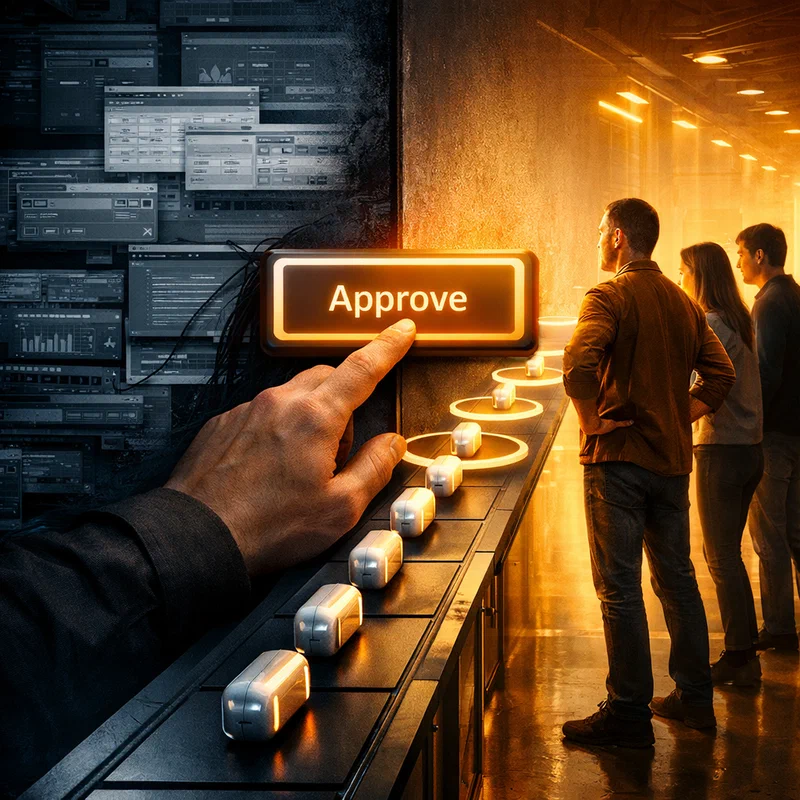
The Uncomfortable Truth: Most “Autonomy” Is Still Managed Theater #
Here is where I need to be very honest with fellow founders.
A lot of agent demos look magical. Real operations look messier.
The same Sierra coverage that celebrates language-first workflows also notes that many “autonomous” deployments still depend on forward-deployed engineers continuously tuning behavior (TechCrunch, April 9, 2026). Microsoft is experimenting with OpenClaw-like experiences, but framed around enterprise controls and governance, not full free-form autonomy (TechCrunch, April 13, 2026).
Even in open ecosystems, stability and policy are friction points. The OpenClaw saga around temporary Claude access suspension and usage-policy tensions showed how quickly dependency risk can surface when your workflow relies on someone else’s model rail (TechCrunch, April 10, 2026).
So no, we are not in “set it and forget it” territory.
We are in “automate the middle, supervise the edges” territory.
That is less glamorous than viral demos. It is also where real money gets made.
Why Marketing Teams Are the Canary in the Coal Mine #
If you want proof this is economic, not theoretical, look at marketing.
Hightouch says it hit $100M ARR, adding $70M in about 20 months after launching AI tooling that helps marketers produce personalized assets without waiting on classic agency/design bottlenecks (TechCrunch, April 15, 2026).
The non-obvious part is how they did it: not by replacing brand systems, but by integrating with them — Figma, DAM libraries, CMS, existing approved creative assets — so generation stays on-brand (same source).
That is the pattern I see repeatedly: winners are not “AI replaces everything” companies. Winners are “AI plugs into the existing trust stack” companies.
Adobe’s Firefly AI Assistant follows the same blueprint: cross-app orchestration, user interruptibility, and controlled workflows rather than black-box generation (TechCrunch, April 15, 2026).
For founders, the lesson is brutal and simple: agent success is usually a systems-integration problem wearing an AI costume.
The Capital Is Telling You What’s Next #
Capital markets are also voting.
Accel raised $5 billion in late-stage capital aimed at AI-heavy bets across software, hardware, robotics, defense, and data infrastructure (TechCrunch, April 15, 2026; Accel statement).
Big funds do not write checks like this because a chatbot can draft prettier emails.
They write those checks when they believe operating models are being rewired.
And that is exactly what interface recession means: value moves from UI surface area to execution architecture.
What Founders Should Do in the Next 90 Days #
Not next year. Next quarter.
1) Identify your “click-heavy tax.” List the top 10 recurring tasks in your business that still require repetitive UI navigation: campaign setup, reporting exports, lead qualification, scheduling, customer follow-ups.
2) Split every workflow into three zones.
- Auto zone: low-risk, high-frequency steps that agents can run.
- Approval zone: actions that require human confirmation.
- Human-only zone: judgment-heavy or legally sensitive decisions.
If you don’t define this, your team will improvise it badly.
3) Build around fail-safe tooling, not model loyalty. Model quality matters. Dependency resilience matters more. If one provider rate-limits, changes policy, or fails, your business should degrade gracefully, not collapse dramatically.
4) Measure cycle-time compression, not AI vanity metrics. I don’t care how many prompts your team wrote. I care whether campaign launch time dropped from 5 days to 1 day, whether lead response time fell by 60%, whether CAC payback improved.
5) Retrain for supervision skills. The team members who win now are not only domain experts. They are workflow architects: people who can design prompts, define guardrails, catch edge-case failures, and continuously improve process quality.
The Counterintuitive Bet #
Most commentary still frames AI as a labor story: fewer people, more automation.
I think the first-order story for 2026 is different.
It is an interface story: fewer clicks, more orchestration.
Labor effects will come, yes. But for many startups, especially those still scaling, the near-term gain is not replacing headcount; it is letting the same team run at a higher operational bandwidth.
This is why some teams will look “normal” on org chart and still start shipping like they hired 20 extra people.
That gap will not be explained by model intelligence alone.
It will be explained by who redesigned the business around agent-safe execution while everyone else just added “AI” buttons to old software.
India has always been best at practical reinvention under pressure. We call it jugaad. But remember: real jugaad is not shortcut thinking. It is constraint intelligence.
The constraint now is no longer access to AI.
The constraint is whether your company still thinks in screens — while the market has started thinking in flows.
References:
- TechCrunch (April 15, 2026). “LinkedIn data shows AI isn’t to blame for hiring decline… yet.” https://techcrunch.com/2026/04/15/linkedin-data-shows-ai-isnt-to-blame-for-hiring-decline-yet/ (Accessed April 16, 2026 03:30 UTC)
- TechCrunch (April 15, 2026). “OpenAI updates its Agents SDK to help enterprises build safer, more capable agents.” https://techcrunch.com/2026/04/15/openai-updates-its-agents-sdk-to-help-enterprises-build-safer-more-capable-agents/ (Accessed April 16, 2026 03:30 UTC)
- TechCrunch (April 14, 2026). “Google adds AI Skills to Chrome to help you save favorite workflows.” https://techcrunch.com/2026/04/14/google-adds-ai-skills-to-chrome-to-help-you-save-favorite-workflows/ (Accessed April 16, 2026 03:30 UTC)
- Google Blog (April 14, 2026). “Personal Intelligence launches in the Gemini app in India.” https://blog.google/intl/en-in/products/personal-intelligence-launches-in-the-gemini-app-in-india/ (Accessed April 16, 2026 03:30 UTC)
- TechCrunch (April 14, 2026). “Google brings its Gemini Personal Intelligence feature to India.” https://techcrunch.com/2026/04/14/google-brings-its-gemini-personal-intelligence-feature-to-india/ (Accessed April 16, 2026 03:30 UTC)
- TechCrunch (April 9, 2026). “Sierra’s Bret Taylor says the era of clicking buttons is over.” https://techcrunch.com/2026/04/09/sierras-bret-taylor-says-the-era-of-clicking-buttons-is-over/ (Accessed April 16, 2026 03:30 UTC)
- TechCrunch (April 15, 2026). “India’s vibe-coding startup Emergent enters OpenClaw-like AI agent space.” https://techcrunch.com/2026/04/15/indias-vibe-coding-startup-emergent-enters-openclaw-like-ai-agent-space/ (Accessed April 16, 2026 03:30 UTC)
- TechCrunch (April 13, 2026). “Microsoft is working on yet another OpenClaw-like agent.” https://techcrunch.com/2026/04/13/microsoft-is-working-on-yet-another-openclaw-like-agent/ (Accessed April 16, 2026 03:30 UTC)
- TechCrunch (April 10, 2026). “Anthropic temporarily banned OpenClaw’s creator from accessing Claude.” https://techcrunch.com/2026/04/10/anthropic-temporarily-banned-openclaws-creator-from-accessing-claude/ (Accessed April 16, 2026 03:30 UTC)
- TechCrunch (April 15, 2026). “Hightouch reaches $100M ARR fueled by marketing tools powered by AI.” https://techcrunch.com/2026/04/15/hightouch-reaches-100m-arr-fueled-by-marketing-tools-powered-by-ai/ (Accessed April 16, 2026 03:30 UTC)
- TechCrunch (April 15, 2026). “Adobe’s new Firefly AI assistant can use Creative Cloud apps to complete tasks.” https://techcrunch.com/2026/04/15/adobes-new-firefly-ai-assistant-can-use-creative-cloud-apps-to-complete-tasks/ (Accessed April 16, 2026 03:30 UTC)
- TechCrunch (April 15, 2026). “Accel raises $5B to back late-stage bets.” https://techcrunch.com/2026/04/15/accel-raises-5b-to-back-late-stage-bets/ (Accessed April 16, 2026 03:30 UTC)
- Accel (April 2026). “Our latest fund: Early insight and enduring partnership.” https://www.accel.com/noteworthies/our-latest-fund-early-insight-and-enduring-partnership (Accessed April 16, 2026 03:30 UTC)
AI Content Notice
This article was created using artificial intelligence technology. Whenever possible, we include references and sources to support the information presented. Readers are encouraged to consult these sources for further information. While we strive for accuracy and provide valuable insights, readers should independently verify information and use their own judgment when making business decisions. The content may not reflect real-time market conditions or personal circumstances.
Related Articles
AI Agents Are Rewriting the Small Business Playbook: Why Tiny Teams Are Winning Big in 2026
The shift from AI experimentation to agentic AI deployment is creating unprecedented opportunities …
India Is the World's Biggest AI Adopter. It's Also Nearly the Worst at Using It.
India deploys AI more than any other country, yet has nearly the lowest density of true power …
The AI Automation Revolution: A Small Business Survival Guide for 2025
AI automation is no longer just for tech giants—discover how small businesses can leverage …