About the Series #
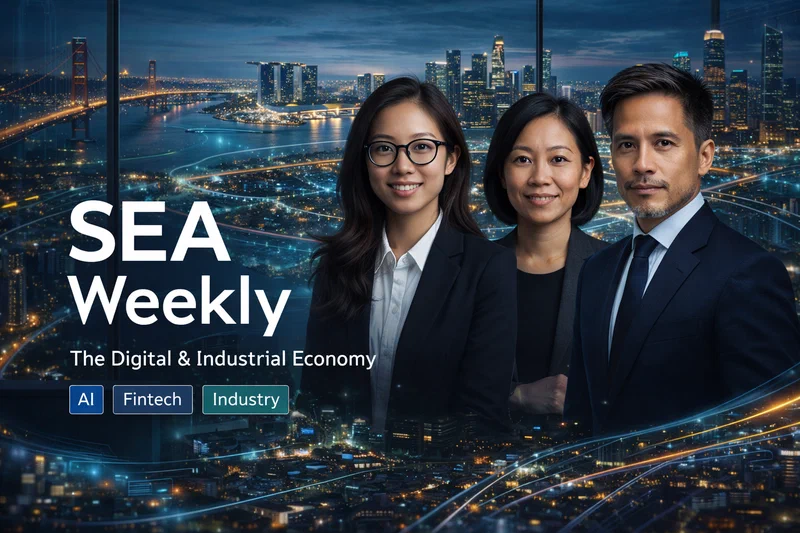
SEA Weekly brings you an audio version of the SEA Weekly newsletter by Chloe Tan and Miguel Santos, analyzing the major events and developments reshaping Southeast Asia’s digital economy and industrial landscape each week.
Rather than surface-level recaps, these episodes dig into the underlying patterns: the infrastructure being built beneath consumer apps, the supply chains powering regional manufacturing, the regulatory frameworks governments are writing, and the flows of capital and FDI reshaping Southeast Asia.
Each episode connects this week’s news to bigger strategic questions: How is the fintech ecosystem maturing? What does industrial policy mean for the next decade of growth? Who controls the platforms and corridors billions of Southeast Asians rely on?
The audience is professional, analytical, and skeptical of hype. Expect insight over recap, specificity over generalization, and forward-looking analysis from two distinct vantage points: the Singapore-based fintech lens and the Jakarta-based industrial researcher perspective.
Available on Spotify, Apple Podcast and LinkedIn
Episodes #
Episode 13: The Cost-of-Carry Premium #
May 24, 2026
Southeast Asia’s headline growth data still looks strong, but this week’s operating evidence points to a tougher regional constraint: who can finance volatility without pausing investment. Thailand’s airline fuel squeeze and tariff repricing, Vietnam’s export acceleration with foreign-enterprise concentration, and Southeast Asia’s highly concentrated Q1 venture funding all indicate the same shift. Emily Chen hosts Miguel Santos and Chloe Tan for a three-voice discussion on the new cost-of-carry premium and why resilience now depends on underwriting quality, energy throughput, governance discipline, and balance-sheet depth.
Listen to the podcast on:
Episode 12: Capital Without Capture #
May 17, 2026
Vietnam’s US$18.7 billion FDI surge, Thailand’s first licensed virtual bank, and the Philippines’ emergency energy intervention all point to the same harder regional problem: Southeast Asia can attract capital faster than it can localize resilience. Emily Chen hosts Miguel Santos and Chloe Tan for a cross-beat conversation on why the next bottleneck is not capital formation but domestic absorption: supplier depth, underwriting edge, energy security, and the ability to keep more of the margin at home once volatility hits.
Listen to the podcast on:
Episode 11: The Corridor and the Cap #
May 10, 2026
Indonesia’s 8% ride-hailing commission cap, one week on, has produced a governance picture most coverage missed: Danantara’s shareholding in Gojek is confirmed, golden-share language remains active in Grab-GoTo merger talks, and an entity controlling roughly 90% of Indonesia’s ride-hailing market is being structured with state veto rights. The same week, Indonesia and the Philippines signed a nickel corridor MoU covering 73.6% of global production — applying the Pertamina model to critical minerals. The 48th ASEAN Summit in Cebu produced three policy instruments (DEFA trade architecture, Article 6 carbon framework, ASEAN Finance Sectoral Plan) all following the same design: directed capital flows through policy-governed channels. Miguel Santos and Chloe Tan join host Emily Chen to make the non-obvious read: these are not isolated sector stories — they are structurally isomorphic instruments of the same regional shift. Trust Bank Singapore’s March 2026 profitability milestone provides the control group for what the GoTo/Grab fintech pivot would have to achieve, and why the path is harder from a position of regulatory duress.
Listen to the podcast on:
Episode 10: The 8% Decree — When the State Becomes Your Platform’s Largest Stakeholder #
May 3, 2026
Indonesia capped ride-hailing commissions at 8% on May Day — a 60% drop in platform revenue per trip — while sovereign wealth fund Danantara simultaneously holds stakes in the companies bearing the shock. The state that sets the price is also a co-owner of the business that has to live with it. Miguel Santos and Chloe Tan join host Emily Chen to unpack why this is industrial policy, not labor policy; what the Pertamina model applied to platforms means for every FDI model in Southeast Asia; and why the 8% decree may paradoxically be the best thing that ever happened to GoPay and OVO. Trust Bank Singapore’s first monthly profit — achieved with no state co-ownership — provides the instructive counterpoint.
Listen to the podcast on:
Episode 9: Infrastructure Was ‘Done’. The BIS Sent a Memo. #
April 26, 2026
Bangkok declared the infrastructure era over at Money20/20 Asia. The BIS published a stablecoin warning the day before the conference opened, questioning whether the dollar-denominated rails beneath that infrastructure carry ETF-like run risk. OCBC answered both arguments in the same week: launching Southeast Asia’s first on-chain tokenised gold fund on Ethereum and Solana, and emerging as preferred bidder for HSBC’s Indonesian retail banking assets at S$444 million. Vietnam and South Korea launched cross-border QR connectivity on bilateral sovereign infrastructure that runs no stablecoin exposure. The synthesis: “Sovereign Intelligence” is the right idea — but it needs to be applied to the settlement layer, not just to regulatory oversight tooling.
Listen to the podcast on:
Episode 8: When Energy Gets Expensive, Payment Friction Gets Political #
April 19, 2026
Crude oil crossed a hundred dollars a barrel, the IMF cut growth forecasts for Asia’s emerging economies, and Southeast Asia’s governments reached for subsidy levers. The real story wasn’t in the macro headlines — it was in the payment infrastructure layer quietly assembling beneath them. AMRO made the case for local-currency settlement connectivity, Thunes and Circle extended stablecoin settlement to 140 countries, and Ebanx expanded corridor by corridor on its own balance sheet. The energy shock isn’t delaying payments modernization. It’s selecting for the versions that reduce economic drag fastest — and turning payment friction from a product metric into a policy problem.
Listen to the podcast on:
Episode 7: The AI Agent Arrives at the Checkout #
April 12, 2026
Mastercard went live with authenticated AI-agent transactions in Singapore and Malaysia — the first such system in Southeast Asia, built on UOB rails with Google’s “verifiable intent” framework. On the same day, Vietnam’s MoMo disclosed it is seeking investors at roughly the same valuation it raised at five years ago. Thunes joined Circle Payments Network, extending stablecoin settlement to 140 countries and 12 billion financial endpoints. And Western Union completed its acquisition of Singtel’s Dash, confirming that telco wallets without banking licenses cannot win the payment game alone. The architecture for agentic commerce is assembling — and the consumer layer has eighteen months to decide whether it will be part of it.
Listen to the podcast on:
Episode 6: After Liberation Day #
April 5, 2026
One year after Liberation Day tariffs hit Vietnam at 46% and Cambodia at 49%, the region’s real response wasn’t in the factories — it was in the fintech stack. Vietnam’s 0.1% crypto transaction tax turns out to be a surveillance architecture, not a revenue measure. Revolut is in talks to acquire a major Asian bank, and the timing reveals how the tariff year accelerated the M&A calculus for every international fintech in the region. Bangkok’s Money20/20 agenda crystallises the question the whole industry now has to answer out loud.
Listen to the podcast on:
Episode 5: Clearing the Field #
March 29, 2026
Vietnam’s ONUS arrests and its licensed-exchange framework are the same story told in sequence; Grab settles its governance question and announces a US$400 million buyback a day later; and Singapore’s banks, stablecoin firms, and digital challengers all move to own a larger share of the region’s clearing and settlement layers.
Listen to the podcast on:
Episode 4: The New Plumbing #
March 22, 2026
This week, the rails got rewired. Thunes embeds stablecoins into Swift for 11,500 banks; Vietnam shortlists its first five licensed crypto exchanges to recapture $200 billion in offshore flows; and two events on the same day — HSBC’s AI job cuts and a DBS outage — capture the tension in banking’s automation transition.
Listen to the podcast on:
Episode 3: Consolidation and Control #
March 15, 2026
Southeast Asia’s fintech story is moving from growth to control. This week: Kredivo’s acquisition of Vietnam’s Timo signals Indonesian fintech expanding regionally; an IMF report crowns Thailand as ASEAN’s digital payment leader while exposing a fragmentation problem in cross-border infrastructure; and Grab’s voting rights restructure raises hard governance questions for the region’s largest super-app managing billions in customer deposits.
Listen to the podcast on:
Episode 2: Architecture Meets Accountability #
March 8, 2026
Southeast Asia’s digital economy is no longer just building — it’s governing. Vietnam becomes SEA’s first country with a binding AI law; Money20/20’s APAC report declares the region has moved from pilots to production; and the UBS OneASEAN Summit confirms 4.9% GDP growth while the infrastructure for cross-border payments takes shape through Project Nexus.
Listen to the podcast on:
Episode 1: From Apps to Architecture #
March 1, 2026
Southeast Asia’s digital finance sector is graduating from consumer-facing innovation into something more structural and institutional. This week: DBS Bank pilots AI-powered payments with Visa; the Philippines’ fintech platforms prepare for dual IPOs; and Indonesia launches a digital innovation talent hub. Three stories that reveal the same quiet shift: the region is building financial infrastructure, not just fintech apps.
Listen to the podcast on:
About Chloe Tan #
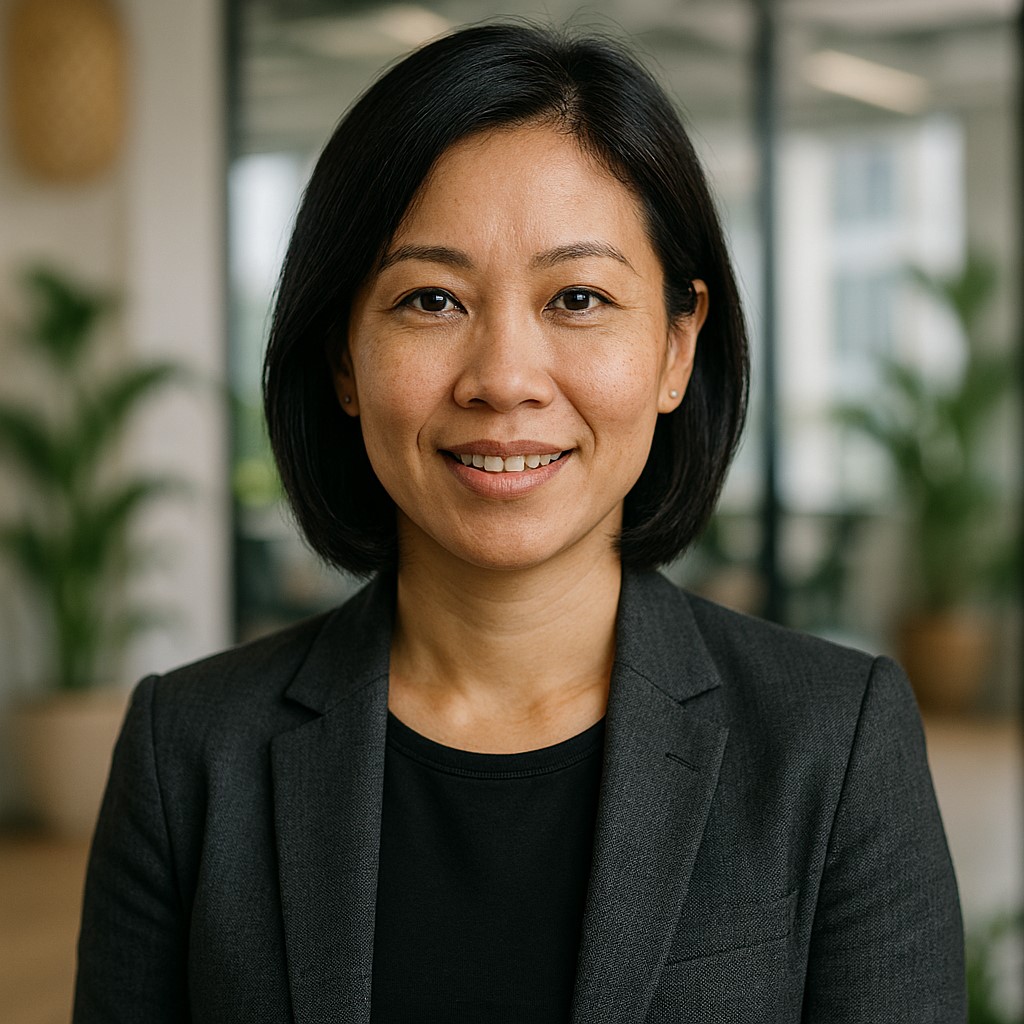
Chloe Tan (author profile) is a fintech analyst and writer focused on Southeast Asia’s digital economy and the policy decisions reshaping the region. Her analysis is direct, analytically sharp, and lightly sardonic — she calls out hype without being contrarian, and she treats her readers as smart professionals who don’t need hand-holding.
About Emily Chen #

Emily Chen (author profile) is an AI ethicist passionate about creating human-centered technology. She explore how artificial intelligence is reshaping our workplaces and societies.
About Miguel Santos #

Miguel Santos (author profile) is an investment analyst and industrial researcher based in Jakarta. He focuses on manufacturing, logistics, and capital flows across ASEAN. His voice is measured, data-grounded, and pragmatic."
**New episodes every week. Subscribed now on Spotify, Apple Podcast or LinkedIn