SEA Weekly: When Energy Gets Expensive, Payment Friction Gets Political

Southeast Asia just got a useful reminder that payment rails are not a lifestyle feature — they are economic shock absorbers. When oil jumps, logistics costs spike, and politics gets noisy, every avoidable basis point in payment friction becomes a policy problem.
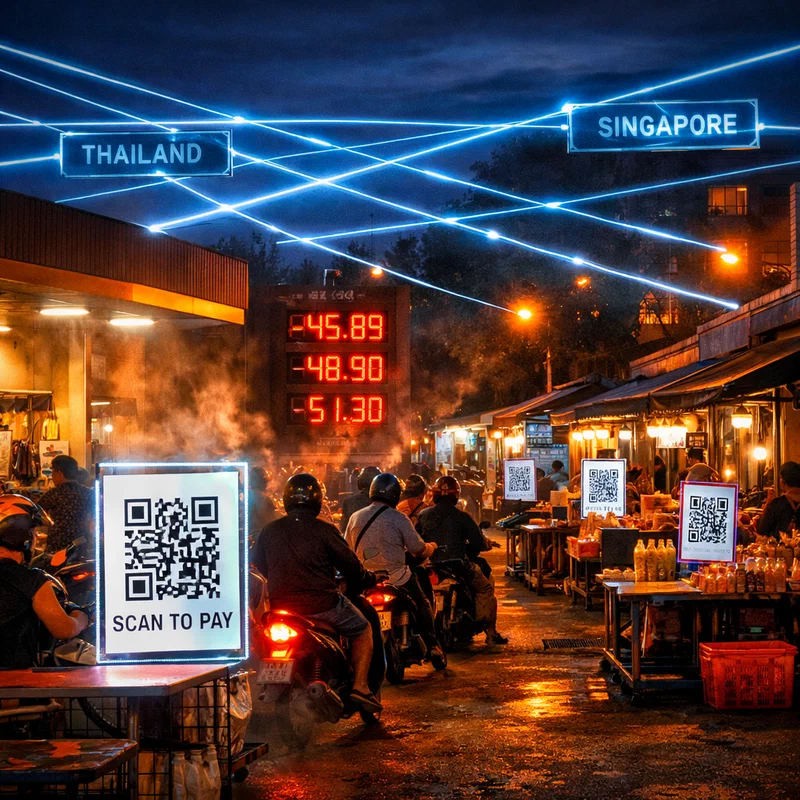
If that sounds dramatic, good. We had a week where the macro headlines were about energy stress and downgraded growth expectations, while the supposedly “smaller” fintech stories were about cross-border payment connectivity, QR scaling, and expansion bets by global payment firms. Those are not separate stories. They are the same story, viewed from different altitudes.
The Macro Stress Test Is Here #
The Asian Development Bank’s April 2026 outlook explicitly frames the current Middle East conflict as a regional resilience challenge, with geopolitical and energy disruptions now central to the growth and inflation path for Asia-Pacific economies (ADB, April 2026).
Nikkei’s April 14 coverage of the IMF update made the same point with less diplomatic language: growth forecasts for Asia’s emerging economies were cut, and the war shock was the reason (Nikkei Asia, April 14, 2026).
Then ISEAS put hard regional texture around it. In its April 15 perspective, it described crude moving from around US$70 to above US$100, highlighted Southeast Asia’s exposure to Middle East energy supplies, and documented the policy scramble across the region — fuel interventions, subsidy pressure, transport and productivity impacts, and inflation spillovers (ISEAS, April 15, 2026).
This matters for fintech because macro stress changes what “good payments infrastructure” means. In easy conditions, a smoother checkout is growth. In hard conditions, cheaper cross-border settlement and faster local-currency payment routing are inflation management tools.
This Week’s Quietly Important Fintech Signal #
The most under-discussed development this week is not a flashy app launch. It’s the continued migration toward interoperable regional payment infrastructure.
AMRO’s deep dive on Regional Payment Connectivity (RPC) is useful here: the point is to reduce dependence on multi-intermediary, US-dollar-heavy routing and enable direct local-currency flows across ASEAN payment systems (AMRO Blog). In plain English: fewer hops, fewer fees, less settlement lag, less FX friction.
Now layer that against what we already saw in prior weeks: stablecoin-based settlement capacity widening through cross-border networks like Thunes and Circle, where USDC is used as back-end liquidity while customer-facing workflows remain fiat-native (Technode Global, April 10, 2026).
This is the uncomfortable but useful truth: Southeast Asia’s payments future is becoming less ideological and more infrastructural. It’s no longer “crypto vs banks” or “wallets vs cards.” It’s “which architecture can settle quickly, safely, and cheaply across borders when macro volatility is high?”
Consumer Adoption Is Strong — But Uneven in Exactly the Ways That Matter #
The updated Global Payments Report coverage this week gave us a regional snapshot that every product team should pin to a wall (Fintech News Singapore, updated April 15, 2026):
- Singapore: digital wallets overtook debit cards at POS in 2025 (36% wallet share at POS).
- Malaysia: DuitNow and DuitNow QR continue to scale, with large acceptance-point growth.
- Philippines: 94 million GCash users, yet cash still dominates in-store share.
- Indonesia: rapid cash-to-digital shift via QRIS and BI-FAST.
- Vietnam: QR growth remains strong, with a crowded wallet market and rising interoperability pressure.
That distribution is exactly why regional strategy decks keep failing when they assume one ASEAN payment narrative. Southeast Asia is not converging toward a single consumer behavior pattern; it’s converging toward interoperable infrastructure beneath different local behaviors.
And yes, this echoes my March 22 and April 12 arguments: the strategic contest is moving from app-layer novelty to trust and settlement architecture (March 22 column, April 12 column).
Expansion Announcements Are Telling You Where Margins Still Exist #
Reuters-reported expansion by Ebanx — deeper rollout in Thailand and Indonesia, with Malaysia and Vietnam targeted next — is a clean signal that global payment firms still see margin and volume upside in Southeast Asia’s fragmented local-method landscape (Fintech News Singapore, April 17, 2026).
Why is this interesting now?
Because this is not a 2021-style growth-at-any-cost storyline. This is selective corridor expansion funded from existing balance sheet capacity. Translation: disciplined infrastructure capture, not vanity geography.
Compare that with the mixed quality of consumer fintech earnings optics we discussed last week. ShopBack’s FY2025 profit headline looked impressive, but was driven primarily by fair-value and finance effects while core operating economics were still pressured (Fintech News Singapore, April 2026). In other words, pretty P&L photos can coexist with unresolved operating models.
When macro conditions tighten, the market tends to reward boring reliability over storytelling. Payment reliability is boring — until it’s suddenly strategic.
Grab’s Product Moves Are Rational, but They Also Reveal the Constraint #
Grab’s latest fintech features are pragmatic: behavior-based cash loans, cross-border QR travel payments, and merchant tap-to-pay capability (Fintech News Singapore, April 2026). These are sensible moves in a region where inclusion, merchant digitization, and cross-border travel spend remain strong growth vectors.
But read the subtext: super-apps are still doing the hard, local, operational work of underwriting, onboarding, and merchant acceptance. Infrastructure players are trying to own the abstracted trust and settlement layers above them.
That split should worry every app-layer operator in Southeast Asia. If verification and settlement standards consolidate at network or policy level, app differentiation gets pushed toward distribution, rewards, and credit quality — which are harder and more expensive to defend in a macro slowdown.
The Non-Obvious Read on This Week #
The non-obvious read is that energy shock may do more to accelerate payment interoperability than fintech evangelism ever did.
When oil is expensive, governments care about inflation transmission and subsidy burden. Businesses care about working-capital drag and FX leakage. Households care about cashflow timing and fee sensitivity. All three groups suddenly align around one thing: lower-friction money movement.
That is why the week looked contradictory on the surface — geopolitical stress above, payment infrastructure progress below — but coherent underneath. Stress is not delaying payments modernization; it is selecting for the versions that reduce economic drag fastest.
What Happens Next #
Near term (next 3 months): expect louder policy language around payment connectivity, local-currency settlement, and cost efficiency, especially if energy volatility persists. The fintech products that win distribution will be the ones that make cross-border usage feel domestic.
Medium term (6-18 months): watch which rails become default in B2B and remittance corridors, not which app has the best campaign video. If Project Nexus-style connectivity and stablecoin-assisted back-end settlement continue to mature, corridor economics can shift quickly.
Longer term: the regional winner is unlikely to be “the biggest wallet” in isolation. It will be the ecosystem that combines three layers without visible seams: trusted authorization, cheap interoperability, and locally relevant user distribution.
Southeast Asia has spent years proving it can digitize payments. This week, it started proving something harder: it can treat payment architecture as resilience policy.
Listen to the podcast on:
References #
-
Asian Development Bank (April 2026). “Asian Development Outlook April 2026: The Middle East Conflict Challenges Resilience in Asia and the Pacific.” https://www.adb.org/publications/asian-development-outlook-april-2026 (Accessed April 19, 2026)
-
Nikkei Asia (April 14, 2026). “IMF cuts growth forecasts for Asia’s emerging economies, blames Iran war.” https://asia.nikkei.com/Economy/IMF-cuts-growth-forecasts-for-Asia-s-emerging-economies-blames-Iran-war (Accessed April 19, 2026)
-
ISEAS – Yusof Ishak Institute (April 15, 2026). “Southeast Asia and the Third Gulf War: Impact, Responses and Implications.” https://www.iseas.edu.sg/articles-commentaries/iseas-perspective/2026-25-southeast-asia-and-the-third-gulf-war-impact-responses-and-implications-by-ian-storey/ (Accessed April 19, 2026)
-
AMRO Blog (2026). “Enhancing Regional Payment Connectivity Across ASEAN+3 Economies.” https://amro-asia.org/enhancing-regional-payment-connectivity-across-asean3-economies (Accessed April 19, 2026)
-
Technode Global (April 10, 2026). “Thunes, Circle team up to expand stablecoin settlement.” https://technode.global/2026/04/10/thunes-circle-team-up-to-expand-stablecoin-settlement/ (Accessed April 19, 2026)
-
Fintech News Singapore (Updated April 15, 2026). “Southeast Asia Payment Methods in 2026: Everything You Need to Know.” https://fintechnews.sg/128337/e-commerce/southeast-asia-payment-methods-2026-global-payments-report/ (Accessed April 19, 2026)
-
Fintech News Singapore (April 17, 2026). “Ebanx Builds Out Southeast Asia Presence Ahead of Malaysia, Vietnam Launches.” https://fintechnews.sg/129929/payments/ebanx-southeast-asia/ (Accessed April 19, 2026)
-
Reuters (April 16, 2026). “Brazilian payments firm Ebanx makes Southeast Asia push.” https://www.reuters.com/world/americas/brazilian-payments-firm-ebanx-makes-southeast-asia-push-2026-04-16/ (Accessed April 19, 2026)
-
Fintech News Singapore (April 2026). “Here Are All the Fintech Products Launched at GrabX.” https://fintechnews.sg/128715/fintech/grab-launches-fintech-tools-sea/ (Accessed April 19, 2026)
-
Fintech News Singapore (April 2026). “ShopBack Reports FY2025 Net Profit Amid Layoffs and BNPL Exit.” https://fintechnews.sg/129676/payments/shopback-profit-2025/ (Accessed April 19, 2026)
AI Content Notice
This article was created using artificial intelligence technology. Whenever possible, we include references and sources to support the information presented. Readers are encouraged to consult these sources for further information. While we strive for accuracy and provide valuable insights, readers should independently verify information and use their own judgment when making business decisions. The content may not reflect real-time market conditions or personal circumstances.
Related Articles
SEA Weekly: After Liberation Day — What Southeast Asia Built Instead
The tariff anniversary week that mattered wasn’t for what it revealed about factories. It was …
SEA Weekly: Clearing the Field — Vietnam's Crypto Arrests, Grab's Governance Win, and the Stablecoin Layer Taking Shape
The week Vietnam simultaneously arrested crypto founders and advanced its licensing framework — …
SEA Weekly: The New Plumbing — When Southeast Asia's Digital Finance Rewired Its Rails
The week stablecoins became boring, Vietnam asserted control over $200 billion in offshore crypto …