SEA Weekly: The Cost-of-Carry Premium

If you still think Southeast Asia’s problem is attracting growth, you are reading last year’s map. This week’s evidence says the harder problem is paying to carry volatility while still expanding.
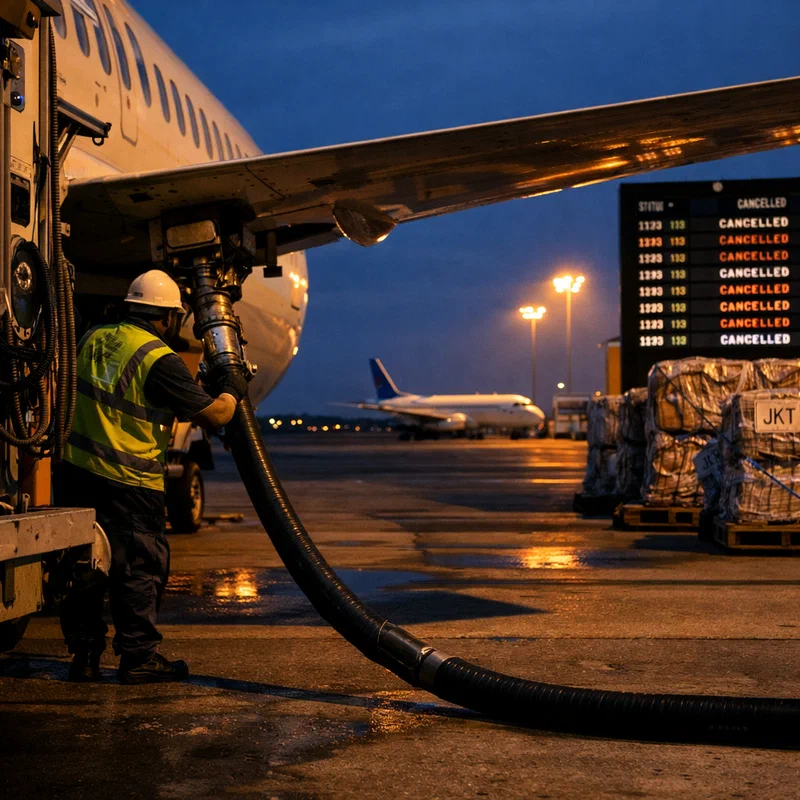
Thailand’s airlines are the cleanest operating example. Bangkok Post reported that jet fuel jumped from 30–35% of operating costs to 60% in May. Bangkok Airways cut or downsized routes; Thai AirAsia lifted fares and fuel assumptions, yet still could not fully offset the shock. This is what a margin squeeze looks like when demand is present but input pricing moves faster than your ability to reprice passengers.
Now put that next to Thailand’s export story from the same week. Exim Bank raised its export growth forecast to 7% after Q1 shipments surged 17%, but the bank also warned of a “triple-high” stack of costs, compliance burdens, and competition. In other words: top-line momentum can coexist with deteriorating carry economics.
The state is already adapting to this reality at the household level. Thailand’s energy regulator is redesigning tariffs to shield low-usage homes while pushing higher users to absorb more cost, after subsidy-era debt accumulated to roughly 40 billion baht. The policy implication is straightforward: volatility financing is moving from private ledgers to public tariff design, and governments are choosing where the pain lands.
Vietnam’s Export Strength, Still With a Capture Gap #
Vietnam delivered another strong trade print. VIR cited FiinGroup data showing Q1 exports up 19.1% year-on-year to US$122.9 billion, with electronics and machinery making up roughly half the total. That is industrial momentum by any standard.
But the composition matters more than the headline. The same report says foreign-invested enterprises account for 74.4% of export value. This does not invalidate the growth story; it clarifies its dependency structure. Vietnam is scaling inside global value chains, but still with a high foreign-enterprise concentration in trade capture.
That warning is echoed by the World Bank’s May update via VIR: growth remains strong, but medium-term resilience depends on retaining more value domestically, deepening linkages between FDI firms and local suppliers, and raising productivity. The uncomfortable truth is that export acceleration and domestic capture can diverge for long periods — until financing conditions tighten.
Energy policy is where Vietnam appears to be trying to close that gap faster. Petrovietnam’s MoU with Vitol Asia spans crude, products, LNG, infrastructure, and decarbonisation projects. In parallel, VIR’s power-sector reporting highlights reforms under PDP VIII, with renewables targeted at 40–47% of the power mix by 2030 and LNG positioned as transition baseload. Read together, this is less about “green narrative” branding and more about securing the energy throughput required by export manufacturing and data-centre demand.
Capital Is Not Gone. It Is Concentrated. #
The week’s venture data should end the lazy “recovery has arrived” narrative. DealStreetAsia’s Q1 2026 review shows Southeast Asia raised US$2.81 billion, but deal count fell to 98 — the lowest quarterly level in at least eight years. More than 70% of that capital came from a single US$2 billion DayOne round, while Indonesia logged just five deals.
That distribution matters more than the aggregate. Capital is available, but mostly for outliers with scale, governance confidence, or strategic infrastructure characteristics. Everyone else is now competing for thinner pools while paying higher volatility insurance in the form of dilution, covenant pressure, and stricter diligence.
And governance risk has moved from “soft concern” to hard repricing factor. DealStreetAsia reports prosecutors are seeking 9–12 year sentences in the TaniHub-linked corruption case involving former startup and venture executives. Whether or not courts accept all prosecutorial arguments, the signaling effect is immediate: legal-process risk is now a balance-sheet input for founders and investors, not a footnote.
Chloe’s take: #
Retail participation is still expanding — Pluang’s US$10 million raise and local-equities launch is a good example, with reported growth to 18 million local equity investors and 19 million crypto investors in Indonesia. But this is exactly where teams can misread the market. User growth is not the moat anymore; durable risk pricing is. If funding is narrower and governance tolerance is lower, then platforms win by underwriting volatility better than competitors, not by adding another “all-in-one finance” tab. The next two years in ASEAN fintech will reward boring disciplines — treasury, credit controls, fraud management, compliance stamina — far more than narrative velocity.
The Non-Obvious Read #
The region’s bottleneck has shifted. Southeast Asia is not short of demand, and it is not short of policy ambition. It is increasingly short of cheap balance-sheet capacity to absorb synchronized shocks across fuel, logistics, compliance, and capital markets.
This extends the line we laid out in The 8% Decree, The Corridor and the Cap, and Capital Without Capture: policy is increasingly deciding where value sits. This week adds the financing dimension. Even when growth prints look strong, the institutions that can fund volatility through the cycle will take disproportionate share.
Near term, watch three indicators. First, whether Thai carriers can stabilize route economics if fuel remains elevated. Second, whether Vietnam can convert export acceleration into deeper domestic supplier capture while scaling power capacity fast enough. Third, whether venture capital in Indonesia broadens beyond a handful of defensible names despite higher governance scrutiny.
Longer term, the winners in ASEAN will not be the loudest growth stories. They will be the entities — state, corporate, or hybrid — that can carry stress without suspending investment.
References #
- Bangkok Post (May 23, 2026). “Thai airlines grapple with jet fuel surge.” https://www.bangkokpost.com/business/general/3259634/thai-airlines-grapple-with-jet-fuel-surge (Accessed May 24, 2026)
- Bangkok Post (May 22, 2026). “Exim Bank raises export growth projection to 7%.” https://www.bangkokpost.com/business/general/3259008/exim-bank-raises-export-growth-projection-to-7 (Accessed May 24, 2026)
- Bangkok Post (May 23, 2026). “Higher electricity prices to hit large Thai families.” https://www.bangkokpost.com/business/general/3259429/higher-electricity-prices-to-hit-large-thai-families (Accessed May 24, 2026)
- Vietnam Investment Review (May 22, 2026). “Electronics and machinery drive Vietnam’s export growth in Q1.” https://vir.com.vn/electronics-and-machinery-drive-vietnams-export-growth-in-q1-153243.html (Accessed May 24, 2026)
- Vietnam Investment Review (May 22, 2026). “Petrovietnam signs MoU with Vitol Asia to boost energy cooperation.” https://vir.com.vn/petrovietnam-signs-mou-with-vitol-asia-to-boost-energy-cooperation-153234.html (Accessed May 24, 2026)
- Vietnam Investment Review (May 19, 2026). “Vietnam’s power sector poised to trigger a new investment cycle.” https://vir.com.vn/vietnams-power-sector-poised-to-trigger-a-new-investment-cycle-152964.html (Accessed May 24, 2026)
- Vietnam Investment Review (May 15, 2026). “World Bank projects Vietnam’s growth to moderate to 6.8 per cent in 2026.” https://vir.com.vn/world-bank-projects-vietnams-growth-to-moderate-to-68-per-cent-in-2026-152762.html (Accessed May 24, 2026)
- DealStreetAsia (May 2026). “Southeast Asia startup funding stays thin in Q1 2026 even as agentic and GenAI gain traction.” https://www.dealstreetasia.com/stories/southeast-asia-deal-review-q1-2026-summary-481038 (Accessed May 24, 2026)
- DealStreetAsia (May 2026). “Indonesia’s Pluang raises $10m, launches local equities trading.” https://www.dealstreetasia.com/stories/pluang-local-equities-trading-482696/ (Accessed May 24, 2026)
- DealStreetAsia (May 2026). “Indonesia prosecutors seek up to 12 years’ jail for TaniHub, investors in graft case.” https://www.dealstreetasia.com/stories/indonesia-prosecutors-tanihub-483242/ (Accessed May 24, 2026)
- Bangkok Post (May 15, 2026). “Clicx prepares for Thai virtual bank debut.” https://www.bangkokpost.com/business/general/3255608/clicx-prepares-for-thai-virtual-bank-debut (Accessed May 24, 2026)
AI Content Notice
This article was created using artificial intelligence technology. Whenever possible, we include references and sources to support the information presented. Readers are encouraged to consult these sources for further information. While we strive for accuracy and provide valuable insights, readers should independently verify information and use their own judgment when making business decisions. The content may not reflect real-time market conditions or personal circumstances.
Related Articles
SEA Weekly: Capital Without Capture
This week’s biggest Southeast Asia stories show a region attracting capital at scale while …
SEA Weekly: The Corridor and the Cap
Southeast Asia’s biggest economic stories this week share one pattern: governments are no …
SEA Weekly: The 8% Decree — When the State Becomes Your Platform's Largest Stakeholder
Prabowo’s 8% commission cap is a labor story on the surface. Underneath it is a systematic …