What the June 2026 JOLTS Report Says About Q3 Mobility - Before the August Jobs Report Lands

The Bureau of Labor Statistics released the June 2026 Job Openings and Labor Turnover Survey on Monday with a headline that sounded reassuringly stable: 7.4 million job openings, roughly unchanged from May’s downwardly revised 7.5 million, with layoffs holding at 1.1% (BLS, August 4, 2026). The narrative that will follow is predictable. Openings are holding up. The labor market is resilient. Things are fine.
But the quits rate stayed exactly where it was in May—2.0%—and hires inched up only slightly to 3.4% (Indeed Hiring Lab, August 4, 2026). When openings hold steady while quits and hires barely move, those three numbers are telling you two different stories about the same labor market. One of them is lying about what Q3 is going to look like for professionals trying to make career moves. This is that story.
What the June JOLTS Actually Said #
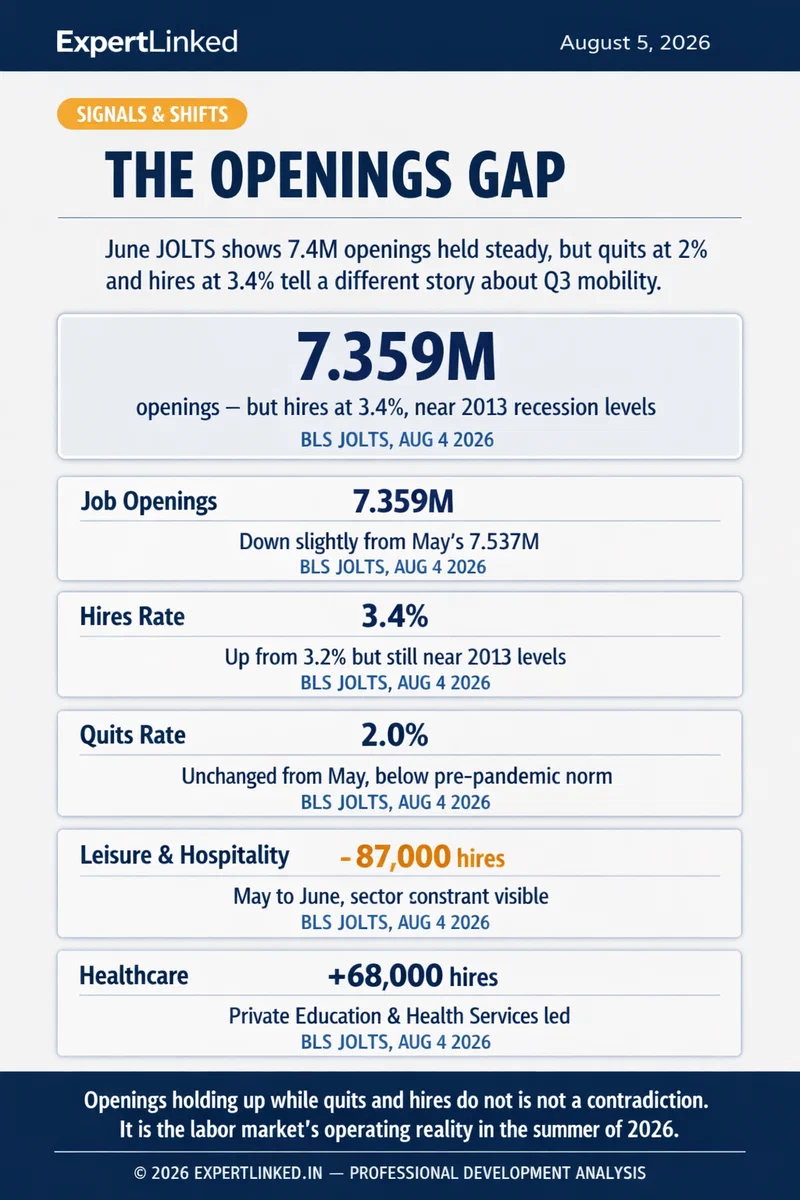
Job openings ticked down slightly to 7.359 million from May’s revised 7.537 million. Not a dramatic shift. Hires came in at 5.348 million, putting the hires rate at 3.4%—marginally better than May’s 3.2%. The quits rate was unchanged at 2.0%, exactly where it sat the month before. Layoffs remained stable at 1.1%. Total separations matched the hires rate at 3.4% (BLS, August 4, 2026).
This is the same low-hire, low-fire environment that has defined the labor market since late 2024. Employers are not aggressively opening doors. Workers are not walking out the back. The labor market is sustaining itself through stasis, not growth. And that distinction matters far more than the headline openings number ever will.
Why Quits at 2% Is the Signal That Matters #
The quits rate has been at or below 2% for nearly a year straight now, well below the pre-pandemic norm and less than half the 3% peak workers hit during the Great Resignation of 2022 (Indeed Hiring Lab, August 4, 2026). Workers tend to quit when they believe something better is attainable. At 2%, the market is broadcasting a consistent read on that belief: they don’t.
Leisure and Hospitality—one of the highest-turnover sectors historically—saw quits drop from a 5.8% rate in 2022 to substantially lower levels today. But the June JOLTS revealed something even more telling: that same sector’s hires dropped by 87,000 between May and June, a 0.5 percentage-point decline in the hires rate. Year-over-year, hires in Leisure and Hospitality are down 174,000, far more than the 27,000 decline in Construction (Indeed Hiring Lab, August 4, 2026).
This is not just demand softening. The civilian labor force has been declining since the end of 2025, which means part of what we are seeing is labor supply pulling back—workers exiting volatile sectors, choosing not to re-enter, or aging out of the workforce faster than replacements arrive. When both quits and hires fall simultaneously in a sector that used to churn constantly, you are watching constraint, not health.
Hires at 3.4% — Better Than 3.2%, But Not Enough #
The hires rate ticked up from May’s 3.2% to 3.4% in June. That sounds like improvement until you remember that 3.2% was the rate in 2013 during the slow crawl out of the Great Recession. A hires rate of 3.4% is marginally better than a level last seen when the economy was still repairing itself from systemic collapse. It is not evidence of a reopening labor market. It is evidence that the market is slightly less stuck than it was thirty days ago.
Openings, meanwhile, sit at 7.4 million—implying that more than 7 million roles are theoretically available. But actual hires came in at 5.3 million. The gap between those two numbers is not noise. Openings measure employer intent to hire eventually. Hires measure what actually happened. And what actually happened in June was that employers filled roles at a rate still barely above recession-era levels.
Healthcare continues to dominate hiring. Private Education and Health Services led with 68,000 new hires in June, but that demand is not being met domestically. International recruitment has become a key battleground for the sector as aging populations drive demand faster than domestic pipelines can supply workers (Indeed Hiring Lab, August 4, 2026). With the foreign-born labor force contributing to the overall decline in the civilian labor force, healthcare’s reliance on international talent is under pressure at exactly the moment the sector is supposed to be carrying the broader labor market.
The Narrative Gap #
The public story is straightforward: 7.4 million openings. The labor market is holding up.
The lived experience is something else entirely. Workers see postings. They apply. They do not get callbacks. When they do get interviews, offers do not materialize or come in below expectations. The friction is not imagined. It shows up in the data as the gap between a 7.4 million openings headline and a 3.4% hires rate that is still stuck near levels last seen during an economic recovery from crisis.
This is exactly the dynamic I described in The Stillness Trap on July 1. Employers are posting roles they are not urgently filling. Workers are seeing listings but not experiencing meaningful movement. The disconnect between openings and actual hiring creates the experience that so many professionals describe: “I keep applying. Why isn’t anything happening?”
The answer is that the hires mechanism is still constrained. Openings are a lagging indicator of intent. Hires and quits measure actual movement. The gap between those two metrics is where professionals live their career decisions. And right now, that gap is wide.
Indeed’s Job Postings Index has stabilized at roughly 1% above the pre-pandemic baseline of February 2020, which confirms that posting activity is holding steady even as actual hiring remains selective (Indeed Hiring Lab, August 4, 2026). That is not a contradiction. It is the labor market’s current operating mode: employer caution dressed up as openness.
What This Means for Q3 Mobility #
The August jobs report lands on August 7. It will give the labor market a new headline payroll number, and everyone will react to it. But the June JOLTS already told you the mechanism that will produce that number. If hires stay around 3.4% and quits stay at or just above 2%, the labor market is not reopening in Q3. It is sustaining itself through low turnover, not through robust hiring.
For professionals, this means external leverage exists—but it is thin. As I argued in The Three Career Moves That Actually Work When the Labor Market Is Stuck on July 13, the highest-ROI moves in this environment are still likely to be internal: scope authorship, workflow proof, and budget adjacency. The external market is not generous enough to treat job postings as the main source of opportunity.
The real question heading into Q3 is whether the August jobs headline will distract professionals from the underlying constraint. History suggests that headlines sound better than the lived experience. Real earnings growth turned negative in Q2 2026 for the first time since 2022, meaning that even workers who do have jobs are losing purchasing power despite “stable” headline conditions (Indeed Hiring Lab, July 31, 2026).
The labor market described by the June JOLTS is calm on the surface but paddling hard underneath, as Indeed’s analysis aptly put it (Indeed Hiring Lab, August 4, 2026). That is not stability. That is strain dressed up as equilibrium.
Before the Headline Arrives #
The June JOLTS confirmed what the July data arc predicted: the stillness continues. Openings holding up while quits and hires do not is not a contradiction. It is the labor market’s operating reality in the summer of 2026. Employers are cautious. Workers are pinned. And the friction between posted roles and actual movement is where Q3 career decisions will be made.
The August jobs report will give you a number. The June JOLTS already gave you the mechanism. That mechanism says Q3 mobility is still more about repositioning inside constrained markets than about a broad reopening of external opportunity. The professionals who act on that read now—before the August headline lands—will be ahead of the ones waiting for the narrative to catch up.
What’s your read on the June JOLTS data, or how are you navigating Q3 career decisions in this environment? I’d be interested to hear your take.
Email me at jackson.rodriguez@tlnw.uk
References #
- U.S. Bureau of Labor Statistics. (August 4, 2026). “Job Openings and Labor Turnover Survey - June 2026.” https://www.bls.gov/jlt/ (Accessed August 5, 2026)
- Indeed Hiring Lab. (August 4, 2026). “June 2026 JOLTS Report: The Labor Market is a Duck on a Pond.” https://www.hiringlab.org/2026/08/04/june-2026-jolts-report/ (Accessed August 5, 2026)
- Indeed Hiring Lab. (July 31, 2026). “Q2 2026 Employment Cost Index: Losing Ground.” https://www.hiringlab.org/2026/07/31/q2-2026-employment-cost-index-losing-ground/ (Accessed August 5, 2026)
- ExpertLinked.in. (July 1, 2026). “The Stillness Trap.” https://expertlinked.in/posts/2026-07-01-signals-shifts-the-stillness-trap/ (Accessed August 5, 2026)
- ExpertLinked.in. (July 8, 2026). “What the June Jobs Report Actually Said About the Hires Rate.” https://expertlinked.in/posts/2026-07-08-signals-shifts-june-jobs-report-hires-rate/ (Accessed August 5, 2026)
- ExpertLinked.in. (July 13, 2026). “The Three Career Moves That Actually Work When the Labor Market Is Stuck.” https://expertlinked.in/posts/2026-07-13-the-three-career-moves-that-actually-work-when-the-labor-market-is-stuck/ (Accessed August 5, 2026)
- ExpertLinked.in. (July 29, 2026). “What July’s Data Trail Tells Us About Q3’s Labor Market Trajectory.” https://expertlinked.in/posts/2026-07-29-signals-shifts-q3-labor-market-trajectory-risk-ignored/ (Accessed August 5, 2026)
AI Content Notice
This article was created using artificial intelligence technology. Whenever possible, we include references and sources to support the information presented. Readers are encouraged to consult these sources for further information. While we strive for accuracy and provide valuable insights, readers should independently verify information and use their own judgment when making business decisions. The content may not reflect real-time market conditions or personal circumstances.
Related Articles
Infographic: What the June 2026 JOLTS Report Says About Q3 Mobility - Before the August Jobs Report Lands
Openings held steady, but quits and hires didn’t move—the gap between those signals is where …
What the June Jobs Report Actually Said About the Hires Rate — and Whether the Stillness Broke
The stillness didn’t break — the ‘strong spring’ was revised down by 74,000 jobs, …
Infographic: What the June Jobs Report Actually Said About the Hires Rate — and Whether the Stillness Broke
The stillness didn’t break — the ‘strong spring’ was revised down by 74,000 jobs, …