The Three Career Moves That Actually Work When the Labor Market Is Stuck

When the labor market freezes, the default professional instinct is to put your head down, do exactly what is asked, and wait for the thaw. But that safety posture is a trap.
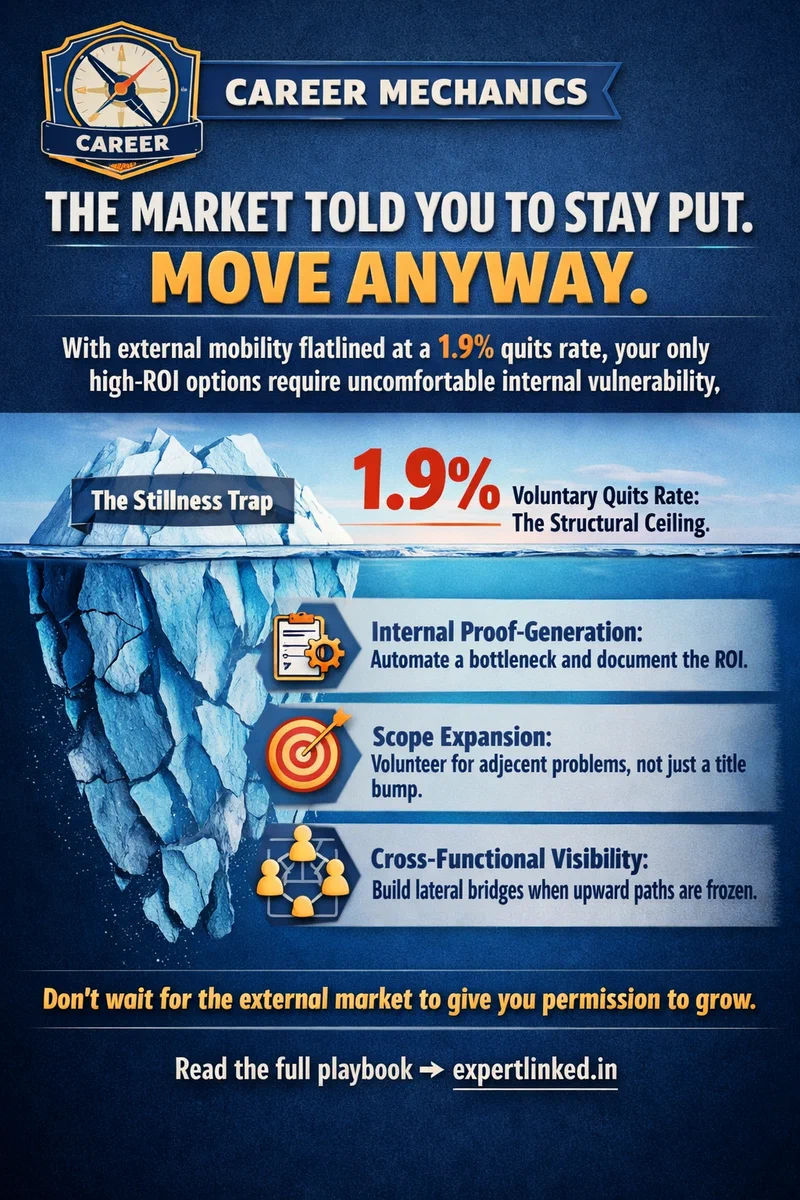
Let’s cut straight to the uncomfortable math: the Bureau of Labor Statistics’ JOLTS report continues to show a quits rate trapped around 1.9%. When voluntary departures evaporate, external hiring slows to a recognizable crawl. We are living inside a structural constraint on external mobility. As I noted fully two weeks ago in The Stillness Trap, organizations are holding onto talent, but they aren’t promoting or compensating generously because they don’t have to fear attrition.
If external mobility is constrained, internal positioning becomes exponentially more valuable. But here is the paradox: internal positioning requires a level of organizational vulnerability—asking for more scope, documenting your own performance, negotiating upward—that feels deeply risky in a market where “be grateful you have a job” is the ambient management message.
These are not consolation prizes for a market that won’t let you leave. They are your highest-ROI moves in a 1.9% quits environment.

Move 1: Internal Proof-Generation #
The highest form of career currency right now is the ability to show, not tell, that you can make work faster and cleaner.
We already know that organizations are struggling to convert AI hype into financial reality. While McKinsey found that overwhelming majorities of companies are deploying AI, only a fraction are extracting measurable EBIT impact—and those winners are the ones redesigning workflows rather than just buying tools. Similarly, Atlassian’s April 2026 data confirmed that executives want AI to increase speed, but knowledge workers feel completely overwhelmed by tool sprawl and coordination drag.
Your first move is to run the Workflow Proof Playbook. Do not ask for permission to completely overhaul your job. Instead, identify one recurring bottleneck in your immediate purview, integrate an AI process to resolve it, and document the before-and-after metrics in a proof memo. In a still market, you must generate your own velocity. When reviews arrive, you don’t want to be measured on compliance; you want to be measured on engineered efficiency.
Move 2: Scope Expansion over Title Chase #
If your employer is not going to give you a promotion or a substantial raise right now, you must negotiate for scope.
Recent Indeed Hiring Lab data indicates a fascinating shift: the premium for AI skills isn’t solely accruing to machine learning engineers and dedicated tech hires anymore. It is accruing to domain practitioners in existing roles who embed AI into legacy functions—marketing operators, compliance officers, and financial analysts.
If you are a domain expert, you hold the leverage of context. Approach your manager and offer to take on an adjacent, higher-value problem by automating or reducing the friction in your current baseline tasks. Expanding your scope makes your role hybrid. By the time the market thaws, you won’t be looking for a job that matches your old title; you will be marketing an expanded, modernized capability that didn’t even exist a year ago.
Move 3: Cross-Functional Visibility #
When vertical advancement within your silo is blocked by budget freezes, your advancement vector has to be lateral.
You need to become visible to the teams and leaders adjacent to your immediate reporting line. If you generated proof (Move 1) and expanded your scope to tackle new problems (Move 2), you now possess a tested methodology. Share it. Offer to brief the operations team on how you eliminated a reporting bottleneck. Volunteer for cross-functional deployment committees.
The goal here isn’t to look busy. The goal is to ensure that when budget does loosen, or when a hybrid role is formally created, your name is already recognized outside your manager’s direct line of sight.
Don’t wait for the external market to give you permission to grow. The stillness is real, but the way out is through the work in front of you.
Have a career story where you successfully negotiated for scope or changed your role from the inside out when the market was stuck? The patterns I find most useful are the ones that surprised the person living them.
Email me at jackson.rodriguez@tlnw.uk to share your story.
References
- Bureau of Labor Statistics (June 2026). Job Openings and Labor Turnover Summary (JOLTS).
- McKinsey Global Institute (November 5, 2025). The State of AI in 2025. https://www.mckinsey.com/capabilities/quantumblack/our-insights/the-state-of-ai
- Atlassian (April 27, 2026). State of Teams 2026. https://www.atlassian.com/blog/state-of-teams-2026
- Indeed Hiring Lab (May 2026). Monthly Labor Market Snapshot.
AI Content Notice
This article was created using artificial intelligence technology. Whenever possible, we include references and sources to support the information presented. Readers are encouraged to consult these sources for further information. While we strive for accuracy and provide valuable insights, readers should independently verify information and use their own judgment when making business decisions. The content may not reflect real-time market conditions or personal circumstances.
Related Articles
Infographic: The Three Career Moves That Actually Work When the Labor Market Is Stuck
When external mobility stalls, the highest-ROI career moves involve organizational vulnerability and …
ExpertLinked Weekly - The Score, the Stillness, and the Signal
Jackson and Olivia spend the week on a single question: who gets to define your AI value before a …
ExpertLinked Weekly — The Proof, the Trap, and the Penalty