Career Mechanics: The Workflow Proof Playbook - How to Turn AI Learning Into Career Capital

Your next AI career advantage is probably hiding inside the most boring recurring process on your calendar.
Not in another certificate. Not in another prompt library. Not in another meeting where everyone says they are “experimenting with agents.”
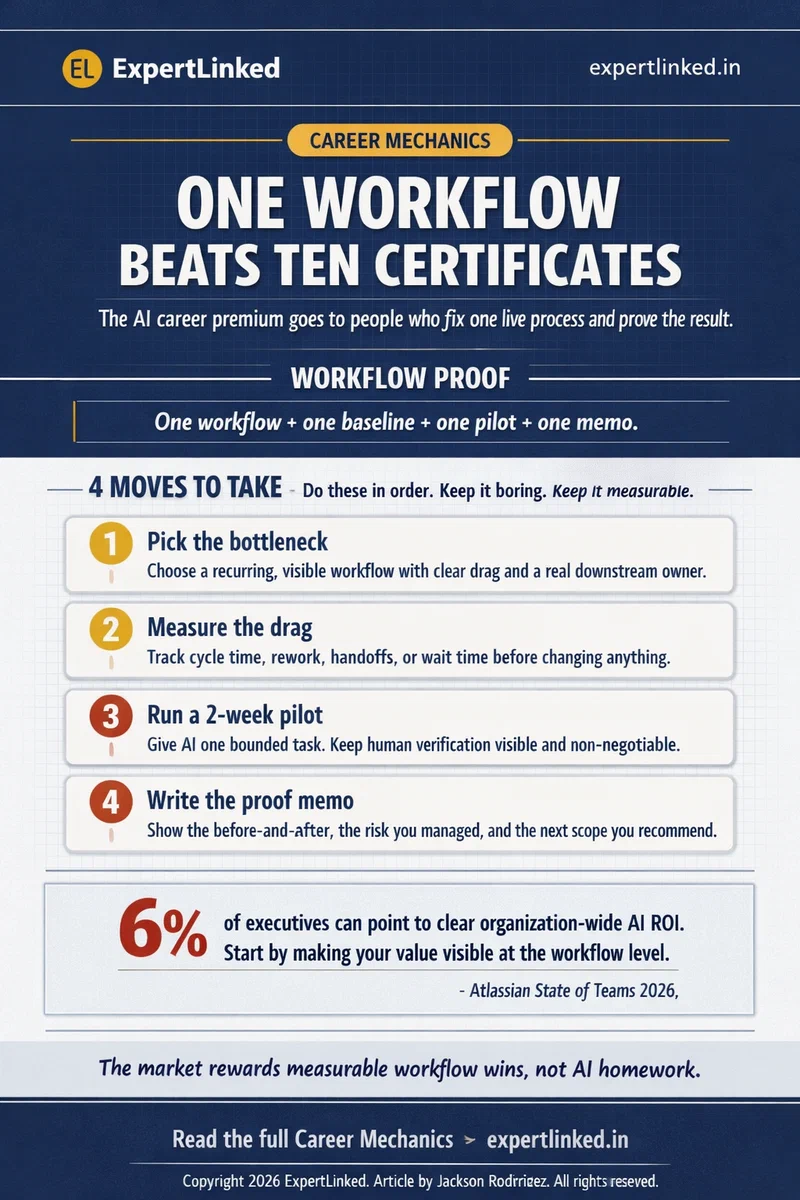
Nearly 88% of respondents in McKinsey’s 2025 state of AI survey say their organizations now use AI in at least one business function. Just 39% report any enterprise-level EBIT impact, and the companies seeing the most value are nearly three times as likely as others to have fundamentally redesigned workflows (McKinsey, November 5, 2025). Atlassian’s State of Teams 2026 lands in the same place from a different angle: 89% of executives say AI is increasing speed, but only 6% can point to clear organization-wide ROI, while 87% of knowledge workers say everyone is moving so fast they no longer have the capacity to coordinate (Atlassian, April 27, 2026).
That gap is the opportunity. The professionals who pull ahead in 2026 will not be the ones who learned AI the loudest. They will be the ones who can point to one live workflow that got faster, cleaner, or more reliable because they changed it.
Here is the uncomfortable truth most AI-upskilling advice keeps skimming past: if your learning does not alter a real process, it is not yet a career asset. It is homework. Worse, if it only increases polished output, you may be producing the exact thing managers are already dreading. BetterUp’s 2025 research found that 54% of managers report receiving AI “workslop,” and workers spend an average of 1 hour and 51 minutes dealing with each instance (BetterUp, September 29, 2025).
The certificate trap #
The rush into AI learning is rational. Indeed Hiring Lab found that 67% of US employees say skill development is a personal priority, but only 48% believe their employer sees it the same way. In a separate eight-country AI survey, 41% of US AI users said they still were not receiving enough AI training, and workers whose employers actively encourage AI use are far more likely to actually use it (Indeed Hiring Lab, April 14, 2026; Indeed Hiring Lab, December 29, 2025).
So people do what ambitious people always do when institutions lag: they self-educate. They take courses. They build prompt libraries. They test tools on nights and weekends. They become the person in the Slack channel who always has the newest AI recommendation.
The problem is that none of this is legible to the business unless it changes a workflow someone else cares about.
Microsoft’s 2025 Work Trend Index says 53% of leaders believe productivity must increase, while 80% of the global workforce says they lack the time or energy to do their work. Employees at the high end of Microsoft’s telemetry are interrupted every two minutes - 275 times a day - by meetings, emails, or pings (Microsoft WorkLab, April 23, 2025). No credible manager is waiting for one more abstract AI enthusiast. They are waiting for less drag.
That is why the sharpest version of the AI career argument is also the least glamorous: boring workflows beat glamorous use cases.
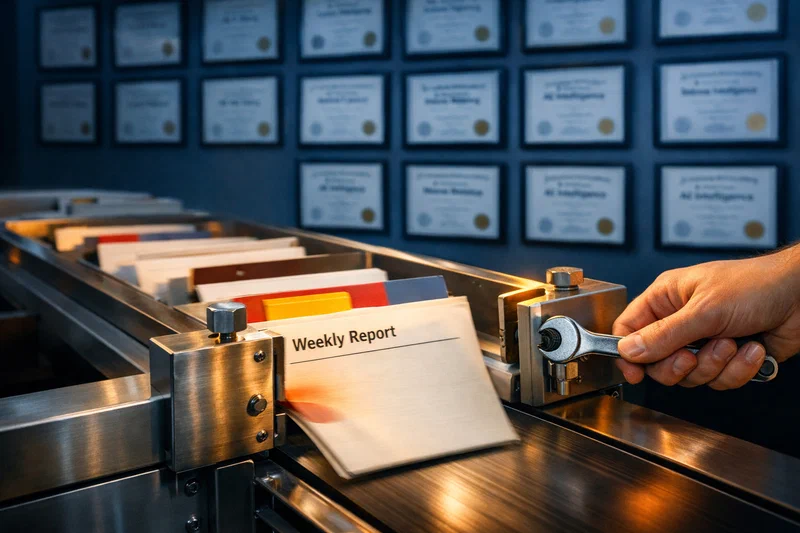
The weekly report pack beats “rethink our strategy process.” The invoice exception queue beats “build an agentic finance function.” The candidate-screening summary beats “transform recruiting.” Why? Because boring workflows are recurring, measurable, bounded, and politically survivable. They let you generate proof instead of vibes.
You are not trying to look futuristic. You are trying to become useful in a way the organization can count.
The Workflow Proof Playbook #
Use this playbook when you want AI learning to become career capital rather than background noise.
Move 1: Pick a boring bottleneck with a visible cost #
Your first target should satisfy five conditions:
- It happens at least weekly.
- It has a clear customer or downstream owner.
- It creates obvious drag: time, rework, delay, or version confusion.
- It can be improved without gambling with confidential or high-risk data.
- Success will be visible to someone besides you.
This is where most people get too ambitious too early. They want a dramatic use case because dramatic use cases feel strategic. Usually they are just diffuse.
What you want instead is a workflow that is annoying enough to matter and ordinary enough to test.
Weak target:
“Use AI to improve strategy work.”
Strong target:
“Cut first-draft turnaround on the weekly pipeline summary from 90 minutes to 30 while keeping human approval.”
That second sentence does three things the first one never will. It names the process. It names the baseline. It names the constraint. Now you have something real enough to improve and specific enough to defend.
The surprise here is that the boring workflow is often the stronger career move. It gives you repeatable volume, clear before-and-after evidence, and a lower-risk arena in which to show judgment. That is far more valuable than being the person with a dazzling demo nobody can operationalize.
Move 2: Baseline the friction before you touch the tool #
If you cannot describe the old pain in numbers, you will end up describing the new value in adjectives. Adjectives do not survive calibration meetings.
Before you run any AI pilot, track at least one week - ideally two - of the current process. Measure:
- Cycle time from start to handoff.
- Number of manual touches or copy-paste steps.
- Average wait time for review or approval.
- Error, rework, or revision count.
- Number of people pulled into the process.
Seven to ten observations will usually tell you enough. You do not need a PhD-grade study. You need a baseline sturdy enough that your result cannot be brushed off as “it feels faster.”
This is the step most AI learners skip because it is boring and slightly humiliating. Baselines force you to admit how vague your own process knowledge may be. But that is exactly why they matter. They turn experimentation into business language.
And they prevent one of the most common career mistakes in the AI era: starting with the tool instead of the bottleneck. The tool is not the story. The drag is the story.
Move 3: Run a constrained two-week pilot and keep human judgment visible #
Now give AI one bounded job inside the workflow. Not the whole workflow. One part.
Good first assignments for AI:
- Draft the first version.
- Summarize repetitive inputs.
- Classify or cluster incoming items.
- Surface possible patterns or anomalies.
- Convert raw notes into a structured template.
Keep the human role explicit and non-negotiable. Someone still verifies. Someone still edits. Someone still owns the decision.
That matters because the whole point of the pilot is not to prove you can make AI produce more text. It is to prove you can redesign work without lowering trust.
MIT Sloan Management Review makes the discipline point clearly: the people who get the best results from AI are not the most technical; they are the most rigorous about auditing how they use it. Vipin Gupta’s self-audit framework centers on five habits - set up, refine, verify, own, and systematize - precisely because process quality matters as much as output quality (MIT Sloan Management Review, April 30, 2026).
For your pilot, that means logging four things every time:
- What exact step AI handled.
- What you still had to verify or correct.
- What error pattern showed up.
- Whether the workflow actually got faster, cleaner, or easier to hand off.
Notice the standard here. A failed pilot is not failure if it reveals a boundary. Showing that AI should not own a specific step is still workflow design. In a market obsessed with AI optimism, the person who can say “this part should stay human, and here is why” is often demonstrating more maturity than the person who tries to automate everything.
Move 4: Write the proof memo and ask for the next scope #
This is where the learning becomes career capital.
At the end of the pilot, write a one-page proof memo. Not a long deck. Not a vague update. A memo with six fields:
Workflow: Baseline: AI role: Human control: Result after two weeks: Main risk uncovered: Recommendation:
Example:
“I piloted AI on our weekly customer-escalation summary for two weeks. Baseline prep time fell from 95 minutes to 38. Manual edits dropped from 14 to 6 per cycle. The main risk was false prioritization on ambiguous tickets, so final triage stayed human. Recommendation: standardize this for the team and test the same method on the monthly operations deck.”
That is the artifact. Not the course completion screen. Not the login count. Not the fact that you tried three different models over the weekend.
The proof memo does what most self-directed AI learning never does: it translates skill into operational consequence. It also gives your manager something concrete to repeat upward, which is how local wins become visible career signals.
What to say when you pitch it #
Most professionals know what they want to test. They get stuck on how to frame it without sounding like they are chasing a side hobby.
Use this:
“I have been building AI skill in a way I want to make useful for the team. Rather than experimenting in scattered ways, I want to run a two-week pilot on [workflow]. I will baseline the current time and revision rate, keep human verification in place, and come back with a one-page before-and-after memo. If the gain is real, we can decide whether it is worth scaling.”
That language does something subtle and important. It makes the proposal sound disciplined, low drama, and business-first. Which is exactly what it should be.
If the pilot works, say this:
“This changed one workflow, not just my tool usage. Turnaround moved from [X] to [Y], rework dropped from [A] to [B], and the main control we kept human was [Z]. My recommendation is [next step].”
If the pilot fails, say this:
“The pilot did not create a real gain because [constraint]. That is useful information. We should not force AI into this step, but we should test it in [adjacent workflow] instead.”
That final script matters more than most people realize. Failed experiments that clarify the boundary of good use are often more valuable than shallow successes that create more workslop.
A five-line checklist #
If you want the shortest possible version of this column, it is this:
- One recurring workflow.
- One baseline.
- One bounded AI role.
- One human control.
- One proof memo.
Everything else is decoration.
McKinsey’s high performers redesign workflows. Atlassian’s top 14% ground AI in context, workflows, and culture. The individual version of that lesson is smaller, simpler, and much harder to fake. Stop trying to look AI-fluent in the abstract. Make one real process measurably better. Then make the evidence visible.
In a market full of people saying they are learning AI, the rare professional is the one who can say, “Here is the workflow. Here is what changed. Here is the risk I managed. Here is what we should do next.”
That person does not sound trendy. That person sounds promotable.
The market will take promotable over trendy every time.
References #
- Atlassian Teamwork Lab. (April 27, 2026). “The State of Teams 2026: How top teams avoid the AI fragmentation tax.” https://www.atlassian.com/blog/state-of-teams-2026 (Accessed June 28, 2026, 12:44 UTC)
- Perry, Elizabeth. (September 29, 2025). “The hidden cost of AI ‘workslop’ - and how leaders can fix it.” BetterUp. https://www.betterup.com/blog/hidden-costs-workslop (Accessed June 28, 2026, 12:44 UTC)
- Victoria Lanzon, Carlos, Jonas Jessen, and Pawel Adrjan. (April 14, 2026). “Workers Want Training but Employers Don’t Always Deliver. Can Policy Help?” Indeed Hiring Lab. https://www.hiringlab.org/2026/04/14/workers-want-training-but-employers-dont-always-deliver/ (Accessed June 28, 2026, 12:44 UTC)
- Aoki, Yusuke. (December 29, 2025). “A Tale of Two Workforces: Who’s Using AI and Who’s Getting Left Behind.” Indeed Hiring Lab. https://www.hiringlab.org/2025/12/29/two-workforces-whos-using-ai-and-whos-getting-left-behind/ (Accessed June 28, 2026, 12:44 UTC)
- Gupta, Vipin. (April 30, 2026). “Audit Yourself to Get More From GenAI.” MIT Sloan Management Review. https://sloanreview.mit.edu/article/audit-yourself-to-get-more-from-genai/ (Accessed June 28, 2026, 12:44 UTC)
- Microsoft WorkLab. (April 23, 2025). “2025: The year the Frontier Firm is born.” https://www.microsoft.com/en-us/worklab/work-trend-index/2025-the-year-the-frontier-firm-is-born (Accessed June 28, 2026, 12:44 UTC)
- Singla, Alex, Alexander Sukharevsky, Bryce Hall, Lareina Yee, Michael Chui, and Tara Balakrishnan. (November 5, 2025). “The state of AI in 2025: Agents, innovation, and transformation.” McKinsey & Company. https://www.mckinsey.com/capabilities/quantumblack/our-insights/the-state-of-ai (Accessed June 28, 2026, 12:44 UTC)
AI Content Notice
This article was created using artificial intelligence technology. Whenever possible, we include references and sources to support the information presented. Readers are encouraged to consult these sources for further information. While we strive for accuracy and provide valuable insights, readers should independently verify information and use their own judgment when making business decisions. The content may not reflect real-time market conditions or personal circumstances.
Related Articles
Infographic: Career Mechanics: The Workflow Proof Playbook - How to Turn AI Learning Into Career Capital
The AI career premium now goes to professionals who can redesign one real workflow and prove the …
Signals & Shifts: The Three-Speed Market
This week’s labor data points to a three-speed market where healthcare concentration, worker-share …
Briefing Room: June 2026
June 2026 confirmed two things at once: AI is now a governance problem, not just a productivity …