Briefing Room: June 2026

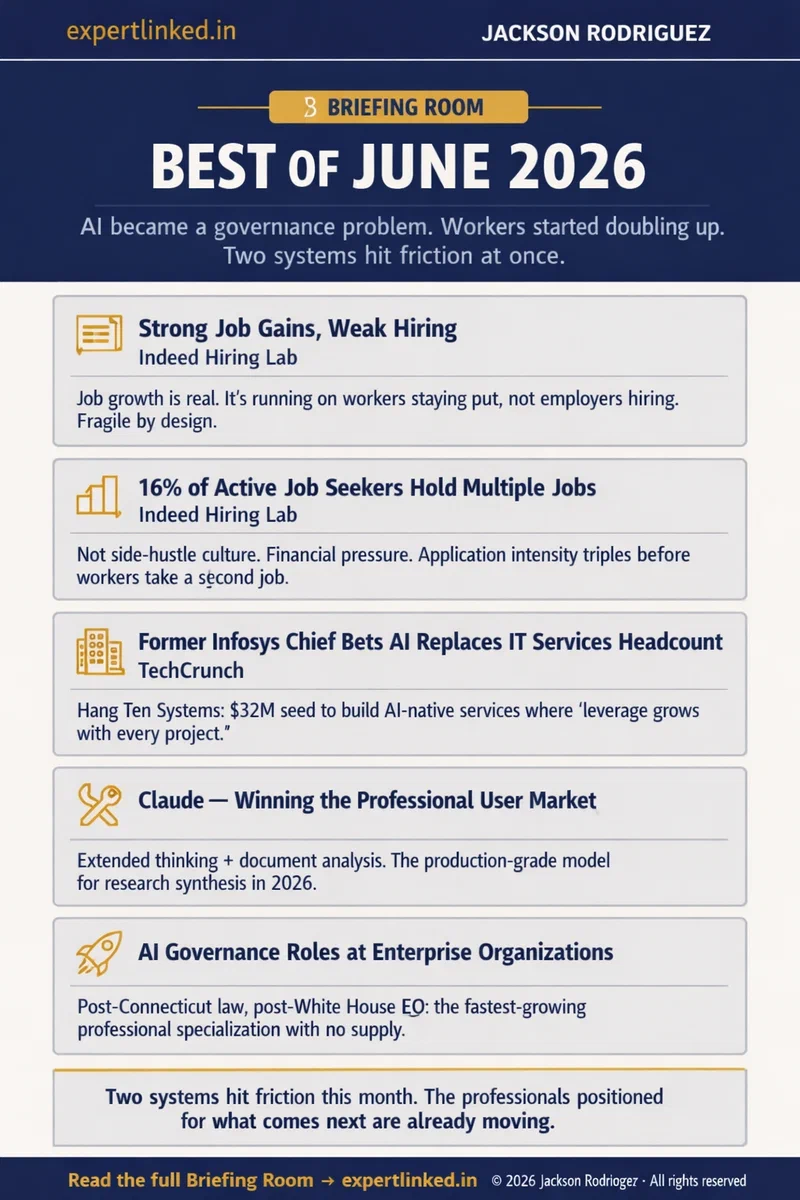
June delivered two signals that belong together, even though they typically appear in separate conversations.
The first: AI has become a governance problem. Two frontier models — Anthropic’s Mythos and OpenAI’s GPT-5.6 — spent the month under White House review, their releases subject to government approval “customer by customer.” The hands-off era of AI policy is over, whether the industry is ready for it or not.
The second: the labor market confirmed that workers are doubling up, not moving on. Nearly 16% of active job seekers already hold multiple positions. Hiring and separations have both sunk to 2013 lows. Job growth is running primarily because workers are staying put, not because employers are aggressively adding headcount.
Read together, these signals describe the same underlying shift: the structures professionals and organizations have relied on for the past decade — frictionless AI development, frictionless talent mobility — are encountering friction simultaneously. The adjustment period begins now.

Best Articles #
Strong Job Gains, Weak Hiring Indeed Hiring Lab — June 18, 2026
The cleanest analytical frame for the current labor market, and essential reading before making any career move in the second half of 2026. Employers added an average of 114,000 jobs per month in the first five months of the year — more than triple the 2025 pace. But hiring activity remains near its lowest point since 2013. Both facts are true, which is only possible when separations (quits, layoffs, discharges) have fallen even faster than hires. As the report states: “Growth that leans on people staying put rather than employers ramping up hiring is a fragile kind of growth.” For professionals: job growth built on stillness is not strength. The labor market will not remain this quiet indefinitely. The professionals who will be positioned for the next phase are building capability and visibility now, not waiting for cleaner signals.
Nearly 16% of Active Job Seekers Are Already Working Multiple Jobs Indeed Hiring Lab — June 9, 2026
This piece changes the mental model of what “worker resilience” looks like in 2026. One in six active job seekers already holds multiple positions at the time of their search — concentrated in food preparation, delivery, nursing assistants, retail, and other hourly-economy roles. The motivation is not ambition. Application intensity triples in the month before someone takes a second job, then drops sharply once the second role starts. That is the signature of financial pressure, not strategic diversification. The professional-class version of this pattern — consulting on the side, fractional arrangements, unreported portfolio work — is driven by the same underlying dynamic: one income stream is increasingly insufficient for a meaningful share of the workforce. The gig share of these profiles has more than doubled since 2018. The number is still relatively small, but the direction is not ambiguous.
Former Infosys chief has a new startup that wants to challenge the IT services world TechCrunch — June 24, 2026
Vishal Sikka — former Infosys CEO, former Oracle board member, now 59 — has raised a $32 million seed round for Hang Ten Systems, an AI-native enterprise services startup headquartered in the Bay Area. The thesis is stated precisely by Mayfield managing partner Navin Chaddha: “Traditional services scale linearly with headcount. Hang Ten is built so its leverage grows with every project.” Sikka is betting AI can perform the project-based work — integrating, customizing, and maintaining enterprise software — that has been the IT services industry’s cash engine for decades. Analysts at Jefferies have argued IT services may be among the first sectors to face meaningful AI disruption. Infosys is simultaneously positioning AI-first services as a $300-400 billion market opportunity by 2030. Both claims cannot be fully right. The bet being made by someone who ran the incumbent is a clearer signal than any analyst note. For IT professionals: the economics of your sector are being renegotiated in real time.
The White House is asking OpenAI to slow roll the release of its new model over safety concerns TechCrunch — June 25, 2026
OpenAI’s GPT-5.6 is being released only to a select group of partners, customer by customer, with White House approval required before broader distribution. The agencies involved are the Office of the National Cyber Director and the Office of Science and Technology Policy. The concern is substantive: frontier cyber models capable of identifying and exploiting software vulnerabilities at machine speed represent genuine threats to enterprise infrastructure. The problem is the review process has no articulated success criteria, no clear timeline, and limited institutional capacity to assess what it is evaluating. For professionals in tech, legal, compliance, and policy: this process — ad hoc as it currently is — will not remain ad hoc. The organizations that build institutional competence to navigate AI model governance before it is required will have structural advantages that compound.
It’s not about Anthropic vs. OpenAI anymore TechCrunch — June 26, 2026
The most important analytical frame for AI’s next phase. Anthropic’s Mythos and OpenAI’s GPT-5.6 are now in the same position — both under government review, both facing the same constraints, both watching their model release timelines become subject to external approval. The AI industry’s habit of treating safety and regulation as competitive levers is now a collective liability. The piece argues that the only workable path involves collective action: trusting independent testing organizations, aligning behind workable regulatory standards, and treating governance as an industry problem rather than a business strategy. For professionals: the era of each AI lab defining its own accountability is ending. Organizations that build genuine AI governance expertise are positioning for the decade ahead. Organizations that treat compliance as theater are accumulating risk.
Best Tools #
Claude Anthropic’s consumer model, and this month’s data suggests it is winning the professional user market. TechCrunch’s June 25 analysis found Claude is “winning over paid consumers” in a segment ChatGPT has dominated. The practical reason is consistently cited: extended thinking, nuanced document analysis, and structured reasoning on complex questions make Claude the strongest available tool for research synthesis and analytical work. The governance story around Claude Mythos adds a relevant signal — Anthropic is treating model safety seriously enough to withhold its most powerful model from general release. The public Claude is a tested, production-grade tool rather than a bleeding-edge experiment. For professionals building the calibration practice described in this month’s Deep Dive: Claude’s ability to audit reasoning chains and steelman counterarguments makes it more useful than faster-but-less-careful alternatives.
Rippling This month, Rippling announced its ambition to become “your entire data stack,” including tracking employee-level AI productivity ROI. This matters for professionals building internal cases for AI tooling — or managing teams and wanting to demonstrate measurable leverage. In a market where 89% of executives agree AI has accelerated execution but only 6% see organization-wide ROI (Atlassian, April 2026), the ability to measure and present specific productivity impact is the argument that gets budget approved and career cases made. Rippling’s platform is among the earliest production tools for making that argument with real data rather than narrative.
Notion AI With Notion Mail shutting down this month — TechCrunch called it an “agent takeover” — Notion’s pivot is complete: the product is now an AI-augmented knowledge management workspace. For professionals building decision logs, recording judgment calls with context and confidence levels, and tracking outcomes over time (as described in this month’s Deep Dive), Notion’s linked database structure is purpose-built for that practice. A decision log integrated with your existing meeting notes, project documentation, and research is significantly more sustainable than a standalone spreadsheet that lives outside your actual workflow.
Best Opportunities #
Hang Ten Systems Vishal Sikka’s AI-native enterprise services startup is actively hiring across delivery, engineering, sales, and leadership, with plans to expand globally to meet enterprise demand. The opportunity is specific: the company currently has paying customers (Siemens Gamesa Renewable Energy and Fresenius are named in the launch announcement), a $32 million seed round from Mayfield and Aramco Ventures, and a founding team that includes executives who have worked with Sikka across SAP, Infosys, and VianAI. For IT professionals, enterprise architects, and consultants who understand the structural disruption in services: this is the place where that disruption is being built from scratch by someone who ran the industry incumbent.
AI Governance Roles at Enterprise Organizations Following the Trump administration’s June executive order directing AI companies to voluntarily submit models for pre-release government testing, Connecticut’s AI Responsibility and Transparency Act, and the White House’s customer-by-customer approval process for GPT-5.6, enterprises across financial services, healthcare, technology, and government contracting are building AI governance functions as a permanent operational requirement. These roles did not exist at scale six months ago and are being filled now. Titles vary — AI policy lead, responsible AI director, AI risk manager, enterprise AI compliance officer — but the skill set is consistent: policy literacy, sufficient technical understanding of model behavior, stakeholder communication, and institutional risk assessment. This is one of the fastest-growing professional specializations in the current market and one of the few where demand genuinely exceeds supply. The credential infrastructure (certifications, degree programs, defined career ladders) does not yet exist. The professionals building this competency now are defining what it looks like.
Best Ideas #
Stillness is not stability. The labor market’s “strong jobs, weak hiring” numbers look healthy on the surface. Below the surface, growth is running almost entirely on workers not leaving — a dynamic the Indeed Hiring Lab explicitly flags as fragile. The professionals treating the current market’s quiet as a reprieve — time to wait, time to consolidate — are making the same mistake as those who were unprepared when their sector was disrupted. Quiet periods in structurally changing markets are when the distances between professional cohorts widen, not narrow. If you have not made a deliberate forward move in the past six months — invested in a specific skill with a specific application, built a relationship outside your current network, documented a capability that would be visible in an external search — the quiet is costing you more than turbulence would.
The AI governance wave will build professional infrastructure, not just compliance risk. Every significant wave of regulation — GDPR, Sarbanes-Oxley, HIPAA — created an entire professional ecosystem that is now built into how organizations operate. AI governance is early in the same cycle. The difference from previous waves: the technical competency required to operate in this space is genuinely specialized, and there are currently very few professionals who combine policy literacy, technical understanding of model behavior, and institutional risk assessment well. The professionals building that combination now — before it becomes a commodity credential — are the ones who will define the field. This is not a niche. It is the infrastructure layer for how AI gets deployed in every major organization for the next decade.
References #
- Indeed Hiring Lab / Cory Stahle (June 18, 2026). “Strong Job Gains, Weak Hiring.” https://www.hiringlab.org/2026/06/18/strong-job-gains-weak-hiring/ (Accessed June 27, 2026)
- Indeed Hiring Lab / Cory Stahle (June 9, 2026). “Nearly 16% of Active Job Seekers Are Already Working Multiple Jobs.” https://www.hiringlab.org/2026/06/09/active-job-seekers-are-already-working-multiple-jobs/ (Accessed June 27, 2026)
- Singh, Jagmeet. TechCrunch (June 24, 2026). “Former Infosys chief has a new startup that wants to challenge the IT services world.” https://techcrunch.com/2026/06/24/former-infosys-chief-has-a-new-startup-that-wants-to-challenge-the-it-services-world/ (Accessed June 27, 2026)
- Ropek, Lucas. TechCrunch (June 25, 2026). “The White House is asking OpenAI to slow roll the release of its new model over safety concerns.” https://techcrunch.com/2026/06/25/the-white-house-is-asking-openai-to-slow-roll-the-release-of-its-new-model-over-safety-concerns/ (Accessed June 27, 2026)
- Brandom, Russell. TechCrunch (June 26, 2026). “It’s not about Anthropic vs. OpenAI anymore.” https://techcrunch.com/2026/06/26/its-not-about-anthropic-vs-openai-anymore/ (Accessed June 27, 2026)
- Atlassian (April 27, 2026). “State of Teams 2026.” https://www.atlassian.com/blog/state-of-teams-2026 (Accessed June 27, 2026)
AI Content Notice
This article was created using artificial intelligence technology. Whenever possible, we include references and sources to support the information presented. Readers are encouraged to consult these sources for further information. While we strive for accuracy and provide valuable insights, readers should independently verify information and use their own judgment when making business decisions. The content may not reflect real-time market conditions or personal circumstances.
Related Articles
Infographic: Briefing Room: June 2026
June 2026 confirmed two things at once: AI is now a governance problem, not just a productivity …
Briefing Room: May 2026
May 2026 confirmed what the data has been building toward for months — AI is pulling up the bottom …
Briefing Room: April 2026
April 2026’s best reads, tools, and ideas — all pointing at the same structural gap between …