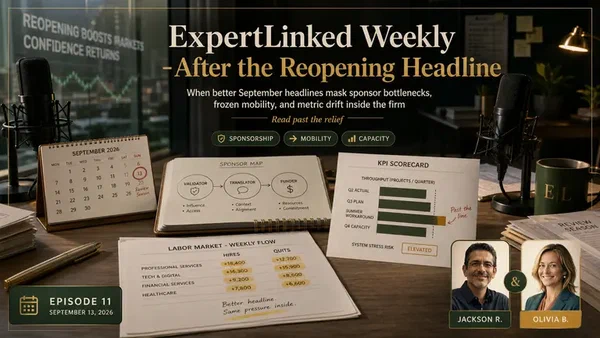
Episode eleven asks whether better headlines, warmer manager language, and strong summer output are being mistaken for real leverage, real mobility, and real capacity.
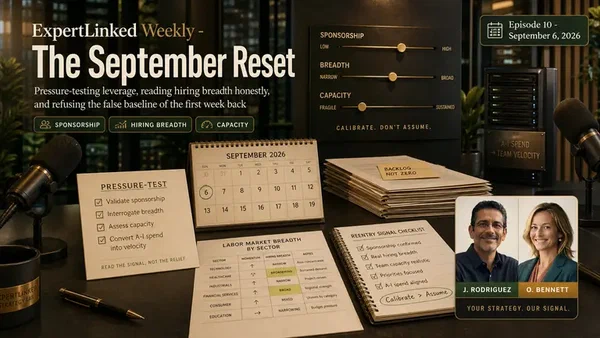
Episode ten is a calibration episode about reading sponsorship, hiring breadth, and post-vacation workload honestly before September momentum becomes Q4 policy.
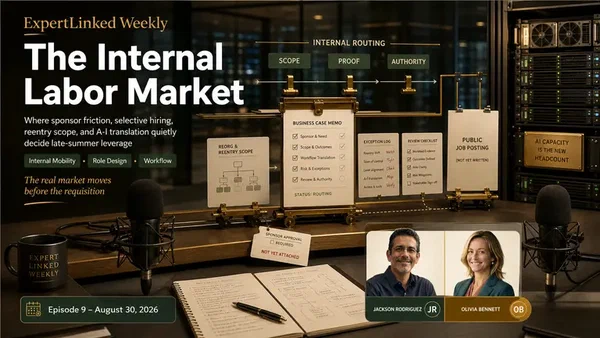
Episode nine connects sponsor friction, selective September hiring, reorganized-team scope drift, translator-role pivots, and Jackson’s August synthesis into one internal-labor-market frame.
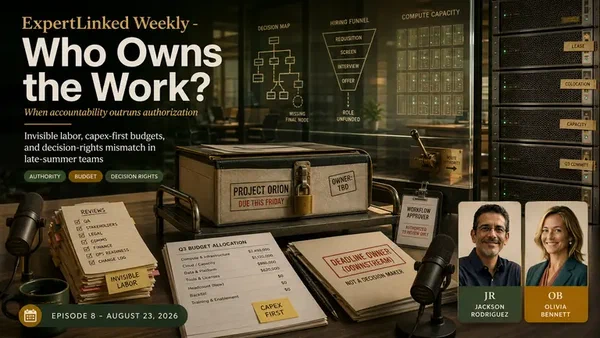
Episode eight follows Jackson’s budget-ask and hiring-risk pieces plus Olivia’s clinic on delegated exposure, then uses From the Notes to name the design debt hiding underneath all three.
Episode seven connects Jackson’s proof stack and real-wage squeeze with Olivia’s clinical read on always-on flexibility and her composite story of a role built in the workflow before it existed on paper.
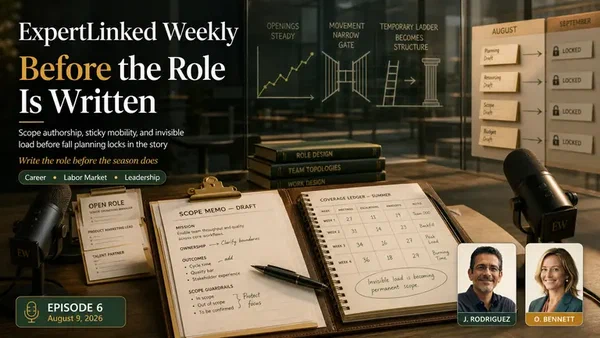
Episode six turns August’s quiet surface into a read on scope authorship, stalled movement, temporary coverage that can harden into permanent design, and the cross-border case for progress before perfection.
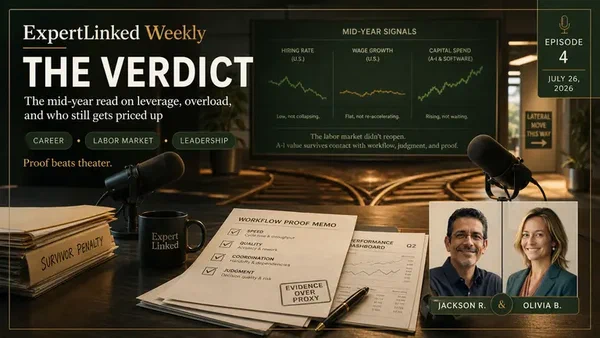
Jackson and Olivia use the week’s six published pieces to deliver a mid-year verdict on work: one proof memo is not enough, the labor market floor held without reopening, managers are absorbing invisible structural cost, and the AI labor market is splitting around workflow judgment.
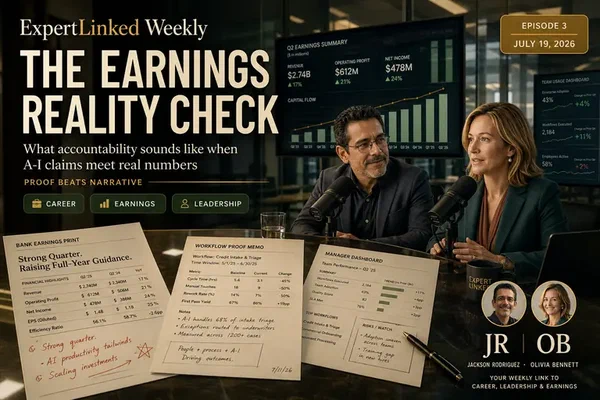
Jackson and Olivia use the week’s three published pieces to ask a blunt question: what counts as accountability when AI claims are everywhere and proof is uneven? They unpack the career moves that still work in a frozen market, the Q2 earnings disclosures that still do not document internal AI ROI cleanly, and the managerial difference between real adoption and compliance theater.
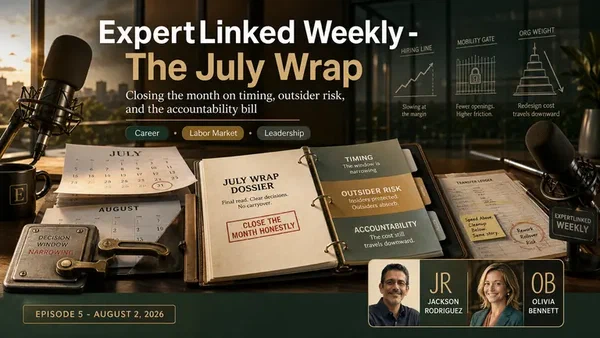
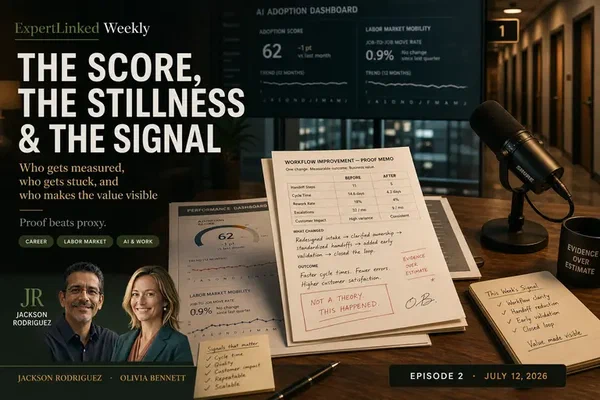
Jackson and Olivia spend the week on a single question: who gets to define your AI value before a dashboard or a stalled labor market does it for you? They unpack the mid-year proof memo, the June jobs report’s still-frozen hiring mechanism, the compliance theater of tool mandates without workflow redesign, and a practitioner story about turning one redesigned bottleneck into a promotion signal.
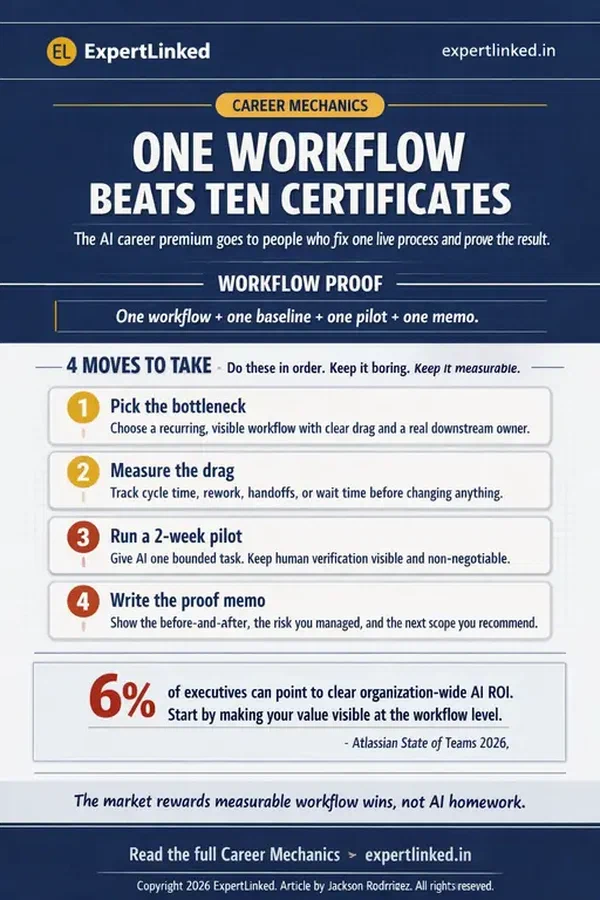
The AI career premium now goes to professionals who can redesign one real workflow and prove the result, not to those collecting tools, certificates, or prompt tricks.
The AI career premium now goes to professionals who can redesign one real workflow and prove the result, not to those collecting tools, certificates, or prompt tricks.
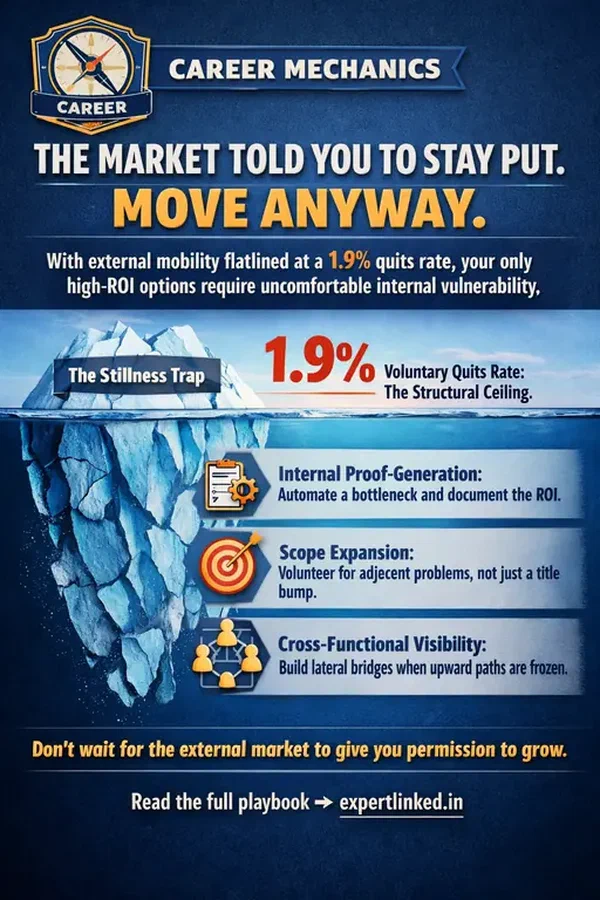
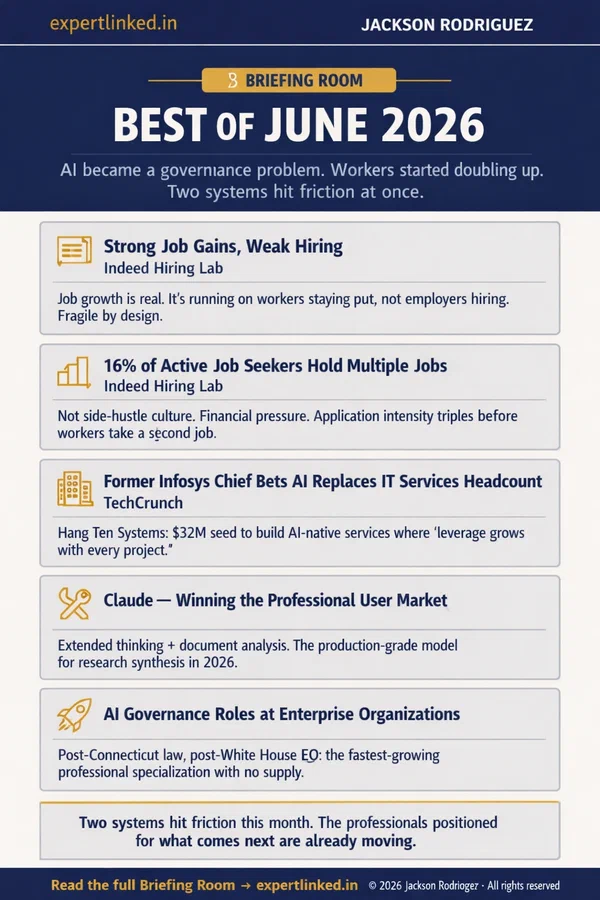
June 2026 confirmed two things at once: AI is now a governance problem, not just a productivity story, and a labor market that looks stable is actually running on workers staying put rather than employers hiring.
June 2026 confirmed two things at once: AI is now a governance problem, not just a productivity story, and a labor market that looks stable is actually running on workers staying put rather than employers hiring.
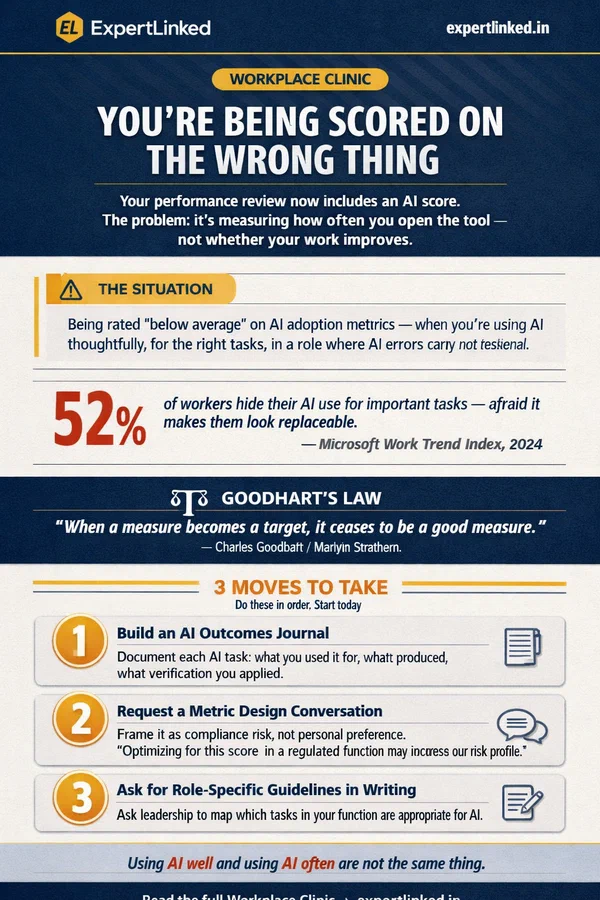
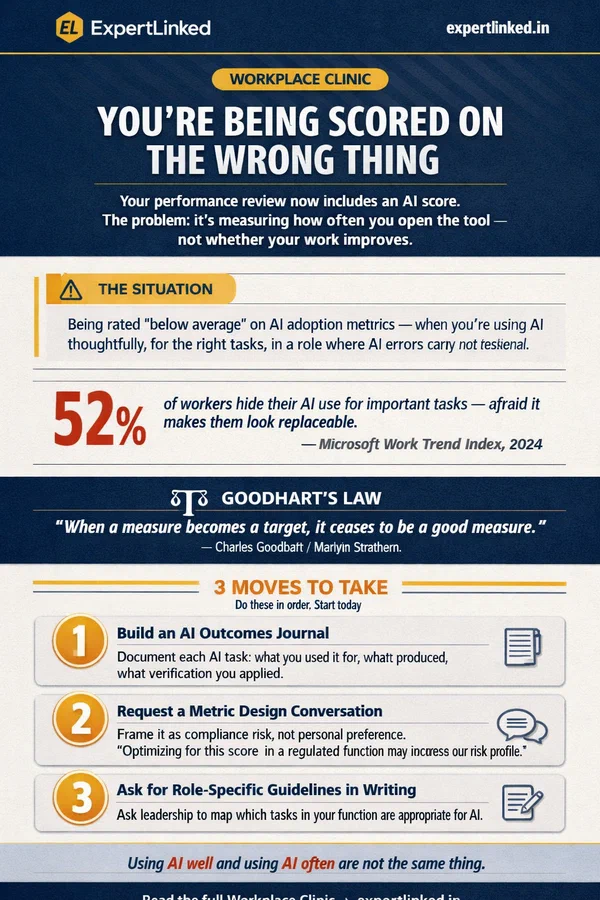
Being graded on how often you open an AI tool — not what you produce with it — is the wrong metric. Here is how to navigate it without becoming a compliance actor.
Being graded on how often you open an AI tool — not what you produce with it — is the wrong metric. Here is how to navigate it without becoming a compliance actor.
In a slowing labor market, the real career premium is shifting toward employers and sectors that actively train, sponsor, and route workers through change rather than leaving them to navigate it alone.
The transition from degree-based to skills-based hiring is revolutionizing career transitions, offering professionals unprecedented freedom to pivot industries.
AI is democratizing expertise and driving a skills-based hiring revolution—learn how to position yourself for career transitions in this new landscape.
Practical strategies for professionals experiencing AI-related career anxiety, focusing on skills mapping and strategic storytelling to pivot confidently in the AI era.
Acqui-hires and the AI talent arms race are changing how professionals pivot into AI; practical steps to leverage your transferable skills and build an AI transition portfolio.
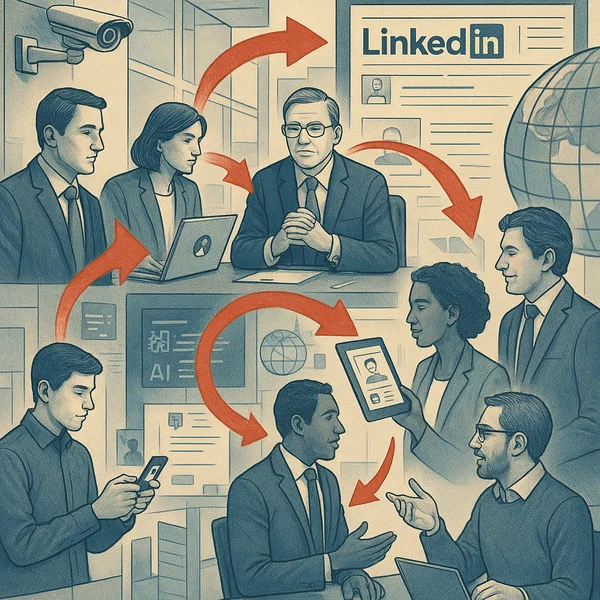
Edelman’s B2B Thought Leadership report reveals ‘hidden buyers’ dramatically reshaping LinkedIn engagement patterns. Meanwhile, xAI surveillance concerns highlight the evolving tension between professional networking transparency and corporate privacy in 2025.
Remote work and flexible schedules promise freedom but often deliver unexpected burnout patterns. This analysis reveals why unlimited flexibility can become a trap and provides strategic frameworks for mastering flexible work without losing professional boundaries or personal sanity.
Transform 2025’s massive layoffs from career disaster into opportunity. Get the strategic playbook for navigating corporate restructuring, identifying pivot opportunities, and positioning yourself for success during workforce transformation.