Signals & Shifts: The Stillness Trap

Yesterday’s JOLTS report arrived on the last day of June with a number built to reassure: 7.6 million job openings in May, unchanged from April, with layoffs ticking only slightly upward to 1.1% (Indeed Hiring Lab, June 30, 2026). Solid. Stable. Fine.
Also, almost entirely a product of workers not moving — not employers opening doors.
The data beneath this week’s headline is a portrait of a labor market sustaining itself through stasis rather than growth. Fewer people are getting hired. Fewer people are leaving. The gap between those two rates is so thin that a small shift in either direction could tip net employment from positive to negative without any single dramatic event. This is not a strength story. It is a stillness story. And stillness, in a labor market, is not the same as stability.

Signal 1: Job growth is being manufactured by people not leaving #
The May payroll report added 172,000 jobs. The average over the first five months of 2026 is 114,000 per month — more than triple the pace set during the same period in 2025 (Indeed Hiring Lab, June 18, 2026). Those numbers land well. The mechanism behind them does not.
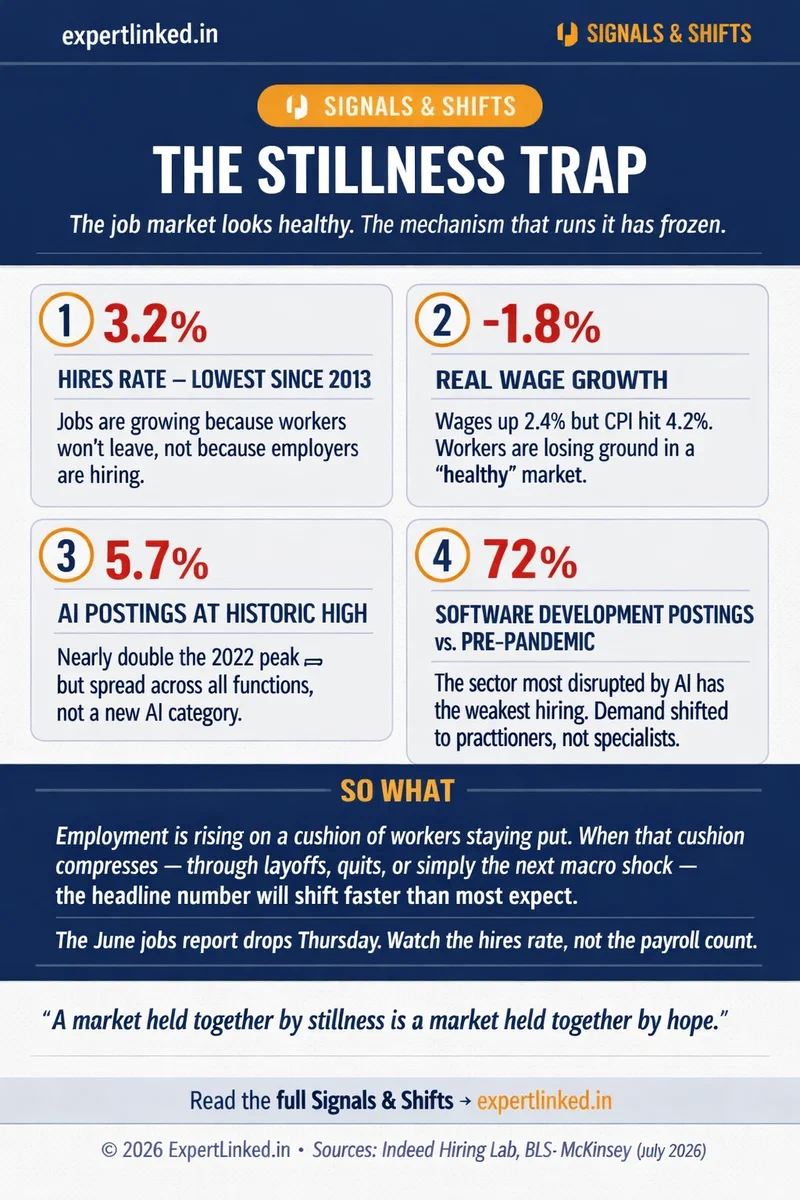
The hires rate in April sat at 3.2% — a level last seen during the long crawl out of the Great Recession in 2013. The separation rate sits at 3.1%, even lower. The net employment gain is positive not because employers are opening the front door at a meaningful pace but because almost nobody is walking out the back (Indeed Hiring Lab, June 18, 2026). Add fewer departures than arrivals across 160 million US jobs, and the payroll count climbs. The math is not wrong. What it describes is not a boom.
The quits rate at 1.9% in May has now been below 2% for nearly a year straight — well below the pre-pandemic norm and half the 3% peak workers hit during the Great Resignation era of 2022 (Indeed Hiring Lab, June 30, 2026). Workers tend to quit when they believe something better is within reach. The data is a consistent read on that belief right now: they don’t. The leisure and hospitality quits rate dropped from 5.8% to 4.0% since 2022. The information sector dropped from 1.9% to 1.1%.
The uncomfortable implication: a market that depends on workers staying put to keep its numbers positive does not carry much of a cushion. Quits and layoffs have both been unnaturally quiet. Neither condition is permanent. “All it would take is an uptick in quits, layoffs, or other separations to lead to softer reports,” Indeed’s Cory Stahle wrote in June. That observation was made two weeks ago. Tomorrow morning, we get the first data point that will tell us whether the cushion is still intact.
Signal 2: In a “healthy” labor market, real wages just turned negative #
This is the one the headlines have mostly missed.
The Indeed Hiring Lab’s May 2026 snapshot shows posted wage growth at 2.4% year-over-year (Indeed Hiring Lab, June 18, 2026). That number trails inflation. CPI climbed to 4.2% year-over-year in May — the highest reading in more than three years, driven by gas prices running 40% above year-ago levels. Real wage growth is now approximately negative 1.8 percentage points.
Workers in an officially healthy labor market — unemployment at 4.3%, 7.6 million openings, employment rising — are earning less in purchasing power this year than last. That is not a rounding error. For a worker earning $80,000, it represents roughly $1,400 in lost real purchasing power over twelve months.
The wage tier breakdown makes the paradox more specific. Low-wage occupations are seeing the fastest nominal growth at 2.7% — and they are still losing ground to inflation (Indeed Hiring Lab, June 18, 2026). The workers at the bottom of the distribution are the most financially exposed, running hardest on the treadmill, and still falling behind. In Q1 2026, hourly wage growth in several white-collar sectors — industrial engineering, software development, data analytics — turned negative in absolute terms (Indeed Hiring Lab, May 28, 2026).
There is a structural element to the wage squeeze that makes it stickier than usual. The vacancy-to-unemployment ratio hit 1.0 in April — exactly one open job for every unemployed worker, compared to roughly 1.2 in 2019 (Indeed Hiring Lab, June 18, 2026). In a market with more open jobs than unemployed workers, workers have leverage. In a market at parity, they don’t. The leverage that allowed wage growth to outpace inflation during 2021–2023 has eroded. The inflation has not.
Signal 3: AI postings are at a historic high — and software development hiring is collapsing #
This one requires reading two numbers together, because each one alone sends the wrong signal.
AI-related job postings now represent 5.7% of all job postings on Indeed — nearly double the previous peak of 3.3% recorded in 2022, which itself felt remarkable at the time (Indeed Hiring Lab, June 18, 2026). At the same time, software development sector postings sit at 72% of their pre-pandemic baseline — the lowest among all tracked sectors, below financial services, below human resources, below every category except one.
Read separately, both look plausible: AI is hot, software development has been struggling since the correction. Read together, they describe something more specific and more consequential: employers are not primarily looking for AI specialists in a new category called “AI jobs.” They are looking for people in existing roles — marketing, finance, operations, healthcare, customer success — who can deploy AI to do something their organization actually needs done today. The 5.7% AI posting share is distributed across the job board, not concentrated in a new AI-engineer category.
McKinsey’s State of AI 2025 report supports this reading. Software engineers and data engineers are the most in-demand AI-related titles for hiring — but that demand is concentrated at organizations with over $5 billion in revenue that have already reached the AI scaling phase (McKinsey Global Survey on the State of AI, November 2025). For everyone else — the two-thirds of organizations still in the experimenting or piloting stage — the AI hire they need is not a specialist. It is a practitioner in an existing domain who has enough AI fluency to redesign the workflow they already own.
Software development postings at 72% is a sector-level signal that AI is substituting within that function — collapsing entry-level and mid-level roles while concentrating demand at the high end. The roles being posted in tech are not disappearing; they are narrowing. The 5.7% AI posting surge is the demand signal for what replaces them across the rest of the economy: embedded practitioners, not specialists.
The shift to make this week #
1) Read tomorrow’s jobs report for the hires rate, not the payroll number. The June employment situation releases Thursday morning at 8:30 AM ET. Every outlet will lead with the headline payroll figure. What actually matters is the hires rate. If it stays at 3.2% or drops, the growth engine is still running on stillness. If it ticks up meaningfully, the underlying dynamic is improving. The payroll number is the output; the hires rate is the mechanism. Watch the mechanism.
2) If your compensation hasn’t moved more than 4% in the past twelve months, you’ve already taken a real pay cut. CPI at 4.2% is not an abstraction. It is purchasing power you have lost. The time to negotiate is not when the market softens — it is now, while the headline numbers are still favorable and before tomorrow’s report changes the narrative. Frame it on market data (wage growth 2.4% YoY, inflation 4.2%) rather than personal need. That framing holds up in a conversation.
3) The AI job you want is not labeled “AI.” If you are trying to reposition toward roles that participate in the 5.7% AI posting surge, do not search for “AI specialist.” Look at the functions where AI deployment is growing: marketing analytics, healthcare operations, financial modeling, customer success. Identify where your current domain expertise sits adjacent to a workflow that AI is visibly transforming. That is where the AI premium accrues — to practitioners who own the context, not to specialists who only own the tool.
The June jobs report drops tomorrow morning. The consensus expects another solid headline. But the more revealing story will be whether the hires rate — stuck at 2013 lows — shows any sign of movement. A market built on workers not moving is a market balanced on the assumption that nothing changes. That assumption has held through a remarkable stretch of data. The question heading into Q3 is not whether the labor market is healthy. It is how much longer it can stay still.
References #
- Indeed Hiring Lab. (June 30, 2026). “May 2026 JOLTS Report: More of the Same.” https://www.hiringlab.org/2026/06/30/may-2026-jolts-report-more-of-the-same/ (Accessed July 1, 2026)
- Indeed Hiring Lab. (June 18, 2026). “Strong Job Gains, Weak Hiring.” https://www.hiringlab.org/2026/06/18/strong-job-gains-weak-hiring/ (Accessed July 1, 2026)
- Indeed Hiring Lab. (June 18, 2026). “US Labor Market Snapshot — May 2026.” https://www.hiringlab.org/2026/06/18/us-labor-market-snapshot-may-2026/ (Accessed July 1, 2026)
- Indeed Hiring Lab. (May 28, 2026). “Pay for Salaried Workers Is Rising Faster Than Hourly Wages.” https://www.hiringlab.org/2026/05/28/pay-for-salaried-workers-is-rising-faster-than-hourly-wages/ (Accessed July 1, 2026)
- McKinsey Global Institute. (November 2025). “The State of AI in 2025: Agents, Innovation, and Transformation.” https://www.mckinsey.com/capabilities/quantumblack/our-insights/the-state-of-ai (Accessed July 1, 2026)
- U.S. Bureau of Labor Statistics. (June 5, 2026). “The Employment Situation — May 2026.” https://www.bls.gov/news.release/empsit.nr0.htm (Accessed July 1, 2026)
AI Content Notice
This article was created using artificial intelligence technology. Whenever possible, we include references and sources to support the information presented. Readers are encouraged to consult these sources for further information. While we strive for accuracy and provide valuable insights, readers should independently verify information and use their own judgment when making business decisions. The content may not reflect real-time market conditions or personal circumstances.
Related Articles
Infographic: Signals & Shifts: The Stillness Trap
Employment is rising but hiring is not: the labor market is being held up by workers staying put, …
Briefing Room: May 2026
May 2026 confirmed what the data has been building toward for months — AI is pulling up the bottom …
Signals & Shifts: Inside, Outside, and Patching
New data from Indeed and the BLS reveals that the labor market is now producing three distinct …