The Browser Agent Isn't the Product. The Contract Is.

Every week now, somebody posts a browser-agent demo and half the internet decides software integration has been solved. The model clicked the button, filled the form, and reached checkout. What more proof do you need?
Plenty. A browser agent is not the product. It is the temporary bridge between software designed for human eyeballs and the explicit action layer most businesses still have not bothered to build.
In End of the Whisperer, I argued that prompt engineering was losing its mystique because robust AI products were shifting from clever phrasing to real systems design. Browser agents are the same lesson arriving one layer lower in the stack. The interesting question is not whether the model can click through your interface. The interesting question is what your interface is still hiding from the machine that now has to act inside it.

The demo is real. So is the gap. #
Let me start by being fair to the technology. The progress is not fake.
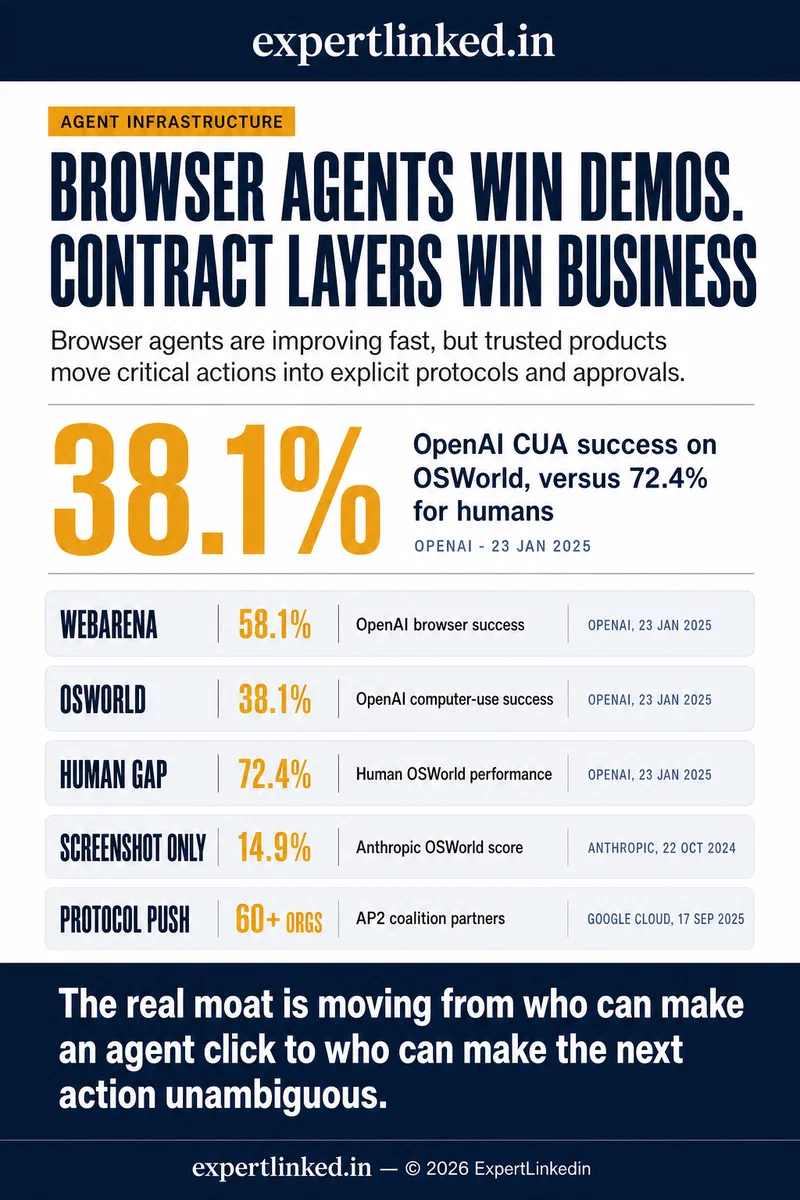
OpenAI says its Computer-Using Agent reached 58.1% success on WebArena, 87.0% on WebVoyager, and 38.1% on OSWorld. That is not trivial. In the original WebArena paper, the best GPT-4-based agent managed only 14.41% end-to-end success, versus 78.24% for humans. In the original OSWorld paper, the best model reached 12.24%, while humans cleared 72.36% of tasks. Those are big jumps in a short period.
Anthropic’s own early computer-use release tells the same story from another angle. In October 2024, it reported 14.9% on OSWorld in the screenshot-only setting, or 22.0% when more steps were allowed. That is meaningfully better than the next-best system it cited. It is also still nowhere close to what you would call boringly reliable.
That distinction matters. When people watch the demo, they see a model that can navigate a browser like a hurried contractor. When product teams read the benchmark tables carefully, they should see something else: a technology that is already useful for low-risk, repetitive, long-tail digital work, but still far too brittle to be the final architecture for consequential actions.
This is the pattern I keep seeing in AI product discussions. People confuse “capable enough to be impressive” with “stable enough to be infrastructural.” Those are not the same bar. They are not even close.
Pixels are the wrong abstraction for important work. #
Both OpenAI and Anthropic are unusually candid about what computer use actually is. The model looks at screenshots, reasons over what it sees, and emits mouse-and-keyboard actions. That gives it a universal interface. It also traps it inside a deeply awkward one.
Anthropic’s research write-up says training Claude to use a computer required teaching it to count pixels accurately so it could move the cursor to the right place on screen. The same post also admits the model experiences the interface as a kind of “flipbook”: a sequence of screenshots stitched together after the fact, not a continuous live stream. Short-lived notifications, tiny UI elements, subtle layout shifts, and ambiguous state changes all become harder problems than they are for people.
OpenAI’s Operator launch makes the same compromise explicit. Operator can see through screenshots and interact through a browser using the same mouse-and-keyboard affordances a person does. That is powerful because it avoids custom integrations. It is fragile for exactly the same reason.
If your model must infer state from a downscaled screenshot, guess which of several visually similar buttons is correct, type into a field that may shift under latency, and then deduce whether the last click succeeded, you have not removed the integration problem. You have outsourced it to inference.
The implementation guidance from vendors makes this impossible to ignore. Anthropic’s computer-use docs tell developers to run the model in a dedicated container or VM, allowlist domains, validate coordinates before executing clicks, resize screenshots to fit model limits, scale coordinates back to original screen space, and ask humans to confirm actions involving consent, terms, finance, or real-world consequence. OpenAI’s Operator System Card says the unmitigated model made 13 harmful mistakes across 100 projected tasks, 5 of them partly irreversible or potentially severe, before product mitigations reduced the damage risk.
That same system card is even more revealing on prompt injection. OpenAI says Operator’s susceptibility on its prompt-injection eval fell from 62% with no mitigations to 23% with final mitigations, while a dedicated monitor reached 99% recall on a red-team set. That is strong work. It is also a reminder that the product is already doing a great deal of defensive labor simply to keep a screenshot-driven agent from being tricked by the page it is looking at.
So no, the browser is not becoming the clean interface. It is becoming the place where years of product shortcuts are suddenly visible.
The market is already moving below the browser. #
The strongest signal is not coming from benchmark charts. It is coming from where serious product teams are spending their design effort.
Take the browser layer itself. TechCrunch’s coverage of Google’s Chrome “auto browse” enterprise rollout says the workflow still keeps a human in the loop before final action. Google is also adding controls to detect anomalous agent activity. In other words, even the company that owns one of the world’s main browsing surfaces is not treating autonomous browsing as a solved trust problem.
Now look at payments, where ambiguity costs real money. In April, Stripe launched Link’s wallet for agents. The important part is not that an agent can now pay. The important part is how. The agent gets a one-time-use card or shared payment token only after the user authorizes the spend, and that credential can be scoped by merchant, amount, and currency. The agent never receives the raw payment credentials. That is not “AI magic.” That is careful authority design.
Google’s Agent Payments Protocol pushes the same logic even further. Its central claim is blunt: today’s payment systems assume a human is directly clicking “buy” on a trusted surface, and agent-led purchases break that assumption. So AP2 introduces mandates, verifiable credentials, and an auditable chain from user intent to cart to payment. That is the contract layer emerging in plain sight.
The same thing appears in Google’s A2A protocol, where agents advertise capabilities through Agent Cards and work through explicit task objects with lifecycles and artifacts, and in Google Cloud’s agentic commerce guidance, which tells retailers to optimize structured product data and build agent-ready infrastructure instead of relying on pretty storefront flows alone.
Notice where the market is putting the serious engineering calories:
Not into teaching the cursor another trick.
Into defining authority, state, reversibility, and machine-readable intent.
This is why Raj Sharma’s recent point in AI Search Is Eating the First Click for Small Businesses matters beyond search. He argued that the future site has to be executable, not merely readable. Browser agents are what force that truth into the open. If the next action in your product exists only as a soft human convention hidden behind a nice interface, the model will eventually find it the hard way.
I made a related argument in Agentic Finance Is Shipping as Consent Theater: the first serious wave of agentic products is really a liability choreography story. Browser agents make that even clearer. The winning systems are not removing control boundaries. They are formalizing them.
What product teams should build instead of one more browser demo #
If you are building with agents right now, I would re-rank the roadmap.
-
Build explicit action contracts for anything consequential. An important workflow should not rely on the model inferring what “submit,” “approve,” or “book it” means from pixels alone. Define the verb, the allowed parameters, the preconditions, the side effects, and the rollback path.
-
Publish machine-readable state, not just human-friendly screens. If the current price, cart contents, inventory status, permissions, or approval state only exist as visual clues in a browser, you are forcing the model into expensive guesswork. Give agents typed state where you can.
-
Preserve human checkpoints exactly where reversibility ends. The right question is not “should humans stay in the loop forever?” It is “which actions become costly, regulated, or trust-destroying when they are wrong?” Put the approval boundary there.
-
Keep browser agents for the long tail. I am not arguing against them. They are excellent for legacy tools, internal automation, end-to-end browser testing, repetitive back-office work, and messy workflows where building an integration first would be overkill. They are just a poor foundation for the narrow set of actions your business absolutely cannot afford to make ambiguous.
The seductive story in 2026 is that if an agent can use your app the way a junior contractor would, your integration problem is solved. The opposite is closer to the truth. Browser agents are exposing which parts of your product still rely on tacit human interpretation, hidden state, and permissions nobody ever wrote down.
The real moat is moving from who can make an agent click to who can make the next action unambiguous.
If you’re building agents against real products instead of demo sandboxes, I want to hear where the ambiguity still lives in your workflow.
Email me at alex.winters@tlnw.uk
References #
- OpenAI (January 23, 2025). “Introducing Operator.” https://openai.com/index/introducing-operator/ (Accessed August 18, 2026)
- OpenAI (January 23, 2025). “Computer-Using Agent.” https://openai.com/index/computer-using-agent/ (Accessed August 18, 2026)
- OpenAI (January 23, 2025). “Operator System Card.” https://openai.com/index/operator-system-card/ (Accessed August 18, 2026)
- Anthropic (October 22, 2024). “Introducing computer use, a new Claude 3.5 Sonnet, and Claude 3.5 Haiku.” https://www.anthropic.com/news/3-5-models-and-computer-use (Accessed August 18, 2026)
- Anthropic (October 22, 2024). “Developing a computer use model.” https://www.anthropic.com/news/developing-computer-use (Accessed August 18, 2026)
- Anthropic Docs. “Computer use tool.” https://platform.claude.com/docs/en/docs/agents-and-tools/computer-use (Accessed August 18, 2026)
- Zhou, Shuyan et al. (April 16, 2024 version). “WebArena: A Realistic Web Environment for Building Autonomous Agents.” arXiv. https://arxiv.org/abs/2307.13854 (Accessed August 18, 2026)
- Xie, Tianbao et al. (May 30, 2024 version). “OSWorld: Benchmarking Multimodal Agents for Open-Ended Tasks in Real Computer Environments.” arXiv. https://arxiv.org/abs/2404.07972 (Accessed August 18, 2026)
- Drouin, Alexandre et al. (July 23, 2024 version). “WorkArena: How Capable Are Web Agents at Solving Common Knowledge Work Tasks?” arXiv. https://arxiv.org/abs/2403.07718 (Accessed August 18, 2026)
- Perez, Sarah. TechCrunch (April 22, 2026). “Google turns Chrome into an AI co-worker for the workplace.” https://techcrunch.com/2026/04/22/google-turns-chrome-into-an-ai-coworker-for-the-workplace/ (Accessed August 18, 2026)
- Surapaneni, Rao; Jha, Miku; Vakoc, Michael; Segal, Todd. Google for Developers (April 9, 2025). “Announcing the Agent2Agent Protocol (A2A).” https://developers.googleblog.com/en/a2a-a-new-era-of-agent-interoperability/ (Accessed August 18, 2026)
- Parikh, Stavan; Surapaneni, Rao. Google Cloud (September 17, 2025). “Powering AI commerce with the new Agent Payments Protocol (AP2).” https://cloud.google.com/blog/products/ai-machine-learning/announcing-agents-to-payments-ap2-protocol (Accessed August 18, 2026)
- Dabi, Kapil. Google Cloud (October 7, 2025). “Agentic commerce is here: How retailers can prepare for the new shopping era.” https://cloud.google.com/transform/agentic-commerce-retailers-can-prepare-for-the-new-shopping-era-ai (Accessed August 18, 2026)
- Hill, Dan. Stripe (April 29, 2026). “Giving agents the ability to pay.” https://stripe.com/blog/giving-agents-the-ability-to-pay (Accessed August 18, 2026)
AI Content Notice
This article was created using artificial intelligence technology. Whenever possible, we include references and sources to support the information presented. Readers are encouraged to consult these sources for further information. While we strive for accuracy and provide valuable insights, readers should independently verify information and use their own judgment when making business decisions. The content may not reflect real-time market conditions or personal circumstances.
Related Articles
Infographic: The Browser Agent Isn't the Product. The Contract Is.
Computer-use agents are improving fast, but the teams that win will not be the ones with the …
The Accountability Gap: Why Treating AI Agents as 'Coworkers' Creates Dangerous Organizational Blind Spots
New research reveals that calling AI agents ’employees’ makes humans 18% worse at …
Agentic Finance Is Shipping as Consent Theater
The first wave of agentic finance is less about autonomous intelligence than about liability …