You Own the Deliverable but Not the Decision - and What to Do About That in Q3 2026

The most exhausting sentence in late-summer work is often not “We need this faster.” It is “You own it” – spoken to someone who does not own the budget, the staffing, the final approval, or the tradeoff when two senior people want different things.

“I am leading a cross-functional launch for a new client workflow. The launch date is mine to defend, the deck is mine to rewrite, and the stakeholder updates are mine to send. But pricing sits with finance, legal has veto power on two open issues, product keeps changing scope, and my manager keeps telling me to ‘drive alignment’ without naming who actually gets the final say when the functions disagree. When the timeline slips, the tension lands on me anyway. I am starting to dread every status meeting because I feel accountable for outcomes I do not have the authority to shape. How do I tell whether I need to be stronger or whether this setup is simply broken?” – Senior program manager, healthcare software company
This is the authority version of the pattern Emily Chen described in The Manager’s AI Accountability Gap, the middle-layer overload I wrote about in The Manager’s Survivor Penalty: When You’re Absorbing Your Team’s Overload and Your Director’s Too, and the one-way access transfer I named in Always-On Flexibility at Work in August 2026 - Here’s the Clinical Read and the 3-Move Response. Those pieces were about hidden governance work, overload, and access. This one is about hidden authority transfer. Someone is expected to land the work, absorb the deadline risk, and keep the system calm, but nobody has clearly said who gets to choose the tradeoffs when priorities collide.
The Clinical Read #
The most useful anchor here is Harvard Business Review’s What Companies Get Wrong About Decision Rights. The article makes a point many overloaded professionals feel before they can name it: decision-rights tools do not fail because nobody has heard of RACI. They fail because teams treat them like static paperwork instead of behavior. Only one person should be accountable for a given decision. The responsible role should usually be limited to the few people with critical input. Consulted or informed stakeholders still matter, but they are not the final decision team. When that line collapses, meetings get bigger, debate gets noisier, and the person closest to the deadline starts carrying risk that was supposed to be distributed more intelligently.
The same HBR piece also explains why the confusion persists: teams assign roles before defining the real goal, assume people will obey a spreadsheet they did not help shape, misunderstand what each role means in practice, and let the same senior people act as if they are accountable for everything. That is the late-summer trap. A worker may be told to own delivery on paper while someone more senior continues to behave like the real decider whenever tension appears.
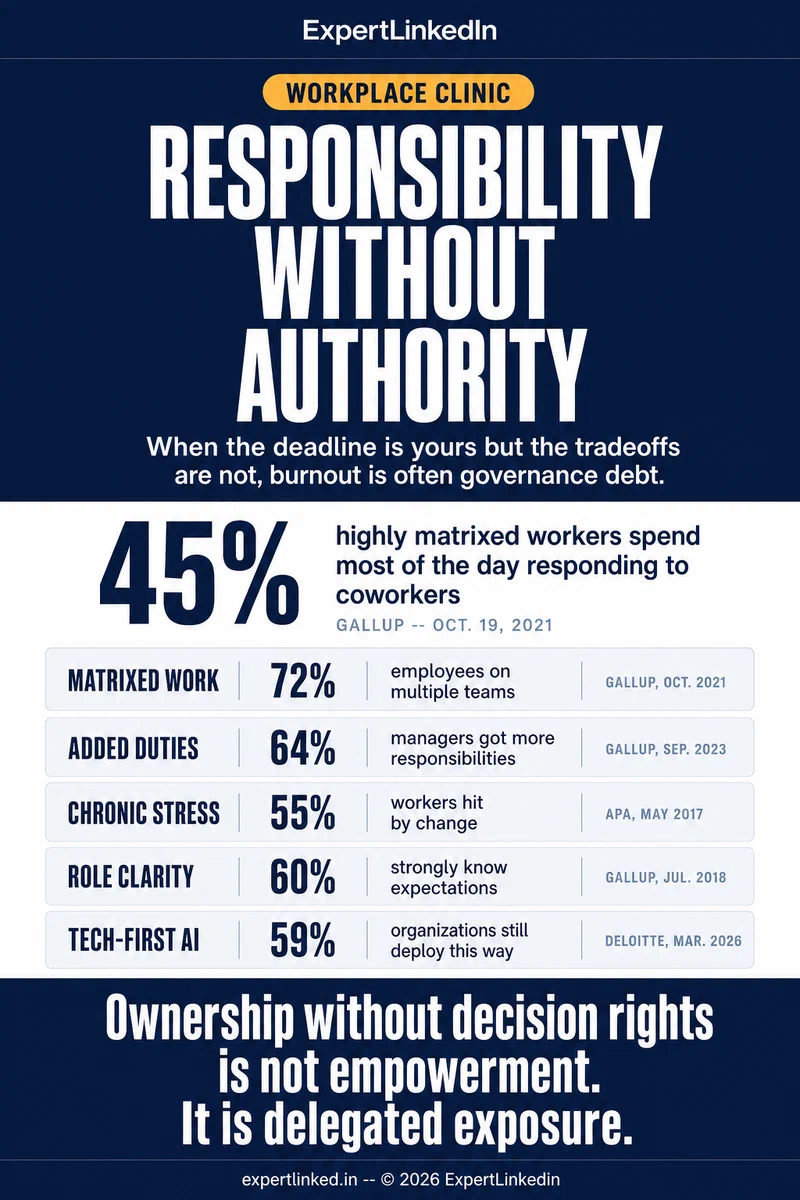
Gallup’s Too Many Teams, Too Many Bosses: Overcoming Matrix Madness shows what this looks like at scale. In Gallup’s 2019 study, 72% of employees were already working on matrixed teams, and 45% of highly matrixed workers said they spent most of their day responding to requests from coworkers. The key line for this article is about role conflict and role ambiguity: when people work across teams for multiple managers, the work often comes with unclear expectations about what to do and which decisions they do or do not have the authority to make. Gallup’s practical clue is just as important: employees whose manager continually clarifies priorities are 3.8 times as likely to be engaged and 53% less likely to feel burned out. Clarity is not cosmetic. It is a performance and wellbeing variable.
Harvard Business Review’s The False Alignment Trap explains why the burden so often lands downstream. The authors distinguish alignment from agreement. Leaders may say they are aligned because they are not openly fighting, but if they have not agreed on why the change is happening, what exactly is changing, and how it will occur, teams fall into paralysis, hyperactivity, or tunnel vision. That is the trap hiding inside so much polite late-summer language. “Drive alignment” can sound like a compliment. Too often it means, “Carry the discomfort until someone more senior is ready to look at the disagreement we never resolved.”
And yes, it shows up physiologically. Gallup’s Employee Burnout, Part 1: The 5 Main Causes remains blunt that burnout is strongly shaped by how work is designed and managed. Its top drivers include unmanageable workload, lack of role clarity, lack of communication and support, and unreasonable time pressure. APA’s 2017 Work and Well-Being survey release adds the human cost of organizational change: workers affected by change were more than twice as likely to report chronic work stress and more than three times as likely to plan to leave within the year. So if this kind of role leaves you tense, cynical, and disproportionately tired, that is not melodrama. It is a normal response to a system that moved responsibility faster than it moved authority.
August 2026 sharpens the mismatch because the broader environment keeps pushing in the wrong direction. Gallup’s The Manager Squeeze found added responsibilities and restructured teams across the manager layer. Atlassian’s State of Teams 2026 found that 89% of executives say AI increases speed while 87% of knowledge workers say teams no longer have the time or capacity to coordinate. Deloitte’s 2026 Global Human Capital Trends adds the design problem underneath: organizations are still underbuilding the decision-rights and accountability layer that should make faster work workable.
What the Authority Gap Actually Does #
When the deliverable is yours but the decision is not, the job quietly mutates. You become the courier for other people’s unresolved choices, the interpreter of vague signals, and the emotional shock absorber for delays you cannot independently prevent. Because the work still has to ship, the stress gets privatized. You keep the meeting civil, chase the answer again, and teach the organization that the current setup is survivable.
That is the danger. If you keep rescuing the work, Q4 will record the rescue as ordinary capacity. This is why I think a meaningful share of burnout is really governance debt. The design flaw is being financed by one conscientious nervous system at a time.
The 3-Move Response #
Move 1: Draw the decision-gap map #
Do not start with a feelings speech. Start with a map.
For the current deliverable, list five things:
- the output you are being held to
- the decisions that determine whether it can ship
- who actually has the final say on each decision now
- when each decision must be made to protect the deadline
- what risk shows up if the decision stays unresolved
This usually reveals the real problem quickly. Many readers can own coordination, sequencing, status updates, and escalation. They do not own legal signoff, pricing exceptions, resourcing choices, scope freezes, or which stakeholder preference outranks another.
Use language like this: “I can own coordination of this deliverable. I cannot privately own the unresolved decisions that determine whether it lands on time. Here is where the gap currently sits.” That sentence separates ownership from exposure.
Move 2: Replace vague alignment with decision rules #
Once the gap is visible, stop asking for “better communication” and start asking for rules.
Harvard Business Review’s decision-rights article and the Center for Creative Leadership’s January 2026 piece on collective sensemaking point in the same direction. Teams need clarity on direction, coordination, and mutual responsibility before they ask one person to execute. In plain English, that means answering a few questions explicitly:
- What exact decision are we making?
- Who has final say?
- Whose input is critical before that call is made?
- What criteria will be used to choose between speed, quality, cost, and risk?
- What happens if no answer is given by the decision deadline?
If those questions stay fuzzy, you are not aligned. You are busy.
One useful script is: “Before I keep driving this forward, I need the decision path named. Who owns the final call on scope, who owns the final call on approval, and what tradeoff rule should I apply if those priorities conflict?” That is not being difficult. It is refusing to let a political gap masquerade as a personal execution gap.
Move 3: Make leadership choose the trade-off #
If authority will not move, then something else has to.
Make the choice explicit:
- “If the deadline is fixed, I need one named final approver and one escalation path.”
- “If the current approval structure stays, we need more time buffer.”
- “If all priorities remain open, the cost will show up as after-hours coordination, more rework, and weaker quality control.”
The Center for Creative Leadership’s work on change fatigue is useful here too. People judge change by whether they have the time, tools, and energy required to absorb it. Deloitte makes the same point from a systems angle when it warns that unclear ownership, accountability, and trust create cultural debt as workflow change accelerates. Your job is not to make every contradiction costless. Your job is to make the cost visible enough that someone with actual authority has to participate in it.
What Not to Let Q4 Do #
Q4 planning has a special talent for turning temporary ambiguity into permanent role design. A professional who keeps saving the work in August and September is often treated in October as proof that the operating model works.
Do not let that happen quietly. The danger is not only that you will work too much. It is that the organization will learn the wrong lesson from your competence. The most conscientious person in the chain becomes the unofficial subsidy for a design problem nobody wanted to name.
You are not failing at ownership. You are subsidizing a system that kept the deliverable on your desk and the decision somewhere else.
Ownership without decision rights is not empowerment. It is delegated exposure.
Living inside a version of this? Send it. The most revealing workplace problems are often the ones still being described as leadership opportunities instead of authority gaps.
Email me at olivia.bennett@tlnw.uk.
References #
- American Psychological Association (May 24, 2017). “Change at Work Linked to Employee Stress, Distrust and Intent to Quit, New Survey Finds.” https://www.apa.org/news/press/releases/2017/05/employee-stress (Accessed August 21, 2026)
- Atlassian (April 27, 2026). “The State of Teams 2026.” https://www.atlassian.com/blog/state-of-teams-2026 (Accessed August 21, 2026)
- Center for Creative Leadership (January 20, 2026). “Collective Sensemaking in an Environment of Constant Disruption.” https://www.ccl.org/articles/leading-effectively-articles/collective-problem-solving-sensemaking-steps-for-leadership-teams/ (Accessed August 21, 2026)
- Center for Creative Leadership (July 30, 2025). “How To Overcome Change Fatigue & Lead Workplace Change.” https://www.ccl.org/articles/leading-effectively-articles/change-fatigue-continual-evolution/ (Accessed August 21, 2026)
- Deloitte (March 4, 2026). “2026 Global Human Capital Trends.” https://www.deloitte.com/us/en/insights/topics/talent/human-capital-trends.html (Accessed August 21, 2026)
- Gallup (July 12, 2018). “Employee Burnout, Part 1: The 5 Main Causes.” https://www.gallup.com/workplace/237059/employee-burnout-part-main-causes.aspx (Accessed August 21, 2026)
- Gallup (September 5, 2023). “The Manager Squeeze: How the New Workplace Is Testing Team Leaders.” https://www.gallup.com/workplace/510326/manager-squeeze-new-workplace-testing-team-leaders.aspx (Accessed August 21, 2026)
- Gallup (October 19, 2021). “Too Many Teams, Too Many Bosses: Overcoming Matrix Madness.” https://www.gallup.com/workplace/354935/teams-bosses-overcoming-matrix-madness.aspx (Accessed August 21, 2026)
- Harvard Business Review (July 2026). “The False Alignment Trap.” https://hbr.org/2026/07/the-false-alignment-trap (Accessed August 21, 2026)
- Harvard Business Review (July 2026). “What Companies Get Wrong About Decision Rights.” https://hbr.org/2026/07/what-companies-get-wrong-about-decision-rights (Accessed August 21, 2026)
AI Content Notice
This article was created using artificial intelligence technology. Whenever possible, we include references and sources to support the information presented. Readers are encouraged to consult these sources for further information. While we strive for accuracy and provide valuable insights, readers should independently verify information and use their own judgment when making business decisions. The content may not reflect real-time market conditions or personal circumstances.
Related Articles
Infographic: You Own the Deliverable but Not the Decision - and What to Do About That in Q3 2026
If the deadline is yours but the tradeoffs, approvals, and staffing decisions are not, you are not …
Always-On Flexibility at Work in August 2026 - Here's the Clinical Read and the 3-Move Response
If your employer can interrupt you anytime but you cannot go unavailable without reputation cost, …
Vacation Coverage Became Permanent Scope - and What to Do Before Fall 2026 Makes It Official
Temporary summer coverage often gets mistaken for permanent capacity. If August stretched your role, …