The Manager's AI Accountability Gap: Why Companies Promise Proof but Don't Measure It

The most quietly expensive employee in the AI economy is not the model engineer, the prompt specialist, or the executive buying another enterprise license. It is the manager standing between machine-generated speed and organizational accountability.
That person is the one checking whether the output is real, deciding whether it can leave the building, coaching juniors who now produce more faster than they understand, and explaining upward why the AI program still counts as progress even when the proof is thin. We keep talking about AI adoption as if the hard part is getting people to use the tools. The harder part is making the results legible, defensible, and trustworthy after the tools are already in use.

Adoption is rising faster than proof #
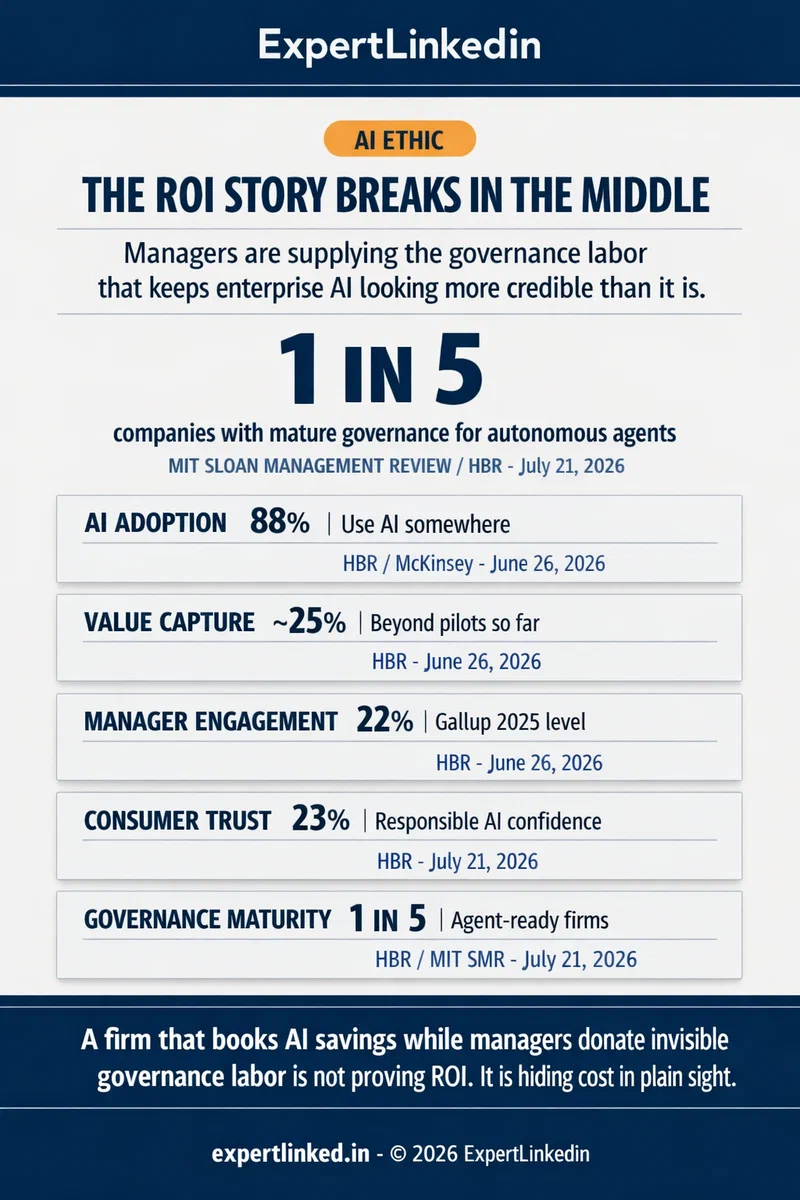
Harvard Business Review’s June research on middle managers puts the contradiction in plain view. Roughly 88% of organizations now use AI in at least one business function, but only about a quarter have developed the capabilities to generate tangible value beyond initial pilots. That gap is usually described as an execution problem. It is also a labor-allocation story.
Earlier this month, in The Amplifier Effect, I argued that AI does not replace expertise so much as amplify the expertise already inside a system. What that framing underplays is the connective tissue between amplified output and durable value. Someone has to decide which machine-generated work is good enough, where it is misleading, what still has to be checked by hand, and how it should be explained to the people who must act on it. In most organizations, that someone is not the vendor and not the executive sponsor. It is the middle layer of management.
That helps explain why adoption numbers look healthier than value numbers. License counts and usage dashboards are easy to capture. Managerial translation labor is not. It disappears into categories like review, coaching, quality control, and team leadership even when those categories have expanded dramatically because AI compressed execution time without compressing verification time.
The manager is becoming the hidden subsidy #
The HBR reporting is useful because it stays close to what managers are actually doing. They learn new prompting techniques before their teams log on. They answer clients asking how AI was used. They inspect AI-assisted deliverables for subtle errors. They document what worked so the next team does not have to rediscover it from scratch. Juniors, in the best cases, get role elevation. Senior leaders get a more compelling strategy story. Managers, by contrast, get role accretion.
That would be difficult under any conditions. It is worse in an environment where manager engagement fell from 30% in 2023 to 22% in 2025, the steepest decline of any employee group, and where AI is already being used to justify flatter structures rather than deeper support.
This is the part corporate ROI slides usually skip. When an organization says AI increased output, whose time was consumed making that output usable? When an organization says a team became more productive, who absorbed the extra review queue, exception handling, and coaching load that kept the new volume from turning into expensive noise? If those hours are real – and they are – then they belong in the return calculation.
The hidden subsidy behind a surprising number of AI wins is not the software alone. It is the manager whose judgment is quietly converting raw acceleration into something the organization can trust.
Accountability without interpretive power turns into fiction #
The July 22 HBR article When Employees Are Held Accountable for AI-Generated Decisions sharpens the problem. In a multi-year field study spanning banking, recruitment, and biotechnology, employees did not pass AI outputs onward untouched. They masked them, reinterpreted them, and sometimes quietly substituted their own explanations to preserve professional credibility.
At a German bank, loan officers had to justify predictive-AI loan decisions they could not override and often did not fully understand. At a consumer-goods company, recruiters tried to lean on AI-generated candidate scores to gain credibility with hiring managers, only to discover that the interpretive work still had to be done by humans and then vanished from view once it got embedded in the interface. Only the biotechnology case worked cleanly, and it worked for a reason organizations do not like to hear: the company funded the interpretive layer. Employees had access to the underlying data, regular feedback loops with developers, and the time to build a common language around the model’s judgments.
That is not a side detail. It is the point.
Accountability becomes ethically unstable when people are expected to defend AI-shaped decisions without the authority, visibility, or time to interrogate them. The result is not neutral. It is plausible fiction: explanations that sound competent enough to keep the meeting moving, the customer calm, or the executive confident, even when the real causal chain is hazy.
This is where the manager’s accountability gap becomes more than an efficiency story. Managers are increasingly the people expected to keep that fiction from escaping the building. They are the last human checkpoint before AI outputs harden into hiring decisions, customer explanations, client recommendations, internal strategy memos, or workflow standards. If they do not have the conditions required to perform that job well, the organization is not merely under-supporting managers. It is misrepresenting how trustworthy its AI operations actually are.
Trust is now a business variable, and most firms are underbuilt #
The trust numbers are worse than the adoption numbers. In Responsible AI Is Becoming a Growth Strategy, HBR cites the 2026 Thales Digital Trust Index: 93% of IT leaders already use, deploy, or plan AI initiatives, yet only 23% of consumers trust companies to handle AI and their data responsibly. The same piece notes that only one in five companies has a mature governance model for autonomous agents.
That is not a communications gap. It is an operating gap.
If an enterprise is deploying AI broadly while governance maturity remains rare, someone inside the system is bridging the distance between technical capability and social legitimacy. Often, again, it is the manager. The person who knows which workflow can tolerate AI assistance and which cannot. The person who can reconstruct why a tool was used in one case and blocked in another. The person who catches the edge case before it turns into reputational or legal damage.
Healthcare makes the same pattern unusually visible. In STAT’s Hospitals’ AI may be drifting. Who’s watching?, Peter Pronovost and coauthors argue that hospitals are governing AI with the institutional habits they once used for static devices: subcommittees, checklists, quarterly meetings, approval-or-rejection routines. That model was already strained. For dynamic AI systems drafting notes, flagging sepsis, screening imaging, and answering patient messages, it is dangerously slow and incomplete. The authors’ conclusion is direct: this is a senior-leadership problem, not an IT one.
The same is true outside healthcare. Governance is not the thing you do after rollout if something goes wrong. It is the condition under which rollout deserves to count as value creation at all. When firms treat governance as a thin afterlayer, the labor required to make AI usable does not disappear. It simply moves into human improvisation, usually in the management layer, where it is less visible and harder to budget honestly.
This is also how organizations create expertise debt #
The manager accountability gap becomes even more consequential when you look one layer down. McKinsey’s July essay Building expertise in the age of AI: Who trains the next generation? starts from a basic reality: tasks such as research, documentation, data cleanup, basic coding, and preliminary analysis are exactly the activities through which early-career workers used to build judgment. Those tasks are now being streamlined or absorbed into AI systems.
The article’s numbers are not abstract. Recent college-graduate unemployment stood at roughly 5.7% in the first quarter of 2026. About four in ten recent graduates were underemployed. Stanford Digital Economy Lab research found that workers aged 22 to 25 in the most AI-exposed occupations experienced a 16% relative decline in employment even after controlling for firm-level shocks.
McKinsey’s solution is not anti-AI nostalgia. It is deliberate redesign: knowledge management that captures how experts think, role design that turns AI into an answer key rather than an autopilot, learning in the flow of work, and manager upskilling so coaching shifts from task mechanics to judgment, context, and influence.
That last point is where this article meets The Entry-Level Trust Gap. If managers are buried under ever-thicker review queues, they are not spending that time coaching how to interpret, challenge, or contextualize AI-assisted work. The organization then accumulates two debts at once. First, governance debt: not enough structure to prove value or responsibility cleanly. Second, expertise debt: not enough deliberate formation of the people who will be asked to carry those responsibilities next.
That is why the accountability gap matters far beyond manager burnout. It is not only overwork in the present. It is capability erosion in the future.
What real proof would actually require #
Brookings’ June framework on AI’s coming impacts on work and workers argues that institutions keep reaching for silver bullets when what they need is a wider repertoire: brakes, steers, buffers, and shifts. Inside companies, the equivalent mistake is thinking that usage dashboards and a few vendor case studies amount to proof.
Real proof is slower and less flattering.
It looks like a named owner for every consequential AI system, an idea HBR’s July trust piece borrows from model-risk inventories in regulated sectors. It looks like workflow metrics that compare cycle time, error rates, rework, escalation volume, and customer or client outcomes instead of mistaking session counts for value. It looks like protected time for managers to document what works, share review techniques, and participate in the cross-functional loops that make AI behavior legible rather than mystical. It looks like organizations explicitly rewarding interpretive expertise – the work of improving, questioning, and explaining AI outputs – instead of letting it vanish into the software and crediting the machine alone.
That design work is not academic. HBR’s July 20 essay on strengthening human reasoning argues that AI systems can erode contextual judgment unless organizations deliberately create AI-free thought space, parallel review, and interfaces that force deliberation rather than passive acceptance.
It also looks like honesty.
McKinsey’s 2025 State of AI found broad adoption but much thinner measurable EBIT impact. BetterUp’s 2025 research on workslop found that 54% of managers had received polished, plausible AI-generated work that ultimately created more drag than value, costing employees an average of one hour and 51 minutes to deal with each instance. Those numbers belong in the same conversation. One tells you why executives are still chasing returns. The other tells you where some of the missing margin went.
If AI only works because managers donate invisible governance labor, the savings are not as real as the deck suggests.
The firms that will get durable value from AI are not the ones that merely deploy the tools more widely. They are the ones that stop treating managerial judgment as free infrastructure. A firm that books AI savings while managers donate invisible governance labor is not proving ROI. It is hiding cost in plain sight.
Seen this accountability gap inside your own organization, or found a team that actually measures AI value honestly? I want the details that never make it into the rollout deck.
Email me at emily.chen@tlnw.uk
References #
- Harvard Business Review (June 26, 2026). “AI Adoption Is Overloading Your Middle Managers.” https://hbr.org/2026/06/ai-adoption-is-overloading-your-middle-managers (Accessed July 23, 2026)
- Harvard Business Review (July 22, 2026). “When Employees Are Held Accountable for AI-Generated Decisions.” https://hbr.org/2026/07/when-employees-are-held-accountable-for-ai-generated-decisions (Accessed July 23, 2026)
- Harvard Business Review (July 21, 2026). “Responsible AI Is Becoming a Growth Strategy.” https://hbr.org/2026/07/responsible-ai-is-becoming-a-growth-strategy (Accessed July 23, 2026)
- Harvard Business Review (July 20, 2026). “Design AI Systems That Actually Strengthen Human Reasoning.” https://hbr.org/2026/07/design-ai-systems-that-actually-strengthen-human-reasoning (Accessed July 23, 2026)
- STAT (July 22, 2026). “Hospitals’ AI may be drifting. Who’s watching?” https://www.statnews.com/2026/07/22/hospital-ai-systems-ceo-leadership-accountability-governance/ (Accessed July 23, 2026)
- McKinsey & Company (July 14, 2026). “Building expertise in the age of AI: Who trains the next generation?” https://www.mckinsey.com/capabilities/people-and-organizational-performance/our-insights/building-expertise-in-the-age-of-ai-who-trains-the-next-generation (Accessed July 23, 2026)
- Brookings (June 29, 2026). “Getting to all-of-the-above: A framework of solutions for AI’s coming impacts on work and workers.” https://www.brookings.edu/articles/ai-workforce-policy-framework/ (Accessed July 23, 2026)
- McKinsey & Company (November 5, 2025). “The State of AI: How organizations are rewiring to capture value.” https://www.mckinsey.com/capabilities/quantumblack/our-insights/the-state-of-ai (Accessed July 23, 2026)
- BetterUp Labs (September 29, 2025). “The hidden costs of workslop.” https://www.betterup.com/blog/hidden-costs-workslop (Accessed July 23, 2026)
AI Content Notice
This article was created using artificial intelligence technology. Whenever possible, we include references and sources to support the information presented. Readers are encouraged to consult these sources for further information. While we strive for accuracy and provide valuable insights, readers should independently verify information and use their own judgment when making business decisions. The content may not reflect real-time market conditions or personal circumstances.
Related Articles
Infographic: The Manager's AI Accountability Gap: Why Companies Promise Proof but Don't Measure It
The hidden subsidy behind enterprise AI is the manager translating machine-generated speed into work …
Capex Is Eating Payroll — and We Still Call It Productivity
This week’s layoffs-and-capex cycle reveals that AI workforce risk is less about automation magic …
LinkedIn's AI Writing Reality Check: Why Smart Workers Are Choosing Authenticity Over Automation
Explore why LinkedIn’s AI writing assistant failed to gain traction and what this reveals …