The Amplifier Effect: What AI Gets Backwards About Human Value

The AI productivity story being told in 2026 has a flattering, dangerous flaw: it treats expertise as a cost center that AI will displace, rather than the signal AI is built to amplify.
Three organizations proved otherwise this week. One builds trucks. One builds AI models. One moves money. Their findings converge on the same conclusion — and it should reframe every conversation happening right now about who gets to benefit from the AI era.
What Ford Actually Admitted #
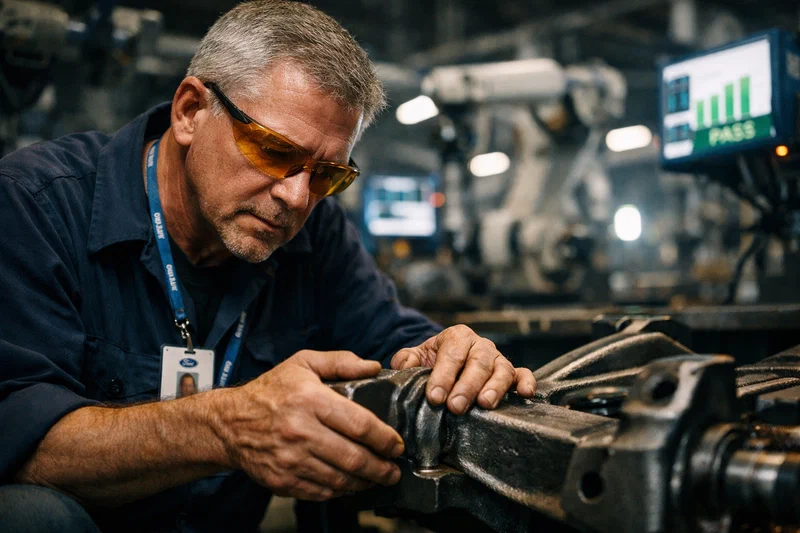
Bloomberg reported June 25 that Ford has been quietly rehiring veteran quality engineers — some former employees, others drawn back from suppliers — after its automated inspection systems failed to deliver projected quality gains. The company’s chief operating officer, Kumar Galhotra, told journalists Ford had been “relying more and more on automated quality systems” with disappointing results. The company responded by bringing back “technical specialists” who “hunt for failure points before a part ever reaches the plant floor.”
Ford vice president of vehicle hardware engineering Charles Poon offered the most precise autopsy of the experiment: “Mistakenly we thought that by just introducing artificial intelligence and ingesting the design requirements that we had, that that would produce a high-quality product.”
Three hundred and fifty rehired engineers later, Ford sits at the top of the JD Power Initial Quality Survey for mainstream brands. CEO Jim Farley credited the program with contributing “hundreds and hundreds of millions of dollars of a tailwind for Ford on cost” through reduced warranty and recall expenses.
Poon’s word — “mistakenly” — is worth sitting with. The assumption was that quality knowledge could be extracted from design documents and loaded into an AI model. The reality was that the knowledge Ford needed was not in the documents. It was in the people who had spent careers watching things go wrong before the data system had a chance to record it.
The gray-beard engineers are not replacing the AI inspection systems. They are training them — and catching, with decades of tacit pattern recognition, the failure modes the models never encountered in training.
The Same Lesson, Faster, in Software #
The same dynamic played out in compressed form inside Anthropic’s own engineering organization. VentureBeat reported June 28 that Claude Code had effectively tripled the output of Anthropic’s engineering team — and the company’s response was not to cut engineers. It was to hire more product managers.
The bottleneck moved from implementation to judgment. Engineers who previously waited for a ticket now ship complete features faster than the product function can decide what to build. The traditional 1:8 PM-to-engineer ratio now operates closer to 1:20 at organizations running agentic workflows in production.
Anthropic is not alone in confronting this. LinkedIn replaced its associate product manager track with a “Product Builder” program, training generalists across product, design, and engineering simultaneously. Amazon’s Kiro IDE team compressed two-week feature builds to two days using spec-driven agentic workflows. An AWS engineering team completed an 18-month rearchitecture project — originally scoped for 30 engineers — with 6 people in 76 days.
The Stack Overflow 2025 developer survey found 84% of developers using AI tools, with 46% reporting they do not trust the output — a figure that rose sharply from 31% the prior year. That gap is the most underexamined data point in the AI productivity conversation. Heavy use, low trust. Somewhere between those two numbers lives an enormous amount of unreviewed code accumulating in production repositories, waiting for the first incident that exposes what no one verified.
The engineer who clears that incident debt — the one who can review AI-generated code with the rigor of someone who wrote it, who understands thread safety and transaction isolation and memory ownership underneath the AI-generated surface — is not replaceable by the model that generated the problem. In the language of the Claude Code era: fundamentals have stopped being hygiene skills. They became leverage skills. The blast radius of the engineer who understands what is happening underneath has expanded, not contracted.
Morgan Stanley’s Deliberate Counterintuition #
Morgan Stanley’s FIXR deployment completes the picture. VentureBeat reported June 30 that the bank cut P&L reconciliation time in half — saving roughly 1,500 controller-hours per week across its global finance team — by building its AI agent system to be less autonomous, not more.
Managing Director Todd Johnson described FIXR in terms that should make AI product teams uncomfortable: “It’s much more like a co-worker than a copilot.” The system analyzes P&L mismatches, proposes resolutions, and flags items it’s uncertain about. Controllers review and approve every recommendation. Their corrections feed directly back into the system. Repeated patterns become codified rules the agent can apply automatically — but only after human judgment has validated them enough times to be trusted.
The intelligence in FIXR is not sourced from pre-training. It is being built, one correction at a time, from the tacit expertise of controllers who have worked this problem across market conditions, edge cases, and four in the morning deadline panics that no benchmark dataset captures.
Johnson’s summary of the implementation challenge was candid: “We recognized that all that intelligence that’s sitting in the mind of a controller is going to be difficult to get all into an agent on day one.”
He added, importantly, that FIXR will require ongoing human training indefinitely. Models evolve. “You’re never going to be able to say: ‘We’ve done all the evaluation and testing that we need to do. Let’s just let it go.’ You’re going to have to have a constant view as it evolves over time.”
The Amplifier Thesis #
Three organizations. Three industries. Three weeks. One pattern.
AI systems built as replacements for tacit expertise — trained only on codified knowledge, given no mechanism to absorb judgment from experienced people — underperform. AI systems built as infrastructure for human expertise — structured to absorb corrections, codify patterns, and learn what the training data missed — deliver outcomes that measurable dollars and hours confirm.
Ford saved hundreds of millions. Morgan Stanley reclaimed 1,500 controller-hours a week. Anthropic and Amazon shipped in weeks what used to take months.
This is the amplifier effect. An amplifier makes a stronger signal from whatever you put in. The organizations seeing the largest gains from AI are not the ones that replaced their most experienced workers — they are the ones that finally discovered what those workers were worth all along.
The uncomfortable implication follows directly: an amplifier amplifies the signal you feed it. If the input is thin — if the accumulated expertise is procedural rather than generative, if the judgment built over years is rule-following rather than pattern recognition — the amplifier does not conjure value from nothing. It makes the limitation more expensive.
This is where the AI jobs data becomes something other than a comfort or a warning. TechCrunch reported June 29 on a Ramp and Revelio Labs analysis of ~22,000 companies that found high-intensity AI adopters — firms spending at least $30 per employee per month on AI — saw headcount grow 10.2%, including entry-level roles by 12%. At the same time, Goldman Sachs continues to estimate AI contributing to roughly 16,000 job losses per month, concentrated disproportionately in Gen Z and junior workers.
Both findings are probably accurate. They describe different organizations. The firms growing headcount have the institutional depth to use AI as an amplifier — the expertise infrastructure to feed the signal. The firms cutting entry-level positions are making a subtler version of Ford’s original mistake: assuming that because the AI can replicate the output of a task, it can replace the accumulation of judgment that performing the task, slowly and imperfectly, was building in the person.
The Pipeline No One Is Protecting #
This is the ethics question that the productivity discourse is not asking.
Ford’s gray-beard engineers are expensive institutional capital that survived years of industry restructuring — or were waiting at suppliers. The entry-level engineers who would, over the next twenty years, have become the gray beards capable of catching what the AI misses — they are not being hired in the same numbers, because companies believe AI can perform the early-career tasks that used to constitute the apprenticeship.
Some of it can. The part that cannot is precisely the part that would have built, through supervised failure and accumulated feedback, the pattern recognition Ford discovered it still needed. You do not learn to catch a failure mode you have never seen fail.
Morgan Stanley’s Johnson acknowledged this structural dependency directly. FIXR will always require human expertise to train it. That expertise must come from somewhere. If the pipeline that develops it is disrupted now by organizations making short-term substitution decisions, the system that requires it will eventually run out of signal to amplify.
The entry-level trust gap I wrote about last month described the organizational risk of cutting apprenticeship pathways. Ford’s rehiring program is what that risk looks like when it arrives — expensive, delayed, and partially irreversible, because some of what those engineers knew retired when they did.
The Question That Matters #
Most professionals are still asking whether AI will take their job. The evidence from this week suggests a sharper question: does your work contain the thing AI cannot amplify for you?
The judgment built through years of failure-proximity. The pattern recognition that sees the failure mode before the log records it. The awareness that surfaces before the assembly line, or the model, or the balance sheet registers the problem.
Ford’s vice president called it “mistaken” to assume AI would absorb quality expertise from design documents. The same mistake is playing out, at smaller scale and longer lag, in every organization that measures AI adoption by output velocity and assumes the expertise infrastructure is keeping pace underneath.
The gray beards know something the models don’t — yet. The window to transfer that knowledge, to apprentice the next generation of experts who will eventually teach the next generation of models, is not permanent.
References:
- Bloomberg (June 25, 2026). “Ford Has Been Rehiring Quality Inspectors After AI Fell Short.” https://www.bloomberg.com/news/articles/2026-06-25/ford-has-been-rehiring-quality-inspectors-after-ai-fell-short (Accessed July 2, 2026)
- TechCrunch (June 28, 2026). “Ford rehires ‘gray beard’ engineers after AI falls short.” https://techcrunch.com/2026/06/28/ford-rehires-gray-beard-engineers-after-ai-falls-short/ (Accessed July 2, 2026)
- VentureBeat / Ishan Gupta (June 28, 2026). “Claude Code turned every engineer into three. Now companies need more product thinkers.” https://venturebeat.com/infrastructure/claude-code-turned-every-engineer-into-three-now-companies-need-more-product-thinkers (Accessed July 2, 2026)
- VentureBeat / Taryn Plumb (June 30, 2026). “Morgan Stanley cut its riskiest reconciliation job in half — by making its agents less autonomous.” https://venturebeat.com/orchestration/morgan-stanley-cut-its-riskiest-reconciliation-job-in-half-by-making-its-agents-less-autonomous (Accessed July 2, 2026)
- TechCrunch / Rebecca Bellan (June 29, 2026). “The AI jobs debate just got messier.” https://techcrunch.com/2026/06/29/the-ai-jobs-debate-just-got-messier/ (Accessed July 2, 2026)
AI Content Notice
This article was created using artificial intelligence technology. Whenever possible, we include references and sources to support the information presented. Readers are encouraged to consult these sources for further information. While we strive for accuracy and provide valuable insights, readers should independently verify information and use their own judgment when making business decisions. The content may not reflect real-time market conditions or personal circumstances.
Related Articles
Capex Is Eating Payroll — and We Still Call It Productivity
This week’s layoffs-and-capex cycle reveals that AI workforce risk is less about automation magic …
LinkedIn's AI Writing Reality Check: Why Smart Workers Are Choosing Authenticity Over Automation
Explore why LinkedIn’s AI writing assistant failed to gain traction and what this reveals …
The Entry-Level Trust Gap in the Age of AI Copilots
The central future-of-work risk in 2026 is a trust gap where firms cut entry-level pathways on AI …