The Manager's Survivor Penalty: When You're Absorbing Your Team's Overload and Your Director's Too

“Since our company cut two managers in April, I’ve been leading my original eight-person operations team and informally covering parts of my former director’s reporting work because no replacement was approved. My team is tired, clients are less patient, and every new AI push from leadership seems to arrive as one more thing I have to translate into daily work. I am the person calming frustrated employees below me and the person telling my director above me that we can still hit the numbers. The part I am ashamed to admit is that I can feel myself becoming the one who says, ‘Let’s just make it work,’ even when I do not believe the workload is sustainable. I do not want to frighten my team or look disloyal with my boss. How do I advocate for myself without turning into another source of instability for everyone else?” — Elena, Operations Manager, B2B services firm
When a manager starts absorbing both the team’s overload and leadership’s urgency, the job has quietly changed. The title may be the same, but the role has become part shock absorber, part pressure pipe, and neither function is usually staffed, priced, or named.

This is the managerial version of the problem described in the July 3 Workplace Clinic on the AI Survivor Penalty. That article was about what happens when extra work lands on the worker who survived the cut. This one is about what happens when the same transfer lands one level up, and the manager is expected to keep the team steady while also making the organization’s optimism look credible.
It is also what follows the pressure described in the July 17 Workplace Clinic on managing team AI resistance. Once the manager becomes the person enforcing AI expectations they did not design, the question is no longer only how to manage the team fairly. It becomes how to carry the burden of that mismatch without disappearing inside it.
The Clinical Read #
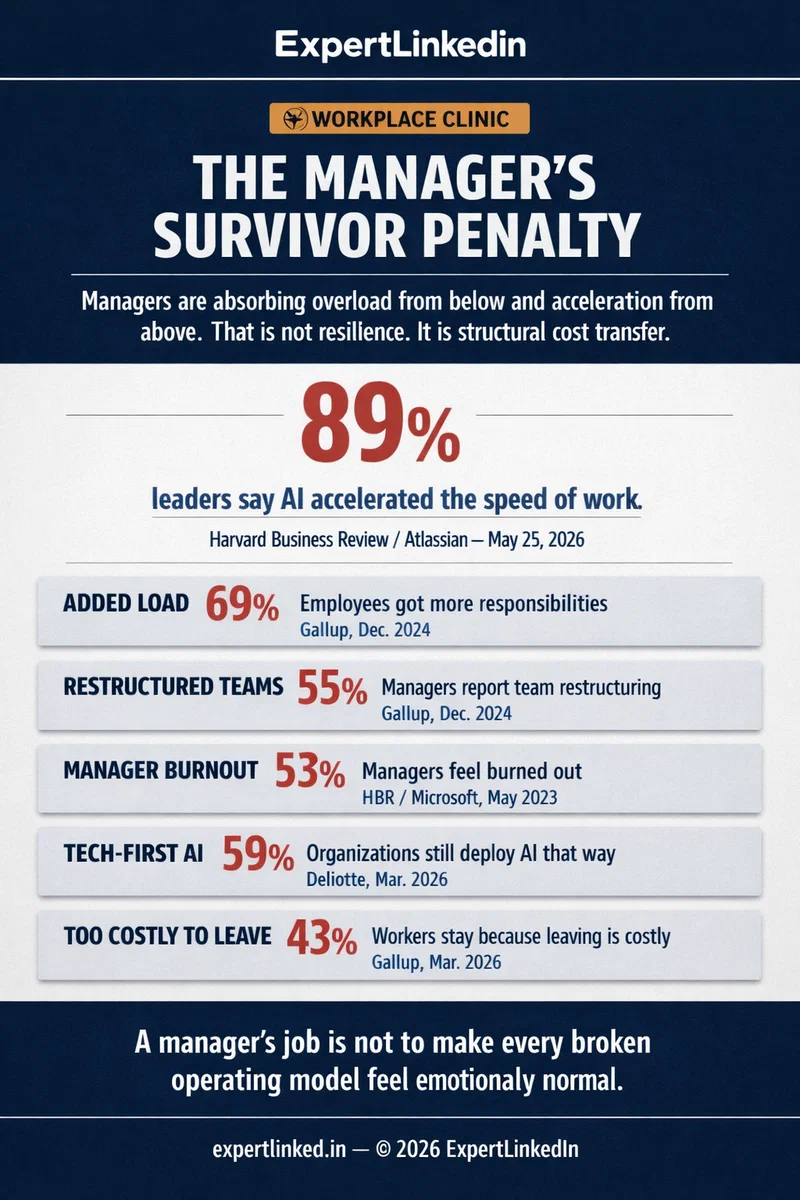
Start with the structural context, because Elena’s problem will sound personal if you do not. Gallup’s December 2024 research on what it calls the Great Detachment found that 73% of employees say their organization experienced disruptive change in the prior year. Managers in that same research reported the specific ingredients of Elena’s reality: 69% said employees had taken on additional job responsibilities, 55% cited restructured teams, and 46% reported budget cuts (Gallup, December 2, 2024). That is not a time-management problem. It is a load-transfer system.
Gallup’s earlier work on the manager squeeze is even more blunt about the position managers occupy inside that system. Managers are more likely than non-managers to be burned out, disengaged, looking for a new job, and feeling their organization does not care about their wellbeing. Why? Because they sit exactly where Elena sits: between employee needs and leadership expectations, expected to make both sides workable during constant change (Gallup, September 5, 2023).
Now add AI pressure to an already stressed middle layer and the role gets more distorted, not less. Harvard Business Review’s June 2026 reporting on middle managers and AI adoption found that the managers who make AI work in practice are not merely using the tools. They are learning new prompting patterns, checking AI-generated work for subtle errors, coaching juniors, translating vague executive expectations, and still carrying the original delivery burden. Others experience role elevation. Managers, as the authors put it, get buried (Harvard Business Review, June 26, 2026).
That same dynamic shows up in a second HBR piece from May, which opens with one manager’s line: “Every 30 minutes, someone creates something I have to look at.” The article cites Atlassian research showing that 89% of leaders say AI has accelerated the speed of work, while 87% of knowledge workers say teams no longer have enough time or capacity to coordinate (Harvard Business Review, May 25, 2026). That is the important reframing for Elena: AI is not only increasing output. It is increasing the volume of managerial review, judgment, and interpersonal translation required to keep that output from turning into noise.
And this burden is landing on a group that was already near its limit. Gallup found that 35% of managers reported being burned out very often or always, and only one in four strongly agreed they could maintain a healthy balance between work and personal commitments (Gallup, November 18, 2021). Harvard Business Review later cited Microsoft’s Work Trend Index showing that 53% of managers report feeling burned out at work (Harvard Business Review, May 18, 2023). Elena is not weak for feeling split. She is describing a role that many organizations have quietly made impossible.
One more layer matters here: why managers so often stay silent. Gallup’s March 2026 worker wellbeing update found that 43% of workers remain in their current role primarily because leaving would be too difficult or costly, and 69% of that group specifically cite the inability to afford losing their current pay or benefits (Gallup, March 23, 2026). Managers live in that labor market too. The person telling everyone else to stay steady may be just as economically pinned in place.
This is why the “be positive” script is so dangerous. It sounds like leadership, but often it is fear wearing a professional tone.
There is also an organizational design problem sitting underneath the emotional one. Deloitte’s 2026 Global Human Capital Trends found that 59% of organizations still take a tech-focused approach to AI, and those organizations are 1.6 times more likely not to realize returns that exceed expectations than organizations taking a human-centric approach that actually redesigns work (Deloitte, March 4, 2026). So when Elena is asked to move faster, reassure the team, raise AI confidence, and do more with fewer management layers, she is often being asked to compensate for a deployment model that is already flawed.
Here is the uncomfortable surprise: managers often believe they are protecting their team by absorbing the strain privately. Sometimes they are, for a week or two. After that, their silence starts teaching the organization the wrong lesson. If the work keeps getting done and the manager keeps sounding calm, the system records the current load as sustainable.
The Three-Move Intervention #
Move 1: Separate the Two Transfers #
Before Elena has any conversation upward, she needs to document what actually moved into her role. Not a feelings journal. A transfer ledger.
Create two columns.
- From below: the coverage she is carrying for the team’s overload. Extra escalations. More emotional containment. More 1:1 time. More direct production work because the team is stretched. More correction of mistakes that exhausted people make.
- From above: the work she is now carrying because the structure thinned out. Reporting that used to sit with a more senior manager. Extra AI check-ins. Faster turnaround requests. New dashboards. Headcount freeze workarounds. Meetings whose real purpose is to preserve confidence.
Then add specifics: team size before and after, number of active projects, number of skipped or shortened coaching conversations, hours spent on reporting, time spent reviewing AI-assisted work, and which responsibilities no longer fit inside a normal week.
If Elena says, “I’m overwhelmed,” she will sound like a person with a stamina problem. If she says, “One role is now carrying both team stabilization and director-level execution,” she is describing an operating model problem.
Move 2: Stop Donating Calm Upward #
Elena does not need to make this a confessional conversation. She does need to stop converting structural strain into private endurance.
The right frame is managerial risk:
“I need to flag a management-capacity risk. Since the restructuring, my role now includes [specific team coverage] plus [specific director-level work]. The current load is starting to crowd out the work that prevents larger failures: coaching, quality review, escalation prevention, and careful rollout of new AI workflows. I want to solve this before the pressure gets transmitted downward onto the team or shows up in client-facing mistakes. I need us to decide what gets deprioritized, what gets resourced, or what gets redesigned.”
That script matters for two reasons. First, it keeps the conversation anchored in business consequences rather than personal virtue. Second, it forces a tradeoff discussion. Managers are routinely told what matters more. Far fewer are told what matters less. Elena does not need another motivational reminder. She needs a decision about scope.
This is also where the July 17 article matters. If leadership pressure is pushing Elena to prove adoption, she cannot simply pass that pressure downward as a loyalty test. The July 17 Clinic made the case that resistance often contains useful information about workflow fit, distrust, or burnout. Elena’s upward conversation has to preserve room for that truth. Otherwise she will create compliance theater below in order to survive reputation risk above.
Move 3: Make a Bounded Ask That Protects the Team #
Do not bring the problem without options. Bring a small menu that protects both Elena and the team she is trying not to crush.
The options might look like this:
- Remove or reassign one recurring director-level responsibility for the next 60 days.
- Narrow the AI expectation to one named workflow pilot with explicit success criteria instead of a vague “move faster” mandate.
- Add temporary capacity: contractor help, project redistribution, or coverage for a specific operational lane.
- Pause one initiative so coaching, quality control, and escalation management can remain intact.
The key is that the ask must expose the real choice. Elena can steady the team and lead a thoughtful rollout. She can also absorb additional reporting and symbolic AI pressure. What she cannot honestly do is promise full performance on both indefinitely without making the team pay for it in hidden ways.
One clean version of the ask is this:
“I can keep the team stable and deliver the current priorities if we narrow scope in one of these places. If we keep all priorities open, the cost will show up in reduced coaching, weaker review, and more pressure pushed onto the team. I want to avoid that, but I can’t avoid it with language alone.”
If the answer is still some version of “just stay positive,” Elena has learned something valuable. The organization is treating her invisible regulation work as free capacity. That is not a reason to panic. It is a reason to document more carefully, protect the team where she can, and stop narrating the strain as something she alone should be able to metabolize.
The Thing Nobody Says Out Loud #
Many managers who tell their teams to be grateful are not cynics. They are survivors.
They are in the same bind. They also fear looking weak. They also suspect the AI push is outrunning the redesign work. They also know the team is tired. So they do what conscientious managers often do under bad systems: they translate pain into calm and call that leadership.
Sometimes it is leadership. But if it goes on too long, it becomes bad data.
The manager who keeps saying, “We’ll make it work,” may believe she is protecting people. What she may also be doing is teaching the organization that the current load is affordable, that the missing headcount is optional, and that the AI pressure does not need redesign because the middle layer will keep absorbing the shock.
That is the manager’s survivor penalty. Not only carrying more. Carrying more while being rewarded for making the excess invisible.
If Elena wants to protect her team, she has to stop letting the system confuse her silence with strength. A manager’s job is not to make every broken operating model feel emotionally normal.
It is to tell the truth early enough that the damage is still reversible.
Have a management dilemma you want addressed in the Clinic? The most important questions are usually the ones asked by people trying to protect a team without disappearing inside the process.
Email me at olivia.bennett@tlnw.uk
References #
- Gallup (December 2, 2024). “The Great Detachment: Why Employees Feel Stuck.” https://www.gallup.com/workplace/653711/great-detachment-why-employees-feel-stuck.aspx (Accessed July 24, 2026)
- Gallup (September 5, 2023). “The Manager Squeeze: How the New Workplace Is Testing Team Leaders.” https://www.gallup.com/workplace/510326/manager-squeeze-new-workplace-testing-team-leaders.aspx (Accessed July 24, 2026)
- Gallup (November 18, 2021). “Manager Burnout Is Only Getting Worse.” https://www.gallup.com/workplace/357404/manager-burnout-getting-worse.aspx (Accessed July 24, 2026)
- Gallup (March 23, 2026). “U.S. Worker Thriving Declines as Job Market Pessimism Grows.” https://www.gallup.com/workplace/703280/worker-thriving-declines-job-market-pessimism-grows.aspx (Accessed July 24, 2026)
- Deloitte (March 4, 2026). “2026 Global Human Capital Trends.” https://www.deloitte.com/us/en/insights/topics/talent/human-capital-trends.html (Accessed July 24, 2026)
- Harvard Business Review (June 26, 2026). “AI Adoption Is Overloading Your Middle Managers.” https://hbr.org/2026/06/ai-adoption-is-overloading-your-middle-managers (Accessed July 24, 2026)
- Harvard Business Review (May 25, 2026). “Managers Are Struggling to Keep Up with the AI Productivity Boom.” https://hbr.org/2026/05/managers-are-struggling-to-keep-up-with-the-ai-productivity-boom (Accessed July 24, 2026)
- Harvard Business Review (May 18, 2023). “More Than 50% of Managers Feel Burned Out.” https://hbr.org/2023/05/more-than-50-of-managers-feel-burned-out (Accessed July 24, 2026)
AI Content Notice
This article was created using artificial intelligence technology. Whenever possible, we include references and sources to support the information presented. Readers are encouraged to consult these sources for further information. While we strive for accuracy and provide valuable insights, readers should independently verify information and use their own judgment when making business decisions. The content may not reflect real-time market conditions or personal circumstances.
Related Articles
Infographic: The Manager's Survivor Penalty: When You're Absorbing Your Team's Overload and Your Director's Too
Managers caught between team overload and executive AI pressure need clearer boundaries, better …
The Step Sideways: Why More High Performers Are Choosing Influence Over Authority
For a growing share of professionals, the smartest career move is no longer upward by title, but …
The Manager's AI Accountability Gap: Why Companies Promise Proof but Don't Measure It
The hidden subsidy behind enterprise AI is the manager translating machine-generated speed into work …