Workplace Clinic: The AI Survivor Penalty

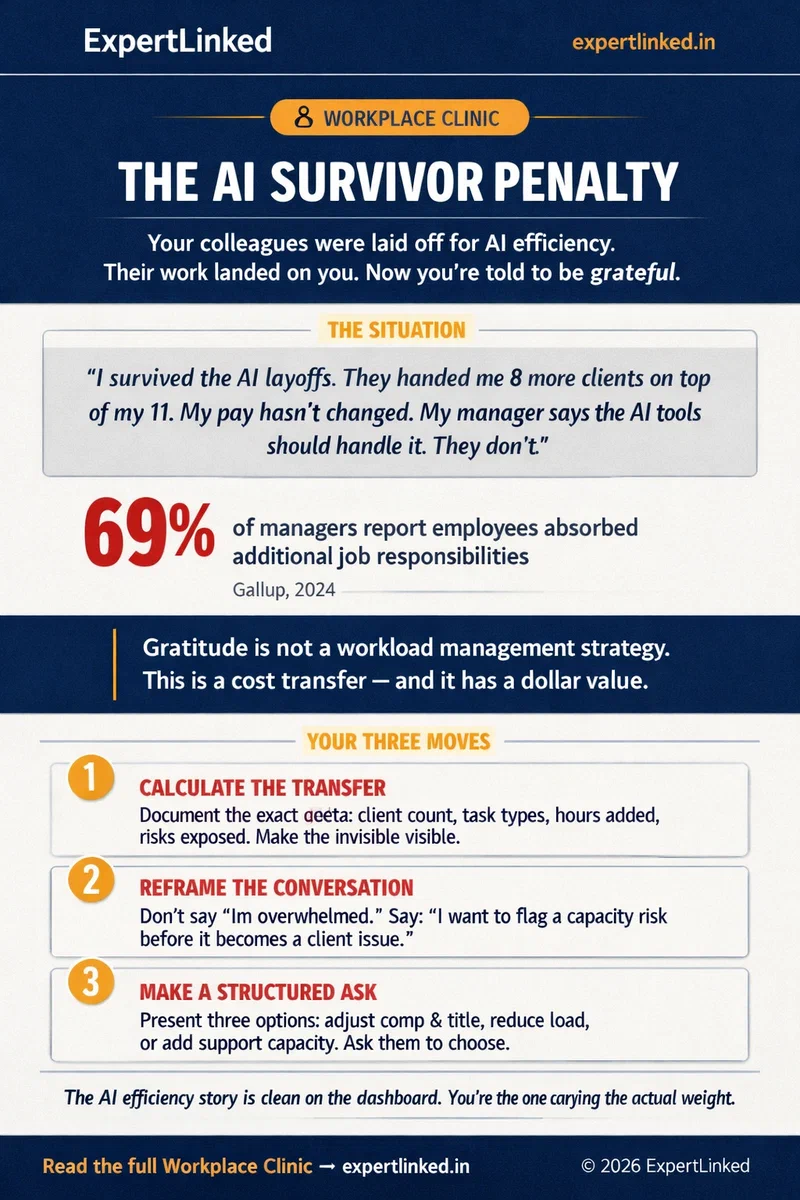
“Six months ago, my company laid off 40% of our department. Management cited AI efficiency gains. I survived the cut. Within days, I was handed my former colleagues’ accounts — eight additional clients on top of my existing eleven. My manager said the AI tools ‘should be able to pick up the slack.’ They don’t. Not even close. I’m doing the work of two people, possibly three. My salary hasn’t moved. My title hasn’t moved. And every time I raise how unsustainable this is, I’m told to ‘be grateful’ I still have a job or to ‘get better at using the tools.’ I’ve been using them. They help with drafts and summaries. They do not build client trust, catch nuanced context, or add hours to my day. I’m burning out and I feel like I can’t say anything without looking ungrateful or difficult. What do I actually do?” — Raj, Senior Account Manager, enterprise software company
Gratitude is not a workload management strategy. Let’s start there.
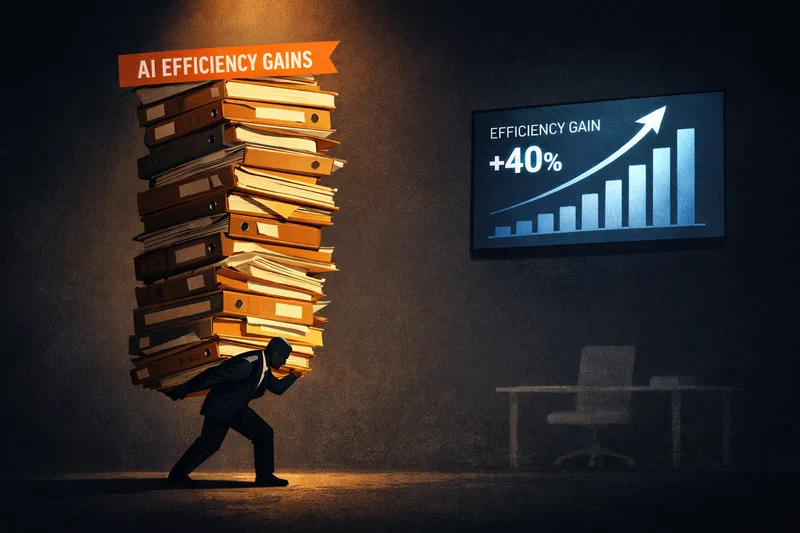
What happened to Raj is not a temporary stretch. It is a permanent restructuring — of his scope, his obligations, and his risk exposure — executed without a corresponding adjustment to his compensation, title, or support resources. That arrangement has a name in labor economics even if it rarely gets one in team meetings: cost transfer. The company reduced its headcount costs by 40% and booked the savings. It transferred 40% of that operational capacity onto the shoulders of the surviving employees, using AI tool access as the justification. The tools do not do 40% of an account manager’s job. The tools do not do 40% of anyone’s relational, judgment-intensive job. Raj does.
The most important thing Raj can do before any conversation with his manager is to recognize this for what it is — not a temporary ask, not a stretch assignment, not a test of loyalty, but an undocumented, uncompensated change to the terms of his employment. Once that framing is clear internally, the path forward becomes structurally navigable.
The Clinical Read #
Here is the broader picture Raj is living inside.
Gallup’s December 2024 research on what it has called the Great Detachment found that 73% of employees say their organization has experienced disruptive change in the past year. Among managers specifically, 69% report that employees have absorbed additional job responsibilities as a consequence of that disruption — and 55% report team restructuring alongside budget cuts (Gallup, December 3, 2024). Raj’s situation is not unusual. It is the modal organizational experience of 2026.
The same Gallup data shows that “the more disruption employees have experienced, the more likely they are to feel burned out today” — not a surprising finding, but an important one, because it frames what is happening to Raj as a predictable clinical outcome, not a personal failure.
What makes this moment especially compressive is the labor market context. Gallup’s Q4 2025 data, published in March 2026, found that for the first time in the organization’s tracking history, more U.S. workers are struggling in their lives (49%) than thriving (46%) — a historic inversion (Gallup, March 24, 2026). Among workers who feel trapped in their roles, 43% stay primarily because leaving would be too costly, with 69% citing their inability to afford to lose their current pay and benefits as the barrier. Raj’s anxiety about speaking up is rational. It is also being used as a management tool, consciously or not.
The “be grateful you still have a job” framing is not motivational — it is a trap. It converts a labor economics conversation into a moral virtue test. It positions any pushback as ingratitude, which psychologically closes off the negotiating space before the negotiation begins. Raj has been handed a restructured role with an expanded scope and told to feel fortunate about it. That is not a reasonable exchange. Naming that — first to himself, then carefully in conversation — is the foundation of everything else.
One more piece of the clinical picture: the promised substitute has not materialized. Management’s assurance that AI tools “should” handle the extra load reflects a systemic organizational error that Deloitte’s 2026 Global Human Capital Trends report documented explicitly. Their survey of more than 9,000 business and HR leaders found that 59% of organizations are taking a tech-focused approach to AI deployment. But those same organizations are 1.6 times more likely to not realize expected returns on their AI investment compared to those taking a human-centric approach — one that intentionally redesigns how humans and AI work together rather than simply expecting AI to absorb lost human capacity (Deloitte, March 4, 2026). Raj’s manager almost certainly was told by their leadership that the tools would compensate. That message was wrong, and the organization is already underperforming its potential because of it.
Understanding this matters for Raj’s conversation, because it means he is not pushing back against a well-designed policy. He is surfacing a flaw in an assumption that the organization has not yet examined.
The Three-Move Intervention #
Move 1: Calculate the Transfer — Make the Invisible Visible #
Before any conversation, build the case file. Not a feelings document — a scope document.
Write a precise before-and-after comparison of your actual work:
- Client or account count: Before the restructuring and after. Raj went from 11 to 19 clients — a 73% increase.
- Task categories absorbed: What specifically were your former colleagues doing that now lands on you? New business onboarding, quarterly reviews, escalation handling, stakeholder communication? Name them.
- Hours estimate: How many additional hours per week does the expanded scope require? Be honest. Ten hours of extra work per week over six months is 260 hours — more than six additional work weeks at no additional pay.
- Risk categories: What could go wrong when you are stretched at this level? Client relationship degradation, slower response times, missed renewal signals, errors under cognitive overload? Specifics matter.
This exercise does three things. It tests your own assumption: is the load genuinely unsustainable, or does it just feel that way in the most exhausted moments? If the case file tells a clear story, you have evidence. If the numbers are smaller than you expected, you have useful calibration. And it removes emotion from the conversation — you are presenting a scope analysis, not a complaint.
Move 2: Reframe the Conversation — From Personal Complaint to Organizational Risk #
Do not enter this conversation with “I’m overwhelmed.” That framing positions you as someone who needs management support, which invites sympathy at best and performance concerns at worst.
Reframe to organizational risk — specifically, the risk that accumulates when a key person is systematically over-capacity:
“I want to flag a capacity risk before it becomes a client issue. Since the restructuring, I’ve absorbed [specific number] of additional accounts alongside my original scope — here’s what that looks like in concrete terms. At this sustained level of load, I’m concerned about [specific risk: slower response times on [client type], reduced capacity to catch renewal signals, increased error rate in [task category]]. I want to work with you on a sustainable path before that risk materializes, rather than after.”
This framing does several things simultaneously. It positions you as performance-oriented rather than compliance-resistant. It converts the conversation from “are you grateful enough” to “what is the plan to protect these outcomes.” And it surfaces the issue as something your manager can take up the chain, rather than a personal grievance they have to absorb or dismiss.
Gallup’s research on burnout is unambiguous about the organizational cost of this dynamic: burned-out employees are 2.6 times more likely to actively seek a new employer, 63% more likely to take sick days, and 13% less confident in their own performance (Gallup, July 12, 2018). The turnover cost of losing an experienced senior account manager — recruiting, onboarding, ramp-up time, client relationship disruption — is typically estimated at 50–200% of annual salary, depending on role complexity. That cost is not theoretical. It is predictable. Your manager should be motivated to avoid it.
The Center for Creative Leadership’s research on psychological safety consistently shows that professionals who raise operational risks directly and constructively — framing them as problems to solve rather than grievances to process — are received more effectively and achieve better outcomes than those who either stay silent or lead with emotion (CCL, 2025). You are not complaining about your situation. You are doing your job.
Move 3: Make a Structured Ask With Options #
Come with a proposal, not just a problem. Present three paths — not as ultimata, but as a business conversation about resource allocation:
Option A — Adjust compensation and title to reflect actual scope. If you are now performing the work of a senior manager with responsibility for 19 major accounts, the role should be priced and positioned accordingly. A title and compensation adjustment that reflects current scope is the most direct remedy.
Option B — Reduce the load to a sustainable level. Specifically: redistribute some of the absorbed accounts, either to a new hire, a contractor, or colleagues in adjacent roles. This is the simplest structural fix and may be politically easier for your manager to secure.
Option C — Provide dedicated support capacity. A junior account support role, a contractor engaged for high-volume administrative tasks, or a formal AI workflow redesign that actually addresses the workload gap (rather than the generic “use AI more” instruction). If the organization genuinely believes the tools can absorb this work, ask them to show you how — with a specific workflow redesign, not a vague directive.
Ask your manager to choose. This reframes the conversation from “I need help” to “which of these solutions works best for the organization?” It also reveals something important: if all three options are declined and the only available response is “you need to manage better,” you now have clear information. The organization is not going to address this gap. That is useful data for a different kind of planning.
One important note: if the answer you receive is genuinely some form of “we hear you and we’re working on it,” ask for a timeline and a specific follow-up date. Vague acknowledgment has an excellent track record of converting back into status quo.
The Thing Nobody Says Out Loud #
Here is the uncomfortable truth beneath this situation: many managers who are delivering the “be grateful” message are themselves in the same structure. They absorbed scope when their own manager left or was cut. They were told the tools would compensate. They are also not asking for recalibration because they also feel that asking would look ungrateful or disloyal.
When you bring this conversation to your manager, you may be doing them a favor. You are giving them organizational-risk language they can take upward — a documented capacity concern, not a personal complaint. The manager who can say to their director “here is a scope analysis and here is what I think will happen if we don’t address it” is more useful than one who simply absorbs the complaint silently.
The AI efficiency narrative that justified these layoffs carries an implicit promise: that productivity would be maintained or improved at a lower headcount. In most organizations, the promise has not been kept. It has simply been hidden, because it is being kept by the silent extra effort of the people who stayed.
You are allowed to make it visible.
Have a workplace dilemma you want addressed in the Clinic? The questions that generate the most useful columns are the ones people find most difficult to say out loud.
References #
- Gallup (December 3, 2024). “The Great Detachment: Why Employees Feel Stuck.” https://www.gallup.com/workplace/653711/great-detachment-why-employees-feel-stuck.aspx (Accessed July 2, 2026)
- Gallup (March 24, 2026). “U.S. Worker Thriving Declines as Job Market Pessimism Grows.” https://www.gallup.com/workplace/703280/worker-thriving-declines-job-market-pessimism-grows.aspx (Accessed July 2, 2026)
- Gallup (January 14, 2025). “U.S. Employee Engagement Sinks to 10-Year Low.” https://www.gallup.com/workplace/654911/employee-engagement-sinks-year-low.aspx (Accessed July 2, 2026)
- Gallup (July 12, 2018). “Employee Burnout, Part 1: The 5 Main Causes.” https://www.gallup.com/workplace/237059/employee-burnout-part-avoidable-management-problem.aspx (Accessed July 2, 2026)
- Deloitte (March 4, 2026). “2026 Global Human Capital Trends.” https://www.deloitte.com/us/en/insights/topics/talent/human-capital-trends.html (Accessed July 2, 2026)
- Center for Creative Leadership (2025). “What Is Psychological Safety at Work?” https://www.ccl.org/articles/leading-effectively-articles/what-is-psychological-safety-at-work/ (Accessed July 2, 2026)
AI Content Notice
This article was created using artificial intelligence technology. Whenever possible, we include references and sources to support the information presented. Readers are encouraged to consult these sources for further information. While we strive for accuracy and provide valuable insights, readers should independently verify information and use their own judgment when making business decisions. The content may not reflect real-time market conditions or personal circumstances.
Related Articles
Infographic: Workplace Clinic: The AI Survivor Penalty
The AI efficiency dividend is being harvested by the organization, not the people who stayed. …
Workplace Clinic: Doing Senior Work in a Junior Box
When your scope outgrows your title, staying silent isn’t patience — it’s a daily vote …
The Pivotal 40s: When the Career You Built Starts Asking Questions You Can't Answer
The 40s have become the most structurally dangerous decade in a modern career — and the system that …