How to Manage a Team Member Who Won't Use AI Tools — Without Creating Compliance Theater

“I lead a six-person customer operations team. Three months ago our company rolled out Copilot and every manager started getting weekly adoption snapshots. Five people on my team use it at least occasionally. One does not. She says it slows her down, does not trust it with client nuance, and goes visibly tight whenever the topic comes up. My director keeps asking what I am doing to raise the number. I can feel myself being nudged toward ‘getting her on board’ quickly, but I do not want to turn this into a loyalty test. At what point is this a performance issue, and at what point is it a design issue? How do I handle it without humiliating her or looking weak with my own boss?” — Daniel, Customer Operations Manager, logistics sector
If one person on your team will not use AI, you probably do not have an AI problem. You have a trust problem, a workflow-fit problem, or a burned-out employee correctly detecting that the organization is measuring compliance before it has designed the work.
That distinction matters because the fastest way to lose both the employee and the adoption metric is to treat resistance as defiance before you understand what it is protecting.

The Clinical Read #
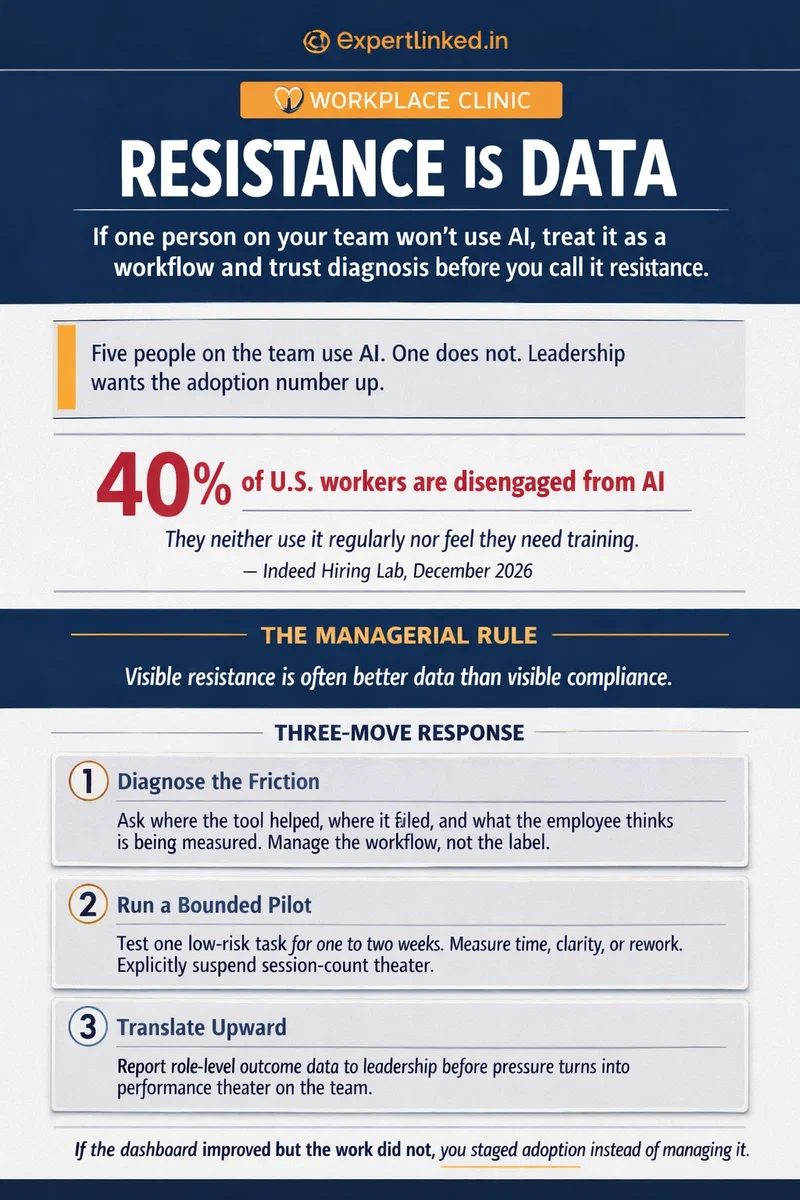
The first thing Daniel needs is a more realistic baseline. Regular workplace AI use is not the universal norm in 2026. Indeed Hiring Lab’s December 2025 survey of employed workers across eight countries found that only 43% of employed U.S. workers said they use AI at work more than once per month. Just as important, 40% of U.S. workers fell into what Indeed calls the disengaged group: they neither regularly use AI nor feel they need training on it (Indeed Hiring Lab, December 29, 2025). That is not a fringe population. It is a structural chunk of the workforce.
Read the rest of that survey closely and the lazy-manager story falls apart even faster. Workers whose employers actively encourage AI use are significantly more likely to use it at work, but encouragement is not the same as support. In the same U.S. dataset, 41% of AI users still said they were not receiving enough AI training. In other words: even people who are already using the tools often do not feel properly equipped. If one person on Daniel’s team is resisting, the more plausible interpretation is not “she refuses to adapt.” It is that she is naming a gap the system has not resolved.
Gallup’s January 2025 engagement update sharpens the context further. Only 31% of U.S. employees were engaged at work, matching the lowest level in a decade. Just 46% clearly knew what was expected of them at work, and only 30% strongly agreed that someone at work encourages their development (Gallup, January 14, 2025). In an environment like that, “use AI more” is not a clear expectation. It is an ambiguous instruction with a scoreboard attached.
That is where the managerial risk begins. The employee hears a mandate, not a workflow. The manager hears a number, not a diagnosis. And the team learns very quickly that visible tool use may matter more than whether the work actually gets better.
The July 10 Workplace Clinic on AI mandates without workflow redesign looked at what this pattern feels like from the employee side. The June 26 Workplace Clinic on AI performance scores looked at the measurement error directly. Daniel’s situation is the managerial version of both: the pressure has moved one level up, but the underlying defect is the same.
Deloitte’s 2026 Global Human Capital Trends report makes that defect explicit. Most organizations, 59%, are still taking a tech-focused approach to AI. Those organizations are 1.6 times more likely to not realize AI returns that exceed expectations than organizations taking a human-centric approach (Deloitte, March 4, 2026). That is the uncomfortable part managers rarely get told: the request to raise adoption may itself be coming from a deployment model that is already underperforming.
There is one more piece Daniel should understand before he acts. Psychological safety is not soft padding around change; it is the condition that makes experimentation possible. The Center for Creative Leadership defines psychological safety as the belief that you will not be punished or humiliated for speaking up with ideas, concerns, mistakes, or questions. In a study of nearly 300 leaders over 2.5 years, teams with higher psychological safety reported higher performance and lower interpersonal conflict. CCL also notes that just 3 in 10 employees strongly agree their opinions count at work (Center for Creative Leadership, April 10, 2026). If Daniel’s team member believes the wrong AI experiment could make her look slow, replaceable, careless with client context, or “not on board,” then not experimenting is rational behavior.
This is the counterintuitive insight most AI management advice avoids: visible resistance is often better data than visible compliance. Resistance tells you where trust, workflow fit, or training is broken. Compliance theater hides all three.
The Three-Move Intervention #
Move 1: Diagnose the Friction Before You Diagnose the Person #
Do not begin with: Why won’t you use it?
That question frames the employee as the problem before the workflow has been examined. Start with the work instead.
In a private conversation, Daniel needs to ask four very specific questions:
- Which tasks have you actually tried the tool on?
- Where did it help, even a little?
- Where did it slow you down, lower quality, or create a trust problem?
- What, exactly, do you think I am measuring when I ask about AI use?
That last question matters more than most managers expect. It often surfaces the real issue in one sentence. Some employees hear “use AI” as a performance surveillance message. Some hear it as a signal that human judgment is now negotiable. Some hear it as one more mandate dropped onto an already overloaded day.
Daniel’s goal in this conversation is not to extract a confession. It is to determine which of the three most common patterns he is looking at:
- Surveillance fear: “I think I am being scored on how many times I open the tool.”
- Workflow mismatch: “I have tried it, and for this task it creates more verification than value.”
- Mandate fatigue or burnout: “I do not have the energy to learn one more system that may or may not help.”
Each pattern requires a different managerial response. Collapsing them into “resistance” is how managers create the very theater they say they want to avoid.
The script can be plain:
“I am not interested in whether you can perform enthusiasm for the tool. I am trying to understand where it helps, where it creates risk, and what you think is being asked of you. Show me the workflow, not your opinion of the company line.”
That sentence does two useful things at once. It lowers the emotional temperature, and it tells the employee this is not a belief test.
Move 2: Run a Bounded Pilot With Learner Safety #
Once Daniel understands the friction, he needs to move the conversation from ideology to a limited experiment.
Not a teamwide mandate. Not “just use it more this week.” One bounded pilot.
Pick a single task that is repetitive enough to test, low-risk enough to contain, and concrete enough to evaluate. In customer operations, that might be first-draft status updates, internal recap notes, or template-based process documentation. It is usually not the client-facing judgment call, the exception case, or the emotionally nuanced communication where the employee’s distrust is highest.
Then make the rules explicit:
- The pilot lasts one to two weeks.
- The task being tested is named in advance.
- The success criteria are outcome-based: time saved, clarity improved, or rework reduced.
- Session count is not the measure.
- If the tool creates more drag than value, that result will be treated as useful data, not disloyalty.
This is where psychological safety stops being abstract. CCL’s framework calls this learner safety — people need to feel safe asking questions, experimenting, and making mistakes. If the pilot itself feels like a trap, you will not get an honest trial. You will get defensive compliance.
Daniel can say it plainly:
“For the next ten working days, I want us to test this on one workflow only. I do not care how many prompts you enter. I care whether this reduces time, improves clarity, or creates extra checking. If it does not fit, we will say so. I want a real answer, not a prettier dashboard.”
That is a manager doing design work rather than enforcement work.
One important line to draw here: if the employee participates in a fair, bounded pilot and the tool still does not fit the workflow, that is not resistance. That is role-specific evidence. If the employee refuses even a narrow, supported, low-risk experiment after expectations and support have been clarified, then Daniel may be approaching a performance-management issue. But most managers jump to that conclusion two steps too early.
Move 3: Manage Upward With Outcome Language Before Pressure Travels Downward #
This is the move many managers skip because it feels politically dangerous. It is also the one that prevents compliance theater from spreading.
Daniel has to translate what he learns upward in the language leadership can use. If he does not, the number keeps coming down as pressure and goes back up as theater.
After the pilot, he should send a brief update framed around workflow evidence:
“We tested AI use in one bounded workflow on the team. Result: it improved draft speed in X task, added verification time in Y task, and does not yet fit Z task without additional workflow redesign or training. We are measuring outcome fit by workflow rather than session volume so we do not confuse activity with value.”
Notice what this script does. It is not anti-AI. It is not defensive. It signals adoption discipline. It also subtly resists the false premise that every role and every task should produce the same usage pattern.
This is especially important because Gallup’s December 2024 research on the Great Detachment found that 73% of employees said their organization had experienced disruptive change in the past year, while managers reported team restructuring (55%), added responsibilities for employees (69%), and budget cuts (46%) (Gallup, December 3, 2024). Daniel is probably being asked to deliver adoption in the middle of broader disruption. If he passes that pressure down unfiltered, he is not managing change. He is transmitting it.
If he converts it into role-level workflow evidence, he becomes more useful to the organization than the manager who simply reports a greener number.
This is also where Daniel gets his answer to the performance question. It becomes a performance issue only when these conditions are true:
- The employee has received a clear explanation of what successful use would look like.
- The role has at least one reasonable, low-risk workflow where AI use is plausibly relevant.
- The employee has been given support and a bounded chance to test it.
- The employee still refuses any good-faith participation in the agreed experiment.
Before those conditions are met, managers who label the problem as performance are usually managing their own anxiety, not the employee’s behavior.
The Thing Nobody Says Out Loud #
The managers most likely to create compliance theater are often the ones complying without conviction themselves.
They have been told to raise AI adoption. They do not fully believe session count equals value. They may not trust the deployment model either. But they also do not feel safe pushing back upward, so they pass the pressure down one level cleaner than they received it.
This is the managerial version of the pattern this column has been tracking all month: operational costs get transmitted downward while accountability stays diffuse. The employee is told to adapt. The manager is told to enforce. The workflow design gap remains unowned.
Daniel’s real job is not to make one skeptical employee look more enthusiastic. It is to stop a bad measurement regime from teaching his team that pretending is safer than thinking.
If the employee’s resistance reveals that the tool does not yet fit the task, that is useful information. If the employee’s resistance reveals that she expects humiliation for a failed experiment, that is even more useful information. Both findings tell Daniel where management actually needs to happen.
The worst possible outcome here is not one team member with low usage. It is a whole team that learns to click the tool, inflate the number, and quietly stop telling the truth about whether the work improved.
That is not adoption. That is theater.
Have a management dilemma you want addressed in the Clinic? The most useful questions are usually the ones that make you feel split in two — responsible to the people below you and answerable to the system above you.
Email me at olivia.bennett@tlnw.uk with the situation you are trying to handle.
References #
- Center for Creative Leadership (April 10, 2026). “How Leaders Can Build Psychological Safety at Work.” https://www.ccl.org/articles/leading-effectively-articles/what-is-psychological-safety-at-work/ (Accessed July 17, 2026)
- Deloitte (March 4, 2026). “2026 Global Human Capital Trends.” https://www.deloitte.com/us/en/insights/topics/talent/human-capital-trends.html (Accessed July 17, 2026)
- Gallup (December 3, 2024). “The Great Detachment: Why Employees Feel Stuck.” https://www.gallup.com/workplace/653711/great-detachment-why-employees-feel-stuck.aspx (Accessed July 17, 2026)
- Gallup (January 14, 2025). “U.S. Employee Engagement Sinks to 10-Year Low.” https://www.gallup.com/workplace/654911/employee-engagement-sinks-year-low.aspx (Accessed July 17, 2026)
- Indeed Hiring Lab (December 29, 2025). “A Tale of Two Workforces: Who’s Using AI and Who’s Getting Left Behind.” https://www.hiringlab.org/2025/12/29/two-workforces-whos-using-ai-and-whos-getting-left-behind/ (Accessed July 17, 2026)
AI Content Notice
This article was created using artificial intelligence technology. Whenever possible, we include references and sources to support the information presented. Readers are encouraged to consult these sources for further information. While we strive for accuracy and provide valuable insights, readers should independently verify information and use their own judgment when making business decisions. The content may not reflect real-time market conditions or personal circumstances.
Related Articles
Infographic: How to Manage a Team Member Who Won't Use AI Tools — Without Creating Compliance Theater
If a team member resists AI tools, manage the trust, workflow fit, and measurement problem first or …
Your Company Mandated AI Tools But Not AI Workflows — Here Is the Clinical Read and the Three-Move Response
Tool deployment without workflow redesign reliably produces compliance theater — and compliance …
Workplace Clinic: When Your Performance Review Includes an AI Score
Being graded on how often you open an AI tool — not what you produce with it — is the wrong metric. …