Your Company Mandated AI Tools But Not AI Workflows — Here Is the Clinical Read and the Three-Move Response

“Three months ago my company deployed Microsoft Copilot to all employees. The rollout included two training sessions — both vendor demos, not how-to-do-my-specific-job sessions. Since then I’ve received three reminders that my usage is ‘below the team average.’ My manager mentioned at my last check-in that ’leadership is watching AI adoption closely.’ I work in operations planning: inventory forecasting, supplier coordination, process documentation. I’ve experimented with Copilot on some tasks. Occasionally it helps with drafts. Mostly it adds a step. No one has told me which of my tasks I should redesign around the AI tools. No one has redesigned anything. They deployed the tools and started measuring usage. Now I’m being quietly scored on whether I use them enough — but I’m not sure using them more would actually make my work better. What am I actually dealing with, and what should I do?” — Maya, Senior Operations Analyst, manufacturing sector
Your company didn’t deploy AI. It deployed a mandate. Those are not the same thing — and the gap between them is exactly where your career risk lives.
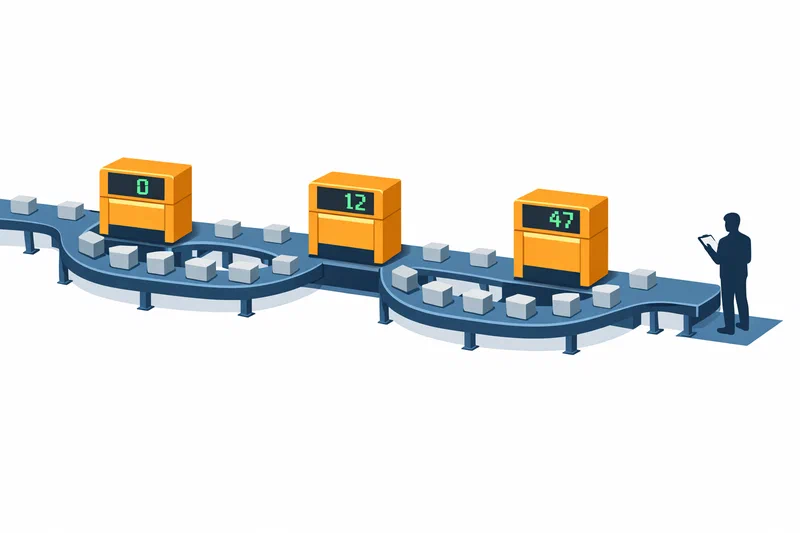
What Maya received was licenses. What she needed was a redesign. The distinction matters because the organization’s failure to make it is the source of the compliance pressure she is now feeling — and because the response that looks safest (use the tools more to raise the score) is the one that most reliably produces the outcome most damaging to her career over time.
The Clinical Read #
What happened to Maya’s organization has a precise technical name: technology deployment without workflow redesign. It is the dominant mode of AI adoption in 2026, and it has a well-documented failure pattern.
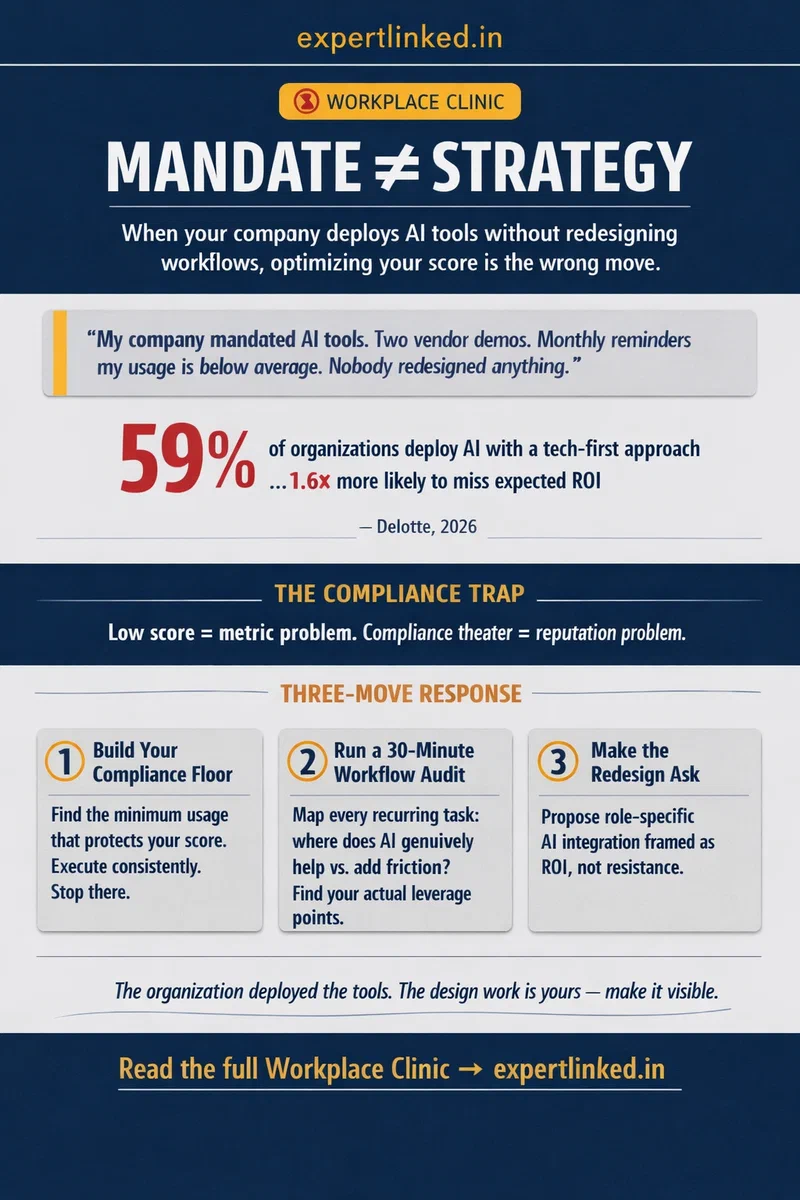
Deloitte’s 2026 Global Human Capital Trends, which surveyed more than 9,000 business and HR leaders across 89 countries, found that most organizations — 59% — are taking a tech-focused approach to AI deployment. Those organizations are 1.6 times more likely to not realize expected returns on their AI investment compared to organizations that take a human-centric approach: one that intentionally designs how humans and AI collaborate, rather than deploying tools and measuring how often they are used (Deloitte, March 4, 2026).
Read that finding carefully from Maya’s position. The organization measuring her usage frequency is the type of organization — tech-focused — that is statistically more likely to fail to realize AI ROI. Maya’s adoption score is being tracked by an organization that, by its own deployment pattern, is already underperforming its AI investment. She is being evaluated on compliance with a strategy that does not work.
That is the clinical backdrop. Now here is the sharper, more uncomfortable part.
The predictable outcome of technology deployment without workflow redesign is what I have called compliance theater in this space before: employees using AI tools in ways that satisfy usage metrics without producing meaningful work improvements. The June 26 Workplace Clinic examined the metric problem directly — Goodhart’s Law applied to AI: when tool usage becomes the target, optimizing the usage score and improving actual work quality diverge. Fatima in that case was being penalized for not gaming the system. Maya’s situation is the upstream version: she is being pulled toward gaming it before she has had time to evaluate whether it would even help.
Here is the counterintuitive insight that most AI adoption advice avoids: a low adoption score is a performance review problem. Compliance theater is a reputation problem. They are not the same, and they are not equivalently damaging.
A low adoption score can be explained. It can be corrected with documentation of thoughtful, targeted use. It can be challenged with evidence. It is a metric gap — visible, addressable, finite.
Compliance theater, by contrast, trains your manager, your organization, and your own habits simultaneously. It trains your manager to see AI-formatted output as a proxy for quality. It trains the organization’s measurement system to count volume as value. And it trains you — gradually — to design your work around the tool’s presence rather than around the actual outcome. Each of these effects compounds quietly, and none of them show up in a dashboard.
The McKinsey research that Jackson Rodriguez explored in the June 29 Career Mechanics is precise on what the genuine alternative looks like: organizations seeing the most AI value are nearly three times as likely to have fundamentally redesigned workflows — not deployed tools more frequently, but changed the process structure. Companies seeing real EBIT impact from AI (39% of surveyed organizations) are doing something categorically different from what Maya’s company is doing. They are redesigning how work happens. The majority are measuring session frequency (McKinsey, November 5, 2025).
Maya is inside the 59% pattern, and she is being asked to feed it.
The contextual pressure making this particularly hard to resist: Gallup’s Q4 2025 survey found that only 31% of U.S. employees are engaged at work — a decade low — and 43% stay in their current roles primarily because leaving would be too costly or difficult (Gallup, March 24, 2026). Maya is not alone in feeling she cannot simply opt out of compliance pressure. Most workers in 2026 are operating with constrained exit options and elevated performance anxiety. That is exactly the context in which compliance theater spreads fastest: people are scared enough to comply and stuck enough to stay.
Understanding this is not an invitation to despair. It is a clinical read of the system Maya is inside — and the first prerequisite for navigating it deliberately rather than reactively.
The Three-Move Intervention #
Move 1: Establish Your Compliance Floor — and Stop There #
The first move is not to increase usage. It is to find the minimum viable compliance level that protects Maya’s performance score, execute it consistently, and stop there.
This may seem counterintuitive, but it is the structural prerequisite for everything that follows. If all available cognitive bandwidth is spent trying to maximize the adoption score, there is no space to build real proof. If it is spent resisting the score, performance risk accumulates with no offsetting gain.
The compliance floor looks like this: identify the two or three tasks in your workflow where the AI tool already helps — drafts, meeting summaries, template generation. Use those consistently. Let the usage metrics capture what they capture. Then disengage from the score-optimization cycle entirely.
What this move protects is time and attention — specifically, the margin needed for Move 2.
One thing to be careful about: the compliance floor is not a forever position. It is a temporary buffer that buys operational space. The goal is not permanent strategic compliance theater at low intensity. It is protected space in which to build the evidence base that makes compliance theater unnecessary.
Move 2: Run a 30-Minute Workflow Audit — Find the Real Leverage #
Spend 30 to 45 minutes mapping your actual recurring tasks. For each task category, ask three questions:
- Does AI currently help here — not could it in theory, but does it in practice, in this specific workflow?
- Where does it add friction — extra verification steps, lower-quality outputs that require significant editing, a mismatch between what the tool produces and what the work requires?
- Where is the genuine leverage — what tasks are time-consuming, repetitive, and pattern-based enough that AI could materially reduce the burden?
This audit does something different from what the organization’s training sessions did: it grounds AI adoption in the actual shape of the work, rather than in a vendor demo designed to show the best-case scenario. It is also the foundation of Move 3.
For Maya specifically: operations planning work tends to have strong AI leverage in documentation, status update synthesis, and process description templates — and weaker leverage in forecasting logic, supplier relationship decisions, and exception-handling judgment calls. A 30-minute audit would likely reveal genuine deployment opportunities that are currently invisible to both her and to the organization.
This matters for a reason beyond the immediate tactical payoff. The June 29 Workflow Proof Playbook makes the case for documenting one real improvement with measurable before-and-after data. The audit is the prerequisite step that self-directed workflow proof requires. In Maya’s situation, she is not self-directing — she is being compliance-directed. But the audit converts the compliance-directed situation into a self-directed one by identifying where genuine proof can be built within the mandate’s constraints.
Move 3: Make the Workflow Redesign Ask — Framed as Organizational ROI #
Once the audit exists, use it. Not to push back on the mandate, but to propose something better:
“I’ve been working through where AI genuinely improves my workflow and where it introduces friction. I’ve found three specific areas where proper integration would produce verifiable time savings and two areas where the current approach creates more steps than it removes. Could we spend 20 minutes with the AI program team or my manager to map the right deployment for my role? I want to use these tools well, not just frequently.”
This request does several things simultaneously. It signals engagement with AI adoption — not resistance, not gaming. It positions Maya as someone thinking about outcomes rather than scores. It surfaces the design gap as something fixable. And it creates a conversation about the right question — where does AI fit in this specific workflow — rather than the wrong one, which is how often the tool is being opened.
If the response is positive, Maya gets support. If the response is “just use it more,” she has learned something important about how the organization is thinking, and she can calibrate her compliance floor accordingly. Either outcome is more useful than optimizing the score in silence.
This ask also creates a documented record — in an email thread, a meeting note, a Slack message — that she raised the workflow design question. When the ROI reckoning arrives (and Deloitte’s data suggests it will, for 59% of organizations), that record has value. Employees who can show they tried to make AI adoption meaningful rather than merely metric-compliant are in a fundamentally different position from those who ran up usage scores and produced nothing accountable.
The Thing Nobody Says Out Loud #
Here is the structural truth that most organizations in Maya’s position have not stated clearly: they have outsourced their workflow design problem to their employees.
By deploying tools without redesigning processes, the organization has implicitly assigned each worker the task of individually figuring out where AI fits in their specific role. That is design work. It requires judgment, experimentation, and iteration. It has real organizational value. And it is being done — or not done — by thousands of individual workers on their own time, without support, while also being measured on whether they are using the tool often enough.
The inverse of this pattern is what Jackson’s proof playbook describes: self-directed workflow improvement that generates visible evidence. The mandate pattern is compliance-directed without the design direction that would make compliance meaningful. The gap between those two is not small. It is the 1.6x failure multiplier that Deloitte is measuring.
The three-move response described here is, at its core, doing the organization’s design work yourself — and making that work visible rather than invisible. The compliance floor buys time. The audit produces the design insight. The ask surfaces it where it can generate organizational response.
That is more than most organizations are doing. It is also more than anyone told Maya to do. The mandate came with tools and metrics. The design work is being done by whoever is paying attention.
And if the organization’s only answer to the design ask is another reminder about usage frequency? That is the most useful piece of information yet. It tells you whether you are inside an organization that is building something real — or inside a compliance theater that is measuring its own performance at the expense of yours.
References #
- Deloitte (March 4, 2026). “2026 Global Human Capital Trends.” https://www.deloitte.com/us/en/insights/topics/talent/human-capital-trends.html (Accessed July 10, 2026)
- Gallup (December 3, 2024). “The Great Detachment: Why Employees Feel Stuck.” https://www.gallup.com/workplace/653711/great-detachment-why-employees-feel-stuck.aspx (Accessed July 10, 2026)
- Gallup (March 24, 2026). “U.S. Worker Thriving Declines as Job Market Pessimism Grows.” https://www.gallup.com/workplace/703280/worker-thriving-declines-job-market-pessimism-grows.aspx (Accessed July 10, 2026)
- McKinsey & Company (November 5, 2025). “The State of AI: How organizations are rewiring to capture value.” https://www.mckinsey.com/capabilities/quantumblack/our-insights/the-state-of-ai (Accessed July 10, 2026)
AI Content Notice
This article was created using artificial intelligence technology. Whenever possible, we include references and sources to support the information presented. Readers are encouraged to consult these sources for further information. While we strive for accuracy and provide valuable insights, readers should independently verify information and use their own judgment when making business decisions. The content may not reflect real-time market conditions or personal circumstances.
Related Articles
Infographic: Your Company Mandated AI Tools But Not AI Workflows — Here Is the Clinical Read and the Three-Move Response
Tool deployment without workflow redesign reliably produces compliance theater — and compliance …
Career Mechanics: The Workflow Proof Playbook - How to Turn AI Learning Into Career Capital
The AI career premium now goes to professionals who can redesign one real workflow and prove the …
Signals & Shifts: The Pipeline Premium
In a slowing labor market, the real career premium is shifting toward employers and sectors that …