The Late-August 2026 Labor Market Verdict: 3 Signals That Will Shape September Hiring

If you are waiting for today’s GDP and PCE releases to tell you whether September hiring is about to thaw, you are waiting on confirmation, not the verdict.
The verdict is already mostly in, and it is not especially generous to workers. August gave employers just enough macro calm, just enough inflation relief, and just enough AI-demand confidence to keep September selective rather than open-handed.
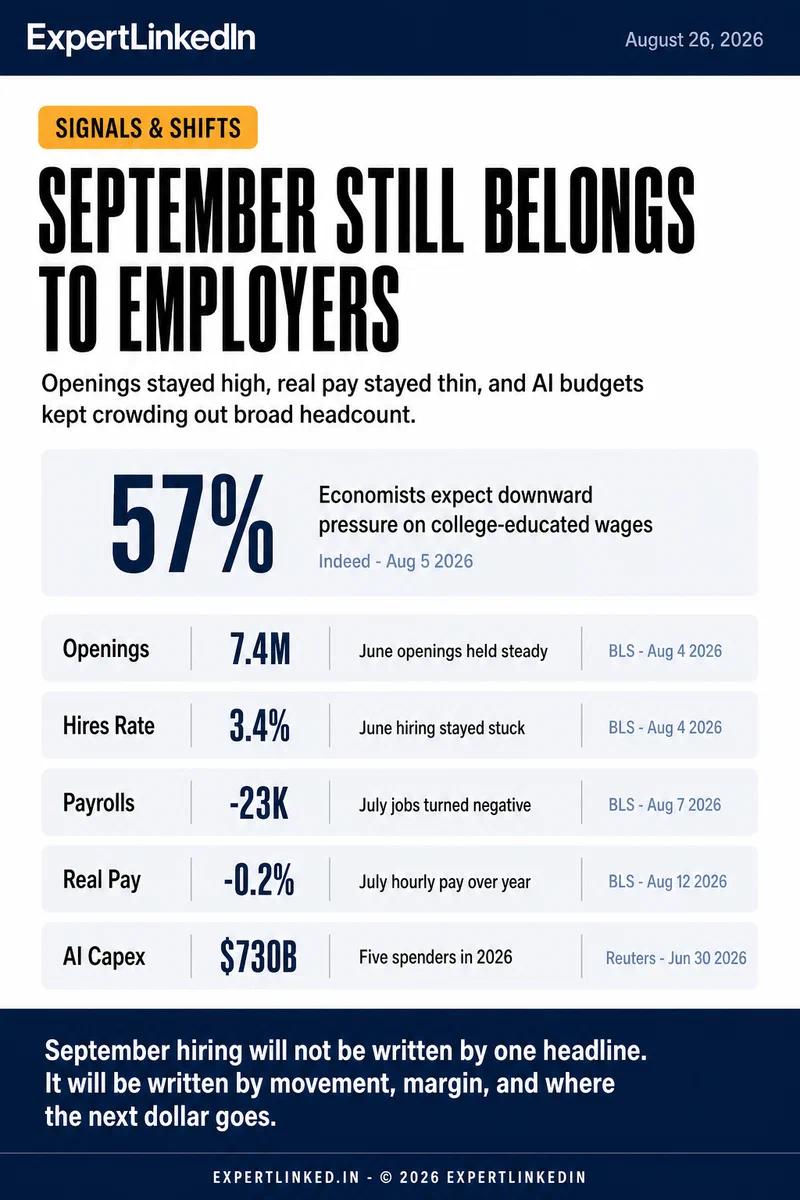
At the time of writing, the Bureau of Economic Analysis is still due later today with GDP’s second estimate, Q2 corporate profits, and July Personal Income and Outlays because this article is dated in an Asian timezone while those releases land at 8:30 a.m. Eastern Time (Bureau of Economic Analysis, accessed August 26, 2026). But the bigger pattern is already visible: June JOLTS showed 7.4 million openings against a 3.4% hires rate and a 2.0% quits rate; July payrolls fell by 23,000 and prior gains were revised down by 103,000; July CPI cooled to 3.4% while real hourly earnings still fell 0.2% over the year; and the Fed kept rates at 3.5% to 3.75% while praising strong productivity and capital investment (U.S. Bureau of Labor Statistics, August 4, 2026; U.S. Bureau of Labor Statistics, August 7, 2026; U.S. Bureau of Labor Statistics, August 12, 2026; U.S. Bureau of Labor Statistics, August 12, 2026; Board of Governors of the Federal Reserve System, July 29, 2026).

Signal 1: Movement still has not reopened #
The first signal is still the simplest one: openings are not the same thing as movement.
June JOLTS gave the market another healthy-sounding headline, but the flow measures still looked stuck: 7.4 million openings, 5.3 million hires, a 3.4% hires rate, a 2.0% quits rate, and a 1.1% layoffs rate (U.S. Bureau of Labor Statistics, August 4, 2026). That is not a reopening. It is a market that still looks busier than it feels.
Indeed Hiring Lab had the cleaner interpretation: a duck on a pond, calm on the surface and paddling hard underneath. Leisure and Hospitality hires fell by 87,000 in a month, while Private Education and Health Services added 68,000, reinforcing that what movement exists is concentrated rather than broad (Indeed Hiring Lab, Sneha Puri, August 4, 2026). July’s jobs report then made the same point from another angle: payrolls fell 23,000, May and June were revised down by 103,000, participation stayed weak, and long-term unemployment still made up 25.5% of all joblessness (U.S. Bureau of Labor Statistics, August 7, 2026; Indeed Hiring Lab, Cory Stahle, August 7, 2026).
So September still opens with the same unresolved test when July JOLTS arrives on Sept. 1 and the August jobs report follows on Sept. 4: are hires and quits finally moving, or are openings still doing all the talking? (U.S. Bureau of Labor Statistics, accessed August 26, 2026)
Signal 2: Pay relief is still too thin to restore leverage #
The second signal is the one headline coverage keeps overstating. Inflation cooled. Worker leverage did not.
July CPI rose just 0.1% in the month and eased to 3.4% year over year, but BLS real earnings still showed real hourly pay down 0.2% over the year and real weekly earnings up just 0.1% (U.S. Bureau of Labor Statistics, August 12, 2026; U.S. Bureau of Labor Statistics, August 12, 2026). In plain English, the household math got a little less punishing. It did not become spacious.
The broader wage picture is harsher. Indeed’s Q2 Employment Cost Index analysis found real private-sector wages and salaries down 0.4% year over year, with posted wage growth in June still only 2.4% (Indeed Hiring Lab, Cory Stahle, July 31, 2026). And Indeed’s August economist survey found 57% of respondents expecting downward pressure on college-educated wages over the next year even as the macro outlook stays relatively calm (Indeed Hiring Lab, Laura Ullrich and Svenja Gudell, August 5, 2026). That is the same inside-the-office squeeze I described in The Skills Bifurcation: lower inflation is not the same thing as restored pricing power.
Signal 3: The next dollar still goes to capacity first #
The third signal is the employer-side one. If you want to understand September hiring, watch where companies still feel forced to spend.
The Fed already gave employers a usable script on July 29. It held rates at 3.5% to 3.75%, said productivity growth and capital investment were strong, still described inflation as elevated, and recorded three dissents for a hike (Board of Governors of the Federal Reserve System, July 29, 2026). That is not a backdrop that pushes managers toward broad labor loosening.
The earnings math says the same thing more bluntly. Reuters put combined 2026 AI capex for five major spenders at about $730 billion (Reuters, June 30, 2026). Microsoft posted $90.0 billion in quarterly revenue and 43% Azure growth while Reuters said quarterly capex hit $41 billion and 2026 capex was tracking around $175 billion (Microsoft, July 29, 2026; Reuters, July 29, 2026). Alphabet’s cloud revenue rose 82% as capex moved up to $195 billion to $205 billion and free cash flow turned negative (Reuters, July 22, 2026). Amazon lifted capex to $220 billion and still said capacity would fall short of demand (Amazon, updated July 30, 2026; Reuters, July 30, 2026). Meta’s revenue jumped 28% even as free cash flow fell 91% and its capex range climbed as high as $145 billion (Reuters, July 29, 2026).
That is the same core point from What the July 2026 FOMC Minutes and Q2 Earnings Say About Q4 Hiring Risk: the audited cash decisions still favor compute, power, leases, and capacity over a broader labor reopening. Today’s BEA releases can still shift tone, but not this underlying priority. A stronger print gives employers even less reason to loosen. A weaker one makes them more cautious, not more generous.
The September verdict #
By late August, the labor-market story is no longer especially mysterious.
Movement is still weak beneath the openings headline. Inflation has cooled without creating much real worker comfort. And the first dollar in AI-era budgets is still going to infrastructure, not general headcount. That does not mean September hiring disappears. It means the openings most likely to clear budget are the ones tied to visible backlog, revenue, risk reduction, and bottlenecks that cannot be solved any other way.
What would change this verdict? A real reopening in hires and quits when July JOLTS lands on Sept. 1, a better worker-side pay story than July real earnings and Q2 ECI imply, or a clear employer shift away from capacity-first spending. None of that is visible yet.
September hiring will not be written by one headline. It will be written by movement, margin, and where the next dollar goes.
Have a read on what your own team or company is actually funding for September - people, proof, or more capacity? I would like to hear it.
Email me at jackson.rodriguez@tlnw.uk.
References #
- Amazon. (Updated July 30, 2026). “Amazon.com announces second quarter results.” https://www.aboutamazon.com/news/company-news/amazon-earnings-q2-2026-report (Accessed August 26, 2026)
- Board of Governors of the Federal Reserve System. (Accessed August 26, 2026). “Meeting calendars, statements, and minutes (2021-2027).” https://www.federalreserve.gov/monetarypolicy/fomccalendars.htm (Accessed August 26, 2026)
- Board of Governors of the Federal Reserve System. (July 29, 2026). “Federal Reserve issues FOMC statement.” https://www.federalreserve.gov/newsevents/pressreleases/monetary20260729a.htm (Accessed August 26, 2026)
- Bureau of Economic Analysis. (Accessed August 26, 2026). “Release Schedule.” https://www.bea.gov/news/schedule (Accessed August 26, 2026)
- Indeed Hiring Lab, Sneha Puri. (August 4, 2026). “June 2026 JOLTS Report: The Labor Market is a Duck on a Pond.” https://hiringlab.indeed.com/2026/08/04/june-2026-jolts-report/ (Accessed August 26, 2026)
- Indeed Hiring Lab, Laura Ullrich and Svenja Gudell. (August 5, 2026). “Economists Expect a Cooled Labor Market and an AI Reshuffling of White-Collar Work.” https://hiringlab.indeed.com/2026/08/05/q2-labor-market-outlook-survey/ (Accessed August 26, 2026)
- Indeed Hiring Lab, Cory Stahle. (August 7, 2026). “July 2026 Jobs Report: Unexpected Turbulence.” https://hiringlab.indeed.com/2026/08/07/july-2026-jobs-report-unexpected-turbulence/ (Accessed August 26, 2026)
- Indeed Hiring Lab, Cory Stahle. (July 31, 2026). “Q2 2026 Employment Cost Index: Losing Ground.” https://hiringlab.indeed.com/2026/07/31/q2-2026-employment-cost-index-losing-ground/ (Accessed August 26, 2026)
- Microsoft. (July 29, 2026). “Microsoft Cloud and AI Strength Fuels Fourth Quarter Results.” https://www.microsoft.com/en-us/Investor/earnings/FY-2026-Q4/press-release-webcast (Accessed August 26, 2026)
- Reuters. (June 30, 2026). “AI spending, earnings hopes, Fed outlook set to sway US stocks in second half.” https://www.reuters.com/business/ai-spending-earnings-hopes-fed-outlook-set-sway-us-stocks-second-half-2026-06-30/ (Accessed August 26, 2026)
- Reuters. (July 22, 2026). “Google increases capex forecast again after cloud-driven quarterly beat.” https://www.reuters.com/business/google-quarterly-cloud-revenue-growth-beats-expectations-2026-07-22/ (Accessed August 26, 2026)
- Reuters. (July 29, 2026). “Meta cash flow craters as Zuckerberg doubles down on AI spending.” https://www.reuters.com/business/meta-narrows-annual-capex-forecast-ai-buildout-grows-2026-07-29/ (Accessed August 26, 2026)
- Reuters. (July 29, 2026). “Microsoft says cash will keep flowing from AI, shares rise.” https://www.reuters.com/business/microsoft-tops-quarterly-cloud-growth-estimates-easing-spending-concerns-2026-07-29/ (Accessed August 26, 2026)
- Reuters. (July 30, 2026). “Amazon lifts investment plans after strong cloud sales; shares jump.” https://www.reuters.com/business/retail-consumer/amazon-beats-estimates-quarterly-cloud-revenue-growth-2026-07-30/ (Accessed August 26, 2026)
- U.S. Bureau of Labor Statistics. (Accessed August 26, 2026). “August 2026 Release Calendar.” https://www.bls.gov/schedule/2026/08_sched.htm (Accessed August 26, 2026)
- U.S. Bureau of Labor Statistics. (August 4, 2026). “Job Openings and Labor Turnover - June 2026.” https://www.bls.gov/news.release/jolts.nr0.htm (Accessed August 26, 2026)
- U.S. Bureau of Labor Statistics. (August 7, 2026). “The Employment Situation - July 2026.” https://www.bls.gov/news.release/empsit.nr0.htm (Accessed August 26, 2026)
- U.S. Bureau of Labor Statistics. (August 12, 2026). “Consumer Price Index Summary - July 2026.” https://www.bls.gov/news.release/cpi.nr0.htm (Accessed August 26, 2026)
- U.S. Bureau of Labor Statistics. (August 12, 2026). “Real Earnings - July 2026.” https://www.bls.gov/news.release/realer.nr0.htm (Accessed August 26, 2026)
AI Content Notice
This article was created using artificial intelligence technology. Whenever possible, we include references and sources to support the information presented. Readers are encouraged to consult these sources for further information. While we strive for accuracy and provide valuable insights, readers should independently verify information and use their own judgment when making business decisions. The content may not reflect real-time market conditions or personal circumstances.
Related Articles
Signals & Shifts: The Stillness Trap
Employment is rising but hiring is not: the labor market is being held up by workers staying put, …
Infographic: Signals & Shifts: The Stillness Trap
Employment is rising but hiring is not: the labor market is being held up by workers staying put, …
What the August 2026 Jobs Report and July CPI Say About Real Wages - and Why "Stable" Still Feels Tight
Payrolls slipped, wage growth slowed, and the room for a reassuring real-wage story got much smaller …