What the August 2026 Jobs Report and July CPI Say About Real Wages - and Why "Stable" Still Feels Tight

Stable is one of those labor-market words that survives longer on television than it does in a household budget.
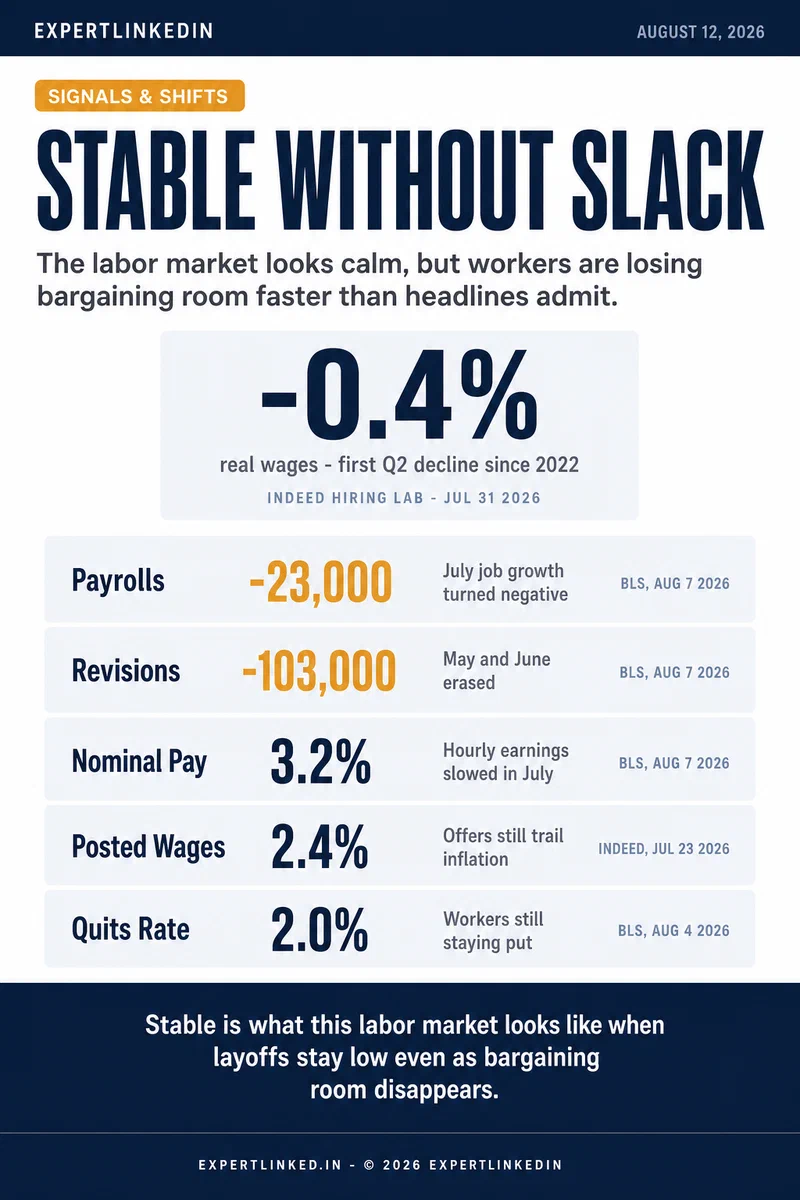
July payrolls fell by 23,000. May and June were revised down by another 103,000. Average hourly earnings slowed to 3.2% year over year. The unemployment rate, at 4.1%, still looks calm enough for someone to call this a steady market. But a steady market is not the same thing as a roomy one, and July’s report made that distinction harder to ignore (U.S. Bureau of Labor Statistics, August 7, 2026; Indeed Hiring Lab, August 7, 2026).
At the time of writing, the July CPI and July Real Earnings releases are still due later today, not earlier, because this article is dated in an Asian timezone while BLS publishes those reports at 8:30 a.m. Eastern Time (BLS Release Calendar, accessed August 12, 2026). That timing matters less than it sounds. The jobs report already narrowed the room for a reassuring real-wage story. If July inflation prints above 3.2%, real wage growth for incumbents likely slips negative again. If it cools enough to match or undercut 3.2%, workers still face a labor market with weaker hiring flow and thinner bargaining power than the unemployment rate implies.
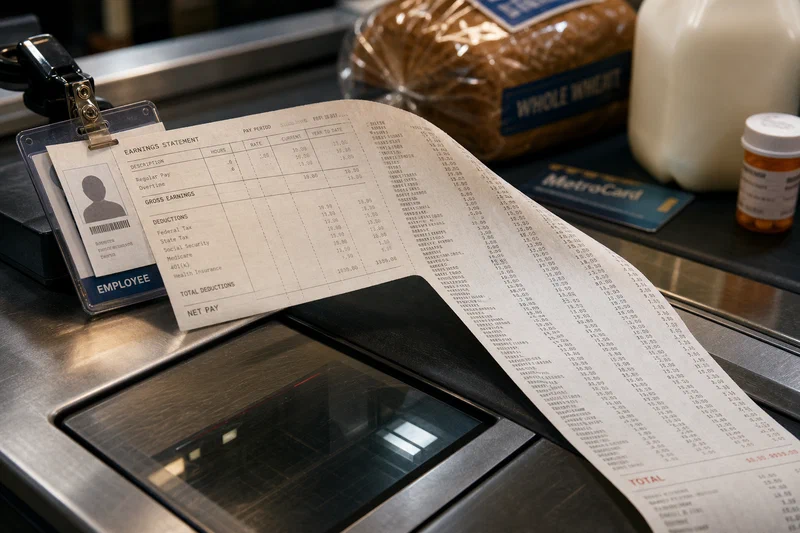
The jobs report did not break the market. It removed the cushion. #
The most generous reading of July is that the weakness was noisy rather than systemic. Local government education lost 50,000 jobs, a category vulnerable to odd seasonal moves. Retail lost 19,000. Financial activities lost 14,000. Health care still added 22,000. That is not a recession map. It is a cross-current map (BLS, August 7, 2026).
But the revisions are what make the report harder to wave away. May went from +129,000 to +63,000. June went from +57,000 to +20,000. That means a good part of what looked like spring resilience was revised out after the fact. Indeed’s Cory Stahle put it plainly: the labor market is facing turbulence at lower altitude, with less room for policy mistakes or another inflation flare-up (Indeed Hiring Lab, August 7, 2026).
That fits the mechanism I argued in What the June 2026 JOLTS Report Says About Q3 Mobility and then extended in What July’s Data Trail Tells Us About Q3’s Labor Market Trajectory. Openings still exist. Movement does not necessarily follow.
June JOLTS showed 7.4 million job openings, which is enough for a healthy-sounding headline. It also showed hires stuck at 5.3 million and a 3.4% hires rate, quits pinned at 2.0%, and layoffs steady at 1.1% (BLS, August 4, 2026). Indeed’s read on the same report was even sharper: a duck on a pond, calm above the waterline and paddling hard underneath, with hiring concentrated in a narrow set of sectors and Leisure & Hospitality hires falling by 87,000 in a single month (Indeed Hiring Lab, August 4, 2026).
So the labor market problem in August is not that everything suddenly cracked. It is that the parts making workers feel safer never really reopened. The July jobs report removed more of the cushion before anyone could claim the squeeze was over.
Purchasing power was already thin before the CPI lands. #
June was the last confirmed month that gave workers anything close to a clean real-wage reprieve. CPI slowed to 3.5% year over year. Real average hourly earnings for all employees edged up only 0.1% over the year. Real average weekly earnings rose 0.3%. That was progress compared with the first-half squeeze, but it was narrow progress, not abundance (BLS CPI, July 14, 2026; BLS Real Earnings, July 14, 2026).
Even that official reprieve looked less comfortable once you widened the frame. Indeed’s Q2 Employment Cost Index analysis found that inflation-adjusted private-sector wages and salaries fell 0.4% year over year in Q2, the first real decline since 2022. Private-sector nominal wage growth cooled to 3.1%. Indeed’s posted wage tracker, which tends to lead the government wage series, was running at just 2.4% in June (Indeed Hiring Lab, July 31, 2026).
That means June’s real-wage parity was already thinner than the headlines made it sound. It was more like a narrow ledge than a platform.
Now add July’s jobs report to that picture. Average hourly earnings slowed to 3.2%. In plain English, the last confirmed inflation print was already only barely being kept at bay, and the newest confirmed wage print is softer than the one before it. That is why the July CPI release matters mathematically. But it is also why the July jobs report matters emotionally. Workers do not need a dramatic inflation resurgence to feel tight. They only need the margin between pay growth and prices to be small enough that every rent payment, grocery trip, insurance bill, and childcare decision still feels negotiated rather than absorbed.
Openings are not bargaining power. #
This is the variable most headline coverage still handles badly.
Real wages are not just the difference between one inflation number and one wage number. They are also filtered through the worker’s outside option. Can you switch roles? Can you credibly push for more? Can you leave a stagnant situation without stepping backward?
On that measure, the market still looks tight.
The June quits rate was 2.0%. The vacancy-to-unemployment ratio was 1.0. Posted wages were still growing at only 2.4% year over year in June, below the last confirmed CPI reading. And Indeed’s new Labor Market Outlook Survey found economists expecting only a gentle cooling ahead, with unemployment drifting to about 4.4% by year-end and the Indeed Job Postings Index down only 1.4% through June 2027 (Indeed Hiring Lab, July 23, 2026; Indeed Hiring Lab, August 5, 2026). That is a labor market that has cooled, not a labor market reopening for workers.
Even the one premium that still exists is narrower and harder to capture than it first appears. The Atlanta Fed’s Wage Growth Tracker put June wage growth at 3.6% overall, 3.4% for job stayers, and 4.1% for job switchers (Federal Reserve Bank of Atlanta, updated July 9, 2026). So yes, switching still pays better than staying. But that premium matters less when quits remain pinned, hiring remains slow, and posted pay no longer signals an especially generous outside market.
This is where the article connects back to The Mid-2026 Labor Market Verdict. July’s useful distinction between incumbents and movers still holds. People already inside jobs may be close to flat in real terms if inflation cooperates. People trying to improve their position through the market are still meeting thinner offers, slower hiring, and less confidence that a move will pay enough to justify the risk.
Why “stable” still feels tight. #
It feels tight because the labor market can be statistically calm while the worker-side sources of comfort keep weakening.
Negative payroll growth matters. Downward revisions matter. Slower wage growth matters. Narrow sector strength matters, too. Health care adding 22,000 jobs is real, but it does not automatically help a retail worker, a mid-career analyst, or a white-collar professional watching AI reshape adjacent roles. Indeed’s economist survey found that 57% of respondents expect downward pressure on the wages of college-educated workers over the next year. That is a reminder that professional readers should not confuse a low unemployment rate with personal insulation (Indeed Hiring Lab, August 5, 2026).
That is also why tonight’s CPI release matters, but cannot rescue the story by itself. A benign print can preserve a sliver of real-wage relief for incumbents. A hotter print can erase it. What neither outcome can do on its own is rebuild bargaining room in a market where openings look better than mobility, revisions erase momentum, and workers are still not quitting like they believe something better is easy to reach.
Stable is what this labor market looks like when layoffs stay low even as bargaining room disappears.
Have a read on this jobs report - or a better signal for how purchasing power feels inside your role, team, or search? I would like to hear it.
Email me at jackson.rodriguez@tlnw.uk.
References #
- Federal Reserve Bank of Atlanta. (Updated July 9, 2026). “Wage Growth Tracker.” https://www.atlantafed.org/chcs/wage-growth-tracker (Accessed August 12, 2026)
- Indeed Hiring Lab. (July 23, 2026). “US Labor Market Snapshot - June 2026.” https://hiringlab.indeed.com/2026/07/23/us-labor-market-snapshot-june-2026/ (Accessed August 12, 2026)
- Indeed Hiring Lab, Cory Stahle. (July 31, 2026). “Q2 2026 Employment Cost Index: Losing Ground.” https://hiringlab.indeed.com/2026/07/31/q2-2026-employment-cost-index-losing-ground/ (Accessed August 12, 2026)
- Indeed Hiring Lab, Sneha Puri. (August 4, 2026). “June 2026 JOLTS Report: The Labor Market is a Duck on a Pond.” https://hiringlab.indeed.com/2026/08/04/june-2026-jolts-report/ (Accessed August 12, 2026)
- Indeed Hiring Lab, Laura Ullrich and Svenja Gudell. (August 5, 2026). “Economists Expect a Cooled Labor Market and an AI Reshuffling of White-Collar Work.” https://hiringlab.indeed.com/2026/08/05/q2-labor-market-outlook-survey/ (Accessed August 12, 2026)
- Indeed Hiring Lab, Cory Stahle. (August 7, 2026). “July 2026 Jobs Report: Unexpected Turbulence.” https://hiringlab.indeed.com/2026/08/07/july-2026-jobs-report-unexpected-turbulence/ (Accessed August 12, 2026)
- U.S. Bureau of Labor Statistics. (July 14, 2026). “Consumer Price Index Summary - June 2026.” https://www.bls.gov/news.release/cpi.nr0.htm (Accessed August 12, 2026)
- U.S. Bureau of Labor Statistics. (July 14, 2026). “Real Earnings - June 2026.” https://www.bls.gov/news.release/realer.nr0.htm (Accessed August 12, 2026)
- U.S. Bureau of Labor Statistics. (August 4, 2026). “Job Openings and Labor Turnover - June 2026.” https://www.bls.gov/news.release/jolts.nr0.htm (Accessed August 12, 2026)
- U.S. Bureau of Labor Statistics. (August 7, 2026). “The Employment Situation - July 2026.” https://www.bls.gov/news.release/empsit.nr0.htm (Accessed August 12, 2026)
- U.S. Bureau of Labor Statistics. (Accessed August 12, 2026). “Release Calendar - August 2026.” https://www.bls.gov/schedule/2026/08_sched.htm (Accessed August 12, 2026)
AI Content Notice
This article was created using artificial intelligence technology. Whenever possible, we include references and sources to support the information presented. Readers are encouraged to consult these sources for further information. While we strive for accuracy and provide valuable insights, readers should independently verify information and use their own judgment when making business decisions. The content may not reflect real-time market conditions or personal circumstances.
Related Articles
Infographic: What the August 2026 Jobs Report and July CPI Say About Real Wages - and Why "Stable" Still Feels Tight
A five-signal view of why a statistically calm labor market can still feel tight for workers on pay, …
What July's Data Trail Tells Us About Q3's Labor Market Trajectory - and the Risk That's Still Being Ignored
July’s data says Q3 will likely protect incumbents, not reopen mobility, while longer …
The Mid-2026 Labor Market Verdict: Three Numbers That Define Your H2 Career Position
Hiring stayed frozen, real pay only crawled back to flat, and the AI boom still points to workflow …