The Mid-2026 Labor Market Verdict: Three Numbers That Define Your H2 Career Position

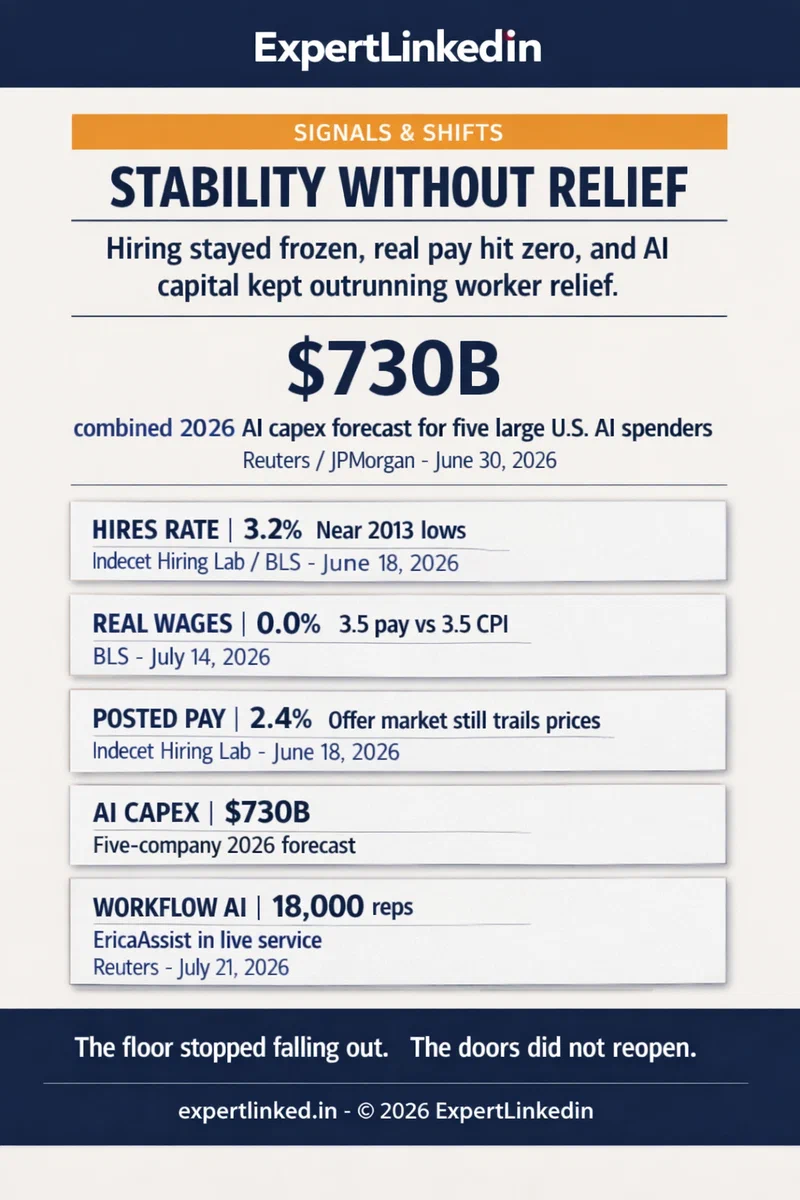
July gave us the answer in three numbers: 3.2, 0.0, and 730.
If you work for a living rather than allocate capital, they add up to a mid-year verdict that is less catastrophic than the first half of 2026 threatened and far less generous than the AI spending headlines imply. The Stillness Trap asked whether the labor market was living off stasis. The July 8 follow-up tested whether the mechanism had actually moved. Last week’s earnings read asked whether the AI boom had finally produced audited, worker-visible proof of value.
July’s answer is specific. Hiring is still structurally frozen. Real wage erosion has stopped, but only barely. And the AI money is still moving faster through data centers, financing desks, and tightly scoped workflow tools than through the broader labor market.
Number 1: 3.2% #
The first number is still the hires rate.
The direct June JOLTS hires rate is not out yet. That matters, and it is worth saying plainly. But the May reading was 3.2%, the separation rate was 3.1%, and the quits rate held at 1.9% (Indeed Hiring Lab, June 30, 2026). Then June payroll growth came in at just 57,000, with April and May revised down by a combined 74,000 (U.S. Bureau of Labor Statistics, July 2, 2026). That is not proof that June hires printed at exactly 3.2%. It is strong evidence that the mechanism described in the July 8 piece did not suddenly reopen.
Cory Stahle’s June analysis remains the cleanest explanation of why this matters. Employers added an average of 114,000 jobs per month over the first five months of 2026, yet hiring itself remained near its weakest level since 2013 because quits, layoffs, and other separations fell even faster (Indeed Hiring Lab, June 18, 2026). June’s employment report did not overturn that reading. If anything, it made it harder to pretend the spring had momentum. Laura Ullrich’s phrase for the June report was “slack water” (Indeed Hiring Lab, July 2, 2026). That still feels right.
The mid-year verdict on labor mobility, then, is not ambiguous. The floor under existing workers held. The front door did not open.
For H2 career positioning, that means the core constraint I laid out in The Three Career Moves That Actually Work When the Labor Market Is Stuck still stands. External motion is possible, but the market itself is not providing much lift. Any strategy that depends on a suddenly generous hiring environment is betting against the data.
Number 2: 0.0% #
This is the number July improved.
Average hourly earnings rose 3.5% year-over-year in June, exactly matching the 3.5% year-over-year increase in CPI (BLS, July 2, 2026; BLS, July 14, 2026). After the -1.8 percentage point real-wage gap I flagged on July 1, that is real progress. The darkest version of this July verdict would have been low hires plus still-negative real wages. We did not get that.
But zero is not the same thing as relief.
The more interesting read is the methodological split that July finally made useful to surface. BLS wage data tells you what happened to workers already in jobs. Indeed’s wage tracker tells you what employers are offering in new postings. Those are different labor-market experiences. In May, posted wage growth was still only 2.4% year-over-year, and even the fastest-growing low-wage postings were at 2.7% (Indeed Hiring Lab, June 18, 2026). Earlier Indeed analysis also showed salaried roles up 2.9% from Q1 2025 to Q1 2026 versus just 1.7% for hourly roles, with negative hourly wage growth in sectors including software development and data and analytics (Indeed Hiring Lab, May 28, 2026).
That means July’s “real wages are back to zero” headline is true mainly for incumbents.
If you already have a job, the erosion has stopped. If you are trying to switch jobs, especially through hourly, contract, or entry-to-mid-level white-collar openings, the offer market is still weaker than the CPI headline suggests. That is a more uncomfortable verdict than either optimism or doom allows. The pain is no longer uniform. It is being sorted by employment status, pay structure, and leverage.
This is the most useful H2 distinction in the data trail so far. Inflation is no longer actively stripping purchasing power from many incumbents. It is still quietly weakening the external option for people who need the market to bid them upward.
So if you are planning a compensation conversation in H2, the argument shifts. A generic “prices are up” case is weaker now than it was two weeks ago. An evidence-and-scope case is stronger. The logic of building an AI proof portfolio before Q4 review season survives July precisely because flat real wages do not create leverage by themselves. They only stop destroying it.
Number 3: 730 #
The third number is not a wage figure or a hiring figure. It is capital spending.
Reuters reported on June 30 that five companies including Microsoft, Alphabet, and Amazon are forecasting combined capital expenditures of about $730 billion this year, according to JPMorgan (Reuters, June 30, 2026). In April, Reuters framed the same question more bluntly: Big Tech is on track to pour around $600 billion into AI this year, and investors still want one answer back from the earnings cycle: will any of this actually pay off? (Reuters, April 28, 2026)
That is the labor-market bridge most commentary keeps skipping. Massive AI spending is real. It is not automatically a worker-side recovery signal.
The most concrete disclosures we have so far still point somewhere narrower. Reuters’ April 28 preview of Big Tech results noted that only 3.3% of Microsoft’s more than 450 million enterprise customers subscribe to its $30-a-month Copilot assistant, even as the company remains under pressure to justify the scale of its AI investment (Reuters, April 28, 2026). Last week’s bank earnings showed capital formation and financing fees booming around AI infrastructure, with Goldman calling the environment an AI “capex super cycle” and Bank of America saying it has helped raise nearly $500 billion for AI-related companies since 2025 (Reuters, July 15, 2026).
Then came the most grounded labor-side data point of the week: Bank of America expanded the generative AI capabilities of EricaAssist, a tool now used by more than 18,000 customer-service representatives to deliver contextual guidance in under three seconds during live conversations (Reuters, July 21, 2026).
That is what the current phase of AI employment impact looks like when it becomes concrete. Not a broad-based hiring boom. Not a clean layoff-to-productivity equation either. A targeted workflow assistant inside an existing job architecture.
Atlassian’s State of Teams 2026 report explains why this matters. Eighty-nine percent of executives say AI increases speed, but only 6% are sure they have clear organization-wide AI ROI. Eighty-seven percent of knowledge workers say that with everyone in execution mode, they lack the time or capacity to coordinate (Atlassian, April 27, 2026). McKinsey’s November 2025 survey lands on the same fault line from the opposite direction: 88% of respondents report AI use in at least one business function, but only 39% report any enterprise-level EBIT impact (McKinsey, November 5, 2025).
Put those together and the third number becomes easier to read. The AI boom is still a capital-spending story first, a workflow-compression story second, and a broad labor-market relief story not yet.
That matters for your H2 position because it tells you where the premium is likely to appear. Not in generic “AI enthusiasm.” In bounded, documentable workflow value inside a labor market that still is not moving very much.
The H2 Read #
So what does the full July trail actually say?
It says the labor market did not break. It also did not reopen.
It says real wages stopped getting worse for many incumbents. It does not say the offer market suddenly became generous.
It says AI investment remains enormous. It does not say that investment has already translated into broad worker leverage, cleaner external mobility, or audited operating gains large enough to change the employment picture on their own.
That combination produces a narrower and more honest H2 strategy than either the panic version or the hype version.
If you are securely employed, the highest-return move is still internal positioning. Build evidence, expand scope where you can, and make your contribution legible in workflow terms rather than tool-usage terms. If you are pursuing an external move, use the posted-wage data and the frozen hires mechanism as your baseline rather than the headline CPI improvement. And if you are trying to interpret AI headlines as career signals, separate capital deployment from labor-market benefit. They are not arriving on the same timeline.
The most uncomfortable truth July surfaced is that this is probably the better outcome.
If July had closed with negative real wages and flat hires, the case for individual positioning as the primary answer would have weakened sharply. Instead, July delivered a thinner, more demanding verdict: the market gave workers just enough improvement to stay in the game, not enough to coast. The floor stopped falling out. The doors did not reopen.
Have a reaction to this verdict - or a data point that shifts it? The most useful signals are the ones professionals catch from inside actual teams, budgets, and hiring conversations.
Email me at jackson.rodriguez@tlnw.uk.
References #
- Atlassian Teamwork Lab. (April 27, 2026). “The State of Teams 2026.” https://www.atlassian.com/blog/state-of-teams-2026 (Accessed July 22, 2026)
- Indeed Hiring Lab. (May 28, 2026). “Pay for Salaried Workers Is Rising Faster Than Hourly Wages.” https://www.hiringlab.org/2026/05/28/pay-for-salaried-workers-is-rising-faster-than-hourly-wages/ (Accessed July 22, 2026)
- Indeed Hiring Lab, Cory Stahle. (June 18, 2026). “Strong Job Gains, Weak Hiring.” https://www.hiringlab.org/2026/06/18/strong-job-gains-weak-hiring/ (Accessed July 22, 2026)
- Indeed Hiring Lab. (June 18, 2026). “US Labor Market Snapshot - May 2026.” https://www.hiringlab.org/2026/06/18/us-labor-market-snapshot-may-2026/ (Accessed July 22, 2026)
- Indeed Hiring Lab, Sneha Puri. (June 30, 2026). “May 2026 JOLTS Report: More of the Same.” https://www.hiringlab.org/2026/06/30/may-2026-jolts-report-more-of-the-same/ (Accessed July 22, 2026)
- Indeed Hiring Lab, Laura Ullrich. (July 2, 2026). “June 2026 Jobs Report: An Unmoving Tide.” https://www.hiringlab.org/2026/07/02/june-2026-jobs-report-an-unmoving-tide/ (Accessed July 22, 2026)
- McKinsey & Company. (November 5, 2025). “The state of AI in 2025: Agents, innovation, and transformation.” https://www.mckinsey.com/capabilities/quantumblack/our-insights/the-state-of-ai (Accessed July 22, 2026)
- Reuters. (April 28, 2026). “Big Tech investors to gauge payoff as AI spending set to hit $600 billion.” https://www.reuters.com/business/retail-consumer/big-tech-investors-gauge-payoff-ai-spending-set-hit-600-billion-2026-04-28/ (Accessed July 22, 2026)
- Reuters. (June 30, 2026). “AI spending, earnings hopes, Fed outlook set to sway US stocks in second half.” https://www.reuters.com/business/ai-spending-earnings-hopes-fed-outlook-set-sway-us-stocks-second-half-2026-06-30/ (Accessed July 22, 2026)
- Reuters. (July 15, 2026). “Wall Street banks see AI ‘super cycle’ set to boost deals, financing.” https://www.reuters.com/legal/transactional/wall-street-banks-see-ai-super-cycle-set-boost-deals-financing-2026-07-14/ (Accessed July 22, 2026)
- Reuters. (July 21, 2026). “BofA enhances AI-powered tool to resolve client needs faster.” https://www.reuters.com/business/finance/bofa-enhances-ai-powered-tool-resolve-client-needs-faster-2026-07-21/ (Accessed July 22, 2026)
- U.S. Bureau of Labor Statistics. (July 2, 2026). “The Employment Situation - June 2026.” https://www.bls.gov/news.release/empsit.nr0.htm (Accessed July 22, 2026)
- U.S. Bureau of Labor Statistics. (July 14, 2026). “Consumer Price Index Summary - June 2026.” https://www.bls.gov/news.release/cpi.nr0.htm (Accessed July 22, 2026)
AI Content Notice
This article was created using artificial intelligence technology. Whenever possible, we include references and sources to support the information presented. Readers are encouraged to consult these sources for further information. While we strive for accuracy and provide valuable insights, readers should independently verify information and use their own judgment when making business decisions. The content may not reflect real-time market conditions or personal circumstances.
Related Articles
Infographic: The Mid-2026 Labor Market Verdict: Three Numbers That Define Your H2 Career Position
Hiring stayed frozen, real pay only crawled back to flat, and the AI boom still points to workflow …
Briefing Room: May 2026
May 2026 confirmed what the data has been building toward for months — AI is pulling up the bottom …
Signals & Shifts: The Quiet Freeze
This week’s labor data shows a quiet freeze—headline stability with uneven opportunity—making …