How to Build an AI Proof Portfolio Before Q4 Review Season - One Workflow at a Time

A single AI proof memo can help you win one conversation. It is not enough to survive a calibration room, a manager change, or a reorg that suddenly asks what exactly your AI contribution has been all year.
That is the mistake in stopping at one pilot. If you want the Q4 review conversation to go your way, you do not need one good AI example. You need a small portfolio of documented workflow proofs that shows a repeatable operating pattern.
McKinsey’s 2025 state of AI survey found that 88% of organizations are using AI in at least one business function, but only 39% report any enterprise-level EBIT impact. The organizations seeing the strongest results are nearly three times as likely as others to have fundamentally redesigned workflows (McKinsey, November 5, 2025). Atlassian’s State of Teams 2026 lands on the same fault line from a different angle: 89% of executives say AI increases speed, but only 6% are sure they have clear examples of organization-wide AI ROI, while 87% of knowledge workers say everyone is moving so fast they no longer have the capacity to coordinate (Atlassian, April 27, 2026).
That is the environment your review is happening inside. Leaders want evidence. Most do not have a good instrument for finding it. One proof memo is useful. A portfolio of three or four, each covering a different workflow and risk category, is much harder to dismiss as luck, novelty, or personal enthusiasm.
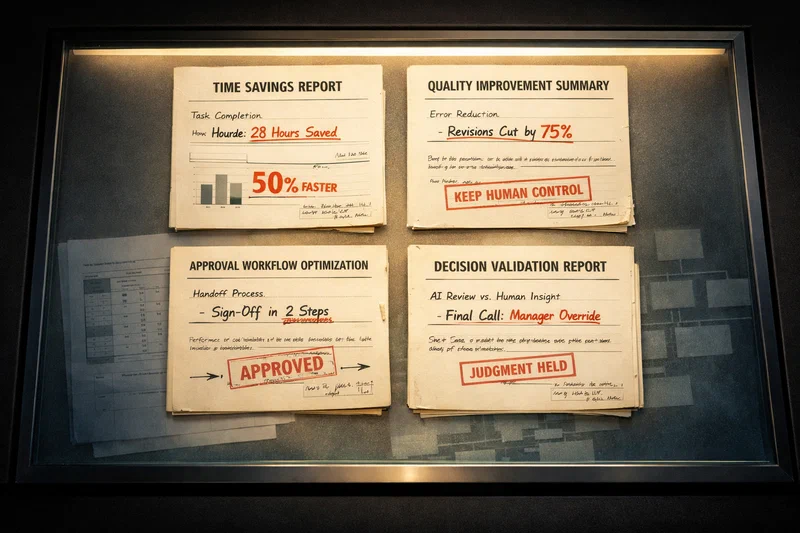
Why one memo stops working #
The Workflow Proof Playbook gave you the base unit: one workflow, one baseline, one bounded AI role, one human control, one proof memo. The mid-year review playbook showed how that one memo changes the terms of a review conversation before a dashboard does. This article is the next step in the arc: moving from a single proof unit to an evidence system.
Why does that matter now? Because a single memo answers one narrow question: did this pilot work? A portfolio answers a much more valuable one: does this person know how to redesign work repeatedly without creating downstream damage?
Those are not the same question. In many organizations, one successful pilot can still be explained away.
- Maybe you picked an unusually easy workflow.
- Maybe the savings were real but isolated.
- Maybe the tool happened to fit that one task.
- Maybe your manager liked the presentation more than the process.
Three or four memos across different workflow types force a different conclusion. They show that you are not just AI-curious. You are building operating judgment.
That distinction matters more in July 2026 than it would have two years ago. Indeed Hiring Lab’s June 30 JOLTS analysis put the quits rate at 1.9%, at or below 2% for almost a year straight, a sign that workers do not feel confident greener pastures are waiting elsewhere (Indeed Hiring Lab, June 30, 2026). In a market where fewer people are moving, internal artifacts matter more than external optionality. If you are going to build leverage inside the organization, it needs to be documented.
What a proof portfolio actually proves #
The first thing a portfolio does is solve the trust problem.
BetterUp’s September 2025 workslop research found that 54% of managers report receiving AI-generated material that looks finished but creates more confusion, correction, or rework. Employees spend an average of 1 hour and 51 minutes dealing with each instance, equivalent to $186 per employee per month in hidden productivity cost (BetterUp, September 29, 2025). This is the quiet backdrop of every AI performance discussion now: managers are not just wondering whether their teams use AI. They are wondering whether AI use makes the work cleaner or just faster to produce and slower to trust.
A portfolio lets you answer that question before someone asks it badly.
The second thing a portfolio does is make your skill legible in the market that actually exists. Indeed’s May 2026 labor market snapshot showed AI-related postings at 5.7% of all Indeed postings, well past their prior 2022 peak, while software development postings sat at 72% of their pre-pandemic baseline (Indeed Hiring Lab, June 18, 2026). Read together, those numbers say something sharper than “learn AI.” Employers are not broadly paying for abstract AI fluency. They are paying for practitioners who can embed AI into existing functions under real workflow constraints.
That is exactly what a proof portfolio demonstrates.
And here is the counterintuitive part that makes the portfolio stronger than a pile of success stories: one of your memos should usually be a boundary memo.
Not a failure hidden in the appendix. A deliberate record of where AI did not get to own the step, why you kept human control, and what risk the constraint prevented.
That memo often becomes the most important one in the set. Anyone can claim enthusiasm. Fewer people can show restraint.
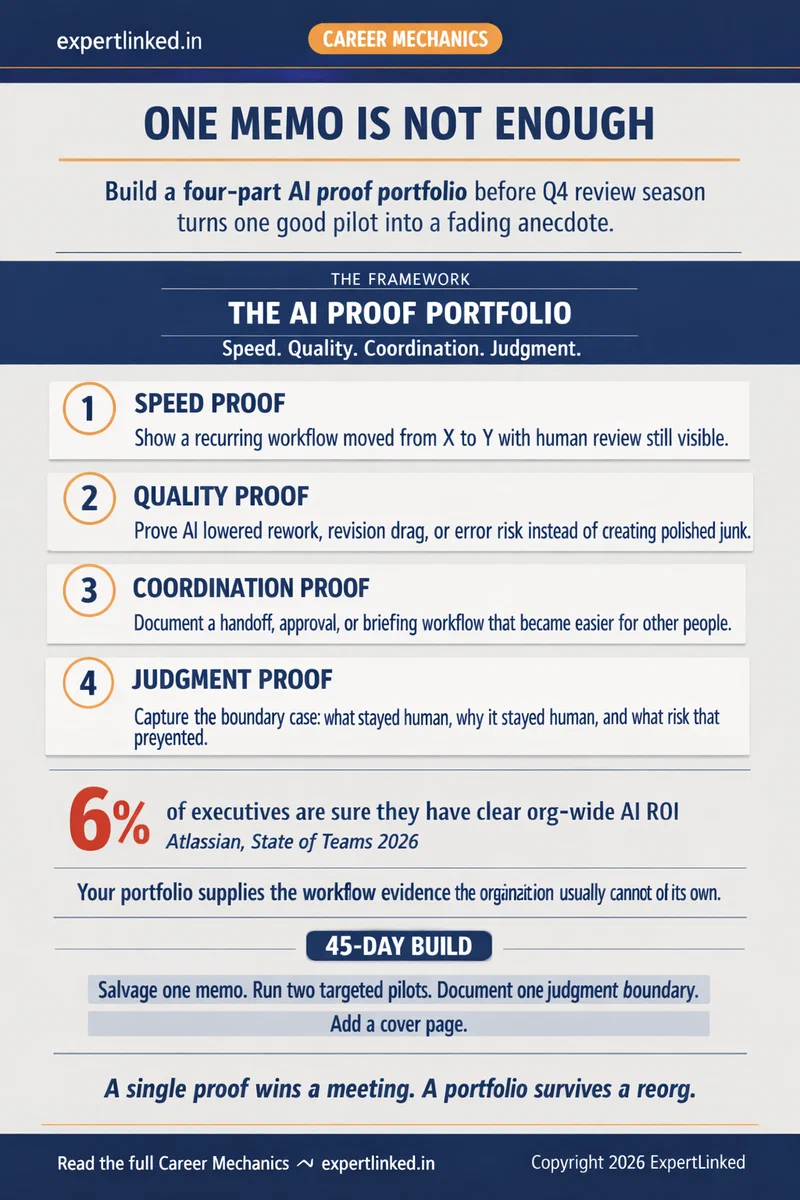
The Four-Memo Portfolio #
If you want the most durable version of this artifact, build four proof types. Do not invent a new memo format for each one. Reuse the seven fields from the July 6 piece:
- Workflow
- Baseline
- AI role
- Human control
- Result
- Main risk
- Recommendation
What changes is the category of evidence each memo is designed to cover.
Memo 1: The speed proof #
This is the easiest one to build and the one most readers should already have started after June 29.
Target a recurring workflow with clear cycle-time drag: weekly reporting, first-draft summaries, meeting note conversion, triage queues, or templated stakeholder updates. The point of this memo is simple: show that a real workflow moved from X to Y without lowering trust.
What you are proving here is not that AI made you faster in the abstract. You are proving that you can identify friction, baseline it, and remove a measurable chunk of it.
If you do not have this memo yet, start here. It is the foundation.
Memo 2: The quality proof #
This is where the portfolio stops looking like generic efficiency talk.
Choose a workflow where the pain is not just time. The pain is rework, inconsistency, missed details, or review fatigue. That could be compliance summaries, customer recap emails, invoice exception notes, candidate handoff packets, or monthly deck assembly.
The result field in this memo should talk about quality in business language:
- revision rounds dropped
- error escapes decreased
- formatting variance tightened
- reviewer intervention fell
- downstream questions declined
The quality proof is politically stronger than most people realize. It directly answers the manager fear created by workslop: not “did you produce more?” but “did you create something other people had to clean up?”
Memo 3: The coordination proof #
This is the memo most professionals skip, and it is often the one managers value most.
Atlassian’s report is useful here because it names the structural problem clearly: individual speed gains do not automatically produce team-level value when approvals, handoffs, and shared context cannot keep up. That is why the top 14% of teams in the study look different. They ground AI in context, workflows, and culture rather than isolated bursts of output (Atlassian, April 27, 2026).
Your coordination proof should therefore focus on one workflow where the gain was visible to somebody besides you.
Examples:
- a cleaner briefing format that reduced follow-up questions from a manager
- an intake summary that sped up cross-functional approvals
- a standardized project note that shortened the handoff between sales and operations
- a recurring analysis pack that made review meetings shorter or more decisive
This memo matters because it shows you understand the unit of value most AI users miss. The job is not to produce more text. The job is to reduce drag between people.
Memo 4: The judgment proof #
This is the portfolio’s differentiator.
Pick a workflow where AI looked plausible on the surface but should not fully own the step: a decision with legal nuance, a client-facing judgment call, a prioritization problem with ambiguous inputs, or a workflow where the output is easy to draft but risky to trust.
Then document exactly what happened.
Maybe AI produced a decent first pass but weak prioritization. Maybe it summarized accurately but flattened the nuance that mattered. Maybe it sped up the draft while increasing verification time enough to erase the gain. Maybe it looked polished and still could not be trusted without full human review.
Write that down cleanly. A judgment proof says:
“I tested the boundary. Here is what the tool could do. Here is what stayed human. Here is why.”
That is not anti-AI. It is anti-sloppiness. In a review conversation, it signals the kind of maturity organizations say they want but rarely know how to measure.
If you only build three memos this quarter, do not skip this one. Your strongest portfolio may be three gains plus one principled limit.
A 45-day build plan #
Do not misread this framework as four net-new projects. In most cases, at least one memo can be reconstructed from work you have already done in H1 or early Q3.
Use this sequence:
- Days 1-3: Audit the last four months of AI-assisted work and salvage one speed or quality memo from something that already happened.
- Days 4-17: Run one low-risk speed pilot if the portfolio still lacks a clean time-saved case.
- Days 18-31: Build the quality or coordination memo, whichever category is weakest in your current set.
- Days 32-40: Run or document the judgment test on a higher-risk workflow where human control matters.
- Days 41-45: Assemble the four memos under one cover page with one paragraph explaining the pattern across them.
That cover page should not be fancy. It should say, in plain language, what the set proves. For example:
Over Q3, I built four documented workflow proofs covering speed, quality, coordination, and judgment. Across the set, AI reduced cycle time in two recurring workflows, lowered review drag in one cross-functional handoff, and clarified one boundary where human control should remain explicit. The pattern is not higher tool usage. The pattern is repeatable workflow redesign with defined controls.
That is the sentence a manager can reuse upward.
What to say when you bring it in #
Use this when the review conversation turns to AI contribution:
“I do not want to frame my AI contribution as a usage count or a single anecdote. I brought a four-part proof portfolio covering speed, quality, coordination, and judgment so we can evaluate the work at the workflow level.”
Then hand over the cover page first, not the individual memos.
If the manager asks why you built multiple proofs instead of one, use this:
“One memo can be luck. Four across different workflows show a repeatable operating pattern. They also show where I deliberately kept human control, which matters as much as the time saved.”
And if you want to turn the portfolio into an H2 or Q4 growth conversation rather than a backward-looking recap:
“Two of these workflows are now stable enough to scale. One should stay local to my role. One marks a boundary where I do not recommend further automation. My Q4 recommendation is to expand the first two and keep the fourth explicitly human.”
That is a stronger review posture than “I use AI a lot” or even “I had one good pilot.” It sounds like someone who can manage technology inside a real operating environment.
The real Q4 advantage #
The portfolio matters because review systems are imperfect and organizations forget quickly.
Managers change. Priorities move. Reorgs reclassify whole chunks of work. A single proof memo can disappear with a meeting. A portfolio creates a paper trail of judgment across multiple contexts. It is the closest thing you can build, inside your current job, to a durable career artifact.
It also travels. If your manager leaves, the documents remain. If your organization starts talking about AI adoption scores, you already have better evidence. If the labor market forces you to make an external move later, the portfolio becomes the internal version of a public evidence stack: concrete, recent, and tied to real work rather than abstract claims.
The mistake most professionals make in July is assuming they are too early for review season. In practice, July and August are the only months where the evidence can still be created under live conditions instead of reconstructed under pressure.
One proof memo is a data point. A proof portfolio is a case.
And in an AI-saturated organization, the promotable person is usually the one who can put four pages on the table and quietly change the room’s definition of useful.
Have you built a workflow proof portfolio that changed a review conversation - or learned the hard way that one memo was not enough? The most useful patterns are the ones where the second or third proof changed how the organization understood the first.
Email me at jackson.rodriguez@tlnw.uk to share it.
References #
- Atlassian Teamwork Lab (April 27, 2026). “The State of Teams 2026.” https://www.atlassian.com/blog/state-of-teams-2026 (Accessed July 20, 2026)
- BetterUp (September 29, 2025). “The hidden cost of AI ‘workslop’ - and how leaders can fix it.” https://www.betterup.com/blog/hidden-costs-workslop (Accessed July 20, 2026)
- Indeed Hiring Lab (June 18, 2026). “US Labor Market Snapshot - May 2026.” https://www.hiringlab.org/2026/06/18/us-labor-market-snapshot-may-2026/ (Accessed July 20, 2026)
- Indeed Hiring Lab (June 30, 2026). “May 2026 JOLTS Report: More of the Same.” https://www.hiringlab.org/2026/06/30/may-2026-jolts-report-more-of-the-same/ (Accessed July 20, 2026)
- McKinsey Global Institute (November 5, 2025). “The state of AI in 2025: Agents, innovation, and transformation.” https://www.mckinsey.com/capabilities/quantumblack/our-insights/the-state-of-ai (Accessed July 20, 2026)
AI Content Notice
This article was created using artificial intelligence technology. Whenever possible, we include references and sources to support the information presented. Readers are encouraged to consult these sources for further information. While we strive for accuracy and provide valuable insights, readers should independently verify information and use their own judgment when making business decisions. The content may not reflect real-time market conditions or personal circumstances.
Related Articles
Infographic: How to Build an AI Proof Portfolio Before Q4 Review Season - One Workflow at a Time
One proof memo is a data point; a portfolio of three to four across different workflows is the …
Career Mechanics: The Workflow Proof Playbook - How to Turn AI Learning Into Career Capital
The AI career premium now goes to professionals who can redesign one real workflow and prove the …
Infographic: The Three Career Moves That Actually Work When the Labor Market Is Stuck
When external mobility stalls, the highest-ROI career moves involve organizational vulnerability and …