How to Turn Your Mid-Year Review Into an AI Capability Signal Before Your Manager Creates One for You

Your mid-year review is in six weeks. Someone at your company is already calculating what your AI contribution looks like — and they almost certainly are not asking you about it.
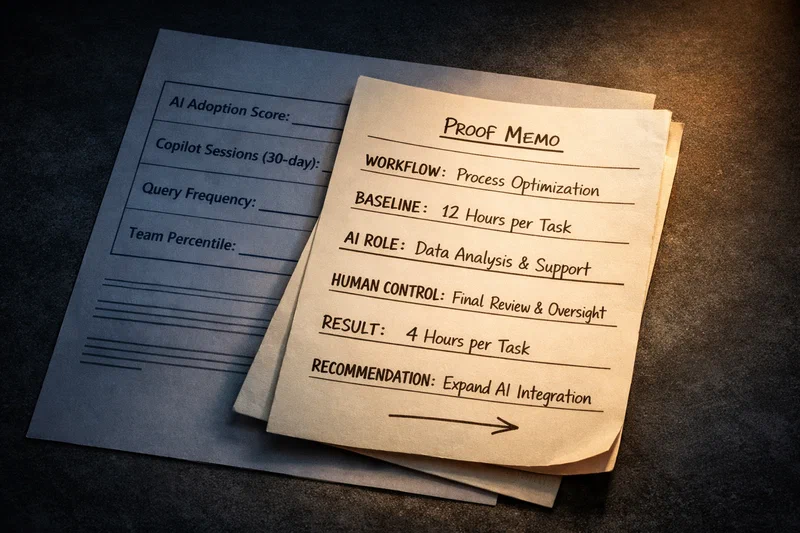
The machinery has been in place for about a year. Microsoft launched its AI Adoption Score — a tool that tracks Copilot usage frequency, task types, and session engagement organization-wide — as a management dashboard for IT and HR teams to measure “how well your organization has adopted Microsoft 365 Copilot” (Microsoft, 2025). Workday and SAP SuccessFactors have integrated AI interaction signals into their performance management modules. The organizations that deployed AI tools twelve months ago are now starting to score the people who use them.
And here is the structural problem with mid-year 2026: most of these measurement systems were designed to track tool use, not value created. McKinsey’s November 2025 survey found that 88% of organizations now use AI in at least one business function — and just 39% report any enterprise-level EBIT impact from it (McKinsey, November 5, 2025). The other 61% have adoption metrics and no business outcome. That gap is precisely where your mid-year review currently lives.
What gets measured at your review is almost certainly some version of this: how often you used AI tools, whether your usage is above or below the team average, and a qualitative assessment of your AI “engagement.” What does not get measured — unless you make it so — is whether any workflow changed because of what you did.
The professionals who are changing the terms of that conversation are not waiting to be evaluated. They are arriving with evidence.
The signal your manager is building without you #
The Microsoft AI Adoption Score measures Copilot session frequency, the types of tasks where Copilot was invoked, and whether interactions fit certain patterns associated with “productive” use. It is useful data for IT administrators deciding how to configure enterprise tools. It is a poor substitute for evidence of actual workflow redesign.
The problem — documented in detail in the June 26 Workplace Clinic case — is that when session frequency becomes the performance signal, optimizing for session frequency is rational behavior. Open Copilot. Leave it running. Query it for things you already know the answer to. The dashboard reads as high AI adoption. The actual work does not improve. And in functions with quality requirements — compliance, legal, financial analysis, client-facing deliverables — it may actively degrade.
BetterUp’s September 2025 research on what it calls AI “workslop” — AI-generated content that looks complete but is actually low-quality, unhelpful, or wrong — found that 54% of managers are already receiving it from the people they manage. Workers spend an average of one hour and 51 minutes dealing with each instance, amounting to $186 per month per employee in hidden productivity costs. For an organization of 10,000 workers, that figure exceeds $9 million annually (BetterUp, September 29, 2025).
The uncomfortable arithmetic: some of the people with the highest AI adoption scores in your organization are the ones generating the most workslop. The score and the value are sometimes negatively correlated.
Your manager knows this at some level. What they do not have — what almost no one in most organizations currently has — is a disciplined framework for evaluating the difference between AI use that generated value and AI use that generated volume. Your proof memo fills that gap before they fill it with a dashboard average.
Why mid-year is the window that matters #
Year-end reviews follow a pattern: the context has cooled, the data has been aggregated, and the narrative is nearly set. Changing the framing at year-end is possible but costs considerably more political capital than changing it in July.
Mid-year reviews are different because the narrative is still liquid. A manager who receives a one-page, outcome-documented memo in mid-July has a materially different reference frame than one who receives nothing and defaults to the platform. That reference frame does not disappear when the review ends — it shapes how Q3 and Q4 performance gets interpreted.
The AI Survivor Penalty, detailed in the July 3 Workplace Clinic, operates partly through exactly this mechanism: organizations that have already embedded visible AI enthusiasm into their evaluation language — without defining what “real” AI contribution looks like — create a scope document for themselves that employees never see until the review is over. The mid-year window — specifically the window before the review, not during it — is where individuals still have the leverage to write a different document first.
After August, this window closes. Whatever assessment got built in July becomes the H1 record. The time to change the signal is before it is written.
The Mid-Year Review Proof Playbook #
Four moves. Use them in this order.
Move 1: Run the 90-minute audit #
Before you write anything, spend ninety minutes doing an honest inventory of every AI-assisted workflow from the past three to four months.
For each instance, answer four questions:
- What specific task or workflow did AI touch?
- What was the time cost, error count, or friction level before?
- What is it now, even approximately?
- Who else saw or experienced the difference?
The fourth question is the one most people skip. An outcome that only you observed is an anecdote. An outcome visible to a downstream reviewer, a client, or a colleague who received the deliverable — that is evidence.
Most people who run this audit find two things. First, they have more usable material than they expected: usually two or three specific examples that hold up to all four questions. Second, a significant portion of their AI usage does not survive the audit — generated content that was not used, summaries that were not consulted, drafts that were fully rewritten. The exercise makes both categories visible, which is precisely the point. It tests your own assumptions before your manager’s dashboard does.
If the audit returns nothing that survives all four questions, you have an urgent but solvable problem. You have five to six weeks before most mid-year reviews close. That is enough time to run one two-week structured pilot following the Workflow Proof Playbook and return with a real memo.
Move 2: Build the proof memo #
Take your strongest one or two audit examples and write them up using this structure:
Workflow: [the specific process that was modified] Baseline: [what it took before — time, steps, error rate, revision count] AI role: [what AI specifically handled] Human control: [what you verified or owned, and why it stayed human] Result: [the measurable change] Main risk: [the boundary you maintained and the reason] Recommendation: [what you would do next with this workflow]
One paragraph per field. One page total. That is the artifact.
The human control field is more important than it looks. It is the field that separates a proof memo from an enthusiasm document. Naming the specific judgment step you kept human — and giving a real reason for it — demonstrates a level of process understanding that “I use AI regularly” never does.
For professionals in roles with inherent quality or risk constraints — compliance, legal, clinical, financial reporting, client relationship management — this field converts what might read as cautious or low-adoption behavior into a demonstration of exactly the capability organizations say they want: the judgment to know what AI should own and what it should not. That is what Fatima in the June 26 clinic case was doing. What she was missing was the documented memo that made her judgment legible to the person evaluating it.
McKinsey’s finding that AI high performers are nearly three times as likely as others to have fundamentally redesigned their workflows is worth noting here. The proof memo is not the redesign. It is the documentation that makes the redesign visible and repeatable.
Move 3: Frame the review conversation #
Use this when you open the mid-year discussion on AI contribution:
“I want to walk you through my AI work this half year in a way I think is more useful than adoption stats. I have been running structured pilots and tracking outcomes — here is what I found.”
Hand over the memo. Let it sit for thirty seconds before you say anything else. The written artifact does more work than the spoken summary.
When you close the AI segment, use this:
“What I have found is that the highest-value applications in my role are [specific category]. The places I have deliberately kept human judgment are [specific category], because [one-sentence reason]. Going into H2, my plan is to [next pilot or next workflow].”
The closing sentence is the one most people forget to say. It moves the conversation from audit to planning. It positions you as managing your AI development rather than being evaluated by the review cycle — which is the exact framing shift the playbook is designed to produce.
Move 4: Propose the Q3 pilot before you leave the room #
The strongest move in a mid-year review is not the one that closes the H1 argument. It is the one that opens the H2 plan before your manager fills in that column themselves.
After presenting the memo:
“For Q3, I want to test [specific workflow] using the same methodology — two-week pilot, before-and-after tracking, human verification at [specific decision point]. I will have a memo for you by [specific date]. If the gain holds, the Q4 recommendation would be to [scale or expand].”
This does three things. It shows continuity of method rather than episodic experimentation. It removes uncertainty from your manager’s H2 evaluation — they know what signal to expect and when. And it pre-fills the Q4 review with a milestone you set, not one the platform assigned.
The professionals building the most durable AI career capital in 2026 are not the ones with the highest session counts. They are the ones who can walk into every review cycle with a documented log of what they redesigned, what they left human, and what they plan to test next.
The arithmetic that most mid-year prep advice ignores #
Organizations measuring AI by session frequency are paying $186 per employee per month for the workslop that measurement incentivizes. The managers drowning in that output are not looking for another enthusiastic user. They are looking for someone who understands the difference between production volume and workflow value — and can prove it in writing.
That is the actual capability gap in most organizations right now. Not adoption. Not enthusiasm. Not prompt technique. The gap is between people who treat AI as a content accelerator and people who treat it as a process redesign tool. The proof memo is how you show which side of that distinction you are on.
It is also a legibility device: a piece of documentation that makes your judgment visible to someone who currently has no instrument for seeing it. It converts the mid-year review from a scoring event into a negotiation about what good AI contribution means in your specific role.
You have until the end of July. That is enough time to build something that changes the terms.
References #
- McKinsey Global Institute (November 5, 2025). “The state of AI in 2025: Agents, innovation, and transformation.” https://www.mckinsey.com/capabilities/quantumblack/our-insights/the-state-of-ai (Accessed July 5, 2026)
- BetterUp (September 29, 2025). “The hidden cost of AI ‘workslop’ — and how leaders can fix it.” https://www.betterup.com/blog/hidden-costs-workslop (Accessed July 5, 2026)
- Microsoft (2025). “Announcing General Availability of AI Adoption Score.” https://techcommunity.microsoft.com/blog/microsoft_365blog/announcing-general-availability-of-ai-adoption-score/4403118 (Accessed July 5, 2026)
- Microsoft WorkLab (April 23, 2025). “2025: The Year the Frontier Firm Is Born — Work Trend Index Annual Report.” https://www.microsoft.com/en-us/worklab/work-trend-index/2025-the-year-the-frontier-firm-is-born (Accessed July 5, 2026)
AI Content Notice
This article was created using artificial intelligence technology. Whenever possible, we include references and sources to support the information presented. Readers are encouraged to consult these sources for further information. While we strive for accuracy and provide valuable insights, readers should independently verify information and use their own judgment when making business decisions. The content may not reflect real-time market conditions or personal circumstances.
Related Articles
Career Mechanics: The Workflow Proof Playbook - How to Turn AI Learning Into Career Capital
The AI career premium now goes to professionals who can redesign one real workflow and prove the …
Career Mechanics: The AI Competency Playbook – Why Usage Won't Protect Your Career and What Will
Nearly 1 in 4 CEOs say half their workforce needs AI retraining, but the problem isn’t …
Signals & Shifts: The Quiet Freeze
This week’s labor data shows a quiet freeze—headline stability with uneven opportunity—making …