The Skills Bifurcation: How AI Is Splitting the Labor Market Into Two Non-Overlapping Career Tracks

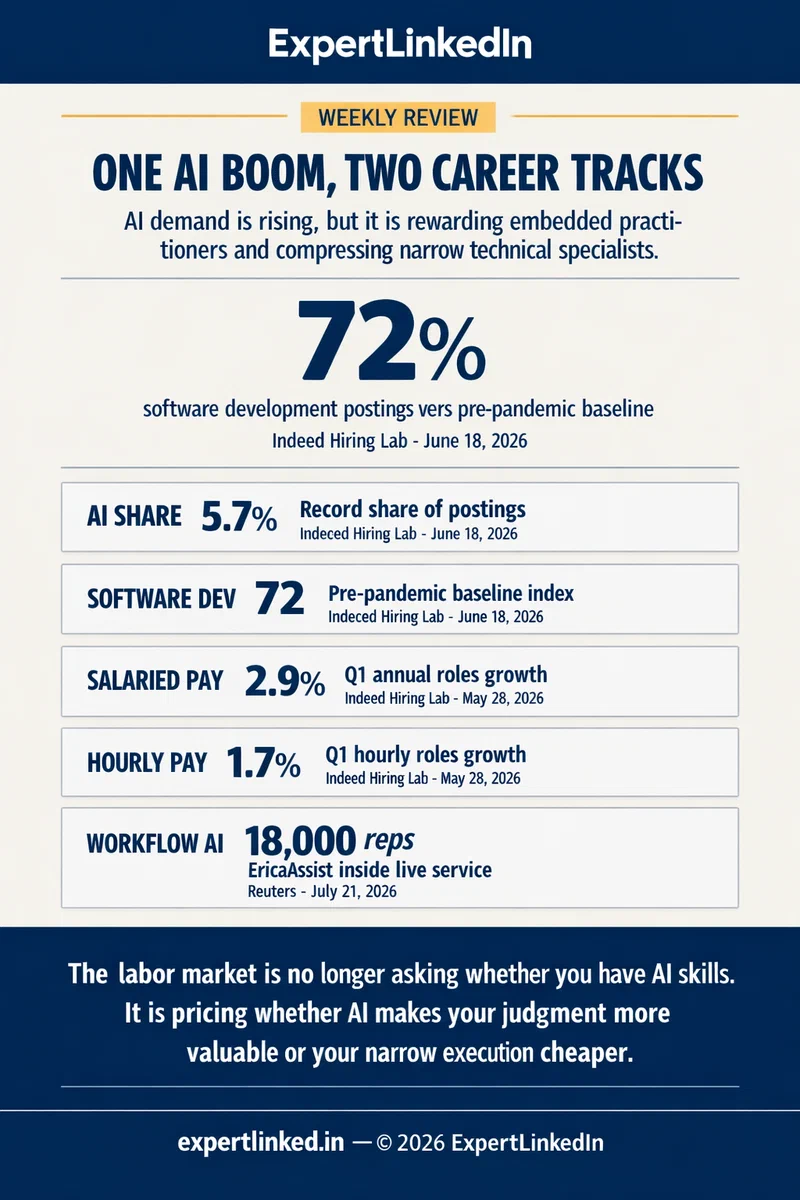
Two labor-market numbers arrived this summer with enough force to cancel each other out if you read them lazily. AI-related job postings climbed to 5.7% of all postings on Indeed, a record share. Software development postings fell to 72% of their pre-pandemic baseline, the weakest major sector in the same snapshot.
Most commentary still treats those as contradictory signals: AI is booming, tech is cooling, the market is messy, move on. That is the wrong read. These numbers are not fighting each other. They are describing the same structural event.
The labor market is splitting into two tracks. On one track are AI-embedded practitioners: people whose value rises because AI makes their existing domain work faster, broader, and more measurable. On the other are AI-displaced specialists: people whose work is narrow enough, codified enough, or oversupplied enough that AI compresses the middle of the role before it expands the frontier. The biggest H2 career mistake a professional can make is assuming these tracks are interchangeable.

Read the two numbers together #
Indeed’s May 2026 snapshot matters less for the headline and more for the juxtaposition. Overall postings sat at 100.4 on the Job Postings Index, basically back to pre-pandemic levels. Posted wage growth was only 2.4% year over year. The vacancy-to-unemployment ratio had fallen back to 1.0. And within that already cooler market, AI-related postings reached 5.7% while software development fell to 72% of baseline (Indeed Hiring Lab, June 18, 2026).
That is not a story about a fresh category of “AI jobs” opening wide enough to absorb everyone touched by automation. It is a story about AI diffusing across the board while a specific technical lane gets more selective.
McKinsey’s 2025 State of AI survey supplies the missing mechanism. Eighty-eight percent of respondents report regular AI use in at least one business function, but nearly two-thirds are still in experimentation or pilot mode, only 39% report any enterprise-level EBIT impact, and larger organizations are far more likely than smaller ones to have reached the scaling phase (McKinsey, November 5, 2025). In other words, AI demand is real, but it is not evenly distributed, and it is not rewarding everyone with the same skill label.
Indeed’s June 2 JOLTS analysis makes that even more concrete. Openings at establishments with 5,000 or more workers ran 81% above their pre-pandemic baseline in April, while employers with 50 to 999 workers, which account for roughly 40% of all openings, were still 12% below baseline. Nearly all AI-related hiring remained clustered at the very largest firms (Indeed Hiring Lab, June 2, 2026).
That is why The Stillness Trap mattered: the market is not reopening broadly enough to let professionals shrug off mispositioning.
Track 1: The AI-embedded practitioner #
This track is defined less by title than by role architecture.
AI-embedded practitioners sit in jobs where context, workflow ownership, stakeholder judgment, and domain fluency matter more than raw task execution. AI makes them faster, but it does not make the surrounding judgment disappear. In some cases it raises the value of that judgment because the volume of plausible output increases and someone still has to decide what is true, safe, relevant, and worth acting on.
This is why the strongest AI labor-market signal right now is not “prompt engineer.” It is the spread of AI requirements across ordinary business functions. McKinsey found that the companies getting the most value from AI are the ones redesigning workflows, not merely buying tools, and those high performers are nearly three times as likely as others to fundamentally redesign how work happens (McKinsey, November 5, 2025). Atlassian’s 2026 State of Teams report lands on the same fault line from inside the firm: 89% of executives say AI increases speed, but only 6% are sure they have clear organization-wide ROI, while 85% of knowledge workers use AI and only 29% have embedded it into actual flows of work (Atlassian, April 27, 2026).
Indeed’s skills analysis gives us a cleaner way to identify them. In IT systems and solutions, less than half of required skills come from the technology category, while business operations skills account for 18.2% and leadership and communications together account for 11.2% (Indeed Hiring Lab, June 3, 2026). That is the practitioner signature: technical fluency still matters, but the leverage comes from translation, integration, and coordination.
The wage premium here is usually defensive rather than spectacular. Salaried postings grew 2.9% from Q1 2025 to Q1 2026 while hourly roles grew 1.7%, and several tech-adjacent hourly categories turned negative (Indeed Hiring Lab, May 28, 2026). June CPI cooling only brought incumbents back to flat in real terms, not into a new bidding war (BLS, July 2, 2026; BLS, July 14, 2026). The premium is that your role becomes easier to justify and broaden when you can show that AI improved a real workflow under your control. That is the logic behind The Workflow Proof Playbook.
Bank of America’s expansion of EricaAssist to more than 18,000 customer-service representatives is the cleanest live example in this week’s reporting: AI is landing inside an existing role, not replacing the need for context, escalation judgment, and relationship handling (Reuters, July 21, 2026).
Track 2: The AI-displaced specialist #
This track is where the most confusion lives, because it still contains real demand. McKinsey does show software engineers and data engineers leading AI-related hiring. It also shows that this hiring is concentrated at large organizations already scaling AI (McKinsey, November 5, 2025). That is very different from saying technical specialists in general are safe.
Indeed’s skill-concentration research explains why. Software development is the most concentrated occupation in the dataset: 79.4% of the typical software-development skill mix sits inside the technology category (Indeed Hiring Lab, June 3, 2026). That concentration made software careers powerful in the buildout era. It also makes the middle more compressible now. Employers can automate slices of the workflow, route more output through fewer senior people, and raise the bar on the openings that remain.
That is what the 72% posting baseline is telling you. It does not mean technical work stopped mattering. It means broad middle-layer demand for technical execution weakened while AI diffused across the rest of the economy. The wage split shows the same pattern: hourly technical work is where bargaining power disappears first (Indeed Hiring Lab, May 28, 2026). Once workers fall out of that lane, re-entry is slower. May’s long-term unemployment share rose to 27.5%, and June still counted 1.9 million long-term unemployed (Indeed Hiring Lab, June 5, 2026; BLS, July 2, 2026).
The wrong response from this track is “learn more AI.” The right response is to push technical fluency outward into systems integration, analytics translation, governance, vendor evaluation, or other roles where business operations and communication skills matter. That is how a specialist stops being priced as interchangeable execution and starts being priced as translation.
The grey zone is where most professionals actually live #
Most mid-career knowledge workers are not pure practitioners yet, and they are not pure specialists either. They sit in the grey zone where the bifurcation becomes a choice: analysts, project managers, marketers, operations leads, finance partners, compliance staff, HR operators, customer-success managers, and plenty of mid-level technical people whose work touches business process as much as pure production.
The risk here is passivity. Teams are using AI, but most have not embedded it into flows of work, and 87% of knowledge workers say coordination cannot keep up with the speed of new output (Atlassian, April 27, 2026). In the grey zone, AI does not automatically move you onto the practitioner track. It can just as easily turn you into a faster producer of unpriced output.
That is why The Three Career Moves That Actually Work When the Labor Market Is Stuck matters so much in this context. In a still market, the professionals who win are not waiting for the title of the future to be posted. They are generating proof, expanding scope, and becoming visible across workflows before the market names the job for them.
The grey-zone diagnostic is straightforward.
If AI makes your current work faster, does anyone above you care because a real workflow improved?
If your role disappeared tomorrow, would your strongest replacement case be built on domain judgment and coordination, or on narrow task execution?
And over the past 90 days, have you produced evidence that you reduce friction across a system, or only evidence that you can use a tool?
The bifurcation is not between coders and everyone else. It is between workers whose value compounds when AI gets cheaper and workers whose value gets benchmarked downward by the same fact.
A positioning framework for H2 #
If you misread the track you are on, you will make the wrong H2 move.
If you are an AI-embedded practitioner, turn hidden workflow gains into visible career currency. Document one bottleneck you reduced, tie it to time, error rate, throughput, cost, or revenue protection, and use that proof to negotiate for scope.
If you are an AI-displaced specialist, stop interpreting generic AI demand as demand for your current version of the role. Audit how concentrated your skill stack is, then add one adjacent value layer that forces your technical fluency into contact with business operations.
If you are in the grey zone, run a 60-day test. Improve one recurring workflow with AI, measure the result, and watch what the organization actually rewards. Recognition of cleaner outcomes moves you toward Track 1. Indifference to outcomes and fixation on volume alone is a warning.
There is no single “AI skills” market anymore. There is a market rewarding workflow owners, context carriers, and translators. There is another compressing narrowly legible execution and reserving the remaining openings for a smaller number of high-end specialists.
The professionals who do best in H2 will not be the ones with the loudest AI language. They will be the ones who correctly diagnose which side of the split they are on and reposition before the market makes that diagnosis for them.
Have a question, counterexample, or track-shift story from inside your own role? Those are the signals worth following now.
Email me at jackson.rodriguez@tlnw.uk.
References #
- Atlassian. (April 27, 2026). “The State of Teams 2026.” https://www.atlassian.com/blog/state-of-teams-2026 (Accessed July 24, 2026)
- Indeed Hiring Lab. (May 28, 2026). “Pay for Salaried Workers Is Rising Faster Than Hourly Wages.” https://www.hiringlab.org/2026/05/28/pay-for-salaried-workers-is-rising-faster-than-hourly-wages/ (Accessed July 24, 2026)
- Indeed Hiring Lab. (June 2, 2026). “April 2026 JOLTS Report: The Bigger They Are, the Harder They Hire.” https://www.hiringlab.org/2026/06/02/april-2026-jolts-report-the-bigger-they-are-the-harder-they-hire/ (Accessed July 24, 2026)
- Indeed Hiring Lab. (June 3, 2026). “How Skill Concentration Sets Tech and Healthcare Sectors Apart.” https://www.hiringlab.org/2026/06/03/how-skill-concentration-sets-tech-and-healthcare-sectors-apart/ (Accessed July 24, 2026)
- Indeed Hiring Lab. (June 5, 2026). “May 2026 Jobs Report: One Strong Headline, but Two Realities.” https://www.hiringlab.org/2026/06/05/may-2026-jobs-report-one-strong-headline-but-two-realities/ (Accessed July 24, 2026)
- Indeed Hiring Lab. (June 18, 2026). “Strong Job Gains, Weak Hiring.” https://www.hiringlab.org/2026/06/18/strong-job-gains-weak-hiring/ (Accessed July 24, 2026)
- Indeed Hiring Lab. (June 18, 2026). “US Labor Market Snapshot - May 2026.” https://www.hiringlab.org/2026/06/18/us-labor-market-snapshot-may-2026/ (Accessed July 24, 2026)
- McKinsey & Company. (November 5, 2025). “The state of AI in 2025: Agents, innovation, and transformation.” https://www.mckinsey.com/capabilities/quantumblack/our-insights/the-state-of-ai (Accessed July 24, 2026)
- Reuters. (July 21, 2026). “BofA enhances AI-powered tool to resolve client needs faster.” https://www.reuters.com/business/finance/bofa-enhances-ai-powered-tool-resolve-client-needs-faster-2026-07-21/ (Accessed July 24, 2026)
- U.S. Bureau of Labor Statistics. (July 2, 2026). “The Employment Situation - June 2026.” https://www.bls.gov/news.release/empsit.nr0.htm (Accessed July 24, 2026)
- U.S. Bureau of Labor Statistics. (July 14, 2026). “Consumer Price Index Summary - June 2026.” https://www.bls.gov/news.release/cpi.nr0.htm (Accessed July 24, 2026)
AI Content Notice
This article was created using artificial intelligence technology. Whenever possible, we include references and sources to support the information presented. Readers are encouraged to consult these sources for further information. While we strive for accuracy and provide valuable insights, readers should independently verify information and use their own judgment when making business decisions. The content may not reflect real-time market conditions or personal circumstances.
Related Articles
Infographic: The Skills Bifurcation: How AI Is Splitting the Labor Market Into Two Non-Overlapping Career Tracks
The 2026 AI job market is splitting into embedded practitioners with leverage and specialists facing …
Briefing Room — July 2026: The Best of a Month That Asked Hard Questions
July 2026’s sharpest article, tool, opportunity, research, and internal idea all pointed to …
The Mid-2026 Labor Market Verdict: Three Numbers That Define Your H2 Career Position
Hiring stayed frozen, real pay only crawled back to flat, and the AI boom still points to workflow …