Briefing Room — July 2026: The Best of a Month That Asked Hard Questions

July was the month AI stopped getting graded on novelty and started getting graded on evidence.
The most useful reporting of the month did not ask whether AI can draft, summarize, or impress a board deck. It asked harder questions: what kind of hire the AI era now rewards, what kind of tool actually survives inside a real workflow, what adoption looks like when engagement is still flat, and who absorbs the cost when organizations measure usage before they redesign work.
That is why this month’s Briefing Room feels cleaner than June’s. The noise is still high, but the signal is sharper: adoption is easy to announce, far harder to prove, and hardest of all to make durable for the people doing the work.

Best Article #
Research: AI Is Changing What Employers Want from New Hires Harvard Business Review — July 8, 2026
The best external article of the month because it refuses the lazy frame that AI lowers the bar for knowledge work. Jim Doucette and Vishal Gaur studied 30 organizations across banking and finance, management consulting, and technology, media, and e-commerce and came back with the harder conclusion: AI is collapsing junior execution tasks into broader roles while raising the premium on system-level judgment. Product, design, and engineering work begins converging into a more generalist “general technologist” shape. New hires are expected to prototype faster, pressure-test outputs, and redesign workflows, not simply talk intelligently about AI in the abstract.
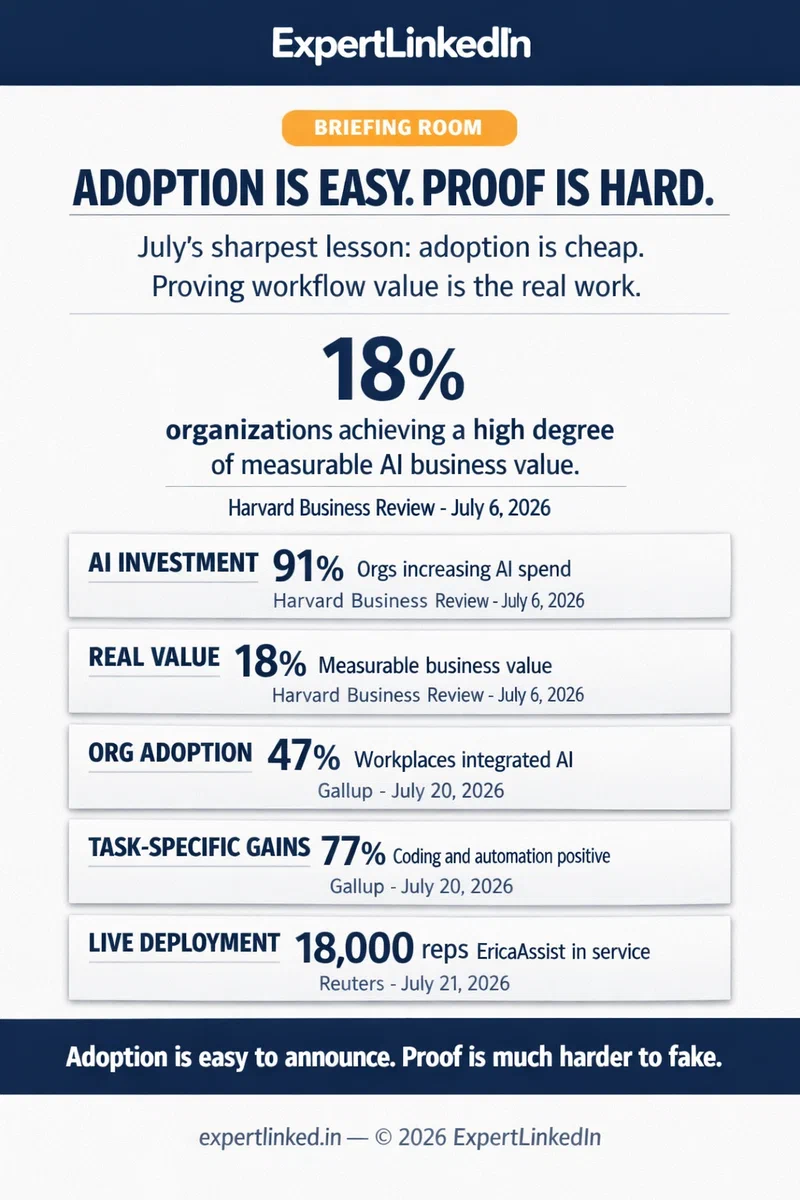
That argument lands even harder when read beside HBR’s Performance Management Needs New Metrics in the AI Era from two days earlier. That piece cites a 2026 data-and-AI leadership survey in which 91% of organizations say AI investment is rising, 99% call AI a top priority, and only 18% say they are achieving a high degree of measurable business value. Put those two pieces together and July’s best labor-market read becomes obvious: the market is not demanding more AI talk. It is demanding broader operators who can turn AI into accountable work.
Best Tool #
EricaAssist at Bank of America Reuters — July 21, 2026
The best tool of the month is not public, which is exactly why it matters. Bank of America expanded EricaAssist to more than 18,000 customer-service representatives, with the system delivering contextual guidance in under three seconds during live conversations. That is a much better signal than another general-purpose chatbot demo. It is narrow, embedded, supervised, and wired to a recurring workflow where speed and context both matter.
Reuters’ July 13 survey of digital assistants across Wall Street makes the pattern clearer. Morgan Stanley is testing client-facing assistants with human oversight. BNY gives digital employees logins, nicknames, and human managers. UBS says AI agents help advisors spend 70% of their time with clients instead of routine tasks. The proof-playbook connection is direct. The winning AI tool is not the one that can do everything. It is the one that removes friction from one real step, inside one real system, with one clear owner.
Best Opportunity #
IT Systems & Solutions roles Indeed Hiring Lab — June 3, 2026
If you want the clearest practitioner opportunity visible in real postings right now, look at the jobs that sit at the boundary between technology and workflow. Indeed’s skill analysis shows software development remains intensely concentrated, with 79.4% of its required skills inside the technology category. IT systems and solutions roles are different: only 48% of their required skills are pure technology, while 18.2% sit in business operations and another 11.2% in leadership and communications.
That is not a consolation category. It is where AI-era leverage is likely to compound. These jobs are about integration, translation, rollout, context, and cross-team coordination, exactly the work organizations still struggle to price correctly and exactly the work generic AI fluency does not replace. Read it next to HBR’s July 8 new-hire analysis and the late-July opportunity picture sharpens further: the market is rewarding people who can make AI useful inside the messy middle of a business, not just people who can sit closest to the model.
Best Research #
Employee Engagement Remains Flat as AI Adoption Accelerates Gallup — July 21, 2026
This is the cleanest July research on what happens after the rollout email goes out. U.S. employee engagement stayed stuck at 31%, even as AI use climbed. Gallup found that employees in AI-adopting organizations are more engaged only when three conditions show up together: frequent use, a clear integration plan, and active manager support. Without those conditions, access to AI is just another ambiguous expectation.
The strongest numbers are the uncomfortable ones. Employees whose organizations provide a clear AI plan show a 15-point engagement advantage. Employees with active manager support show an 18-point advantage. Workers with all the supportive conditions in place are nearly three times as likely to give AI the highest productivity rating, 50% versus 17% among frequent users overall. Read with Gallup’s Organizational AI Adoption Jumps Six Points from July 20, where 47% of employees said their organization had integrated AI and 77% of coding and automation users reported positive productivity effects, and the message is hard to miss: adoption is rising faster than management quality.
Best Idea from ExpertLinked #
There is no single AI skills market anymore.
The best idea we published this month is the one Jackson lands in The Skills Bifurcation: the labor market is splitting between AI-embedded practitioners, whose domain work becomes more valuable when AI is woven into the workflow, and AI-displaced specialists, whose narrow execution gets benchmarked downward by the same tools.
That reframe explains most of July better than any single statistic could. It explains why The Stillness Trap was not contradicted by a 5.7% AI-posting share. It explains why The Three Career Moves That Actually Work When the Labor Market Is Stuck and How to Build an AI Proof Portfolio Before Q4 Review Season both emphasized internal proof over generic AI enthusiasm. And it explains why Olivia’s July clinic arc kept returning to the same human question: when organizations rush adoption without redesign, who absorbs the cost? If you carry one idea from July into H2, carry the diagnostic. Figure out which side of the split your current role is drifting toward, then act before the market names it for you.
July at ExpertLinked #
If you want the full July arc rather than just this month’s picks, start here:
- July 1 — Signals & Shifts: The Stillness Trap
- July 2 — The Amplifier Effect: What AI Gets Backwards About Human Value
- July 3 — Workplace Clinic: The AI Survivor Penalty
- July 6 — How to Turn Your Mid-Year Review Into an AI Capability Signal
- July 7 — The FDA patient-facing LLM accountability gap
- July 8 — What the June Jobs Report Actually Said About the Hires Rate
- July 10 — Your Company Mandated AI Tools But Not AI Workflows
- July 10 — She Automated Her Own Bottleneck
- July 13 — The Three Career Moves That Actually Work When the Labor Market Is Stuck
- July 14 — AI-Resilient Jobs Aren’t AI-Free. That’s the Point.
- July 15 — What Q2 Earnings Calls Are Actually Revealing About Enterprise AI ROI
- July 17 — How to Manage a Team Member Who Won’t Use AI Tools
- July 20 — How to Build an AI Proof Portfolio Before Q4 Review Season
- July 21 — AI Didn’t Kill the Junior Job. Founders Did.
- July 22 — The Mid-2026 Labor Market Verdict
- July 23 — The Manager’s AI Accountability Gap
- July 24 — The Lateral Move Nobody Saw Coming
- July 24 — The Manager’s Survivor Penalty
- July 25 — The Skills Bifurcation
July’s best work kept asking the same hard question from different angles: where is the proof?
Adoption is easy to announce. Proof is much harder to fake.
Have a candidate for next month’s Briefing Room - or a workflow proof story worth surfacing? I’d like to hear what you’re seeing.
Email me at jackson.rodriguez@tlnw.uk.
References #
- Harvard Business Review / Randy Bean, Erik Strauss, and Randeep Singh (July 6, 2026). “Performance Management Needs New Metrics in the AI Era.” https://hbr.org/2026/07/performance-management-needs-new-metrics-in-the-ai-era (Accessed July 25, 2026)
- Harvard Business Review / Jim Doucette and Vishal Gaur (July 8, 2026). “Research: AI Is Changing What Employers Want from New Hires.” https://hbr.org/2026/07/research-ai-is-changing-what-employers-want-from-new-hires (Accessed July 25, 2026)
- Gallup / Andy Kemp (April 12, 2026). “Rising AI Adoption Spurs Workforce Changes.” https://www.gallup.com/workplace/704225/rising-adoption-spurs-workforce-changes.aspx (Accessed July 25, 2026)
- Gallup / Andy Kemp (July 20, 2026). “Organizational AI Adoption Jumps Six Points.” https://www.gallup.com/workplace/712736/organizational-adoption-jumps-six-points.aspx (Accessed July 25, 2026)
- Gallup / Jim Harter (July 21, 2026). “Employee Engagement Remains Flat as AI Adoption Accelerates.” https://www.gallup.com/workplace/712433/employee-engagement-remains-flat-adoption-accelerates.aspx (Accessed July 25, 2026)
- Indeed Hiring Lab / Annina Hering, Sneha Puri, and Virginia Sondergeld (June 3, 2026). “How Skill Concentration Sets Tech and Healthcare Sectors Apart.” https://www.hiringlab.org/2026/06/03/how-skill-concentration-sets-tech-and-healthcare-sectors-apart/ (Accessed July 25, 2026)
- McKinsey & Company (November 5, 2025). “The state of AI in 2025: Agents, innovation, and transformation.” https://www.mckinsey.com/capabilities/quantumblack/our-insights/the-state-of-ai (Accessed July 25, 2026)
- Reuters / Nupur Anand and Tatiana Bautzer (July 13, 2026). “Focus: Wall Street banks ramp up digital assistants in bid to win productivity race.” https://www.reuters.com/business/finance/wall-street-banks-ramp-up-digital-assistants-bid-to-win-productivity-race-2026-07-13/ (Accessed July 25, 2026)
- Reuters (July 21, 2026). “BofA enhances AI-powered tool to resolve client needs faster.” https://www.reuters.com/business/finance/bofa-enhances-ai-powered-tool-resolve-client-needs-faster-2026-07-21/ (Accessed July 25, 2026)
AI Content Notice
This article was created using artificial intelligence technology. Whenever possible, we include references and sources to support the information presented. Readers are encouraged to consult these sources for further information. While we strive for accuracy and provide valuable insights, readers should independently verify information and use their own judgment when making business decisions. The content may not reflect real-time market conditions or personal circumstances.
Related Articles
Infographic: Briefing Room — July 2026: The Best of a Month That Asked Hard Questions
July 2026’s sharpest article, tool, opportunity, research, and internal idea all pointed to …
Briefing Room: April 2026
April 2026’s best reads, tools, and ideas — all pointing at the same structural gap between …
The Skills Bifurcation: How AI Is Splitting the Labor Market Into Two Non-Overlapping Career Tracks
The 2026 AI job market is splitting into embedded practitioners with leverage and specialists facing …