AI-Resilient Jobs Aren't AI-Free. That's the Point.

The phrase “AI-resilient job” sounds reassuring right up until you look closely at the work being placed inside it. The jobs Singapore’s policy debate now treats as resilient - patient experience staff, allied health roles, early-childhood educators, social workers, relationship-heavy service work - are not becoming more important because AI cannot touch them. They are becoming more important because AI can touch everything around them.
That distinction matters far beyond Singapore. In the same week that Singapore officials were arguing for better pay, better redesign and fairer sharing of AI gains, the International Labour Organization said nearly 80 million workers across Asean - 22.9 per cent of total employment - are in occupations where AI can automate or assist with at least some tasks, even as outright job cuts remain limited. If your first instinct is to sort the future of work into “safe” jobs and “unsafe” jobs, you will miss the sharper line. The real divide is between work that accumulates human judgment and work that depends on routine without building it.
AI-resilient jobs are not AI-free. That is the point.
The safest jobs are not the ones furthest from software #
Start with the most misleading assumption in the current conversation: that resilience means distance from technology.
The ILO figures summarized by Bloomberg in The Edge Singapore point in the opposite direction. The highest-exposure occupations in Southeast Asia are not random clerical leftovers; they include financial analysts, multimedia developers and financial brokers. Singapore, meanwhile, has the region’s highest share of AI-exposed work at 42.2 per cent of employment, and it is also the most prepared by the ILO’s assessment because it has the strongest digital infrastructure, talent depth and coordinated state response.
That is the first uncomfortable truth. Exposure is not the same thing as vulnerability. In fact, some of the most valuable work in an AI-heavy economy will sit closest to AI systems, because those workers are the people who decide when the system is good enough, when it is misreading context, and when a human conversation still has to take over.
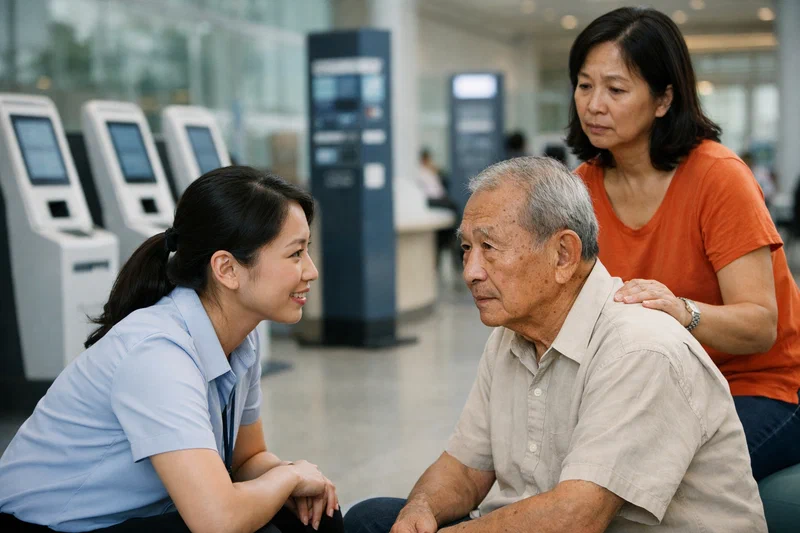
Singapore’s debate about “AI-resilient work” makes this visible. In CNA’s reporting on the Economic Strategy Review, the jobs singled out as resilient are not glamorous engineering roles. They are early-childhood education, allied health and social services - occupations where trust, physical context, persuasion, observation and judgment remain stubbornly human. Jasmin Lau made the point even more directly in her later interview with CNA, arguing that patient experience work and the kind of social work that persuades an elderly person to accept help cannot simply be automated away.
Notice what is actually being said there. Those jobs are not resilient because they are untouched by software. They are resilient because their most consequential tasks are the ones least cleanly reducible to software, even as adjacent tasks - scheduling, documentation, triage, information retrieval, summarization - become highly augmentable.
That is not retreat from AI. It is integration on different terms.
Resilience is a job-design problem, not a distance-from-AI problem #
The data from Singapore’s own labor market backs this up. According to the Ministry of Manpower’s inaugural AI adoption report, as covered by CNA, 71.5 per cent of firms still had not integrated AI as of the first quarter. Among firms already using it, 70.7 per cent reported higher worker productivity. But only 6.2 per cent reported headcount reductions attributable to AI, while 18.9 per cent had redesigned jobs and 13.9 per cent had created new AI-related roles.
That is not a story about machines autonomously eliminating work. It is a story about management choices.
The most serious part of the Singapore conversation is that policymakers seem to understand this. The Economic Strategy Review is not just telling workers to “learn AI.” It is talking about career bridges from at-risk roles into more resilient ones, structured apprenticeship models, modular stackable credentials, and raising the quality and wages of work that is less likely to be commoditized by automation. Tan See Leng tied that to a S$400 million Enterprise Workforce Transformation Package that can cover up to 70 per cent of job redesign costs for SMEs, capped at S$150,000. Jasmin Lau went further, warning that companies repeatedly taking public AI grants while treating workers unfairly should expect intervention.
It assumes the central question is not whether AI arrives, but whether institutions shape it so workers move into better work.
The same logic shows up in the corporate example CNA highlighted from DBS. The bank is using AI to speed trade documentation and spot suspicious transactions, while reskilling workers into new roles including AI agent monitoring managers and generative AI evaluators. All 40,000 employees are being exposed to AI tools, including DBS-GPT in core markets. Again: resilience comes from redesigning work so the human role climbs the value chain instead of being cut out of it.
This extends the case I made earlier this month in The Amplifier Effect: AI does not erase expertise so much as expose where expertise was load-bearing all along. The same is true at the occupational level.
The apprenticeship question deserves more skepticism than it is getting #
The most revealing disagreement in this debate is not between the optimists and the doomers. It is inside the optimistic case itself.
Jasmin Lau argued, reasonably, that younger workers may not need to go through exactly the same repetitive “learning ground” tasks that previous generations did. If AI strips out some of the drudgery, perhaps younger professionals can make judgment calls earlier and build experience faster. There is real promise in that argument.
There is also a major risk inside it.
If you remove the repetitive layer of work without rebuilding the training loop around it, you do not get more experienced workers faster. You get fewer workers who know how to exercise judgment when the automation fails.
That risk is precisely why the ILO’s latest warning about distribution matters more than the headline number. Eco-Business’ coverage of the report notes that women and young workers are expected to bear a disproportionate share of the disruption. That should not be read only as an equity concern. It is also a capability-pipeline concern. Entry-level workers are the people who historically absorbed routine work on the way to acquiring tacit knowledge. If AI absorbs more of that routine before institutions build new supervised pathways into judgment, then “AI literacy” becomes a thin substitute for apprenticeship.
Singapore is at least trying to answer that problem upstream. All higher-education students will learn AI skills from 2027, and the competency framework explicitly includes understanding what AI can and cannot do, what it should and should not do, and how to evaluate its ethical, social and legal implications. Desmond Lee also made the crucial point that AI should deepen learning, not replace thinking.
That is the correct instinct. But curriculum is only part of the answer. The harder question is whether employers will create real structures in which younger workers can still accumulate judgment under supervision, rather than simply inherit AI-mediated outputs and hope that confidence turns into competence. This is the institutional version of the problem I described in The Entry-Level Trust Gap. The bottleneck is no longer only task execution. It is judgment formation.
AI literacy is the floor. Apprenticeship is still the ceiling.
If you call work resilient, pay it like it matters #
The boldest idea in the Singapore debate is also the one most likely to be softened in implementation: raising the wages and status of AI-resilient work.
This matters because many of the jobs now described as resilient were historically treated as socially necessary but economically secondary. Care work, patient navigation, social support, early-childhood instruction, high-trust service coordination - these are roles societies praise rhetorically while underpaying structurally.
That becomes much harder to justify in an AI-saturated economy.
If AI handles more analysis, more drafting, more routing, more documentation and more basic coordination, then the human layer that remains is not a residual. It is the part that keeps institutions legitimate. It is the part that persuades a patient, reassures a family, notices a physical cue, reads hesitation, judges edge cases, and decides whether a rule should really be applied the way the system suggests.
Underpaying that layer is not thrift. It is systems design failure.
This is why Singapore’s insistence on shared gains matters. In the Yahoo-syndicated Straits Times report on Jasmin Lau’s parliamentary speech, she argued that companies benefiting from AI should redesign jobs in consultation with workers, invest in reskilling and redeployment over retrenchment, and make sure productivity gains are shared. In Ng Chee Meng’s parliamentary motion, covered by CNA, the same philosophy appears in a different register: clearer market intelligence, earlier support for displaced workers, more than 1 million AI-Ready SG training places, and a labor compact that treats AI transition as collective design rather than private survival.
That is the real test for every government now invoking resilience. If a role becomes more valuable because it supplies the judgment, empathy and contextual intelligence that AI cannot reliably own, does the system raise its pay, strengthen its progression path and protect its apprenticeship pipeline? Or does it simply relabel the job as “future-proof” and leave the worker where they already were?
One of those approaches builds a future of work. The other builds a slogan.
The phrase to retire is not “AI exposure.” It is “AI-proof.” No serious labor market will be organized around proof against AI. The question is whether jobs are designed so that AI takes the routine layer while human beings move upward into judgment-rich, better-paid, more durable work.
A job does not become future-safe because AI stops at the door. It becomes future-safe when the human judgment inside it is treated as infrastructure, not leftovers.
Have you seen a role get labeled “AI-resilient” without better pay, better progression or better training behind the label? I want to hear the version of this story that policy language usually leaves out.
Email me at emily.chen@tlnw.uk
References #
- Channel NewsAsia (May 27, 2026). “Singapore will act against firms that accept AI grants while treating workers unfairly: Jasmin Lau.” https://www.channelnewsasia.com/singapore/economic-strategy-review-jasmin-lau-ai-workers-young-singaporeans-6144256 (Accessed July 14, 2026)
- Yahoo News Singapore / The Straits Times (May 6, 2026). “As AI advances, S’pore will support workers through job redesign and shared gains: Jasmin Lau.” https://sg.news.yahoo.com/ai-advances-pore-support-workers-111500790.html (Accessed July 14, 2026)
- Channel NewsAsia (May 13, 2026). “‘Career bridges’, raising wages of AI-resilient work: Economic Strategy Review proposes ways to create good jobs.” https://www.channelnewsasia.com/singapore/jobs-ai-transformation-economic-review-6116346 (Accessed July 14, 2026)
- Channel NewsAsia (May 6, 2026). “Singapore will not leave future of work, livelihoods to chance amid AI transition: Tan See Leng.” https://www.channelnewsasia.com/singapore/ai-work-jobless-growth-not-leave-chance-tan-see-leng-manpower-6103516 (Accessed July 14, 2026)
- Channel NewsAsia (April 30, 2026). “No indication of AI displacing jobs widely, as firms using AI see productivity gains: MOM report.” https://www.channelnewsasia.com/singapore/ai-adoption-jobs-workers-no-disruption-productivity-6091746 (Accessed July 14, 2026)
- Channel NewsAsia (May 5, 2026). “Singapore must enable businesses to transform, workers to seize new opportunities in the ‘AI era’: Ng Chee Meng.” https://www.channelnewsasia.com/singapore/ai-job-disruption-workers-business-ng-chee-meng-ntuc-motion-parliament-6100911 (Accessed July 14, 2026)
- The Edge Singapore / Bloomberg (July 10, 2026). “AI could affect millions in Asean but ILO sees no big job cuts yet.” https://www.theedgesingapore.com/news/tech/ai-could-affect-millions-asean-ilo-sees-no-big-job-cuts-yet (Accessed July 14, 2026)
- Eco-Business (July 10, 2026). “Women, young workers to be hardest hit by AI disruption in Asean: report.” https://www.eco-business.com/news/women-young-workers-to-be-hardest-hit-by-ai-disruption-in-asean-report/ (Accessed July 14, 2026)
- Channel NewsAsia (May 21, 2026). “All university, polytechnic and ITE students to learn AI skills from 2027.” https://www.channelnewsasia.com/singapore/ai-artificial-intelligence-skills-courses-ihl-university-polytechnic-ite-students-2027-6133781 (Accessed July 14, 2026)
AI Content Notice
This article was created using artificial intelligence technology. Whenever possible, we include references and sources to support the information presented. Readers are encouraged to consult these sources for further information. While we strive for accuracy and provide valuable insights, readers should independently verify information and use their own judgment when making business decisions. The content may not reflect real-time market conditions or personal circumstances.
Related Articles
The Entry-Level Trust Gap in the Age of AI Copilots
The central future-of-work risk in 2026 is a trust gap where firms cut entry-level pathways on AI …
Capex Is Eating Payroll — and We Still Call It Productivity
This week’s layoffs-and-capex cycle reveals that AI workforce risk is less about automation magic …
Signals & Shifts: The Hiring Split-Screen Is Here
Hiring is slow overall, but demand for AI-adjacent capability is accelerating, creating a …