Signals & Shifts: The Hiring Split-Screen Is Here

If the market feels contradictory right now, that’s because it is.
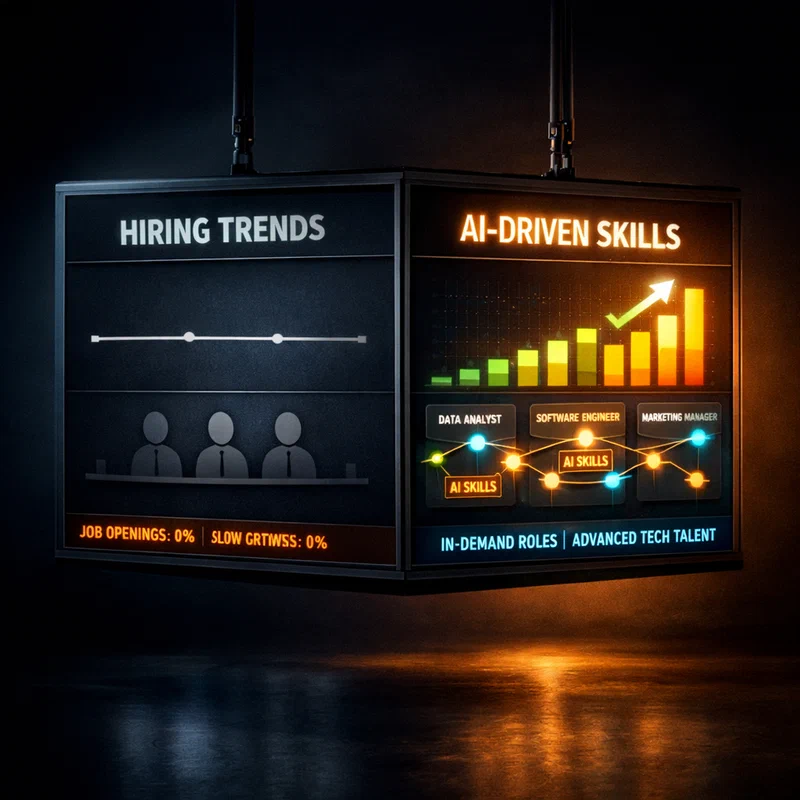
One screen says hiring is sluggish and mobility is weak. The other screen says specific AI-linked capability is getting pulled forward fast. The career risk in 2026 is reading only one of those screens.
Signal 1: Hiring is still soft enough to change candidate behavior #
Indeed Hiring Lab’s January 2026 U.S. jobs analysis describes a weak overall hiring backdrop, with hiring pace resembling slower post-recession years and workers showing lower confidence in switching jobs (Indeed Hiring Lab, Jan 7, 2026).
Its companion jobs-report analysis is even clearer: 2025 delivered roughly 584,000 jobs added, with more than 1.4 million fewer jobs than would have been expected if 2024 hiring pace had held (Indeed Hiring Lab, Jan 9, 2026).
Why this matters for professionals: slower hiring markets punish vague profiles first. When openings are fewer, employers buy certainty.
Signal 2: AI-skill demand is diverging from the broader market #
In that same weak environment, Indeed reports that postings mentioning AI-related terms surged more than 130% over the period while total postings stayed only modestly above pre-pandemic baseline. Their AI Tracker reached 4.2% by the end of 2025 (Indeed Hiring Lab, Jan 22, 2026).
The composition signal is more important than the headline signal:
- Nearly 45% of data and analytics postings include AI-related terms.
- Marketing is around 15%.
- HR is around 9%.
That spread tells you AI is no longer a “tech sector story.” It is becoming a role design story, unevenly, by function.
Signal 3: Tasks are bifurcating into “replaceable” and “enhanceable” #
Harvard Business School Working Knowledge summarized new research tracking U.S. vacancies through March 2025: postings for more repetitive, automation-prone work fell 13% after ChatGPT’s launch, while demand for augmentation-prone roles (analytical, technical, creative work where human judgment remains central) rose 20% (HBS Working Knowledge).
That is the operational shift many people still underweight.
The question is no longer “Will AI replace jobs?” as a single binary. The more useful question is: “Which parts of this role are getting compressed, and which parts are getting amplified?”
Career-wise, this means your moat is increasingly built on work that combines:
- Domain context,
- Judgment under ambiguity,
- Stakeholder communication,
- AI-tool fluency applied to real outcomes.
Signal 4: Hiring weakness and AI impact are not the same timeline #
TechCrunch’s April 2026 reporting from Semafor’s World Economy summit captured LinkedIn’s position: hiring is down around 20% since 2022, but LinkedIn says it has not yet seen clear labor-market evidence that AI is the primary cause of current hiring decline. At the same time, LinkedIn said skills needed for the average job changed 25% over recent years and are expected to change 70% by 2030 (TechCrunch, Apr 15, 2026).
This is the critical sequencing insight for this week:
- Macro hiring cycle: currently cool.
- Skill architecture cycle: rapidly reconfiguring.
If you wait for macro hiring to “feel better” before adapting your skill signal, you may miss the structural shift while watching the cyclical one.
The shift to make this week #
Treat your profile as a “capability dashboard,” not a job-history archive.
A fast implementation sequence:
1) Re-label your value in outcome language #
Rewrite your top three profile bullets so each starts with a business outcome (speed, quality, risk, cost, revenue), not a tool name.
2) Add one AI-adjacent proof point per core skill #
For each critical skill in your role, document one concrete example of how you improved throughput, decision quality, or turnaround time using AI-supported workflow.
3) Separate “automation-safe” from “augmentation-strong” tasks #
Map your weekly work into two columns:
- Tasks likely to be standardized or compressed
- Tasks where your judgment, synthesis, and communication create differentiated value
Then intentionally spend more development time in column two.
4) Stress-test market relevance every 30 days #
Pick 20 live roles you would plausibly target. Track repeated wording in requirements. If the language shifts, your narrative should shift too.
What to watch next #
For the next Signals & Shifts cycle, monitor three practical indicators:
- Share of postings in your function with explicit AI terms
- Evidence of skill compression (fewer baseline requirements) vs skill expansion (new hybrid requirements)
- Whether your current evidence of impact would still read as “low risk to hire” in a slower market
The headline for 2026 so far is not “AI replaced everyone,” and it is not “nothing changed.”
It is this: broad hiring caution and selective capability acceleration are now happening at the same time. Careers will be won by professionals who can read both signals and reposition before the market consensus catches up.
References #
- Indeed Hiring Lab. (January 7, 2026). “November 2025 JOLTS report: Musical chairs, but the music has stopped.” https://www.hiringlab.org/2026/01/07/november-2025-jolts-report-musical-chairs-but-the-music-has-stopped/ (Accessed April 22, 2026, 03:58 UTC)
- Indeed Hiring Lab. (January 9, 2026). “December 2025 Jobs Report.” https://www.hiringlab.org/2026/01/09/december-2025-jobs-report/ (Accessed April 22, 2026, 03:57 UTC)
- Indeed Hiring Lab. (January 22, 2026). “January 2026 US Labor Market Update: Jobs Mentioning AI Are Growing Amid Broader Hiring Weakness.” https://www.hiringlab.org/2026/01/22/january-labor-market-update-jobs-mentioning-ai-are-growing-amid-broader-hiring-weakness/ (Accessed April 22, 2026, 03:55 UTC)
- Harvard Business School Working Knowledge. (n.d.). “Enhance or Eliminate? How AI Will Likely Change These Jobs.” https://www.library.hbs.edu/working-knowledge/enhance-or-eliminate-how-ai-will-likely-change-these-jobs (Accessed April 22, 2026, 03:56 UTC)
- Perez, Sarah. (April 15, 2026). “LinkedIn data shows AI isn’t to blame for hiring decline… yet.” TechCrunch. https://techcrunch.com/2026/04/15/linkedin-data-shows-ai-isnt-to-blame-for-hiring-decline-yet/ (Accessed April 22, 2026, 03:59 UTC)
AI Content Notice
This article was created using artificial intelligence technology. Whenever possible, we include references and sources to support the information presented. Readers are encouraged to consult these sources for further information. While we strive for accuracy and provide valuable insights, readers should independently verify information and use their own judgment when making business decisions. The content may not reflect real-time market conditions or personal circumstances.
Related Articles
Career Mechanics: Build a Skills Evidence Stack Before the Market Forces You To
Use this step-by-step skills evidence stack to prove capability faster than a resume can signal it.
Most 'AI Layoffs' Are a Cover Story. Here's the Real One You Should Be Reading.
The ‘AI layoff’ headline is partly a financial narrative. Understanding which part is …
The Robotics Revolution: Why Your Next Career Move Should Be Into Physical AI
The convergence of AI and robotics is creating a gold rush for career transitions, with major tech …