What the July 2026 FOMC Minutes and Q2 Earnings Say About Q4 Hiring Risk

If you are waiting for the July FOMC minutes to make fall hiring feel safer, you are probably waiting on the wrong document.
At the time of writing, those minutes are still due later on Aug. 19 in U.S. time and are not yet public in this article’s timezone. That matters less than it sounds. The July Fed statement, August’s early labor data, and Q2 earnings already tell readers the practical story: employers are more likely to write Q4 budgets off margins, utilization, and productivity assumptions than off worker hope for a gentler rate path (Federal Reserve, July 29, 2026; Federal Reserve, accessed August 19, 2026; U.S. Bureau of Labor Statistics, August 7, 2026; U.S. Bureau of Labor Statistics, August 12, 2026).
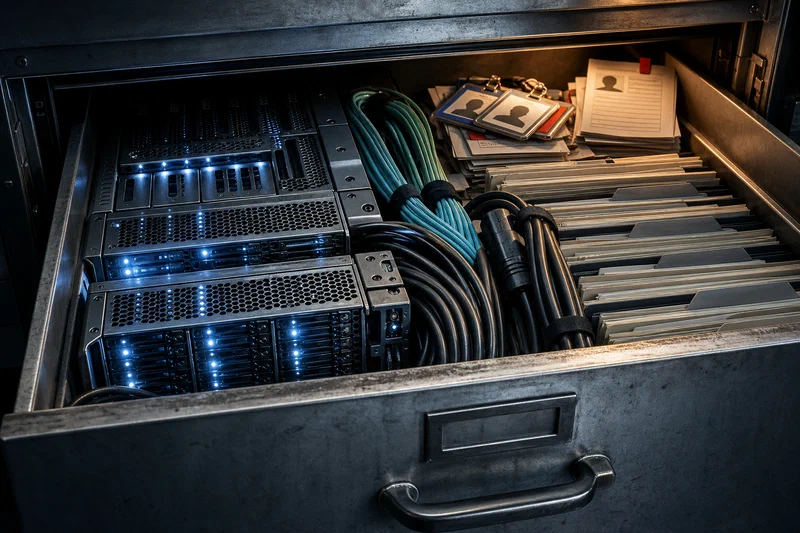
The Fed did not hand employers an easy-money story #
The Federal Open Market Committee held the target range at 3.5% to 3.75%. More important than the hold itself was the tone. The July 29 statement said economic activity was expanding at a solid pace, productivity growth and capital investment were strong, and inflation remained elevated relative to the Fed’s 2% goal, partly because of energy-related supply shocks. Then three voters - Beth Hammack, Neel Kashkari, and Lorie Logan - dissented in favor of a quarter-point hike. That is not what a near-term hiring tailwind sounds like (Federal Reserve, July 29, 2026).
The minutes, once published, may add texture about how sharp that disagreement was. But the statement already gives budget owners what they need. It says policy is still restrictive. It says capital investment is strong enough to be worth naming. And it says inflation is not yet solved.
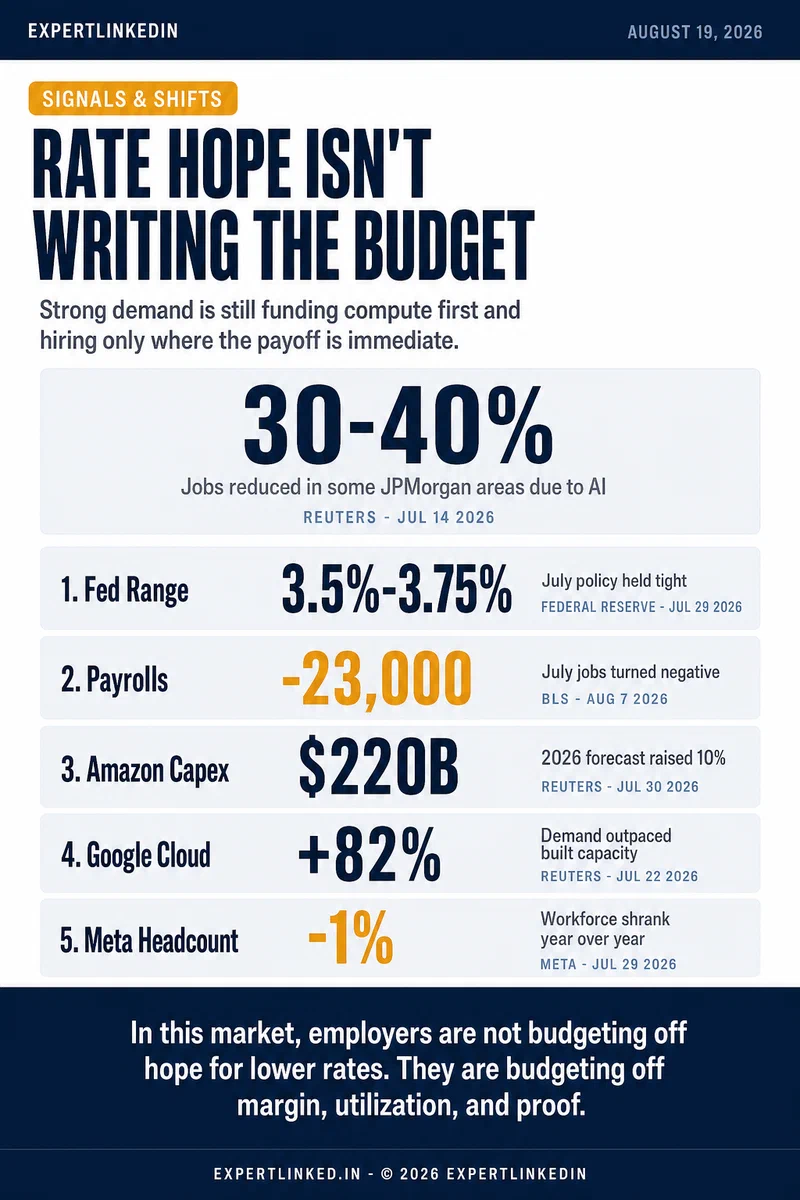
If you pair that with the August labor data, the hiring setup looks narrower rather than looser. July payrolls fell by 23,000. May and June were revised down by another 103,000. Average hourly earnings slowed to 3.2% year over year. July CPI cooled only modestly to 3.4% year over year. June JOLTS then filled in the mechanism: openings still sat at 7.4 million, but hires held at 5.3 million and the quits rate stayed at 2.0% (U.S. Bureau of Labor Statistics, August 7, 2026; U.S. Bureau of Labor Statistics, August 12, 2026; U.S. Bureau of Labor Statistics, August 4, 2026).
That is the same reason What the August 2026 Jobs Report and July CPI Say About Real Wages - and Why “Stable” Still Feels Tight mattered. A calmer inflation print can help household arithmetic a little without restoring broad bargaining power. For Q4 hiring, that distinction is crucial. Managers do not approve requisitions because rate expectations feel nicer on television. They approve them when demand, margin, and capacity constraints make the cost easy to defend.
That framing was already visible by late June, when Reuters described the second half of 2026 as a three-way test of AI spending, earnings delivery, and the Fed path. Q2 results have since made clear which of those tests matters most to fall budgets: the money already committed to capacity (Reuters, June 30, 2026).
Big Tech is buying capacity before it buys slack #
The clearest Q2 earnings signal was not that AI spending is big. Everyone already knew that. The important signal was that the spending is now specific, forward-committed, and strong enough to keep crowding the budget conversation.
Microsoft reported $90.0 billion in quarterly revenue, up 18%, and Azure revenue growth of 43%. It also recorded $41 billion in capital expenditures for the quarter, up more than 70% from a year earlier, while free cash flow fell 23% year over year to $19.6 billion. Even after a lease-accounting change that lowered reported numbers, Microsoft told investors to expect about $175 billion in 2026 capital expenditures and disclosed $329.1 billion of data-center leases that had not yet commenced. Satya Nadella said the company was designing more of its own models and chips and seeing efficiency gains of up to 40% from that work. That is the labor-market signal: management is telling investors it can push more demand through infrastructure and software leverage before it needs broad labor expansion (Microsoft, July 29, 2026; Reuters, July 29, 2026).
Alphabet made the same point from a more uncomfortable angle. Total revenue reached $119.8 billion. Google Cloud jumped 82% to $24.8 billion. Then CFO Anat Ashkenazi raised 2026 capex guidance again, to $195 billion to $205 billion, and the company reported its first negative free cash flow quarter, burning $5.9 billion in Q2. Executives said demand still outpaced the capacity they had built, and the company was willing to rent more data-center capacity even if it hurt margins. That is what a real budget tradeoff looks like: the business is growing, but the constraint getting funded first is compute, not slack headcount (Reuters, July 22, 2026; Reuters, July 23, 2026).
Amazon’s quarter was the clearest expression of the same logic. Net sales rose 20% to $200.6 billion. AWS sales rose 37% to $42.2 billion, its fastest growth in 18 quarters. Amazon raised its 2026 capital spending forecast by 10% to $220 billion. Andy Jassy told investors the company still would not have enough capacity to meet all of the demand it saw in 2026 even at that spending level, and that the “lion’s share” of AWS compute capacity for 2027 was already reserved. Meanwhile, trailing twelve-month free cash flow swung to an outflow of $7.6 billion, driven primarily by property and equipment purchases tied to AI investment. When a company can say demand is booming, backlog is rising, and capacity is still short, the next budget question is usually how to fund more infrastructure faster, not how to reopen hiring broadly (Amazon, updated July 30, 2026; Reuters, July 30, 2026).
Meta is the harsher version of the same tradeoff. Revenue rose 28% to $60.8 billion, but operating margin fell to 31% from 43%. Free cash flow dropped 91% to $784 million. Capital expenditures reached $31.08 billion in the quarter, and Meta narrowed its full-year capex range upward to $130 billion to $145 billion. Headcount at quarter-end was 75,472, down 1% from a year earlier, and the company said that figure still included roughly 8,000 employees affected by the May 2026 headcount reduction. Mark Zuckerberg may be right that personal AI agents become a huge business. But the labor-market message from the quarter was simpler: even with a strong core advertising engine, payroll can stay tight while cash is redirected into infrastructure and restructuring (Meta, July 29, 2026; Reuters, July 29, 2026).
Reuters put a useful cross-company number on the same story the week before the big reports landed. Analysts were already expecting capex-to-revenue ratios to jump sharply this year - to about 41% for Alphabet, 45% for Microsoft, 25% for Amazon, and 54.9% for Meta. Those are not just market stats. They are a shorthand for a fall budget cycle where more of every sales dollar is already spoken for before a manager starts arguing for another hire (Reuters, July 23, 2026).
Wall Street is getting paid on the buildout, not calling for a hiring reopening #
The finance side of earnings does not contradict that read. It confirms it from another angle.
JPMorgan posted a record $21.2 billion quarterly profit. Markets revenue surged 35%. Investment-banking fees climbed 30%. Bank of America reported net income of $9.1 billion, a 50% jump in investment-banking fees to $2.1 billion, and record sales and trading revenue. Goldman described the AI infrastructure buildout as a “multi-year investment cycle” and an AI capex super cycle. Bank of America said the U.S. economy was being helped by AI-driven investments across the board while still warning that inflation and tighter monetary policy remained key risks (Reuters, July 14, 2026; Reuters, July 14, 2026; Reuters, July 15, 2026).
The important point is not just that banks are making money. It is where the money is coming from. Bank of America has helped raise nearly $500 billion for AI-related companies since 2025. Goldman is describing a financing boom around data centers, energy, and infrastructure. JPMorgan CFO Jeremy Barnum said AI-linked demand was showing up in “slightly non-obvious places,” like all the financing and second-order activity around data-center expansion. That is capital formation. It is not a broad hiring thesis (Reuters, July 15, 2026).
And when a bank did offer a direct labor signal, it was not especially comforting. Jamie Dimon said there were areas where JPMorgan had reduced jobs by 30% to 40% because of AI, though most affected employees found other roles inside the firm. That is a redeployment story rather than a layoff headline. It is also a reminder that productivity narratives often show up in staffing plans first as avoidance of new hiring, not as permission for a wider hiring rebound (Reuters, July 14, 2026).
This is why the July 15 Signals & Shifts piece on What Q2 Earnings Calls Are Actually Revealing About Enterprise AI ROI still matters here. The most durable Q2 disclosure was never “AI is everywhere.” It was that the audited payoffs showing up fastest were deal fees, cloud growth, and selective efficiency claims - not a broad-based case for adding more people across the org chart.
Q4 hiring risk now looks more like a proof-bar problem #
Put the pieces together and the practical read becomes less dramatic and more useful.
The risk is not that every large employer is about to slam into recession and start mass layoffs. The risk is that many of them can justify staying selective for longer. The Fed is still restrictive. Inflation is cooler but not conquered. Payroll growth went negative in July and wage growth slowed. Hires and quits are still low. Meanwhile, the companies with the clearest demand signals are already committing extraordinary amounts of money to compute, chips, data centers, financing pipelines, and the legal or restructuring costs that come with reorganizing around AI.
In that environment, the average fall budget does not need to say “freeze everything.” It only needs to say something softer and more dangerous: keep the revenue target, protect margin, fund capacity bottlenecks, and approve headcount only where the payoff is immediate. That is why What July’s Data Trail Tells Us About Q3’s Labor Market Trajectory - and the Risk That’s Still Being Ignored mattered as more than a labor-market piece. It was really a piece about how long employers could preserve calm headlines while opportunity stayed narrow underneath.
The August 12 real-wages article showed why the market still feels tight from the worker side. Q4 adds the employer-side reason. Managers are not just looking at unemployment. They are looking at whether a role beats a server, a lease, a model improvement, an outsourced capacity contract, or another quarter of asking the current team to absorb the load.
If you are trying to read fall hiring honestly, watch three phrases more closely than the minutes:
- “Capacity constrained” usually means spending goes to infrastructure first.
- “Disciplined investments” means headcount has to clear a higher return threshold.
- “Efficiency gains” or “redeployment” means management thinks it can solve more with the current org before it opens broader requisitions.
That is the practical Q4 read. The employers most likely to hire are not the ones who feel emotionally better about rates. They are the ones who can tie a role to revenue, bottleneck relief, risk reduction, or backlog they cannot serve any other way. In this market, employers are not budgeting off hope for lower rates. They are budgeting off margin, utilization, and proof.
Have a read on where your own company is putting the money for Q4 - into headcount, into compute, or into quiet productivity demands? I would like to hear it.
Email me at jackson.rodriguez@tlnw.uk.
References #
- Amazon. (Updated July 30, 2026). “Amazon.com announces second quarter results.” https://www.aboutamazon.com/news/company-news/amazon-earnings-q2-2026-report (Accessed August 19, 2026)
- Board of Governors of the Federal Reserve System. (Accessed August 19, 2026). “Meeting calendars, statements, and minutes (2021-2027).” https://www.federalreserve.gov/monetarypolicy/fomccalendars.htm (Accessed August 19, 2026)
- Board of Governors of the Federal Reserve System. (July 29, 2026). “Federal Reserve issues FOMC statement.” https://www.federalreserve.gov/newsevents/pressreleases/monetary20260729a.htm (Accessed August 19, 2026)
- Meta Platforms, Inc. via PR Newswire. (July 29, 2026). “Meta Reports Second Quarter 2026 Results.” https://www.prnewswire.com/news-releases/meta-reports-second-quarter-2026-results-302838214.html (Accessed August 19, 2026)
- Microsoft. (July 29, 2026). “Microsoft Cloud and AI Strength Fuels Fourth Quarter Results.” https://www.microsoft.com/en-us/Investor/earnings/FY-2026-Q4/press-release-webcast (Accessed August 19, 2026)
- Reuters. (June 30, 2026). “AI spending, earnings hopes, Fed outlook set to sway US stocks in second half.” https://www.reuters.com/business/ai-spending-earnings-hopes-fed-outlook-set-sway-us-stocks-second-half-2026-06-30/ (Accessed August 19, 2026)
- Reuters. (July 14, 2026). “BofA rides market whiplash to trading records, deal activity shines.” https://www.reuters.com/business/finance/bank-america-profit-rises-trading-boost-2026-07-14/ (Accessed August 19, 2026)
- Reuters. (July 14, 2026). “JPMorgan posts highest quarterly profit ever by a U.S. bank as dealmaking, stock trading surge.” https://www.reuters.com/business/finance/jpmorgan-profit-rises-investment-banking-boom-2026-07-14/ (Accessed August 19, 2026)
- Reuters. (July 15, 2026). “Wall Street banks see AI ‘super cycle’ set to boost deals, financing.” https://www.reuters.com/legal/transactional/wall-street-banks-see-ai-super-cycle-set-boost-deals-financing-2026-07-14/ (Accessed August 19, 2026)
- Reuters. (July 22, 2026). “Google increases capex forecast again after cloud-driven quarterly beat.” https://www.reuters.com/business/google-quarterly-cloud-revenue-growth-beats-expectations-2026-07-22/ (Accessed August 19, 2026)
- Reuters. (July 23, 2026). “Alphabet’s cash burn raises alarm for Big Tech as AI spending climbs.” https://www.reuters.com/business/retail-consumer/alphabets-cash-burn-raises-alarm-big-tech-ai-spending-climbs-2026-07-23/ (Accessed August 19, 2026)
- Reuters. (July 29, 2026). “Meta cash flow craters as Zuckerberg doubles down on AI spending.” https://www.reuters.com/business/meta-narrows-annual-capex-forecast-ai-buildout-grows-2026-07-29/ (Accessed August 19, 2026)
- Reuters. (July 29, 2026). “Microsoft says cash will keep flowing from AI, shares rise.” https://www.reuters.com/business/microsoft-tops-quarterly-cloud-growth-estimates-easing-spending-concerns-2026-07-29/ (Accessed August 19, 2026)
- Reuters. (July 30, 2026). “Amazon lifts investment plans after strong cloud sales; shares jump.” https://www.reuters.com/business/retail-consumer/amazon-beats-estimates-quarterly-cloud-revenue-growth-2026-07-30/ (Accessed August 19, 2026)
- U.S. Bureau of Labor Statistics. (August 4, 2026). “Job Openings and Labor Turnover - June 2026.” https://www.bls.gov/news.release/jolts.nr0.htm (Accessed August 19, 2026)
- U.S. Bureau of Labor Statistics. (August 7, 2026). “The Employment Situation - July 2026.” https://www.bls.gov/news.release/empsit.nr0.htm (Accessed August 19, 2026)
- U.S. Bureau of Labor Statistics. (August 12, 2026). “Consumer Price Index Summary - July 2026.” https://www.bls.gov/news.release/cpi.nr0.htm (Accessed August 19, 2026)
AI Content Notice
This article was created using artificial intelligence technology. Whenever possible, we include references and sources to support the information presented. Readers are encouraged to consult these sources for further information. While we strive for accuracy and provide valuable insights, readers should independently verify information and use their own judgment when making business decisions. The content may not reflect real-time market conditions or personal circumstances.
Related Articles
Infographic: What the July 2026 FOMC Minutes and Q2 Earnings Say About Q4 Hiring Risk
If you are waiting for the July FOMC minutes to rescue fall hiring, you are watching the wrong …
How to Write a Q3 2026 Scope Memo Before Budget Season Rewrites Your Role
In a still labor market, a one-page scope memo can turn hidden workflow value into a …
Infographic: How to Write a Q3 2026 Scope Memo Before Budget Season Rewrites Your Role
In a still labor market, a one-page scope memo can turn hidden workflow value into a …