How to Write a Q3 2026 Scope Memo Before Budget Season Rewrites Your Role

Budget season does not begin when Finance sends around the spreadsheet. It begins earlier, when a manager decides whether the extra work you have been quietly carrying sounds like a business line item or like a personal ambition.
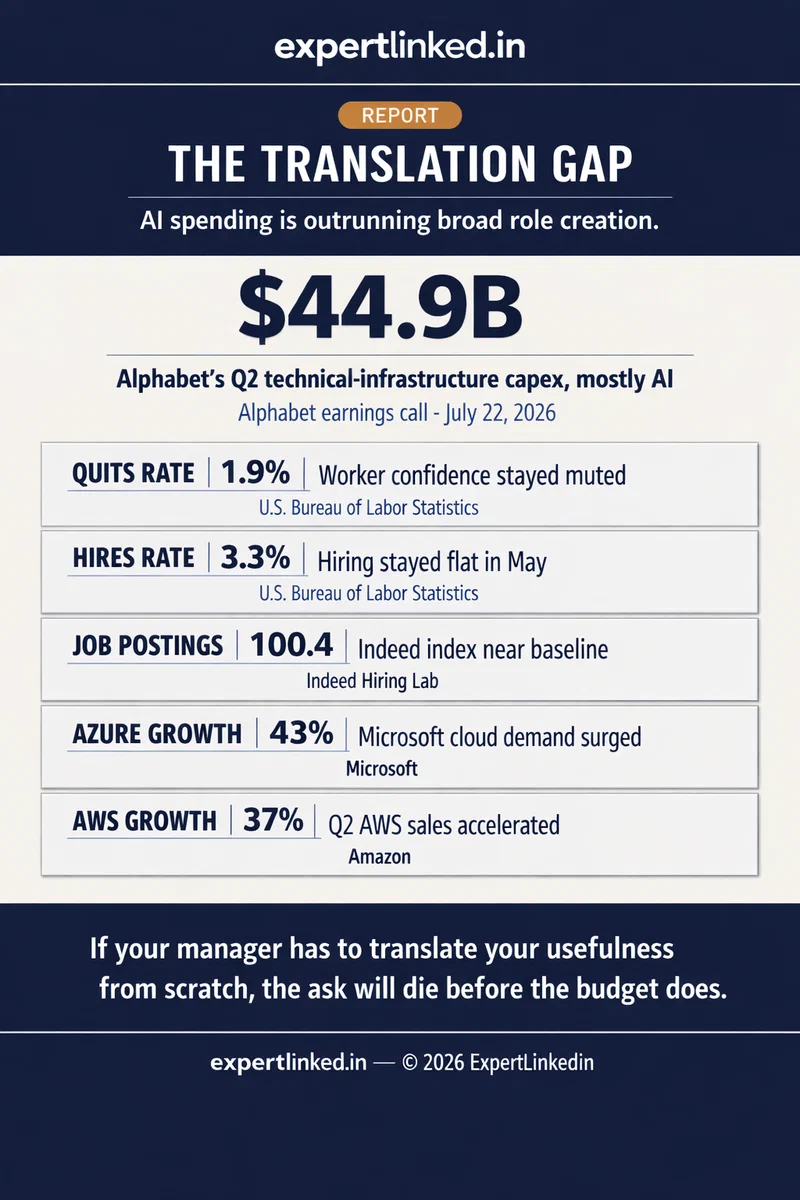
That distinction matters more in August 2026 than most professionals realize. June payrolls added just 57,000 jobs, unemployment held at 4.2%, and average hourly earnings rose 3.5% year over year, while May’s quits rate stayed at 1.9% and hires held at 3.3% (U.S. Bureau of Labor Statistics, July 2, 2026; U.S. Bureau of Labor Statistics, June 30, 2026). The external market is stable enough to stop panicking, but not open enough to assume a better role will simply appear on cue.
At the same time, the companies shaping the AI narrative are still spending hard. Microsoft just closed fiscal 2026 with $90.0 billion in quarterly revenue, Azure growth of 43%, and more than 30 million paid Microsoft 365 Copilot seats (Microsoft, July 29, 2026). Alphabet’s second-quarter capex hit $44.9 billion, mostly for AI infrastructure, while CFO Anat Ashkenazi said the company will continue hiring in key investment areas such as AI and cloud (Alphabet Investor Relations, July 22, 2026). Amazon’s free cash flow swung to a $7.6 billion outflow because purchases of property and equipment rose $66.1 billion year over year, primarily reflecting AI investments, even as AWS sales climbed 37% (Amazon, July 30, 2026).
That is the late-summer contradiction readers need to respect. Companies are investing. They are just not creating broad new roles at the same pace. If you want fall planning to recognize work you are already doing, the safer move is not hoping somebody notices. It is making that work legible before budget season writes the role without you.

Why this window matters more than people think #
If The H2 Career Decisions That Matter Now argued that July narrowed the choice set, and The Skills Bifurcation argued that AI rewards the worker already embedded in real workflows, then this is the practical move that follows: formalize the value you can already prove.
The macro backdrop still supports that call. Indeed’s Job Postings Index was only 100.4 in May, barely above the February 2020 baseline, and posted wage growth was just 2.4% year over year (Indeed Hiring Lab, June 18, 2026). Cory Stahle’s June analysis sharpened the mechanism: employers are still adding jobs, but the hires rate remains near its weakest level since 2013 because quits, layoffs, and other separations all fell even faster (Indeed Hiring Lab, June 18, 2026).
The company-size split matters too. Indeed’s size-class read on April JOLTS showed openings at employers with 5,000 or more workers running 81% above their pre-pandemic baseline, while employers with 50 to 999 workers, which account for roughly 40% of openings, were still 12% below baseline (Indeed Hiring Lab, June 2, 2026). Hyperscaler demand is real. It is just not the same thing as a broad reopening of mid-career opportunity.
That is why waiting for the org chart to catch up is a weak August strategy. And it is why The Lateral Move Nobody Saw Coming landed so hard last month: leverage often accumulates before status does. A scope memo is how you stop that leverage from staying invisible.
The hidden friction is translation work #
Most professionals misread the failure mode here. They assume their manager will block the conversation because the organization is political, stingy, or too distracted. Sometimes that is true. Much more often, the ask dies because the manager has to do too much translation work before they can carry it upward.
The research points in the same direction. McKinsey found that 88% of organizations now use AI in at least one business function, but only 39% report enterprise-level EBIT impact, and the companies seeing the most value are far more likely to redesign workflows rather than simply deploy tools (McKinsey, November 5, 2025). Atlassian’s 2026 team research is even blunter in operating language: 89% of executives say AI increases speed, but only 6% are sure they have clear organization-wide AI ROI; 87% of knowledge workers say coordination cannot keep up; and only 29% say AI is embedded in actual flows of work (Atlassian Teamwork Lab, April 27, 2026).
That is the environment your memo enters. Leaders believe value exists. They know there is too much unowned review work, too much AI-adjacent coordination, too many new outputs outrunning old approval systems. What they often lack is a clean instrument for deciding which messy work deserves formal scope, budget, or title.
Your memo’s job is to become that instrument.
What a Q3 scope memo has to prove #
If the document cannot answer the manager’s forwarding questions in under two minutes, it is not ready. A strong scope memo proves five things.
- This is an operating problem, not a mood report.
Do not begin with “I have been doing a lot” or “my role has expanded.” Begin with the recurring bottleneck. What is happening repeatedly? Where is the handoff failing? What queue, review cycle, or customer outcome keeps getting delayed? Microsoft did not describe its quarter as a burst of AI excitement. Satya Nadella described a “cost-to-outcome curve” and customers turning tokens into business results (Microsoft, July 29, 2026). Your memo needs the same discipline.
- I have proof, not just enthusiasm.
Use one artifact from the last 60 to 90 days. A shortened approval cycle. A recurring exception type you reduced. A reporting layer you cleaned up. A QA burden you absorbed before it turned into visible failure. The memo should make it impossible to say, “Interesting idea, but still hypothetical.”
- The boundary of the role is clear.
Managers do not sponsor fuzzy land grabs. They sponsor contained fixes. What exactly would you own? What would remain with the current team? What decision rights would you need, and which ones would you not? This is the difference between chosen scope and reactive scope.
- There is a cost to leaving the work informal.
Price the drift. Time lost, handoffs duplicated, errors reviewed twice, customer tickets delayed, leaders pulled into escalations, or risk accepted without formal ownership. Alphabet’s CFO did not justify higher 2026 capex because AI felt strategically important in the abstract. She justified it with capacity constraints, backlog, and demand that already existed (Alphabet Investor Relations, July 22, 2026). Your memo needs that same logic at human scale.
- The ask is small enough to sponsor.
In this market, a manager is much more likely to carry a 90-day scope pilot, a formal remit change, dedicated cross-functional ownership, or a title-track conversation than a vague request for recognition. Think “small funded decision,” not “reinvent my career all at once.”
This matters financially as well as politically. Indeed’s wage analysis found that posted pay for salaried roles rose 2.9% year over year, versus only 1.7% for hourly roles (Indeed Hiring Lab, May 28, 2026). In a market like this, better outcomes often follow clearer ownership. Scope recognition is not cosmetic.
A one-page template you can actually use #
Keep the memo to one page. If the argument needs six pages, your manager will have to rewrite it before it moves, which defeats the point.
- Working title: Name the role or remit in plain operating language. Example: “Q4 workflow owner for customer-support QA and AI review.”
- Problem: One paragraph on the recurring bottleneck. Keep it factual and specific.
- Evidence from Q2/Q3: Two or three bullets with dates, metrics, or before-and-after proof.
- Scope to formalize: What you would own for the next 90 days, where it starts and stops, and which teams benefit.
- Business effect: The time saved, queue reduced, risk lowered, rework avoided, or customer issue prevented.
- Decision requested: The smallest decision your manager can carry upward this quarter: pilot ownership, dedicated time, reporting line, title adjustment, compensation conversation, or hybrid-role approval.
If you need one sentence to frame the conversation, use this:
“I am not asking you to invent a role from scratch. I am showing you a recurring operating gap, the proof that it is already real, and the smallest scope decision that would let us stop paying for it informally.”
That sentence works because it reduces sponsor friction. It tells the manager they are not being asked to defend your ambition from first principles. They are being asked to carry a ready-made operating case.
Borrow the language companies are already using #
The best way to sharpen a scope memo is to notice how serious organizations justify spending when they actually mean it.
Microsoft framed AI value in outcomes and adoption. Alphabet framed it in backlog, technical infrastructure, supply constraints, and targeted hiring. Amazon framed it in deployment capability, customer demand, and embedded engineering, even announcing a $1 billion investment in AWS Forward Deployed Engineering so AI engineers can work directly with customers to co-develop solutions in days rather than months (Amazon, July 30, 2026; Amazon, July 30, 2026).
None of that language sounds like “we want more innovation energy.” It sounds like capacity, deployment, constraints, systems, customer outcomes, and faster execution.
Your memo should sound closer to that than to a year-end self-review.
Not: “I have become a go-to person for AI-related work.”
Better: “Over the last eight weeks I reduced the review queue on X workflow from Y to Z, documented the decision rules, and now sit in the handoff between Team A and Team B. Formalizing ownership would reduce escalation load and keep this from remaining ad hoc in Q4.”
That is the real August move. You are not trying to sound more impressive. You are trying to sound easier to fund.
The final test before you send it #
Read the memo once and ask three questions.
- Can my manager forward this without adding a long explanatory preface?
- Does the document name an existing business problem, or only my effort?
- If somebody above my manager reads this cold, can they see the cost of leaving the work informal?
If the answer to any one of those is no, the memo is not ready. Tighten it until the sponsor burden drops.
Budget season rewards legibility before it rewards loyalty. In a labor market this still, and with AI spending this intense, the professionals who move first are often the ones who make messy work readable before somebody else prices it for them.
If your manager has to translate your usefulness from scratch, the ask will die before the budget does.
Have you tried turning workflow proof into a scope memo, or had one stall in management translation? Send me the version of the ask that almost worked.
Email me at jackson.rodriguez@tlnw.uk.
References #
- Alphabet Investor Relations. (July 22, 2026). “2026 Q2 Earnings Call.” https://abc.xyz/investor/events/event-details/2026/2026-Q2-Earnings-Call-2026-GgTAq7Is0z/default.aspx (Accessed August 3, 2026)
- Amazon. (July 30, 2026). “Amazon.com announces second quarter results.” https://www.aboutamazon.com/news/company-news/amazon-earnings-q2-2026-report (Accessed August 3, 2026)
- Amazon. (July 30, 2026). “Q2 Earnings: Andy Jassy on why AWS is booming and what it means for customers.” https://www.aboutamazon.com/news/company-news/amazon-ceo-andy-jassy-aws-revenue-growth-q2-2026-earnings (Accessed August 3, 2026)
- Atlassian Teamwork Lab. (April 27, 2026). “The State of Teams 2026.” https://www.atlassian.com/blog/state-of-teams-2026 (Accessed August 3, 2026)
- Indeed Hiring Lab. (May 28, 2026). “Pay for Salaried Workers Is Rising Faster Than Hourly Wages.” https://www.hiringlab.org/2026/05/28/pay-for-salaried-workers-is-rising-faster-than-hourly-wages/ (Accessed August 3, 2026)
- Indeed Hiring Lab. (June 2, 2026). “April 2026 JOLTS Report: The Bigger They Are, the Harder They Hire.” https://www.hiringlab.org/2026/06/02/april-2026-jolts-report-the-bigger-they-are-the-harder-they-hire/ (Accessed August 3, 2026)
- Indeed Hiring Lab. (June 18, 2026). “Strong Job Gains, Weak Hiring.” https://www.hiringlab.org/2026/06/18/strong-job-gains-weak-hiring/ (Accessed August 3, 2026)
- Indeed Hiring Lab. (June 18, 2026). “US Labor Market Snapshot - May 2026.” https://www.hiringlab.org/2026/06/18/us-labor-market-snapshot-may-2026/ (Accessed August 3, 2026)
- Indeed Hiring Lab. (June 30, 2026). “May 2026 JOLTS Report: More of the Same.” https://www.hiringlab.org/2026/06/30/may-2026-jolts-report-more-of-the-same/ (Accessed August 3, 2026)
- McKinsey & Company. (November 5, 2025). “The state of AI in 2025: Agents, innovation, and transformation.” https://www.mckinsey.com/capabilities/quantumblack/our-insights/the-state-of-ai (Accessed August 3, 2026)
- Microsoft. (July 29, 2026). “Microsoft Cloud and AI Strength Fuels Fourth Quarter Results.” https://www.microsoft.com/en-us/Investor/earnings/FY-2026-Q4/press-release-webcast (Accessed August 3, 2026)
- U.S. Bureau of Labor Statistics. (June 30, 2026). “Job Openings and Labor Turnover - May 2026.” https://www.bls.gov/news.release/jolts.htm (Accessed August 3, 2026)
- U.S. Bureau of Labor Statistics. (July 2, 2026). “The Employment Situation - June 2026.” https://www.bls.gov/news.release/empsit.nr0.htm (Accessed August 3, 2026)
AI Content Notice
This article was created using artificial intelligence technology. Whenever possible, we include references and sources to support the information presented. Readers are encouraged to consult these sources for further information. While we strive for accuracy and provide valuable insights, readers should independently verify information and use their own judgment when making business decisions. The content may not reflect real-time market conditions or personal circumstances.
Related Articles
Infographic: How to Write a Q3 2026 Scope Memo Before Budget Season Rewrites Your Role
In a still labor market, a one-page scope memo can turn hidden workflow value into a …
Career Mechanics: The Internal Mobility Playbook – Own Your Next Move Before the Org Chart Owns It for You
When the external market tightens and restructuring accelerates, your internal career capital …
What July's Data Trail Tells Us About Q3's Labor Market Trajectory - and the Risk That's Still Being Ignored
July’s data says Q3 will likely protect incumbents, not reopen mobility, while longer …