The H2 Career Decisions That Matter Now — Before the Q3 Data Closes the Window

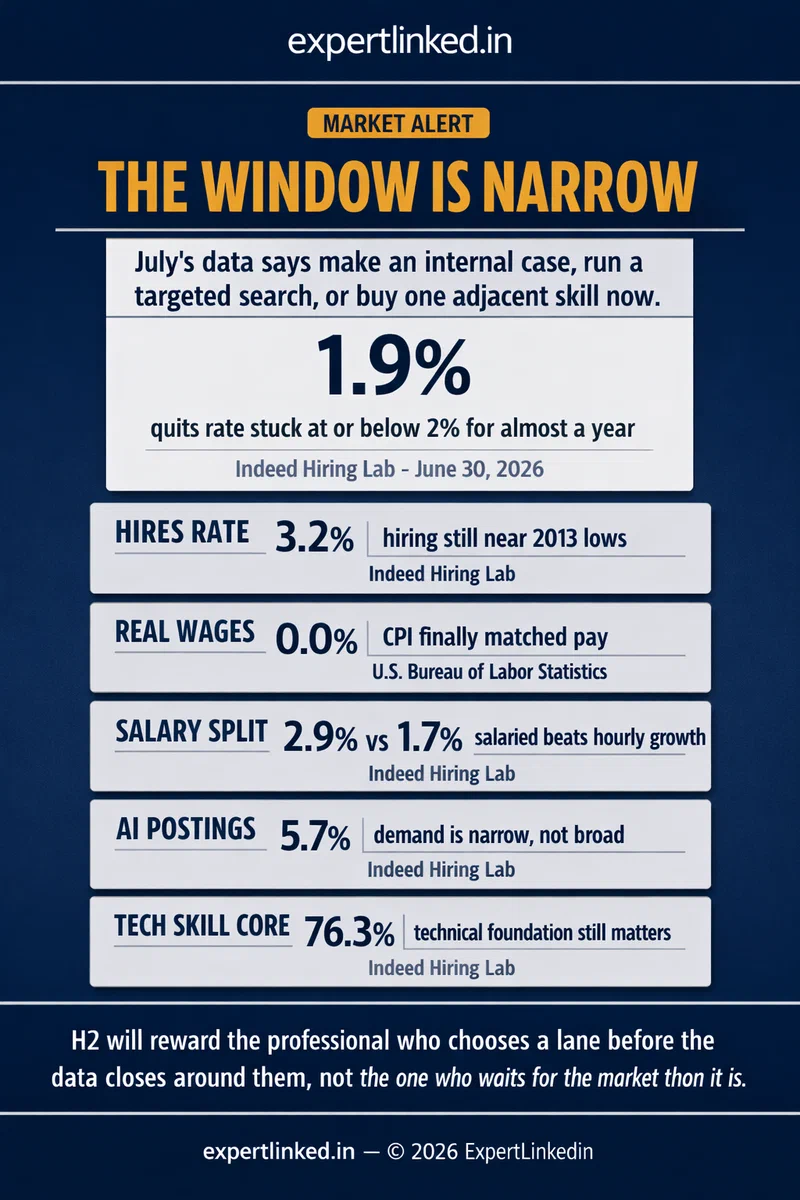
July finally answered the question many professionals have been using to delay an H2 decision: do I move now, or do I wait for clearer data? The data is now clear enough to be uncomfortable. Hiring is still stuck near 2013-style levels, the quits rate is still only 1.9%, and June’s inflation cooling only got real wages back to roughly even rather than back to generous (Indeed Hiring Lab, June 30, 2026; BLS, July 14, 2026).
That combination does not justify panic. It also does not justify drift. The market did not reopen in July. It only stabilized enough to force a more disciplined choice.
Within the next few days, the Federal Reserve’s July 28-29 meeting and the BEA’s advance Q2 GDP release scheduled for July 30 will harden the late-summer story employers tell themselves about budgets, compensation, and headcount. If you are going to make an H2 move, this is the moment to choose the right one. Not in November, when the calendar is full of review paperwork and budget defensiveness. Now.

Decision 1: Make the internal case now if you already have proof #
If you are already employed, already trusted, and already sitting on one or two examples of workflow value, the data is telling you something very specific: this is a better moment to make an evidence-and-scope case than to wait for a cleaner external market.
The reason is not that organizations suddenly became generous. It is almost the opposite. June payroll growth was just 57,000, and April-May payrolls were revised down by another 74,000 (BLS, July 2, 2026). The Indeed Job Postings Index was only 100.4 in May, barely above the pre-pandemic baseline, while posted wage growth for new openings was still just 2.4% year-over-year (Indeed Hiring Lab, June 18, 2026). External leverage exists, but it is thin.
What improved in July was the inflation picture. CPI dropped from 4.2% in May to 3.5% in June, matching average hourly earnings growth at 3.5% (BLS, July 14, 2026; BLS, July 2, 2026). That matters because it weakens a generic “prices are up” compensation argument and strengthens a value argument. If your manager can plausibly say inflation pressure has cooled, then your best case is no longer cost of living. It is scope, workflow improvement, coordination relief, and retained judgment.
That is exactly why the proof-portfolio framework from July 20 matters more now, not less. McKinsey’s AI survey found that 88% of organizations use AI in at least one function, but only 39% report measurable EBIT impact; the high performers are nearly three times as likely to redesign workflows rather than simply deploy tools (McKinsey, November 5, 2025). Atlassian’s 2026 team research makes the same point in operating language: 89% of executives say AI increases speed, but only 6% can point to clear organization-wide ROI (Atlassian, April 27, 2026).
In other words, most organizations still do not have a good instrument for seeing value. If you can put a better instrument on the table before Q4 budget logic hardens, do it.
Make the internal case now if all three of these are true:
- You can point to at least one documented workflow improvement from Q2 or early Q3.
- Someone beyond you benefited from it: your manager, another team, a downstream reviewer, or a customer-facing process.
- The ask can be framed as scope, title track, compensation, or hybrid-role expansion rather than vague recognition.
This is the H2 version of career leverage in a still market: not “I deserve more,” but “here is the operating pattern I have already built, and here is the larger problem I can now own.”
Decision 2: Start an external search only if it is narrow enough to test a real hypothesis #
The cleanest indicator remains the quits rate. At 1.9%, it has now sat at or below 2% for almost a year, which is another way of saying workers do not feel a broad abundance of better options (Indeed Hiring Lab, June 30, 2026). Cory Stahle’s June analysis sharpened the contradiction: payroll employment was still rising, but actual hiring remained near the weakest level since 2013 because quits, layoffs, and other separations had fallen even faster (Indeed Hiring Lab, June 18, 2026). That is not a hiring boom waiting to be discovered by a more optimistic résumé.
The compensation split matters just as much. Indeed’s wage analysis showed posted pay for salaried roles rising 2.9% from Q1 2025 to Q1 2026, versus only 1.7% for hourly roles (Indeed Hiring Lab, May 28, 2026). If you are trying to move from one hourly, contractor-like, or structurally commoditized arrangement into another, the odds that the market will suddenly repair your leverage are not especially good.
Start an external search now only if you can define the hypothesis in one sentence. For example:
- My current function has no internal runway, but my domain knowledge maps into a more salaried adjacent role.
- My title is compressing, but my workflow experience is portable into an operations, systems, analytics, or enablement role.
- My employer cannot convert visible value into scope, so I need a market test before Q4 freezes make the same conversation harder internally.
Then build the search around that hypothesis. Ten titles. Fifteen target employers. A short list of adjacent problems you already know how to solve. Every application should tell you whether the market will pay for your actual mix of context, not whether the market will flatter your self-concept.
Decision 3: Invest in the skill that shortens the path to live workflow value #
Yes, AI demand is real. AI-related postings reached 5.7% of all Indeed postings in May, well above the prior 2022 peak (Indeed Hiring Lab, June 18, 2026). Yes, the spending is real too. Reuters reported that the major AI leaders are on pace for roughly $730 billion in capital expenditures this year (Reuters, June 30, 2026).
But the labor-side translation is narrower than the spending headlines imply. Reuters’ July 21 Bank of America report is the useful example here: the company expanded EricaAssist to more than 18,000 customer-service representatives, with contextual guidance surfacing in under three seconds during live client interactions (Reuters, July 21, 2026). That is not a story about generic AI enthusiasm. It is a story about a legacy role becoming more valuable when the worker can operate inside an augmented workflow.
So what skill should most mid-career readers buy in H2? Usually not the heroic one.
Indeed’s skill-composition research found that tech roles remain deeply concentrated: 76.3% of the skills in a typical tech job are technology skills, and software development is even more concentrated (Indeed Hiring Lab, June 3, 2026). That means a full pivot into a concentrated technical track still requires real foundational depth. Meanwhile, business-operations skills show up in more than 70% of job postings across the labor market, and skill-diverse occupations are often more accessible than workers assume (same source).
That is the actual H2 skill decision.
If you are already on a concentrated technical path, invest in the deeper foundation that keeps you credible inside that path. If you are not, the highest-return investment is usually the adjacent skill that makes your current domain more legible in a workflow redesign: process mapping, reporting automation, prompt-and-review discipline, systems adoption, requirements capture, documentation, or cross-functional coordination.
The top 14% of teams in Atlassian’s study did not win by turning everyone into an AI specialist. They won by grounding AI in context, workflows, and culture (Atlassian, April 27, 2026). For most professionals, the right H2 skill buy is the one you can deploy on a live problem in the next 30 days, not the one that sounds impressive in a bio.
The decision grid #
| If your situation looks like this | The best H2 move | Why the data supports it |
|---|---|---|
| You already have visible workflow proof and some organizational trust | Make the internal case now | Real wages at parity weaken generic inflation arguments, while weak hiring makes internal leverage more valuable than waiting |
| Your role has no internal runway, but your skills map into adjacent salaried or hybrid roles | Run a narrow external search | Quits and hires say the market is still cold, so search has to be targeted enough to test pay and portability, not just volume |
| You feel pressure but lack a live artifact of value | Invest in one adjacent, deployable skill | AI demand is real, but the premium is showing up in workflow-embedded roles rather than abstract enthusiasm |
The most important thing July changed is not the answer to every career question. It changed the timing discipline around them. The FOMC calendar, the GDP release schedule, the late-summer budget conversations, and the first hardening of Q4 review narratives all point in the same direction: by the time the market feels emotionally safer, the decision window will be worse.
Waiting until November is not prudence. In this market, it is usually a way of giving up timing while pretending to gather clarity.
H2 will reward the professional who chooses a lane before the data closes around them, not the one who waits for the market to feel safer than it is.
Have you made one of these H2 decisions already - or are you stuck between two of them? The most useful reader notes are the ones that show what the data looked like from inside the actual conversation.
Email me at jackson.rodriguez@tlnw.uk.
References #
- Atlassian Teamwork Lab. (April 27, 2026). “The State of Teams 2026.” https://www.atlassian.com/blog/state-of-teams-2026 (Accessed July 27, 2026)
- Board of Governors of the Federal Reserve System. (Accessed July 27, 2026). “Meeting calendars, statements, and minutes (2021-2027).” https://www.federalreserve.gov/monetarypolicy/fomccalendars.htm (Accessed July 27, 2026)
- Bureau of Economic Analysis. (Page last modified July 26, 2026). “Release Schedule.” https://www.bea.gov/news/schedule (Accessed July 27, 2026)
- Indeed Hiring Lab. (June 18, 2026). “US Labor Market Snapshot - May 2026.” https://www.hiringlab.org/2026/06/18/us-labor-market-snapshot-may-2026/ (Accessed July 27, 2026)
- Indeed Hiring Lab, Cory Stahle. (June 9, 2026). “Nearly 16% of Active Job Seekers Are Already Working Multiple Jobs.” https://www.hiringlab.org/2026/06/09/active-job-seekers-are-already-working-multiple-jobs/ (Accessed July 27, 2026)
- Indeed Hiring Lab, Cory Stahle. (June 18, 2026). “Strong Job Gains, Weak Hiring.” https://www.hiringlab.org/2026/06/18/strong-job-gains-weak-hiring/ (Accessed July 27, 2026)
- Indeed Hiring Lab, Laura Ullrich. (July 2, 2026). “June 2026 Jobs Report: An Unmoving Tide.” https://www.hiringlab.org/2026/07/02/june-2026-jobs-report-an-unmoving-tide/ (Accessed July 27, 2026)
- Indeed Hiring Lab, Sneha Puri. (May 28, 2026). “Pay for Salaried Workers Is Rising Faster Than Hourly Wages.” https://www.hiringlab.org/2026/05/28/pay-for-salaried-workers-is-rising-faster-than-hourly-wages/ (Accessed July 27, 2026)
- Indeed Hiring Lab, Sneha Puri. (June 30, 2026). “May 2026 JOLTS Report: More of the Same.” https://www.hiringlab.org/2026/06/30/may-2026-jolts-report-more-of-the-same/ (Accessed July 27, 2026)
- Indeed Hiring Lab, Svenja Gudell. (April 13, 2026). “What Goes Up, Must Come Down: How the Labor Market Is Emerging From the Long Shadow of the Pandemic.” https://www.hiringlab.org/2026/04/13/how-the-labor-market-is-emerging-from-the-long-shadow-of-the-pandemic/ (Accessed July 27, 2026)
- Indeed Hiring Lab, Annina Hering, Sneha Puri, and Virginia Sondergeld. (June 3, 2026). “How Skill Concentration Sets Tech and Healthcare Sectors Apart.” https://www.hiringlab.org/2026/06/03/how-skill-concentration-sets-tech-and-healthcare-sectors-apart/ (Accessed July 27, 2026)
- McKinsey & Company. (November 5, 2025). “The state of AI in 2025: Agents, innovation, and transformation.” https://www.mckinsey.com/capabilities/quantumblack/our-insights/the-state-of-ai (Accessed July 27, 2026)
- Reuters. (June 30, 2026). “AI spending, earnings hopes, Fed outlook set to sway US stocks in second half.” https://www.reuters.com/business/ai-spending-earnings-hopes-fed-outlook-set-sway-us-stocks-second-half-2026-06-30/ (Accessed July 27, 2026)
- Reuters. (July 21, 2026). “BofA enhances AI-powered tool to resolve client needs faster.” https://www.reuters.com/business/finance/bofa-enhances-ai-powered-tool-resolve-client-needs-faster-2026-07-21/ (Accessed July 27, 2026)
- U.S. Bureau of Labor Statistics. (July 2, 2026). “The Employment Situation - June 2026.” https://www.bls.gov/news.release/empsit.nr0.htm (Accessed July 27, 2026)
- U.S. Bureau of Labor Statistics. (July 14, 2026). “Consumer Price Index Summary - June 2026.” https://www.bls.gov/news.release/cpi.nr0.htm (Accessed July 27, 2026)
AI Content Notice
This article was created using artificial intelligence technology. Whenever possible, we include references and sources to support the information presented. Readers are encouraged to consult these sources for further information. While we strive for accuracy and provide valuable insights, readers should independently verify information and use their own judgment when making business decisions. The content may not reflect real-time market conditions or personal circumstances.
Related Articles
Infographic: The H2 Career Decisions That Matter Now — Before the Q3 Data Closes the Window
July’s labor data does not justify waiting: choose the right H2 move now - internal case, …
Signals & Shifts: The Quiet Freeze
This week’s labor data shows a quiet freeze—headline stability with uneven opportunity—making …
Signals & Shifts: The Three-Speed Market
This week’s labor data points to a three-speed market where healthcare concentration, worker-share …