He Became the AI Workflow Translator His Team Needed - and Turned It Into a Q3 2026 Career Pivot

Editorial note: This is a composite narrative. “Adrian” is not a specific real individual. His story draws from recurring patterns Olivia has observed among mid-career program, operations, and enablement professionals who become the bridge between AI enthusiasm above and workflow reality below. Institutional details and identifying characteristics have been fictionalised. Any resemblance to a specific person or employer is unintentional.
The new role began with three questions nobody else wanted to own: What did the tool actually do? Who has to check it? And who gets blamed if it goes wrong?
“I think I may have become the AI translator for my team,” a reader wrote me in early August. “I am not the technical expert, the manager, or the lawyer. I am just the person everyone calls when the output has to survive contact with reality.”
That note has stayed with me because it names a late-summer career pivot I keep seeing in smarter organizations and more confused ones alike. The work starts small enough to look administrative from the outside: cleaning up meeting notes, rewriting documentation, checking AI drafts, translating a leader’s request into a usable workflow, or triaging the exception queue nobody planned for. Inside the company, that can become the role nobody knew how to hire for. - Olivia Bennett
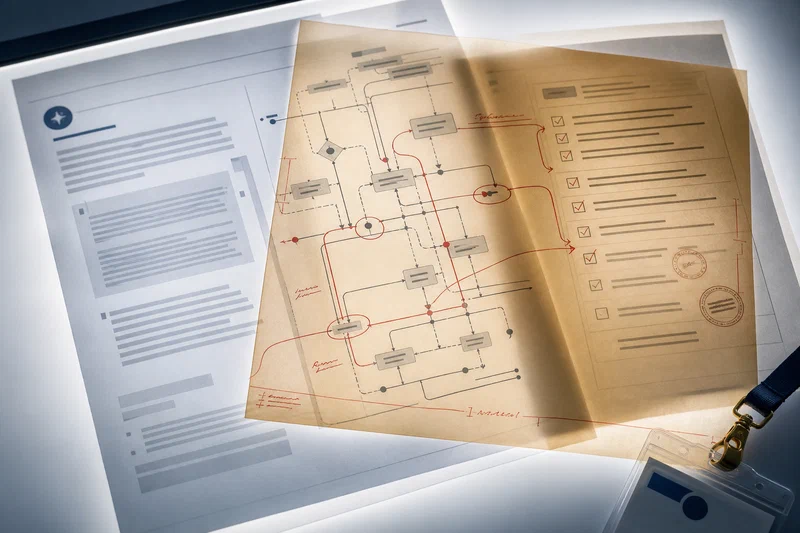
The Job Started in the Cleanup Nobody Wanted #
Adrian was forty-one, a program operations lead at a mid-market health-tech company where every Q2 deck suddenly had the same vocabulary: copilots, faster implementation, fewer handoffs, no new headcount unless it came with proof. He did not work in data science. He worked where customer success, implementation, compliance, and product collided under deadline pressure.
When the company rolled out Microsoft 365 Copilot licenses and an AI assistant for implementation notes in late spring, nobody asked Adrian to lead the transformation. He inherited the Friday rollout sync because he took the clearest notes, then kept getting the work that fit nowhere else: verify AI-written client recaps, rewrite prompt instructions, document which replies needed a human sign-off, and track the exceptions everyone kept calling one-offs.
From the outside, that looked like cleanup. Inside the company, it was becoming the layer between ambition and exposure. The pivot began when other people realized Adrian could make their half-formed AI ideas survive contact with customers, policy, and the actual sequence of work.
By July, the pattern was obvious. Product wanted speed. Customer success wanted fewer surprises. Compliance wanted an audit trail. Support wanted to stop learning about workflow changes from angry accounts. Adrian was the one person who could explain all four positions in the same meeting without reducing them to slogans.
Why This Role Is Appearing Right Now #
The context matters because a story like Adrian’s makes more sense in August 2026 than it would have a year ago.
Microsoft said in April 2025 that 53% of leaders believe productivity must increase while 80% of workers and leaders say they lack enough time or energy, and 78% of leaders are considering AI-specific hiring in the next 12 to 18 months (Microsoft WorkLab, April 23, 2025). By July 29, Satya Nadella said Microsoft 365 Copilot had passed 30 million paid seats, while Reuters reported that five major AI spenders were forecasting about $730 billion in combined capital expenditures this year (Microsoft, July 29, 2026; Reuters, June 30, 2026).
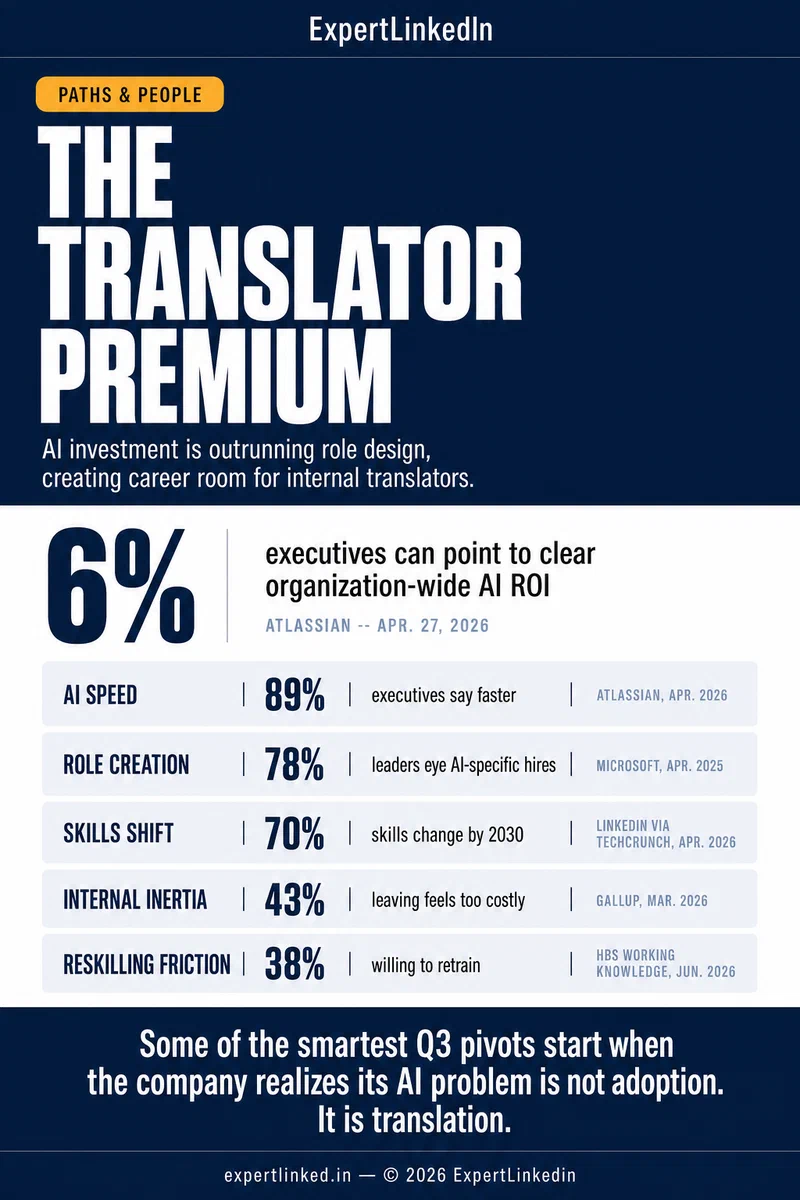
But adoption is outpacing organizational design. Atlassian found that 89% of executives say AI increases speed, while only 6% are sure they have clear examples of organization-wide AI ROI. Only 29% of knowledge workers say AI is embedded in their flows of work, and 87% say they lack the time or capacity to coordinate (Atlassian Teamwork Lab, April 27, 2026). Deloitte adds that organizations still taking a tech-first approach are 1.6 times more likely not to exceed AI return expectations than human-centric organizations, because the hard questions are now about decision rights, accountability, and shared judgment (Deloitte, March 4, 2026).
That is where Adrian’s role appeared: not between humans and machines in the abstract, but between speed and trust.
He Was Translating Between Three Different Kinds of Truth #
Leadership wanted speed, adoption, and proof the licenses were worth it. Operators cared about handoffs, missing context, rework, and the maddening places where AI output was almost right but not safe enough to ship. Governance cared about who checked the promise the draft had made. Adrian became useful because he could translate among all three without pretending they were the same concern.
He built a living decision log with four columns: task, AI assist allowed, human reviewer, exception route. He tracked every time a generated summary invented a deadline, every time a templated response blurred what had actually been approved, every time a manager said “just use the tool” where the real issue was unclear ownership. Over six weeks, the same breaks repeated often enough that the explanation changed. The model was not the whole problem. The workflow around it was.
Adrian started turning messy meetings into usable rules.
AI can draft the client summary, but the implementation lead must verify commitments before it leaves the account.
AI can prepare the status update, but pricing, privacy, and timeline statements need a named reviewer.
AI can help compress the handoff note, but unresolved exceptions must live in one queue with one owner instead of disappearing into five private channels.
Those are boring sentences. They are also the sentences that make a tool survivable.
The Role Became Real Before the Title Did #
By mid-August, Adrian had something more valuable than tool fluency: proof that his translation work was load-bearing. Once his decision log was adopted, unresolved implementation exceptions dropped from twenty-nine items to eleven, the Friday sync got thirty-five minutes shorter, and customer-facing notes stopped bouncing between customer success and compliance after they had already been sent.
He wrote a one-page proposal. Not for a grand transformation. For a ninety-day remit: own AI workflow documentation across implementation and support, chair the weekly exception review, partner with compliance on guardrails, and train frontline managers on where AI output could move past draft stage and where it had to stop.
This is where his story meets Jackson Rodriguez’s one-page business-case piece and why it sits next to, but is not the same as, The Lateral Move Nobody Saw Coming. The title lagged the leverage here too. The difference is that the leverage was not one workflow. It was the ability to make several functions trust the same process.
The HR system eventually settled on a cautious title. Inside the company, the more truthful title had arrived first: Adrian was the person you asked when AI output had to become accountable work.
That distinction matters. If the organization keeps your old workload intact, gives you none of the decision rights, and uses you mainly as a buffer between bad tooling and irritated colleagues, that is not a pivot. It is a more fashionable version of overload. Adrian’s move became strategic only when the company changed something concrete in return: meeting ownership, workflow authority, and a formal remit other people had to respect.
Why So Many People Miss This Opening #
Part of the reason these roles are hard to pursue deliberately is that almost nobody imagines themselves as an AI workflow translator.
Raffaella Sadun’s June 18 Harvard Business School Working Knowledge piece explains why. In research on roughly 1,100 Italian job seekers, only 38% said they would reskill into the offered high-demand roles, while 36% preferred generic upskilling and 26% declined training. Sadun’s line is the one that matters here: people do not see themselves as a bundle of skills; they see themselves as having a role in society (Harvard Business School Working Knowledge, June 18, 2026).
That principle travels. Adrian did not wake up wanting to be an internal translator between automation, workflow, and governance. He backed into the role because his actual edge was not one more tool certification. It was that he could help other people trust where the tool ended and the work began.
LinkedIn’s Blake Lawit put the broader labor-market version plainly in April: hiring is down about 20% since 2022, the skills required for the average job have already changed 25%, and that figure could reach 70% by 2030. “Even if you’re not changing jobs,” he said, “your job’s changing on you” (TechCrunch, April 15, 2026).
That is why the pivot mattered internally. BLS said June job openings were little changed at 7.4 million, with hires at 3.4% and quits at 2.0%, while Indeed described the environment as low-hire and low-fire (U.S. Bureau of Labor Statistics, August 4, 2026; Indeed Hiring Lab, August 4, 2026). Gallup adds the emotional version of the same constraint: only 28% of workers say now is a good time to find a quality job, and 43% say leaving feels too difficult or costly (Gallup, March 23, 2026). In that environment, the intelligent move is often not louder ambition. It is more legible usefulness.
What This Story Is Really About #
Jackson argued in July’s The Skills Bifurcation that the labor market is splitting between people whose value compounds with AI and people whose work becomes easier to benchmark downward. Adrian belongs to the first group, not because he is the most technical person in the room, but because AI made his judgment, coordination instinct, and domain context more valuable.
That is the late-summer lesson I think readers can use. The internal labor market is beginning to reward the people who can make human-machine work legible across a messy organization. The premium does not always go to the person with the loudest AI language. Sometimes it goes to the person who can keep the model, the manager, and the workflow in the same truthful conversation.
Some late-2026 career pivots will still look glamorous from the outside. More of the intelligent ones will begin with documentation nobody notices, exception queues nobody wanted, and the patience to translate between speed, safety, and reality until the company finally admits that translation is a real job.
Some of the smartest Q3 pivots start when the company realizes its AI problem is not adoption. It is translation.
Built an unofficial translator role inside your team before anyone knew what to call it? I want the stories where the work became real first, and the stories where the company never paid it back with real scope or authority.
Email me at olivia.bennett@tlnw.uk.
References #
- Atlassian Teamwork Lab. (April 27, 2026). “The State of Teams 2026.” https://www.atlassian.com/blog/state-of-teams-2026 (Accessed August 28, 2026)
- Deloitte. (March 4, 2026). “2026 Global Human Capital Trends.” https://www.deloitte.com/us/en/insights/topics/talent/human-capital-trends.html (Accessed August 28, 2026)
- Gallup. (March 23, 2026). “U.S. Worker Thriving Declines as Job Market Pessimism Grows.” https://www.gallup.com/workplace/703280/worker-thriving-declines-job-market-pessimism-grows.aspx (Accessed August 28, 2026)
- Harvard Business School Working Knowledge. (June 18, 2026). “Want Workers to Reskill? Show Them Who They Can Become.” https://www.library.hbs.edu/working-knowledge/want-workers-to-reskill-show-them-who-they-can-become (Accessed August 28, 2026)
- Indeed Hiring Lab. (August 4, 2026). “June 2026 JOLTS Report: The Labor Market is a Duck on a Pond.” https://hiringlab.indeed.com/2026/08/04/june-2026-jolts-report/ (Accessed August 28, 2026)
- Microsoft. (July 29, 2026). “Microsoft Cloud and AI Strength Fuels Fourth Quarter Results.” https://www.microsoft.com/en-us/Investor/earnings/FY-2026-Q4/press-release-webcast (Accessed August 28, 2026)
- Microsoft WorkLab. (April 23, 2025). “2025: The year the Frontier Firm is born.” https://www.microsoft.com/en-us/worklab/work-trend-index/2025-the-year-the-frontier-firm-is-born (Accessed August 28, 2026)
- Reuters. (June 30, 2026). “AI spending, earnings hopes, Fed outlook set to sway US stocks in second half.” https://www.reuters.com/business/ai-spending-earnings-hopes-fed-outlook-set-sway-us-stocks-second-half-2026-06-30/ (Accessed August 28, 2026)
- TechCrunch. (April 15, 2026). “LinkedIn data shows AI isn’t to blame for hiring decline… yet.” https://techcrunch.com/2026/04/15/linkedin-data-shows-ai-isnt-to-blame-for-hiring-decline-yet/ (Accessed August 28, 2026)
- U.S. Bureau of Labor Statistics. (August 4, 2026). “Job Openings and Labor Turnover - June 2026.” https://www.bls.gov/news.release/jolts.nr0.htm (Accessed August 28, 2026)
- ExpertLinked. (August 24, 2026). “How to Build a One-Page 2026 Business Case for Internal Mobility and New Scope.” https://expertlinked.in/posts/2026-08-24-how-to-build-a-one-page-2026-business-case-for-internal-mobility-and-new-scope/ (Accessed August 28, 2026)
- ExpertLinked. (July 24, 2026). “The Lateral Move Nobody Saw Coming - Why ‘Stuck’ and ‘Strategic’ Can Look the Same From the Outside.” https://expertlinked.in/posts/2026-07-24-the-lateral-move-nobody-saw-coming/ (Accessed August 28, 2026)
- ExpertLinked. (July 25, 2026). “The Skills Bifurcation: How AI Is Splitting the Labor Market Into Two Non-Overlapping Career Tracks.” https://expertlinked.in/posts/2026-07-25-the-skills-bifurcation-how-ai-is-splitting-the-labor-market-into-two-non-overlapping-career-tracks/ (Accessed August 28, 2026)
AI Content Notice
This article was created using artificial intelligence technology. Whenever possible, we include references and sources to support the information presented. Readers are encouraged to consult these sources for further information. While we strive for accuracy and provide valuable insights, readers should independently verify information and use their own judgment when making business decisions. The content may not reflect real-time market conditions or personal circumstances.
Related Articles
Infographic: He Became the AI Workflow Translator His Team Needed - and Turned It Into a Q3 2026 Career Pivot
The AI career pivot many companies need is not a new model expert. It is the mid-career translator …
She Built the Role Before It Existed - and Made an Internal Move During the 2026 Hiring Slowdown
A composite August 2026 career story about an operations professional who turned summer stretch work …
How to Build a One-Page 2026 Business Case for Internal Mobility and New Scope
Most internal moves stall on sponsor friction, not talent. A one-page business case turns proof, …