How to Build a One-Page 2026 Business Case for Internal Mobility and New Scope

Most internal moves do not die in HR. They die in the manager’s draft folder.
If your sponsor agrees you are solving a real problem but still has to rewrite the case from scratch before sending it upward, the move usually stalls before anyone above them even sees it.
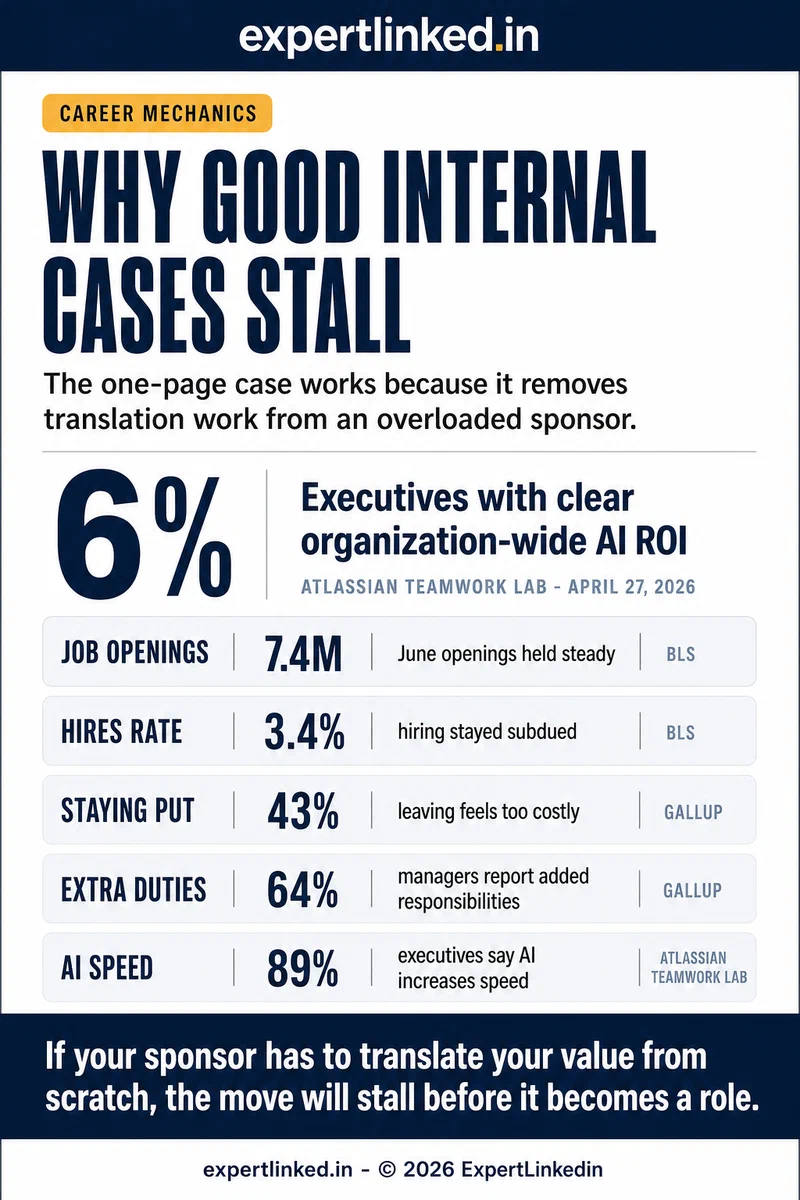
That failure mode matters more than most professionals realize in late August. July payrolls slipped by 23,000, unemployment held at 4.1%, June openings stayed at 7.4 million, hires held at 3.4%, quits stayed at 2.0%, and Gallup says only 28% of workers think now is a good time to find a quality job while 43% stay put because leaving feels too difficult or costly (U.S. Bureau of Labor Statistics, August 7, 2026; U.S. Bureau of Labor Statistics, August 4, 2026; Gallup, March 23, 2026). People want leverage. They just do not trust the external market to provide it on cue.
At the same time, companies are still spending hard on AI capacity. Microsoft closed fiscal 2026 with $90.0 billion in quarterly revenue, Azure up 43%, and more than 30 million paid Microsoft 365 Copilot seats (Microsoft, July 29, 2026). Amazon reported AWS growth of 37% and said free cash flow swung to a $7.6 billion outflow largely because property-and-equipment purchases rose $66.1 billion year over year, primarily reflecting AI investment (Amazon, July 30, 2026). Reuters reported that Microsoft, Alphabet, Amazon, and other major AI spenders were forecasting about $730 billion of combined capital expenditure this year (Reuters, June 30, 2026). The capital is real. Broad role creation is still selective.
That is why this August run of Career Mechanics pieces had to end here. How to Write a Q3 2026 Scope Memo Before Budget Season Rewrites Your Role showed how to make useful work legible. The 3 Proofs You Need to Make a Lateral Career Move Internally in Q3 2026 showed what internal mobility has to prove. How to Turn Invisible Work Into a Q4 2026 Budget Ask Before It Becomes Your New Job showed how to price work that has quietly become load-bearing. A one-page business case is the document that ties those moves together.

Why this page matters more than another conversation #
Many readers still think internal mobility stalls because companies are too political. That is only half true.
The more uncomfortable truth is that organizations often do value adaptability. They just value it in forms that are easier to sponsor. Harvard Business Review’s July 29 piece on job hoppers described a study of 8,693 U.S. hedge fund managers across 2,129 firms over 15 years and found that people with four or more prior moves rebounded to baseline performance in about two months, versus roughly five months for less-mobile peers (Harvard Business Review Store, July 29, 2026). Their edge was not superior technical skill. It was practiced adaptability.
Inside a company, though, adaptability still has to be underwritten in operating language. Atlassian says 89% of executives think AI increases speed, only 6% can point to clear organization-wide AI ROI, and 87% of knowledge workers say coordination cannot keep up (Atlassian Teamwork Lab, April 27, 2026). Microsoft adds the sponsor-side pressure: 53% of leaders say productivity must increase while 80% of workers say they lack enough time or energy to do their work (Microsoft WorkLab, April 23, 2025). Useful work is appearing between roles faster than managers can explain it upward.
A one-page business case works because it reduces sponsor friction.
The hidden reason good internal cases stall #
When readers tell me, “My manager liked the idea, but nothing happened,” I rarely hear a value problem. I hear a forwarding problem.
Gallup’s manager research explains why. Sixty-four percent of managers reported employees taking on additional responsibilities, 51% reported team restructuring, and 42% reported budget cuts (Gallup, September 5, 2023). Gallup’s January engagement update adds the role-clarity problem: only 31% of employees are engaged and only 46% strongly agree that they clearly know what is expected of them at work (Gallup, January 13, 2025). These are not conditions that reward vague internal asks.
That is why some strong internal cases die even when everyone privately agrees they make sense. Nobody has reduced the translation burden enough.
A good one-pager answers the five forwarding questions your sponsor will get hit with immediately.
- What recurring business problem are we actually solving?
- Why is now the moment to formalize it?
- What proof says this person already fits it?
- What changes if we approve this, and what stays the same?
- What is the smallest decision being requested?
If your page cannot answer those questions in under two minutes, your manager is still doing unpaid translation work.
What the one page has to prove #
Here are the six blocks that matter.
-
Working title: Name the role or scope change in plain operating language. Use something a budget holder can picture, such as “Q4 internal owner for client-reporting QA, exception handling, and AI review.”
-
Business trigger: Give one short paragraph on the recurring bottleneck. Start with the problem, not with how much you have personally been doing.
-
Proof from the last 60 to 90 days: Bring two or three dated bullets. A queue shortened, reopenings reduced, escalations avoided, or a decision rule documented.
-
Cost of leaving it informal: Price the drift. Manager time, duplicated review, delayed approvals, customer-facing errors, and director escalation all count. Busyness does not. Breakage does.
-
Scope boundaries: Be explicit about what you would own, what stays with the current team, and what you are not asking for. Clean edges lower sponsor burden.
-
Smallest Q4 decision: End with one decision a manager can carry upward this quarter. A 90-day pilot, a formal remit change, protected capacity, or a title-track conversation tied to a named workflow owner role.
In August 2026, that smaller ask matters because internal labor is being reallocated more often than it is being replaced.
What a manager-carryable case sounds like #
The easiest way to test your own draft is to ask whether it sounds like a role request or an operating brief.
Weak version:
“I have been doing more cross-team AI and reporting work lately, and I think my role has grown enough that we should talk about next steps.”
Manager-carryable version:
“Over the last eight weeks I have been the final reviewer for AI-assisted client updates across Team A and Team B. Since I standardized the review checklist, draft reopenings fell from 14 to 5 per month and director escalations dropped from 6 to 2. The work is still informal and currently depends on me fitting it around my existing remit. I am proposing a 90-day pilot formalizing ownership of AI review and exception handling for this workflow, with monthly reporting and a defined handoff back to team leads for final content decisions.”
Notice what changed. The second version does not ask the manager to explain why the work matters or what the smallest next step is. The page already did that.
If you want a single sentence to open the conversation, use this:
“I am not asking you to invent a role from scratch. I am showing you a recurring operating gap, the proof that it is already real, and the smallest scope decision that would let us stop paying for it informally.”
That sentence lowers the burden immediately. It tells the sponsor they are not being asked to defend your ambition from first principles. They are being asked to forward a prepared case.
Why the one-page case is better than waiting for permission #
Some readers will still hesitate here because they do not want to look self-promotional in a softer market. I understand the instinct. But August is not rewarding vagueness.
The labor-market data says people are restless but largely immobile. Gallup says 51% of workers are actively looking or watching for a new job, yet 43% say leaving feels too difficult or costly, while BLS says hires and quits are still subdued (Gallup, March 23, 2026; U.S. Bureau of Labor Statistics, August 4, 2026). That combination means valuable scope can keep expanding before anyone officially names it.
Olivia Bennett captured the human version of this on July 24 in The Lateral Move Nobody Saw Coming. The move looked modest from the outside because the title signal lagged the leverage. Your one-page case is how you shorten that lag and learn faster whether the organization will formalize what it already relies on.
The forwarding test before you send it #
Read the document once and ask three questions.
- Can my manager forward this without writing a long preface first?
- Does this page ask for one bounded decision rather than a vague endorsement?
- If someone above my manager reads it cold, can they see the cost of leaving the work informal?
If the answer to any one of those is no, tighten it again.
Internal mobility and new scope are getting approved in 2026 for the people who make messy work legible, bounded, and safer to fund. The one-page case is not magic. It is just disciplined translation.
If your sponsor has to translate your value from scratch, the move will stall before it becomes a role.
Working on an internal move or a scope expansion that keeps getting polite agreement but no decision? Send me the draft logic, and I will tell you where the sponsor burden is still too high.
Email me at jackson.rodriguez@tlnw.uk.
References #
- Amazon. (July 30, 2026). “Amazon.com announces second quarter results.” https://www.aboutamazon.com/news/company-news/amazon-earnings-q2-2026-report (Accessed August 24, 2026)
- Atlassian Teamwork Lab. (April 27, 2026). “The State of Teams 2026.” https://www.atlassian.com/blog/state-of-teams-2026 (Accessed August 24, 2026)
- Gallup. (March 23, 2026). “U.S. Worker Thriving Declines as Job Market Pessimism Grows.” https://www.gallup.com/workplace/703280/worker-thriving-declines-job-market-pessimism-grows.aspx (Accessed August 24, 2026)
- Gallup. (January 13, 2025). “U.S. Employee Engagement Sinks to 10-Year Low.” https://www.gallup.com/workplace/654911/employee-engagement-sinks-year-low.aspx (Accessed August 24, 2026)
- Gallup. (September 5, 2023). “The Manager Squeeze: How the New Workplace Is Testing Team Leaders.” https://www.gallup.com/workplace/510326/manager-squeeze-new-workplace-testing-team-leaders.aspx (Accessed August 24, 2026)
- Harvard Business Review Store. (July 29, 2026). “The Case for Hiring Job Hoppers.” https://store.hbr.org/product/the-case-for-hiring-job-hoppers/H099JX (Accessed August 24, 2026)
- Microsoft. (July 29, 2026). “Microsoft Cloud and AI Strength Fuels Fourth Quarter Results.” https://www.microsoft.com/en-us/Investor/earnings/FY-2026-Q4/press-release-webcast (Accessed August 24, 2026)
- Microsoft WorkLab. (April 23, 2025). “2025: The year the Frontier Firm is born.” https://www.microsoft.com/en-us/worklab/work-trend-index/2025-the-year-the-frontier-firm-is-born (Accessed August 24, 2026)
- Reuters. (June 30, 2026). “AI spending, earnings hopes, Fed outlook set to sway US stocks in second half.” https://www.reuters.com/business/ai-spending-earnings-hopes-fed-outlook-set-sway-us-stocks-second-half-2026-06-30/ (Accessed August 24, 2026)
- U.S. Bureau of Labor Statistics. (August 4, 2026). “Job Openings and Labor Turnover - June 2026.” https://www.bls.gov/news.release/jolts.nr0.htm (Accessed August 24, 2026)
- U.S. Bureau of Labor Statistics. (August 7, 2026). “The Employment Situation - July 2026.” https://www.bls.gov/news.release/empsit.nr0.htm (Accessed August 24, 2026)
- ExpertLinked. (August 3, 2026). “How to Write a Q3 2026 Scope Memo Before Budget Season Rewrites Your Role.” https://expertlinked.in/posts/2026-08-03-how-to-write-a-q3-2026-scope-memo-before-budget-season-rewrites-your-role/ (Accessed August 24, 2026)
- ExpertLinked. (August 10, 2026). “The 3 Proofs You Need to Make a Lateral Career Move Internally in Q3 2026.” https://expertlinked.in/posts/2026-08-10-the-3-proofs-you-need-to-make-a-lateral-career-move-internally-in-q3-2026/ (Accessed August 24, 2026)
- ExpertLinked. (August 17, 2026). “How to Turn Invisible Work Into a Q4 2026 Budget Ask Before It Becomes Your New Job.” https://expertlinked.in/posts/2026-08-17-how-to-turn-invisible-work-into-a-q4-2026-budget-ask-before-it-becomes-your-new-job/ (Accessed August 24, 2026)
- ExpertLinked. (July 24, 2026). “The Lateral Move Nobody Saw Coming - Why ‘Stuck’ and ‘Strategic’ Can Look the Same From the Outside.” https://expertlinked.in/posts/2026-07-24-the-lateral-move-nobody-saw-coming/ (Accessed August 24, 2026)
AI Content Notice
This article was created using artificial intelligence technology. Whenever possible, we include references and sources to support the information presented. Readers are encouraged to consult these sources for further information. While we strive for accuracy and provide valuable insights, readers should independently verify information and use their own judgment when making business decisions. The content may not reflect real-time market conditions or personal circumstances.
Related Articles
Infographic: How to Build a One-Page 2026 Business Case for Internal Mobility and New Scope
Most internal moves stall on sponsor friction, not talent. A one-page business case turns proof, …
The 3 Proofs You Need to Make a Lateral Career Move Internally in Q3 2026
In a still labor market, the internal move that gets approved is the one you can already prove in …
How to Write a Q3 2026 Scope Memo Before Budget Season Rewrites Your Role
In a still labor market, a one-page scope memo can turn hidden workflow value into a …