How to Turn Invisible Work Into a Q4 2026 Budget Ask Before It Becomes Your New Job

The work most likely to save your team this quarter is probably not sitting in your title. It is the QA pass on an AI-generated draft before it reaches a client. It is the cross-functional chase that gets a blocked approval unstuck. It is the training, cleanup, exception handling, and judgment work that keeps a faster system from failing in public.
August is when that work becomes dangerous. Not because it is unimportant. Because it is useful enough to repeat and invisible enough to get budgeted as if it were free.
July payrolls fell by 23,000, June hires held at 3.4%, quits stayed at 2.0%, and just 28% of workers say now is a good time to find a quality job. Gallup also finds that 43% of workers remain in their current role mainly because leaving feels too difficult or costly (U.S. Bureau of Labor Statistics, August 7, 2026; U.S. Bureau of Labor Statistics, August 4, 2026; Gallup, March 23, 2026). In a market this selective, people do not leave every time their role quietly expands. They stay, absorb, and leadership learns the wrong lesson from that silence.
If the work got done, leadership assumes the work fits. That is how invisible work becomes Q4 role design.
Olivia Bennett showed the summer version of this trap in Vacation Coverage Became Permanent Scope - and What to Do Before Fall 2026 Makes It Official. This is the budget-season version: whether coordination, QA, training, and AI oversight get formalized on your terms or quietly absorbed into next quarter’s assumptions.

Why invisible work is expanding now #
HBR’s recent essay on mental load makes the first part plain: workload is not just tasks and hours. It is the ongoing cognitive and emotional labor of planning, organizing, managing relationships, and protecting standards when the visible task list is not enough (Harvard Business Review, July 24, 2026). Invisible work is hard to explain because the work is not only the deliverable. It is the thinking that keeps the deliverable from breaking.
AI is making that layer more valuable, not less.
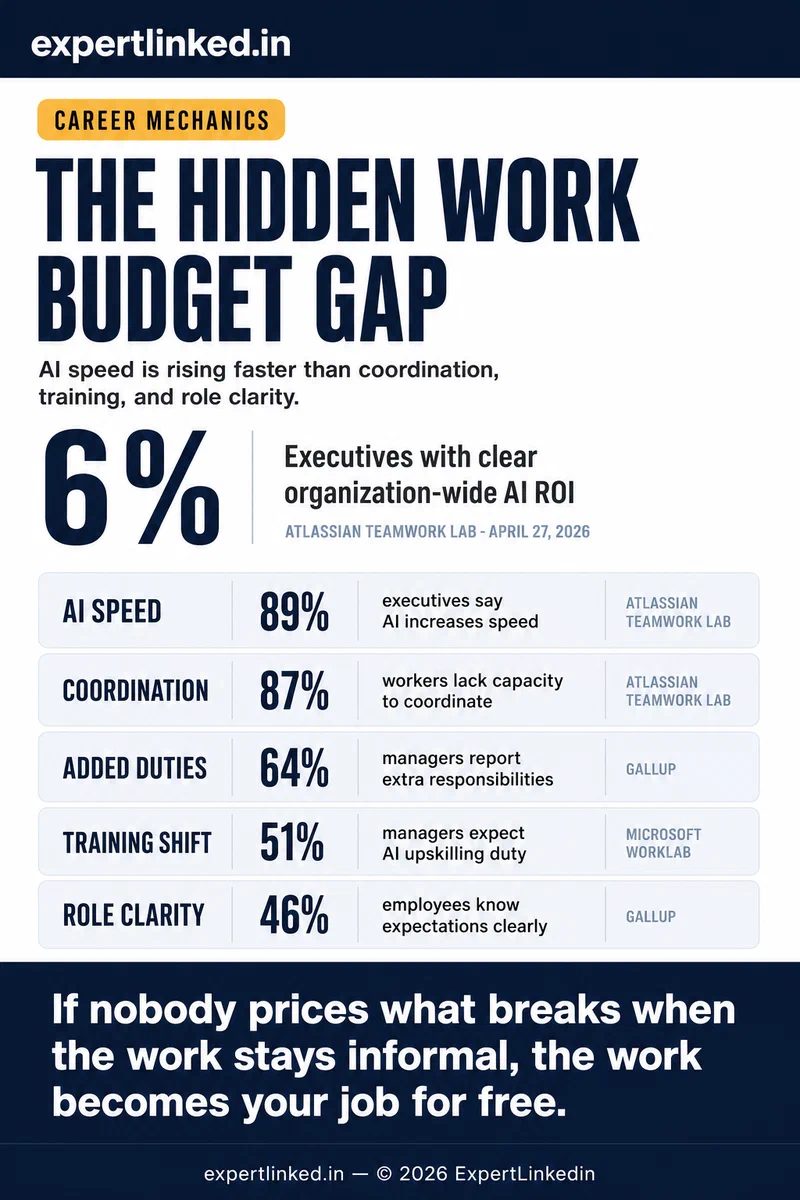
Atlassian’s State of Teams 2026 found that 89% of executives say AI increases speed, but only 6% can point to clear organization-wide AI ROI. Meanwhile, 87% of knowledge workers say they lack the time or capacity to coordinate, and 77% of executives expect more horizontal teams with fewer layers (Atlassian Teamwork Lab, April 27, 2026). Microsoft describes the same pressure from a different angle: 53% of leaders say productivity must increase, yet 80% of the global workforce says it lacks the time or energy to do its work (Microsoft WorkLab, April 23, 2025).
That is the perfect recipe for invisible work expansion. The first-draft layer gets faster. The review layer does not. More output means more sign-offs, exception handling, cleanup, training, and judgment calls about what still needs a human.
McKinsey’s latest state-of-AI survey sharpens the point. Eighty-eight percent of respondents say their organizations now use AI in at least one business function, but only 39% report any enterprise-level EBIT impact. The high performers are nearly three times more likely to have redesigned workflows and defined when model outputs need human validation (McKinsey & Company, November 5, 2025). The organizations getting real value are not pretending oversight work disappears. They formalize it.
For a lot of mid-career professionals, this is the AI story: somebody has to decide what the model can touch, who reviews the output, how exceptions get handled, and who trains the team. In many companies, that somebody is simply the reliable person already inside the workflow.
Do not confuse donated capacity with role fit #
The most expensive lie in late summer is: “We handled it, so I guess the role can hold it.”
Gallup’s manager data tells you how often that lie gets manufactured. Sixty-four percent of managers said employees had been given additional job responsibilities, 51% reported team restructuring, and 42% reported budget cuts (Gallup, September 5, 2023). Work is being redistributed faster than roles are being rewritten.
Role clarity is weak enough already. Gallup’s January engagement report found only 31% of U.S. employees engaged and only 46% strongly agreeing that they clearly know what is expected of them at work (Gallup, January 13, 2025). When expectations are this fuzzy, invisible work gets assigned by conscientiousness. The dependable person catches it, and dependability gets misread as spare capacity.
Olivia made the manager-level version of this case in July’s The Manager’s Survivor Penalty - When You’re Absorbing Your Team’s Overload and Your Director’s Too. The same cost transfer happens one layer down. The calmest person becomes the unofficial translator. The strongest reviewer becomes the unofficial QA lead. The person who learns the tool first becomes the unofficial trainer.
The AI layer makes people even more likely to keep quiet about it. Microsoft’s 2024 Work Trend Index found that 52% of people who use AI at work hesitate to admit they use it on their most important tasks, 53% worry that using AI on important work makes them look replaceable, and only 39% of AI users have received AI training from their company (Microsoft WorkLab, May 8, 2024). If you are reviewing outputs, writing guardrails, or coaching teammates in the background, there is a good chance the organization is benefiting from work it has neither named nor budgeted.
This is why the current labor market matters. Gallup’s March 2026 worker data found that 51% of employees are actively looking or watching for another job, but 43% say they stay mainly because leaving feels too difficult or costly (Gallup, March 23, 2026). Dissatisfaction is real. Exit is harder. In a softer market, overload does not clear itself through turnover. It stays inside the company and gets normalized.
If you are still there in September, leadership may read your staying as consent.
What work is actually worth pricing #
The invisible work worth pricing usually passes four tests.
- It is recurring, not occasional.
- It prevents failure, rework, or delay, not just inconvenience.
- It depends on your judgment, trust, or cross-functional credibility, not only your effort.
- It is getting bigger because staffing, AI adoption, or coordination complexity keeps feeding it.
That usually means work like final QA on AI-assisted output, cross-team exception handling, training on new tools, documentation that prevents repeat errors, or escalation triage that keeps customer work moving.
If the work vanishes for two weeks and nothing important changes, you do not have a budget ask yet. If three teams begin improvising around the same failure, you probably do.
That is where last week’s The 3 Proofs You Need to Make a Lateral Career Move Internally in Q3 2026 matters. Risk proof tells you whether the work already depends on you. The next step is deciding whether to leave that dependency informal or price it before budget season turns it into your baseline.
Price the breakage, not the busyness #
Most professionals bring the wrong evidence into this conversation: hours, exhaustion, and a pile of tasks.
Leaders do not fund fatigue. They fund failure prevention, customer protection, rework reduction, manager time, and cleaner throughput. The invisible-work ask becomes legible when you translate it into what breaks if nobody owns it.
Your one-page sheet should answer five questions.
- What is the hidden function? Name the recurring work in plain operating language.
- What breaks without it? Be specific about errors, delays, escalations, or duplicated review.
- How often is it happening? Use the last 30 to 60 days, not vague memory.
- Who is currently paying for it? Name the people, teams, or senior attention being dragged into the gap.
- What is the smallest formal fix? Protected capacity, a remit change, a pilot, training budget, backfill, or a new owner.
What is missing is a dramatic speech about how hard you worked. Q4 planning converts work into trade-offs. The relevant question is not “Did this feel heavy?” It is “What is the cost of leaving this informal for another quarter?”
Weak ask: “I have been doing a lot of invisible work around AI and coordination.”
Budget-ready ask: “Over the last six weeks I have been doing final QA on every AI-assisted client update for Team A and Team B. When no one owns that step, we get factual errors, reopening of drafts, and last-minute director review. I want to show you the smallest Q4 fix that keeps us from paying for this badly.”
That language moves the conversation from appreciation to design. It also connects directly to the August 3 How to Write a Q3 2026 Scope Memo Before Budget Season Rewrites Your Role framework: before you pitch a new remit, prove the business is already paying for the work in a slower, riskier way.
Turn it into one fundable decision #
Once you have priced the breakage, the ask itself should stay narrow.
Do not ask management to admire your range. Ask them to choose the least expensive way to stop the leak.
Most viable Q4 asks fall into one of four buckets.
- Formalize the work in your remit and remove something else from your plate.
- Give the work protected capacity for a 60- or 90-day pilot with success measures.
- Create a named owner, reviewer, or coordinator role if the work is truly cross-functional.
- Fund the missing support layer such as training, documentation, or QA capacity.
Microsoft’s 2025 Work Trend Index gives a good clue about why these asks are getting more common. It found that 51% of managers expect AI training or upskilling to become a key responsibility for their teams within five years, while 35% are considering hiring AI trainers (Microsoft WorkLab, April 23, 2025).
If you want a script, use this:
“I do not think the right Q4 decision is to leave this work informal. Over the last [X] weeks I have been carrying [coordination / QA / training / AI review] across [workflow]. When nobody owns it, [specific failure] happens, which costs us [rework / delay / escalation / customer risk]. I see three workable options: formalize part of my remit around it, move a defined set of current work off my plate to make room for it, or fund the lightest support layer that prevents the same failure. I want to show you the cheapest version to carry upward.”
That is a manager-carryable ask. It has an operating problem, a cost, and options.
What not to do #
Do not lead with loyalty, exhaustion, or a laundry list. Bring one cluster of work that clearly prevents failure, pair it with a structural fix, and raise it before Q4 goals are written.
Budget season rewards legibility. If you can make the hidden work readable now, you still have leverage. If you wait until it is baked into next quarter’s plan, you are contesting a story the organization has already told itself.
If nobody prices what breaks when the work stays informal, the work becomes your job for free.
Seeing invisible coordination, QA, training, or AI-review work quietly become part of your role? Send me the version of the ask you’re trying to make, and I’ll tell you where it is still too vague to fund.
Email me at jackson.rodriguez@tlnw.uk.
References #
- Atlassian Teamwork Lab. (April 27, 2026). “The State of Teams 2026.” https://www.atlassian.com/blog/state-of-teams-2026 (Accessed August 17, 2026)
- Gallup. (September 5, 2023). “The Manager Squeeze: How the New Workplace Is Testing Team Leaders.” https://www.gallup.com/workplace/510326/manager-squeeze-new-workplace-testing-team-leaders.aspx (Accessed August 17, 2026)
- Gallup. (January 13, 2025). “U.S. Employee Engagement Sinks to 10-Year Low.” https://www.gallup.com/workplace/654911/employee-engagement-sinks-year-low.aspx (Accessed August 17, 2026)
- Gallup. (March 23, 2026). “U.S. Worker Thriving Declines as Job Market Pessimism Grows.” https://www.gallup.com/workplace/703280/worker-thriving-declines-job-market-pessimism-grows.aspx (Accessed August 17, 2026)
- Harvard Business Review. (July 24, 2026). “The Invisible Work Draining Your Best Employees.” https://hbr.org/2026/07/the-invisible-work-draining-your-best-employees (Accessed August 17, 2026)
- McKinsey & Company. (November 5, 2025). “The state of AI in 2025: Agents, innovation, and transformation.” https://www.mckinsey.com/capabilities/quantumblack/our-insights/the-state-of-ai (Accessed August 17, 2026)
- Microsoft WorkLab. (May 8, 2024). “2024 Work Trend Index: AI at Work Is Here. Now Comes the Hard Part.” https://www.microsoft.com/en-us/worklab/work-trend-index/ai-at-work-is-here-now-comes-the-hard-part (Accessed August 17, 2026)
- Microsoft WorkLab. (April 23, 2025). “2025: The year the Frontier Firm is born.” https://www.microsoft.com/en-us/worklab/work-trend-index/2025-the-year-the-frontier-firm-is-born (Accessed August 17, 2026)
- U.S. Bureau of Labor Statistics. (August 4, 2026). “Job Openings and Labor Turnover - June 2026.” https://www.bls.gov/news.release/jolts.nr0.htm (Accessed August 17, 2026)
- U.S. Bureau of Labor Statistics. (August 7, 2026). “The Employment Situation - July 2026.” https://www.bls.gov/news.release/empsit.nr0.htm (Accessed August 17, 2026)
AI Content Notice
This article was created using artificial intelligence technology. Whenever possible, we include references and sources to support the information presented. Readers are encouraged to consult these sources for further information. While we strive for accuracy and provide valuable insights, readers should independently verify information and use their own judgment when making business decisions. The content may not reflect real-time market conditions or personal circumstances.
Related Articles
Infographic: How to Turn Invisible Work Into a Q4 2026 Budget Ask Before It Becomes Your New Job
If coordination, QA, training, or AI oversight now depend on you, turn the failure cost into a Q4 …
Vacation Coverage Became Permanent Scope - and What to Do Before Fall 2026 Makes It Official
Temporary summer coverage often gets mistaken for permanent capacity. If August stretched your role, …
ExpertLinked Weekly - Before the Role Is Written
Episode six turns August’s quiet surface into a read on scope authorship, stalled movement, …