What July's Hardest Workplace Questions Reveal About the State of Organizational Accountability

This month, three readers wrote the same question in different forms. One had been told to use AI more without any redesign of the work. One was being pushed to raise a team adoption number without humiliating the person resisting it. One was carrying her team’s overload and her director’s optimism about what AI was supposedly making possible. Different jobs, same pressure: make the gap disappear. - July’s Workplace Clinic inbox
By the third note, the pattern was too clean to ignore. AI transformation is being narrated upward as strategy and lived downward as private accommodation.

The Clinical Read #
The three July cases were not separate workplace problems. The July 10 Clinic on AI mandates without workflow redesign showed the worker-level version, the July 17 Clinic on managing team AI resistance showed the manager-level version, and the July 24 Clinic on the manager’s survivor penalty showed the middle-layer version. Different vantage points, same failure: the person closest to the work is expected to absorb the cost of a redesign the organization has not fully owned.
That is why I do not think July’s pattern is best described as an AI skills gap or a change-resistance problem. It is an accountability problem. The people choosing the timeline, the metrics, and the public story are often not the people carrying the redesign labor, the review burden, or the reputational risk when the new system fails in practice.
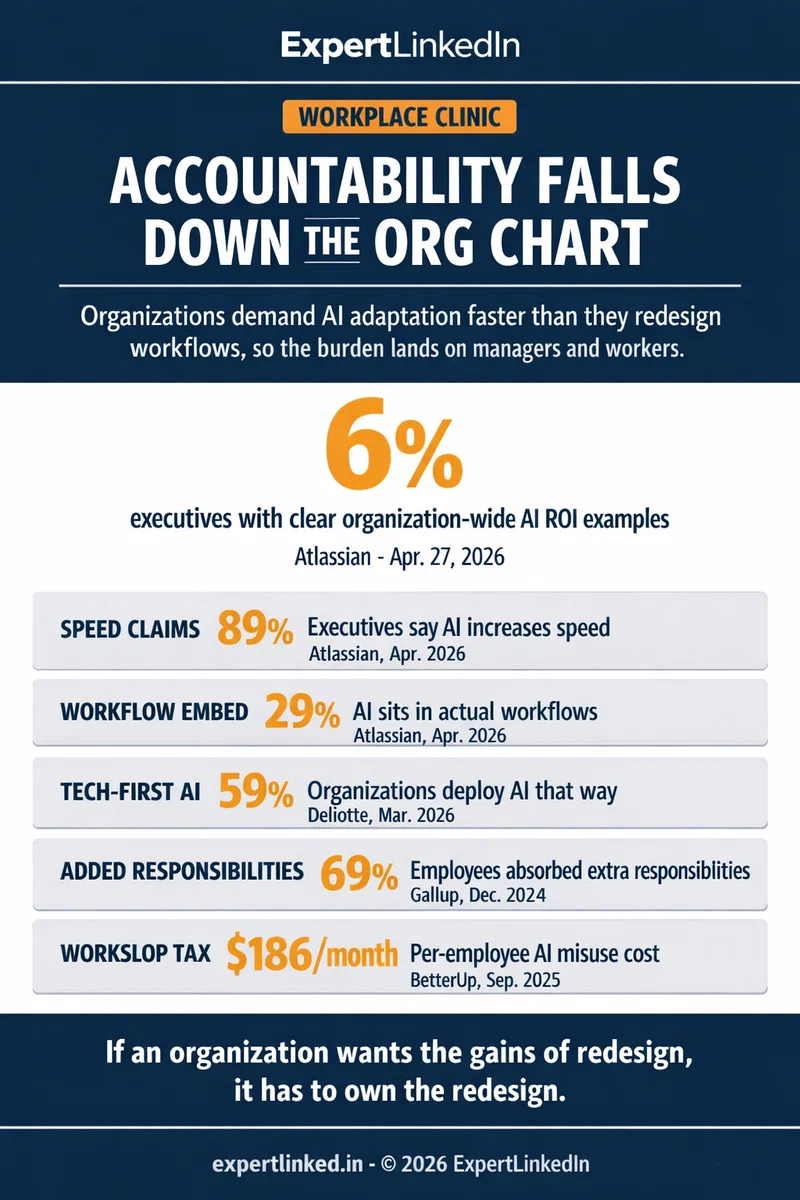
The research keeps pointing to the same split. Atlassian’s State of Teams 2026 found that 89% of executives say AI increases speed, but only 6% are sure they have clear examples of organization-wide AI ROI, and only 29% of knowledge workers say AI has been embedded in actual flows of work (Atlassian, April 27, 2026). Deloitte’s 2026 Global Human Capital Trends report adds the harder diagnosis: 59% of organizations still take a tech-focused approach to AI, and those organizations are 1.6 times more likely to miss AI returns that exceed expectations than organizations taking a human-centric approach (Deloitte, March 4, 2026).
The organization is accelerating tool use faster than it is owning the operating model change required to make the tools useful. That gap does not stay abstract for long. It gets pushed somewhere.
Gallup’s data shows where the gap usually lands. In late 2024, 73% of employees said their organization had experienced disruptive change, while managers reported added job responsibilities (69%), team restructuring (55%), and budget cuts (46%) (Gallup, December 2, 2024). Engagement was already weak: only 31% of employees were engaged, 46% clearly knew what was expected of them, and 30% strongly agreed someone at work encouraged their development (Gallup, January 13, 2025).
BetterUp’s September 2025 workslop research shows the managerial version of the same burden. Fifty-four percent of managers said they had received low-value AI-generated work in the prior month, and employees spent an average of 1 hour and 51 minutes dealing with each instance, an invisible tax BetterUp estimated at $186 per employee per month (BetterUp, September 29, 2025). Speed at the top often means repair work below.
Harvard Business Review’s July research on employees held accountable for AI-generated decisions makes the same point in a sharper way. Employees often masked or reshaped AI outputs they could not cleanly explain. The one case that worked better did so because the company funded the interpretive layer: access to underlying data, time to inspect decisions, and regular learning loops with developers (Harvard Business Review, July 22, 2026).
This is not inevitable. Brookings argues employers still choose how AI enters workflows and how much voice workers have in shaping those changes (Brookings, June 29, 2026).
The Pattern July Exposed #
Once you lay the three July cases side by side, the structural stack of accountability becomes visible.
At the top, the organization wants a convincing story about AI ambition, efficiency, and modernity. That story travels downward as faster expectations, thinner staffing, adoption scorecards, and vague language about doing more with the same headcount.
In the middle, leaders and managers are asked to translate that ambition into local reality. They decide whether a workflow is ready, whether a deliverable is safe, whether hesitation is distrust or burnout, and whether strain should be surfaced upward or absorbed quietly. Harvard Business Review’s June research on middle managers and AI adoption is blunt on this point: managers do not experience role elevation. Without support, they get buried (Harvard Business Review, June 26, 2026).
At the worker level, the same pressure arrives as a metric, a reminder, or a vague demand to use the tool more and complain less.
This is what I mean by accountability deflection. Decision rights stay high. Operational ambiguity travels downward. The closer someone is to the actual work, the more intensely they are expected to compensate for the fact that the redesign has not been fully owned above them.
That pattern is also psychologically corrosive. The Center for Creative Leadership defines psychological safety as the belief that you will not be punished or humiliated for speaking up, and its research found that teams with higher psychological safety reported higher performance and lower interpersonal conflict (Center for Creative Leadership, April 10, 2026). Yet many AI rollouts ask people to experiment while making it feel dangerous to say the experiment is not working.
So July’s hardest questions were not really asking, “How do I keep up with AI?” They were asking, “How do I live inside an organization that wants the gains of redesign without fully owning the redesign itself?”
The Three-Move Intervention #
Move 1: Build a transfer ledger #
Before arguing with the narrative, document the transfer.
Identify where AI adds steps, where it saves time, and where the verification burden shifted. Managers should track time spent translating expectations, reviewing generated work, and reporting adoption. This is not bureaucracy; it is the fastest way to stop an organizational choice from masquerading as personal insufficiency. Identify what changed and where the hidden costs of your continued competence sit. “This workflow now requires three extra review steps” is harder to evade than “I feel overwhelmed.”
Move 2: Convert abstract pressure into named workflows #
Do not let “AI transformation” stay abstract. Force the conversation down to one outcome and one tradeoff at a time:
- Which task are we actually trying to improve?
- What result counts as success?
- What new verification or coordination cost does the tool create?
- What slows or gets deprioritized to make room for this?
This is where truth becomes visible and psychologically safe conversations happen. Experimentation only works when people can test and raise concerns without being treated as disloyal (Center for Creative Leadership, April 10, 2026). Reject vagueness: “I am open to using AI, but we need to name the workflow, success criteria, and review standard.”
Move 3: Make the structural argument visible, then protect portability #
For those without the authority to redesign the organization: Make the structural argument in plain language.
- “We are asking people to absorb redesign labor the organization has not yet owned.”
- “If AI use is expected, we need one named pilot and a decision about what comes off the plate.”
- “If priorities stay open, the cost will show up as rework, slower coordination, or burnout.”
Watch the response. If it remains “just use it more,” you have your answer. Gallup’s March 2026 data found 43% of workers stay primarily because leaving is too costly (Gallup, March 23, 2026). If you cannot exit, keep your compliance floor narrow. Do not volunteer more theater than needed. Build a portable record of judgment—the workflows you improved and the questions you raised. That record matters when you stop donating invisible interpretative labor.
The Thing Nobody Says Out Loud #
Most organizations still talk about AI transformation as if the tool creates the change by itself.
It does not.
People create the change. They absorb the ambiguity, review the output, repair the workflow, calm the team, defend the decision, and decide which parts of the old job still need to be done by hand. When they are asked to do all of that without clearer priorities, better incentives, or real authority, the organization has not solved the accountability problem. It has distributed it.
That is what July exposed. The worker being nudged into compliance theater, the manager trying not to turn resistance into humiliation, and the middle leader translating unsustainable pressure into composure were all being asked to make the same design gap disappear at different levels.
You may not be able to make your organization tell the truth about that immediately. But you can stop helping it confuse private endurance with successful transformation.
If an organization wants the gains of redesign, it has to own the redesign.
If July surfaced a version of this pattern in your own team, send it. The most useful questions are usually the ones where the official story and the lived reality no longer match.
Email me at olivia.bennett@tlnw.uk.
References #
- Atlassian Teamwork Lab. (April 27, 2026). “The State of Teams 2026.” https://www.atlassian.com/blog/state-of-teams-2026 (Accessed July 31, 2026)
- BetterUp. (September 29, 2025). “The hidden cost of AI ‘workslop’ - and how leaders can fix it.” https://www.betterup.com/blog/hidden-costs-workslop (Accessed July 31, 2026)
- Brookings. (June 29, 2026). “Getting to all-of-the-above: A framework of solutions for AI’s coming impacts on work and workers.” https://www.brookings.edu/articles/ai-workforce-policy-framework/ (Accessed July 31, 2026)
- Center for Creative Leadership. (April 10, 2026). “How Leaders Can Build Psychological Safety at Work.” https://www.ccl.org/articles/leading-effectively-articles/what-is-psychological-safety-at-work/ (Accessed July 31, 2026)
- Deloitte. (March 4, 2026). “2026 Global Human Capital Trends.” https://www.deloitte.com/us/en/insights/topics/talent/human-capital-trends.html (Accessed July 31, 2026)
- Gallup. (December 2, 2024). “The Great Detachment: Why Employees Feel Stuck.” https://www.gallup.com/workplace/653711/great-detachment-why-employees-feel-stuck.aspx (Accessed July 31, 2026)
- Gallup. (January 13, 2025). “U.S. Employee Engagement Sinks to 10-Year Low.” https://www.gallup.com/workplace/654911/employee-engagement-sinks-year-low.aspx (Accessed July 31, 2026)
- Gallup. (March 23, 2026). “U.S. Worker Thriving Declines as Job Market Pessimism Grows.” https://www.gallup.com/workplace/703280/worker-thriving-declines-job-market-pessimism-grows.aspx (Accessed July 31, 2026)
- Harvard Business Review. (June 26, 2026). “AI Adoption Is Overloading Your Middle Managers.” https://hbr.org/2026/06/ai-adoption-is-overloading-your-middle-managers (Accessed July 31, 2026)
- Harvard Business Review. (July 22, 2026). “When Employees Are Held Accountable for AI-Generated Decisions.” https://hbr.org/2026/07/when-employees-are-held-accountable-for-ai-generated-decisions (Accessed July 31, 2026)
AI Content Notice
This article was created using artificial intelligence technology. Whenever possible, we include references and sources to support the information presented. Readers are encouraged to consult these sources for further information. While we strive for accuracy and provide valuable insights, readers should independently verify information and use their own judgment when making business decisions. The content may not reflect real-time market conditions or personal circumstances.
Related Articles
Infographic: What July's Hardest Workplace Questions Reveal About the State of Organizational Accountability
July’s hardest workplace questions all trace back to one pattern: AI transformation without …
Your Company Mandated AI Tools But Not AI Workflows — Here Is the Clinical Read and the Three-Move Response
Tool deployment without workflow redesign reliably produces compliance theater — and compliance …
Infographic: Your Company Mandated AI Tools But Not AI Workflows — Here Is the Clinical Read and the Three-Move Response
Tool deployment without workflow redesign reliably produces compliance theater — and compliance …