You Came Back to a Reorganized Team - How to Reclaim Scope Before Q4 2026 Hardens It

The most dangerous sentence to hear on the first day back is not “Welcome home.” It is “While you were out, we made a few changes” – delivered with the calm confidence of a settled plan, as if your reentry silence were the same thing as your consent.
“I was away for six workdays. When I came back, my team had been ‘reorganized’ around a new client onboarding model. The weekly operating review is now mine, two cross-functional handoffs I was only covering in August are still with me because I was ‘already close to the work,’ and my manager keeps saying we can fine-tune later. I do not want to look territorial the week I get back, but budget planning starts soon and temporary changes are already being treated like my permanent role. How do I reclaim scope before this hardens?’ – Customer operations manager, fintech company
This is the reentry version of the pattern I named on Aug. 7 in Vacation Coverage Became Permanent Scope - and What to Do Before Fall 2026 Makes It Official, the authority version I described on Aug. 21 in You Own the Deliverable but Not the Decision - and What to Do About That in Q3 2026, and the larger accountability pattern I pulled together on July 31 in What July’s Hardest Workplace Questions Reveal About the State of Organizational Accountability. But the first week back has its own mechanism: a still-ambiguous operating model gets narrated as settled fact because the person best positioned to challenge it is busy digging out of inbox debt.
The Clinical Read #
Harvard Business Review’s June 26 article The Two-Organizations Problem gives the cleanest language for what happens here. Most scaled companies operate as a reported organization, seen in dashboards and org charts, and a lived organization, navigated day to day. A reorganization announced while you are away arrives first as reported organization: the slide says responsibilities are clearer and August’s coverage model now looks efficient. Then you return to the lived organization: duplicated meetings, ownerless handoffs, and work you were only bridging still sitting on your plate.
Harvard Business Review’s The False Alignment Trap explains why the handoff feels so strange. Leaders often say they are aligned when they have not actually agreed on why the change is happening, what is changing, and how it will work. Downstream teams then produce paralysis, hyperactivity, or tunnel vision. Reentry weeks usually look like hyperactivity: everyone moves fast enough to create the illusion that the structure works while unresolved questions stay parked above.
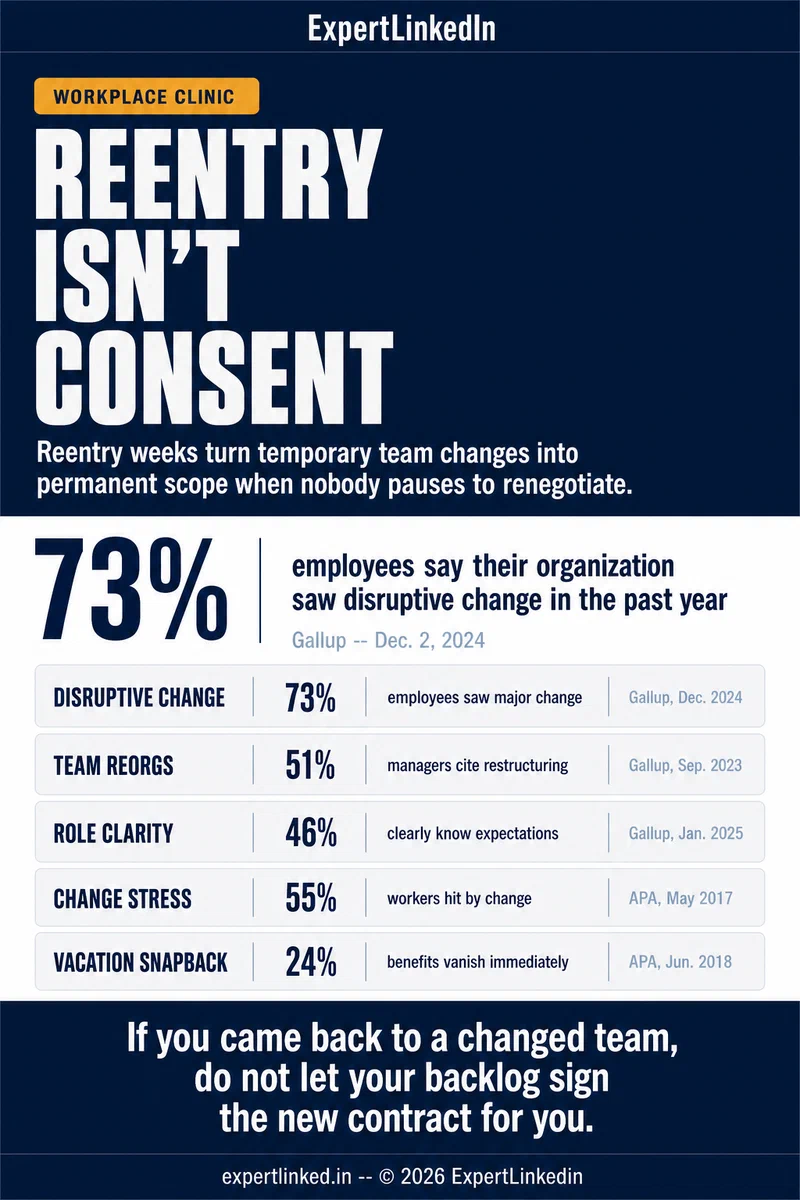
That would be easier to absorb if the broader workplace were stable. It is not. Gallup reported in The Great Detachment that 73% of employees said their organization had experienced disruptive change in the prior year, while managers reported added job responsibilities, team restructuring, and budget cuts at rates of 69%, 55%, and 46%, respectively (Gallup, December 2, 2024). A month later, Gallup found only 31% of employees were engaged and just 46% clearly knew what was expected of them at work in its annual engagement update (Gallup, January 13, 2025).
The timing problem is sharper than many leaders realize. In the APA’s June 27, 2018 release on vacation and wellbeing, 24% of workers said the benefits of vacation disappeared immediately on return, 40% said they lasted only a few days, and 42% said they dreaded returning to work (American Psychological Association, June 27, 2018). That first week back is not a neutral measure of sustainable capacity. APA’s 2017 work-change research adds that workers affected by organizational change were more than twice as likely to report chronic stress, 55% versus 22%, and more than three times as likely to plan to look for another job (American Psychological Association, May 24, 2017). When the work changes while you are away, your nervous system notices even if the org chart treats it as housekeeping.
Gallup’s matrix research helps explain why reorganized teams feel so exhausting so quickly. In Gallup’s study, 72% of employees were working on matrixed teams, 45% of highly matrixed workers spent most of the day responding to requests from coworkers, and role ambiguity became especially common when people worked across teams for multiple managers. Atlassian’s 2026 finding that 87% of knowledge workers lack time or capacity to coordinate only sharpens the point (Atlassian, April 27, 2026).
Why Reentry Weeks Create False Consent #
Reentry is when organizations most easily convert experimentation into role design because the social script works in their favor. You have a backlog, other people are already in motion, and nobody wants the returning colleague to sound difficult after taking time off. So cooperation becomes the default performance: answer the messages, attend the new meeting, absorb the handoff, ask the harder questions later.
Deloitte’s 2026 Global Human Capital Trends argues that redesign now requires explicit decisions about decision rights, accountability, and trust. The Center for Creative Leadership makes the people-side cost explicit in its piece on change fatigue: every reorganization and personnel transition draws down a finite bank of time, effort, and energy. If leaders fail to account for that cost, they start mistaking emergency adaptation for durable capacity.
The 3-Move Reentry Reset #
Move 1: Ask for the before-and-after map before the day consumes you #
Do not start with a vague statement that everything feels messy. Start with a map.
Ask for five things in plain language:
- What changed structurally while I was away?
- Which responsibilities moved permanently?
- Which responsibilities are still temporary or under review?
- What decision paths or approvals changed hands?
- What does success look like through the end of September?
You need the change log, not the mood music. Do not accept “We just shifted a few things around.” Say: “I want to understand the new setup in a before-and-after way. What changed structurally, what is experimental, and what is expected to return to prior owners?”
That question separates declared structure from improvised behavior and stops the team from treating your confusion as the problem when the design itself was never written down clearly enough.
Move 2: Reclaim scope by tying every new duty to a trade-off and an owner #
If a new recurring meeting, escalation queue, status update, approval chain, or client handoff is now supposed to stay with you, something else must move too. Scope should never be renegotiated as a one-way import.
Force the conversation onto three dimensions:
- Scope: what leaves my plate if this stays?
- Authority: what decisions can I now make without waiting?
- Support: what staffing, backup, or review support changes with it?
Work that is reassigned without clearer decision rights does not become a cleaner job. It becomes delegated exposure. A useful sentence here is: “I can support this revised structure. If the weekly operating review and these onboarding handoffs are now part of my standing role, I need us to name what stops, what authority travels with that work, and how we will judge success.”
Do not let the answer remain sentimental. “You are great at this” is not a scope design.
Move 3: Force a 30-day relaunch instead of accepting oral tradition #
The Center for Creative Leadership’s January 2026 piece on collective sensemaking recommends a simple sequence that is perfect for a reorganized team: review, reflect, apply, with decisions, owners, dates, and follow-up. Gallup’s matrix research lands on a similar practical fix: relaunch the team after change so people can reconnect responsibilities, priorities, and coordination.
So ask for a short written reset rather than an endless stream of verbal reassurance. A 30-day relaunch should name:
- who owns which recurring work
- who has final say on key decisions
- what has been deprioritized or removed
- what remains a trial rather than a permanent change
- when the arrangement will be reviewed before Q4 planning
One script to borrow: “I want to support the new structure, but I do not want our first week back to lock in assumptions we have not tested. Let’s run this setup for 30 days with named responsibilities, decision rights, and a review date before Q4 planning.”
What Not to Let Q4 Do #
The reason to act now is simple: Q4 planning writes down whatever survived August and September, not whatever was fairest or most sustainable. If you keep carrying the extra coordination, the organization learns the wrong lesson: that the redesign worked.
Gallup’s burnout research is blunt that unmanageable workload, weak manager support, lack of role clarity, and unreasonable time pressure are among the strongest drivers of burnout (Gallup, July 12, 2018). The World Health Organization defines burnout as chronic workplace stress that has not been successfully managed (World Health Organization). By the time you are exhausted enough to finally raise the issue, the system has already had weeks to normalize it.
So do not treat your first week back as a courtesy period where you have to be endlessly agreeable. Treat it as the narrow window when the lived organization can still talk back to the reported one. Your first week back is not proof that the new role works. It is proof that you know how to catch falling things. If you came back to a changed team, do not let your backlog sign the new contract for you.
Walked back into a “settled” reorg that did not feel settled at all? Send it. The most revealing Clinic notes often begin with one line: “While I was out, everything changed.”
Email me at olivia.bennett@tlnw.uk
References #
- American Psychological Association (May 24, 2017). “Change at Work Linked to Employee Stress, Distrust and Intent to Quit, New Survey Finds.” https://www.apa.org/news/press/releases/2017/05/employee-stress (Accessed August 27, 2026)
- American Psychological Association (June 27, 2018). “Vacation Time Recharges US Workers, but Positive Effects Vanish Within Days, New Survey Finds.” https://www.apa.org/news/press/releases/2018/06/vacation-recharges-workers (Accessed August 27, 2026)
- Atlassian (April 27, 2026). “The State of Teams 2026.” https://www.atlassian.com/blog/state-of-teams-2026 (Accessed August 27, 2026)
- Center for Creative Leadership (January 20, 2026). “Collective Sensemaking in an Environment of Constant Disruption.” https://www.ccl.org/articles/leading-effectively-articles/collective-problem-solving-sensemaking-steps-for-leadership-teams/ (Accessed August 27, 2026)
- Center for Creative Leadership (July 30, 2025). “How To Overcome Change Fatigue & Lead Workplace Change.” https://www.ccl.org/articles/leading-effectively-articles/change-fatigue-continual-evolution/ (Accessed August 27, 2026)
- Deloitte (March 4, 2026). “2026 Global Human Capital Trends.” https://www.deloitte.com/us/en/insights/topics/talent/human-capital-trends.html (Accessed August 27, 2026)
- Gallup (July 12, 2018). “Employee Burnout, Part 1: The 5 Main Causes.” https://www.gallup.com/workplace/237059/employee-burnout-part-main-causes.aspx (Accessed August 27, 2026)
- Gallup (October 19, 2021). “Too Many Teams, Too Many Bosses: Overcoming Matrix Madness.” https://www.gallup.com/workplace/354935/teams-bosses-overcoming-matrix-madness.aspx (Accessed August 27, 2026)
- Gallup (September 5, 2023). “The Manager Squeeze: How the New Workplace Is Testing Team Leaders.” https://www.gallup.com/workplace/510326/manager-squeeze-new-workplace-testing-team-leaders.aspx (Accessed August 27, 2026)
- Gallup (December 2, 2024). “The Great Detachment: Why Employees Feel Stuck.” https://www.gallup.com/workplace/653711/great-detachment-why-employees-feel-stuck.aspx (Accessed August 27, 2026)
- Gallup (January 13, 2025). “U.S. Employee Engagement Sinks to 10-Year Low.” https://www.gallup.com/workplace/654911/employee-engagement-sinks-year-low.aspx (Accessed August 27, 2026)
- Harvard Business Review (June 26, 2026). “The Two-Organizations Problem.” https://hbr.org/2026/06/the-two-organizations-problem (Accessed August 27, 2026)
- Harvard Business Review (July 2026). “The False Alignment Trap.” https://hbr.org/2026/07/the-false-alignment-trap (Accessed August 27, 2026)
- World Health Organization. “Burn-out an ‘occupational phenomenon’.” https://www.who.int/standards/classifications/frequently-asked-questions/burn-out-an-occupational-phenomenon (Accessed August 27, 2026)
AI Content Notice
This article was created using artificial intelligence technology. Whenever possible, we include references and sources to support the information presented. Readers are encouraged to consult these sources for further information. While we strive for accuracy and provide valuable insights, readers should independently verify information and use their own judgment when making business decisions. The content may not reflect real-time market conditions or personal circumstances.
Related Articles
Infographic: You Came Back to a Reorganized Team - How to Reclaim Scope Before Q4 2026 Hardens It
Coming back to a ’new setup’ is one of the easiest ways organizations turn temporary …
Vacation Coverage Became Permanent Scope - and What to Do Before Fall 2026 Makes It Official
Temporary summer coverage often gets mistaken for permanent capacity. If August stretched your role, …
How to Turn Invisible Work Into a Q4 2026 Budget Ask Before It Becomes Your New Job
If coordination, QA, training, or AI oversight now depend on you, turn the failure cost into a Q4 …