The Internal Labor Market: Why Q3 2026 Career Leverage Is Built Before the Job Posting Exists

By the time the job posting goes live, the leverage is usually already allocated.
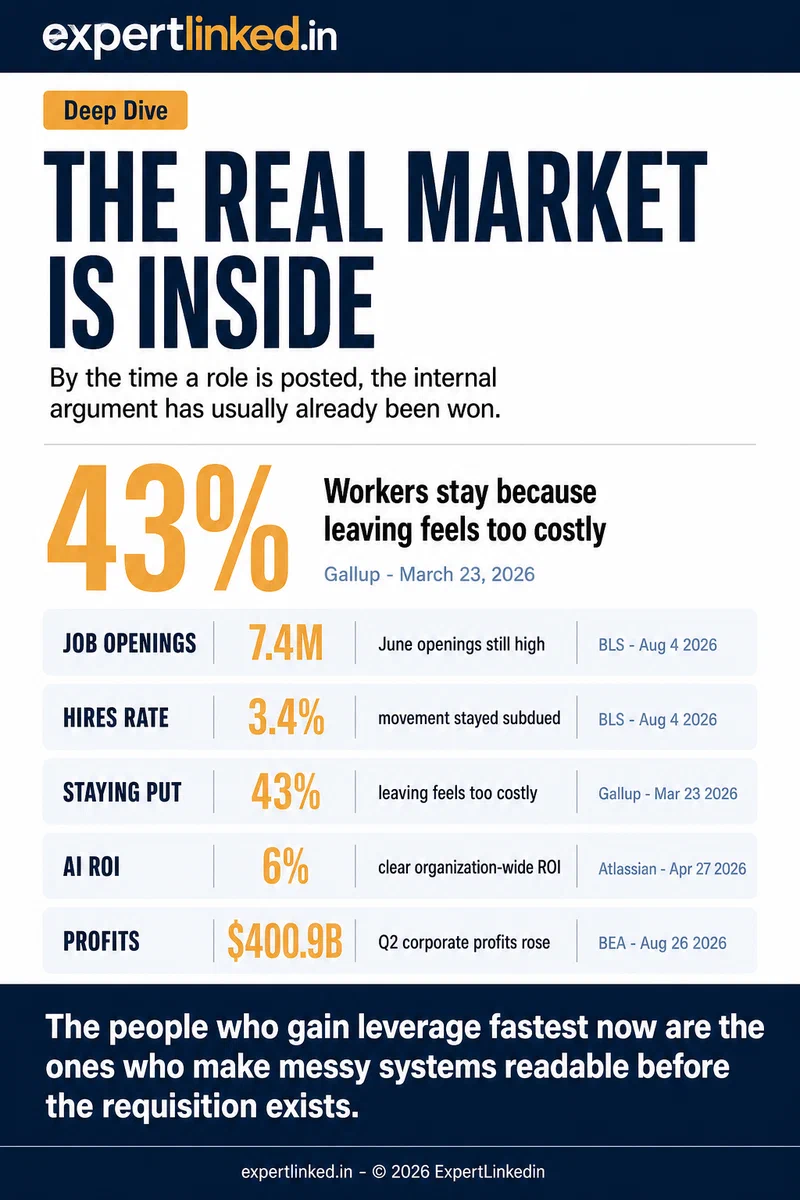
In Q3 2026, the most important labor market for many professionals is inside the firm. June JOLTS still showed 7.4 million openings, but only a 3.4% hires rate and a 2.0% quits rate, July payrolls fell by 23,000, and Gallup found only 28% of workers think now is a good time to find a quality job while 43% say leaving feels too difficult or costly (U.S. Bureau of Labor Statistics, August 4, 2026; U.S. Bureau of Labor Statistics, August 7, 2026; Gallup, March 23, 2026). Employers, meanwhile, are not in retreat: second-estimate Q2 GDP rose at a 1.5% annual rate, real final sales to private domestic purchasers rose 4.2%, corporate profits jumped by $400.9 billion, and July personal income still rose 0.4% (Bureau of Economic Analysis, August 26, 2026; Bureau of Economic Analysis, August 26, 2026).
Capital is still going hard into AI. Reuters reported about $730 billion in combined 2026 capex across five major tech spenders. Microsoft reported $90.0 billion in quarterly revenue, 43% Azure growth, and more than 30 million paid Microsoft 365 Copilot seats while Reuters said capex hit $41 billion. Amazon said AWS sales rose 37% and AI investment drove a $7.6 billion free-cash-flow outflow. Nvidia forecast roughly 70% revenue growth next fiscal year and 2 million additional AWS-deployed GPUs (Reuters, June 30, 2026; Microsoft, July 29, 2026; Reuters, July 30, 2026; Amazon, updated July 30, 2026; Reuters, August 27, 2026). The money is real. Broad external mobility is not. That is why companies are still stretching, reassigning, and selectively formalizing work that is already happening inside the building.

Why external listings are lagging indicators in a selective market #
A public job listing looks like the start of an opportunity. In markets like this one, it is usually closer to the receipt.
Indeed Hiring Lab’s August reads captured the contradiction better than most. June JOLTS looked calm on the surface, but Hiring Lab described the market as “a duck on a pond”: steady openings, low layoffs, and still-subdued movement underneath. Its Labor Market Outlook Survey then argued that this is “a market that has cooled, not one that is cooling,” with economists expecting the Indeed Job Postings Index to slip only 0.5% through Q3 and 1.4% over the following year on average (Indeed Hiring Lab, August 4, 2026; Indeed Hiring Lab, August 5, 2026).
That is the kind of market where employers solve more problems internally before they buy talent externally. The team absorbs the pain, one person becomes the unofficial owner, a manager tests whether the work is real, and only then does a formal role sometimes appear.
That is why The Skills Bifurcation mattered in July. AI was already rewarding the professional embedded in real workflows more than the professional selling generic fluency. What August adds is the organizational mechanism. In a low-hire, low-quit market, the most valuable roles are often assembled in practice before they are named in public.
If you are waiting for the external market to validate your next move first, you are probably several steps behind the actual decision cycle.
How summer overload becomes autumn role design #
Late summer is when organizations accidentally reveal which work they truly need.
Vacation coverage, reorg aftershocks, slower approval cycles, and Q4 budget planning all land at the same time. Harvard Business Review’s The Invisible Work Draining Your Best Employees says leaders still assess workload through hours and visible output while missing the mental load of planning, coordinating, reviewing, and keeping standards intact.
AI is making that hidden layer more valuable, not less. Atlassian’s 2026 State of Teams report found that 89% of executives say AI increases speed, but only 6% can point to clear organization-wide ROI; 87% of knowledge workers say they lack the time or capacity to coordinate; and only 29% say AI is embedded in flows of work (Atlassian Teamwork Lab, April 27, 2026). More output means more hidden review, exception handling, and handoff work.
This is where the internal labor market begins. Not in the HR system. In the lived organization.
Harvard Business Review’s The Two-Organizations Problem describes the split between the reported organization seen in dashboards and the messier lived organization where employees actually experience the work. Budget season is usually written from the first view, leverage from the second.
The False Alignment Trap and What Companies Get Wrong About Decision Rights explain why this hidden work persists: leaders often think they agree on what is changing and who owns it when they do not. Work expands faster than decision rights. Output speeds up faster than ownership.
Gallup’s manager research tells you why this work gets normalized so easily: 64% of managers report added responsibilities, 51% report team restructuring, and 42% report budget cuts (Gallup, September 5, 2023). When managers are this stretched, silence is easily misread as capacity. Summer overload becomes autumn role design because the work kept getting done.
The three internal-leverage archetypes #
Not all useful extra work creates leverage. Some of it just creates exhaustion. The difference is whether the work solves a recurring operating problem in a way the organization can recognize, fund, or defend.
Three archetypes matter most right now.
1. The workflow owner #
This is the person who stops a recurring process from staying fuzzy.
They reduce handoff failure, shorten review cycles, document the rule set, or make a messy queue measurable. This is the logic behind How to Write a Q3 2026 Scope Memo Before Budget Season Rewrites Your Role and How to Build a One-Page 2026 Business Case for Internal Mobility and New Scope. The value is legible: a queue shrank, rework fell, a manager got time back.
2. The translator #
This is the late-summer role many organizations need before they know how to hire for it.
The translator turns abstract AI enthusiasm or executive language into work that a real team can live with. They explain what the tool can do, what it cannot do, where human review still matters, how the handoff should work, and which people need different information to trust the process. They sit between the reported organization and the lived one.
That is why the internal labor market is rewarding legibility as much as talent. Plenty of professionals can generate output faster now. Fewer can make a messy human-machine workflow readable across managers, operators, reviewers, and decision-makers. In an environment where 70% of executives expect AI to create more collaborative roles and 77% expect more horizontal teams with fewer layers, that translation work compounds quickly (Atlassian Teamwork Lab, April 27, 2026).
3. The risk reducer #
This is the person who keeps speed from becoming an expensive mistake.
They own the checklist, the audit trail, the exception path, the escalation rule, or the final human validation step. They are often undervalued because the best version of their work is uneventful. Nothing blows up. Nothing embarrassing reaches a customer. Nothing reaches legal, compliance, or the executive team in crisis form.
In 2026, that is career leverage. When only 6% of executives can point to clear organization-wide AI ROI, the professional who lowers the risk around new workflows has a better sponsorship case than the one who merely produces more raw activity. The internal labor market increasingly pays for verified trust, not just visible speed.
Who benefits from this market, and who gets trapped by it #
The beneficiaries are not always the loudest people in the room.
They are more often mid-career professionals close to real bottlenecks: operators, program leads, analysts, product partners, enablement staff, compliance translators, managers, and senior individual contributors whose domain judgment still matters after the model finishes its first draft. They know enough about the system to see where value leaks out, and they can explain that leak in business language.
The people who get trapped are usually carrying invisible cleanup work without measuring it, confusing tool fluency with organizational traction, operating inside false alignment, or doing valuable stretch work for a sponsor who cannot carry the case upward.
That last point matters. The internal labor market is not a meritocracy in any pure sense. It favors people near visible revenue, risk, coordination, or executive pain. It favors people whose managers have enough standing to translate the ask. It favors people who can show the cost of leaving work informal. That may not feel fair. But it is still more actionable than pretending a public posting will rescue you from a weak-signal environment.
Gallup’s engagement data sharpens the trap. Only 31% of employees are engaged, and only 46% strongly agree they clearly know what is expected of them at work (Gallup, January 13, 2025). In an environment with this little role clarity, organizations will happily treat repeated effort as a stable operating fact unless somebody forces a sharper reading.
A Q4 framework: stay, reshape, escalate, or exit #
Here is the practical test I would use going into Q4.
Stay if the work is real, recurring, and close to a sponsorable business problem. Your next move is not more effort. It is cleaner proof. Show the bottleneck, the boundary, and the smallest decision that formalizes it.
Reshape if the work matters but the role is still blurry. This is where the August playbook becomes useful: scope memo first, one-page business case second. Your goal is to move the conversation from appreciation to design.
Escalate if you own the outcome but not the decision rights. Ask directly what decision is being made, who is accountable, and what will count as success. If you cannot get clarity there, your leverage is being spent to subsidize governance failure.
Exit if the work is indispensable, permanently informal, and repeatedly treated as free. External mobility is still selective, so exiting well means taking your proof with you: the workflow you stabilized, the risk you reduced, the translation work you made real. Do not leave with only frustration. Leave with artifacts.
The point is not that everyone should stay and fight for internal mobility. The point is that in this market you need an honest read on where the real decision is happening. Too many professionals are still treating the public posting as the opportunity itself. In late 2026, it is often only the public record of an opportunity that was already built, tested, and quietly assigned inside the firm.
The people who gain leverage fastest now are the ones who make messy systems readable before the requisition exists.
Have a question, a counterexample, or an internal-labor-market puzzle you want me to research further? I would like to hear it.
Email me at jackson.rodriguez@tlnw.uk.
References #
- Amazon. (Updated July 30, 2026). “Amazon.com announces second quarter results.” https://www.aboutamazon.com/news/company-news/amazon-earnings-q2-2026-report (Accessed August 29, 2026)
- Atlassian Teamwork Lab. (April 27, 2026). “The State of Teams 2026.” https://www.atlassian.com/blog/state-of-teams-2026 (Accessed August 29, 2026)
- Bureau of Economic Analysis. (August 26, 2026). “GDP (Second Estimate) and Corporate Profits, 2nd Quarter 2026.” https://www.bea.gov/news/2026/gdp-second-estimate-and-corporate-profits-2nd-quarter-2026 (Accessed August 29, 2026)
- Bureau of Economic Analysis. (August 26, 2026). “Personal Income and Outlays, July 2026.” https://www.bea.gov/news/2026/personal-income-and-outlays-july-2026 (Accessed August 29, 2026)
- ExpertLinked. (August 3, 2026). “How to Write a Q3 2026 Scope Memo Before Budget Season Rewrites Your Role.” https://expertlinked.in/posts/2026-08-03-how-to-write-a-q3-2026-scope-memo-before-budget-season-rewrites-your-role/ (Accessed August 29, 2026)
- ExpertLinked. (August 24, 2026). “How to Build a One-Page 2026 Business Case for Internal Mobility and New Scope.” https://expertlinked.in/posts/2026-08-24-how-to-build-a-one-page-2026-business-case-for-internal-mobility-and-new-scope/ (Accessed August 29, 2026)
- ExpertLinked. (July 25, 2026). “The Skills Bifurcation: How AI Is Splitting the Labor Market Into Two Non-Overlapping Career Tracks.” https://expertlinked.in/posts/2026-07-25-the-skills-bifurcation-how-ai-is-splitting-the-labor-market-into-two-non-overlapping-career-tracks/ (Accessed August 29, 2026)
- Gallup. (March 23, 2026). “U.S. Worker Thriving Declines as Job Market Pessimism Grows.” https://www.gallup.com/workplace/703280/worker-thriving-declines-job-market-pessimism-grows.aspx (Accessed August 29, 2026)
- Gallup. (January 13, 2025). “U.S. Employee Engagement Sinks to 10-Year Low.” https://www.gallup.com/workplace/654911/employee-engagement-sinks-year-low.aspx (Accessed August 29, 2026)
- Gallup. (September 5, 2023). “The Manager Squeeze: How the New Workplace Is Testing Team Leaders.” https://www.gallup.com/workplace/510326/manager-squeeze-new-workplace-testing-team-leaders.aspx (Accessed August 29, 2026)
- Harvard Business Review. (June 26, 2026). “The Two-Organizations Problem.” https://hbr.org/2026/06/the-two-organizations-problem (Accessed August 29, 2026)
- Harvard Business Review. (July 24, 2026). “The Invisible Work Draining Your Best Employees.” https://hbr.org/2026/07/the-invisible-work-draining-your-best-employees (Accessed August 29, 2026)
- Harvard Business Review. (July-August 2026). “The False Alignment Trap.” https://hbr.org/2026/07/the-false-alignment-trap (Accessed August 29, 2026)
- Harvard Business Review. (July-August 2026). “What Companies Get Wrong About Decision Rights.” https://hbr.org/2026/07/what-companies-get-wrong-about-decision-rights (Accessed August 29, 2026)
- Indeed Hiring Lab. (August 4, 2026). “June 2026 JOLTS Report: The Labor Market is a Duck on a Pond.” https://hiringlab.indeed.com/2026/08/04/june-2026-jolts-report/ (Accessed August 29, 2026)
- Indeed Hiring Lab. (August 5, 2026). “Economists Expect a Cooled Labor Market and an AI Reshuffling of White-Collar Work.” https://hiringlab.indeed.com/2026/08/05/q2-labor-market-outlook-survey/ (Accessed August 29, 2026)
- Microsoft. (July 29, 2026). “Microsoft Cloud and AI Strength Fuels Fourth Quarter Results.” https://www.microsoft.com/en-us/Investor/earnings/FY-2026-Q4/press-release-webcast (Accessed August 29, 2026)
- Reuters. (June 30, 2026). “AI spending, earnings hopes, Fed outlook set to sway US stocks in second half.” https://www.reuters.com/business/ai-spending-earnings-hopes-fed-outlook-set-sway-us-stocks-second-half-2026-06-30/ (Accessed August 29, 2026)
- Reuters. (July 30, 2026). “Microsoft says cash will keep flowing from AI, shares rise.” https://www.reuters.com/business/microsoft-tops-quarterly-cloud-growth-estimates-easing-spending-concerns-2026-07-29/ (Accessed August 29, 2026)
- Reuters. (August 27, 2026). “Nvidia forecasts 70% sales growth next year, signals AI spending boom has years left to run.” https://www.reuters.com/business/media-telecom/nvidia-forecasts-quarterly-revenue-above-estimates-2026-08-26/ (Accessed August 29, 2026)
- U.S. Bureau of Labor Statistics. (August 4, 2026). “Job Openings and Labor Turnover - June 2026.” https://www.bls.gov/news.release/jolts.nr0.htm (Accessed August 29, 2026)
- U.S. Bureau of Labor Statistics. (August 7, 2026). “The Employment Situation - July 2026.” https://www.bls.gov/news.release/empsit.nr0.htm (Accessed August 29, 2026)
AI Content Notice
This article was created using artificial intelligence technology. Whenever possible, we include references and sources to support the information presented. Readers are encouraged to consult these sources for further information. While we strive for accuracy and provide valuable insights, readers should independently verify information and use their own judgment when making business decisions. The content may not reflect real-time market conditions or personal circumstances.
Related Articles
Infographic: The Internal Labor Market: Why Q3 2026 Career Leverage Is Built Before the Job Posting Exists
In Q3 2026, the most important labor market for many professionals is inside the firm. Scope …
How to Write a Q3 2026 Scope Memo Before Budget Season Rewrites Your Role
In a still labor market, a one-page scope memo can turn hidden workflow value into a …
Infographic: How to Write a Q3 2026 Scope Memo Before Budget Season Rewrites Your Role
In a still labor market, a one-page scope memo can turn hidden workflow value into a …