The New Interview Is a Verification Tax

The cheapest thing to manufacture in 2026 is first-round competence.
Generative AI can polish a resume, rehearse an answer, and smooth a candidate’s story faster than most recruiters can open a requisition. Employers know this. Their response has been to ask for more proof: prerecorded AI interviews, timed skills tests, portfolio artifacts, identity checks, and live finals meant to verify that the polished first signal was real.
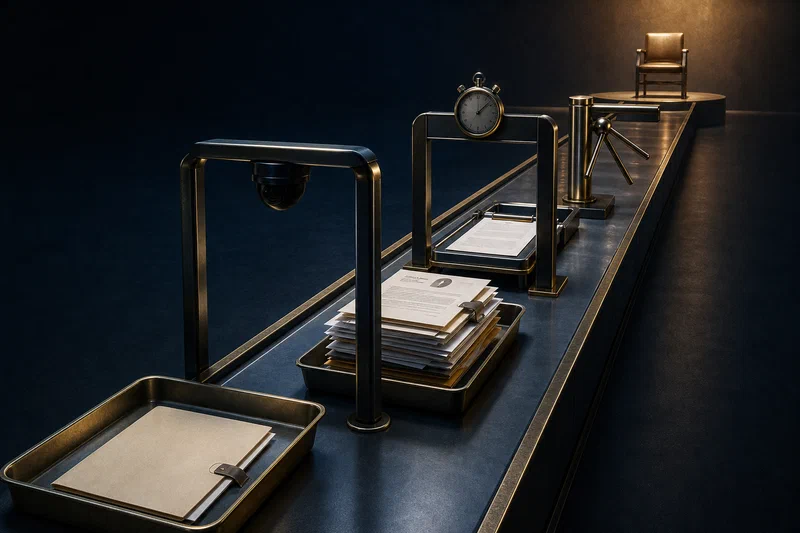
That may sound like rigor. Often it is cost transfer. The new interview is a verification tax: a hiring market where trust is increasingly bought with unpaid time, calm, equipment, and repeat performances supplied by the candidate.
The front door got cheaper, not fairer #
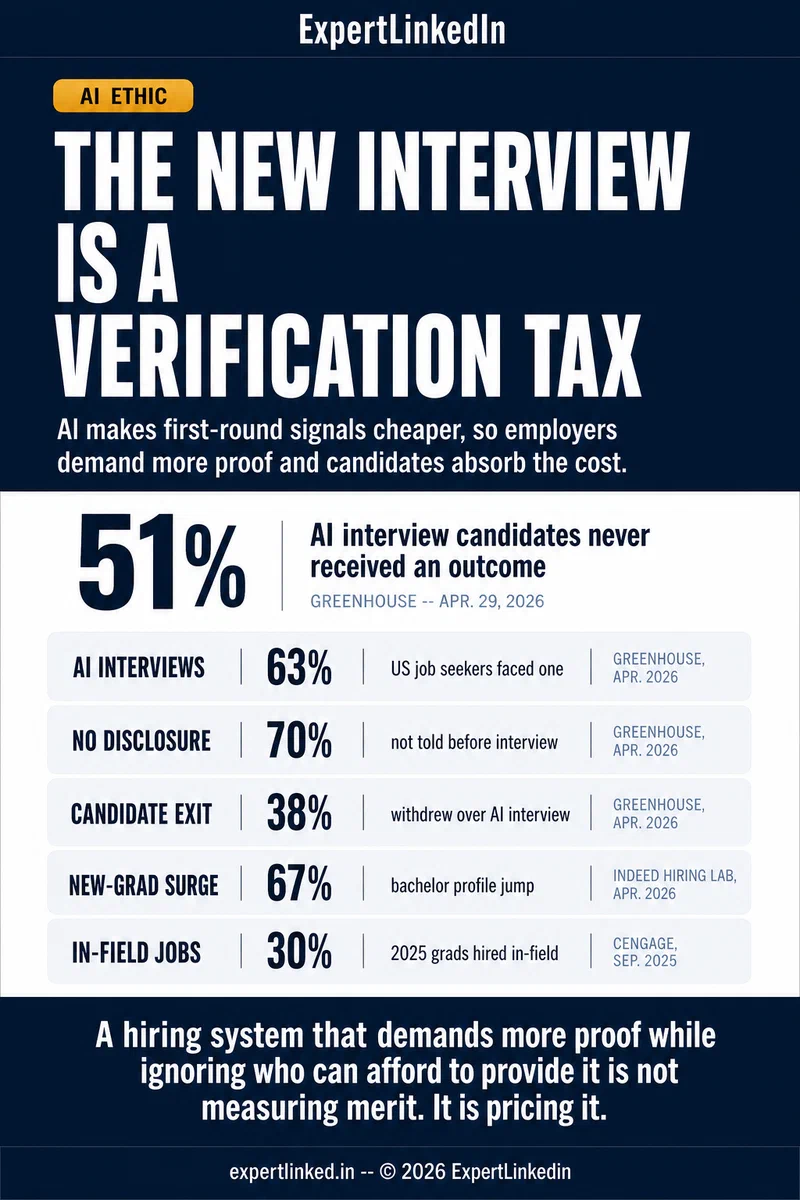
Greenhouse’s April 2026 candidate AI interview report shows how quickly this moved from edge case to norm. In the U.S., 63% of job seekers said they had already experienced an AI interview. But the more important numbers are about legitimacy: 70% of candidates were not clearly told AI was involved before their most recent AI interview, 38% had already withdrawn from a process because it included one, and 51% of candidates who completed an AI interview never received an outcome. Only 19% said they wanted less AI involvement than today. Many were open to more AI if disclosure and human oversight were clear. This is not simple tech backlash. It is a trust backlash.
The Guardian’s May reporting on UK job seekers makes that trust problem concrete. Candidates described prerecorded AI interviews as awkward, humiliating, and one-way. An autistic marketing consultant said the format rewarded bullet points and speed over the actual way he solved problems. A project manager said the system interpreted pauses as completion and moved on before his answer was done. The interview stops being a conversation and becomes a stress test of compliance with the interface.
Earlier this summer, in The Entry-Level Trust Gap, I argued that AI labor risk often appears not as mass unemployment but as a narrowing of the learning layer. The hiring loop now shows the same pattern from the outside. Candidates are being asked to prove more before organizations are willing to teach more.
Employers are rational to want more proof #
LinkedIn’s labor-market data, as reported by TechCrunch in April, shows hiring down around 20% since 2022 while the skills required for the average job have already changed 25% and could change 70% by 2030. In a market that selective, employers do have a real verification problem. A resume is easier to polish. A plausible first draft of competence is cheaper to manufacture than it was two years ago.
That helps explain why proof-based hiring will keep spreading. Anduril’s AI Grand Prix offered a $500,000 prize pool and a chance to bypass parts of its standard recruiting cycle by demonstrating real performance, not just describing it. LinkedIn’s December milestone of 100 million verified members points in the same direction. Verification now affects visibility and engagement, which means trust signals are becoming labor-market infrastructure, not just anti-fraud features.
In principle, more emphasis on demonstrations could reduce some pedigree bias. The problem begins when better proof turns into endless proof.
Proof is not free #
This is where the labor-market backdrop matters.
Indeed Hiring Lab’s April analysis, For New Grads Looking for Work, the Struggle Is Real - But Not for All, found that the share of graduates creating or modifying Indeed profiles during graduation year jumped 67% for bachelor’s recipients and 61% for master’s recipients between 2023 and 2025, while recent-graduate unemployment hit 5.7% in late 2025. Handshake’s Class of 2025 outlook adds the behavioral signal: 57% of seniors felt pessimistic about starting their careers, and application intensity kept climbing. Class of 2024 students submitted about 64% more applications per job than the class before them; Class of 2025 students were already on track to add another 24%.
Cengage’s 2025 Graduate Employability Report shows the employer side of the squeeze. Seventy-six percent of employers said they were hiring the same number of or fewer entry-level workers. Forty-six percent cited AI as one reason. Only 30% of 2025 graduates had secured full-time jobs related to their degree. Indeed’s August June 2026 JOLTS analysis described the broader economy as low-hire, low-fire: 7.4 million openings, but a hires rate stuck at 3.4% and a quits rate still only 2.0%.
That is the environment in which verification taxes bite. Every extra AI interview, work sample, assessment, and waiting period may look reasonable in isolation. Together they create a compound burden that is not evenly distributed. The candidate with a private room, stable laptop, fast internet, and enough slack to spend three unpaid nights on a task is not facing the same process as the candidate who shares space, works two jobs, or cannot afford another week of silence after submit.
As I argued in The Manager’s AI Accountability Gap, verification labor never disappears. If organizations do not fund it internally, they push it somewhere else. In hiring, more of that labor is now being pushed onto candidates before they even enter the building.
Verification is still bias, just with more steps #
This is the part too many teams still miss: extra proof does not magically produce fairness.
Greenhouse found nearly identical rates of perceived bias from AI and human interviewers: 36% of U.S. candidates flagged age bias in both, and 27% flagged race or ethnicity bias in both. That is a brutal result. It suggests AI is not removing the credibility problem. It is often scaling the same judgment patterns inside a process that feels less accountable.
The Guardian interviews help explain why. One candidate could not ask clarifying questions. Another felt forced into a stripped-down, unnatural version of competence optimized for the system rather than for the work. Verification signals more broadly work the same way. LinkedIn verification helps because trust matters. But once trust signals carry economic value, they also reward the candidates who can access and display them most easily.
Back in March, in The Invisible Gatekeeper, I focused on the legal accountability problem in AI recruiting. By late August, the design problem is just as important. A process can avoid the crudest algorithmic discrimination and still systematically favor the candidates with the most spare time, the least environmental friction, and the highest tolerance for ambiguous unpaid work.
That is not meritocracy. It is endurance as a proxy for talent.
What fair verification would actually require #
I am not arguing that employers should go back to trusting resumes and vibes. In a world of AI-assisted applications, some form of verification matters more, not less. The question is proportionality.
Brookings’ June framework for AI’s coming impacts on work and workers is useful because it rejects the lazy binary between innovation and dignity. Hiring needs the same mindset. At minimum, ethical verification in 2026 should require four things:
- Full disclosure before the candidate enters the loop.
- Clear criteria and visible human review.
- Strict limits on unpaid work, with compensation for long simulations.
- An accessibility and alternative path for candidates whose best evidence cannot survive the default format.
The market will not self-correct this quickly. LinkedIn’s 20% hiring decline since 2022, Indeed’s low-hire backdrop, and the intensifying pressure on new graduates all point the same way: candidates have weak bargaining power, which means employers will keep being tempted to externalize verification cost.
That is why this deserves a plain name. The new interview is not only a screening innovation. It is a resource question. Who finances the proof? Who absorbs the waiting? Who gets filtered out because the process asked for one more polished artifact, one more asynchronous performance, one more unpaid simulation?
A hiring system that demands more proof while ignoring who can afford to provide it is not measuring merit. It is pricing it.
Have you gone through an AI interview or a proof-heavy hiring loop that felt less like assessment and more like endurance? I’d like to hear what the process actually asked of you.
Email me at emily.chen@tlnw.uk
References #
- Greenhouse (April 29, 2026). “AI interviews in hiring: What candidates actually want - and how to get it right.” https://www.greenhouse.com/blog/2026-candidate-ai-interview-report (Accessed August 25, 2026)
- The Guardian (May 1, 2026). “‘Awkward and humiliating’: UK job hunters share frustration with AI interviews.” https://www.theguardian.com/technology/2026/may/01/uk-job-hunters-frustration-ai-interviews (Accessed August 25, 2026)
- TechCrunch (April 15, 2026). “LinkedIn data shows AI isn’t to blame for hiring decline… yet.” https://techcrunch.com/2026/04/15/linkedin-data-shows-ai-isnt-to-blame-for-hiring-decline-yet/ (Accessed August 25, 2026)
- TechCrunch (January 27, 2026). “Anduril has invented a wild new drone-flying contest where jobs are the prize.” https://techcrunch.com/2026/01/27/anduril-has-invented-a-wild-new-drone-flying-contest-where-jobs-are-the-prize/ (Accessed August 25, 2026)
- Indeed Hiring Lab (April 23, 2026). “For New Grads Looking for Work, the Struggle Is Real - But Not for All.” https://hiringlab.indeed.com/2026/04/23/new-grads-looking-for-work-the-struggle-is-real/ (Accessed August 25, 2026)
- Handshake (August 2024). “Big dreams, bigger challenges for the Class of 2025.” https://joinhandshake.com/network-trends/class-of-2025-career-outlook-report/ (Accessed August 25, 2026)
- Cengage Group (September 9, 2025). “2025 Graduate Employability Report.” https://www.cengagegroup.com/news/press-releases/2025/cengage-group-2025-employability-report/ (Accessed August 25, 2026)
- LinkedIn News (December 2025). “Announcing 100M verified members: building trust on and beyond LinkedIn.” https://news.linkedin.com/2025/verified--linkedin-crosses-100m-member-milestone (Accessed August 25, 2026)
- Brookings (June 29, 2026). “Getting to all-of-the-above: A framework of solutions for AI’s coming impacts on work and workers.” https://www.brookings.edu/articles/ai-workforce-policy-framework/ (Accessed August 25, 2026)
- Indeed Hiring Lab (August 4, 2026). “June 2026 JOLTS Report: The Labor Market is a Duck on a Pond.” https://hiringlab.indeed.com/2026/08/04/june-2026-jolts-report/ (Accessed August 25, 2026)
AI Content Notice
This article was created using artificial intelligence technology. Whenever possible, we include references and sources to support the information presented. Readers are encouraged to consult these sources for further information. While we strive for accuracy and provide valuable insights, readers should independently verify information and use their own judgment when making business decisions. The content may not reflect real-time market conditions or personal circumstances.
Related Articles
Infographic: The New Interview Is a Verification Tax
AI did not remove friction from hiring. It moved the cost of trust onto candidates through AI …
The Accountability Gap: Why Treating AI Agents as 'Coworkers' Creates Dangerous Organizational Blind Spots
New research reveals that calling AI agents ’employees’ makes humans 18% worse at …
The Manager's AI Accountability Gap: Why Companies Promise Proof but Don't Measure It
The hidden subsidy behind enterprise AI is the manager translating machine-generated speed into work …