What the August 2026 Jobs Report and July JOLTS Still Don't Say About Fall Hiring

The August jobs report gave the fall-rebound story its best headline in months. It did not give it the data it actually needs.
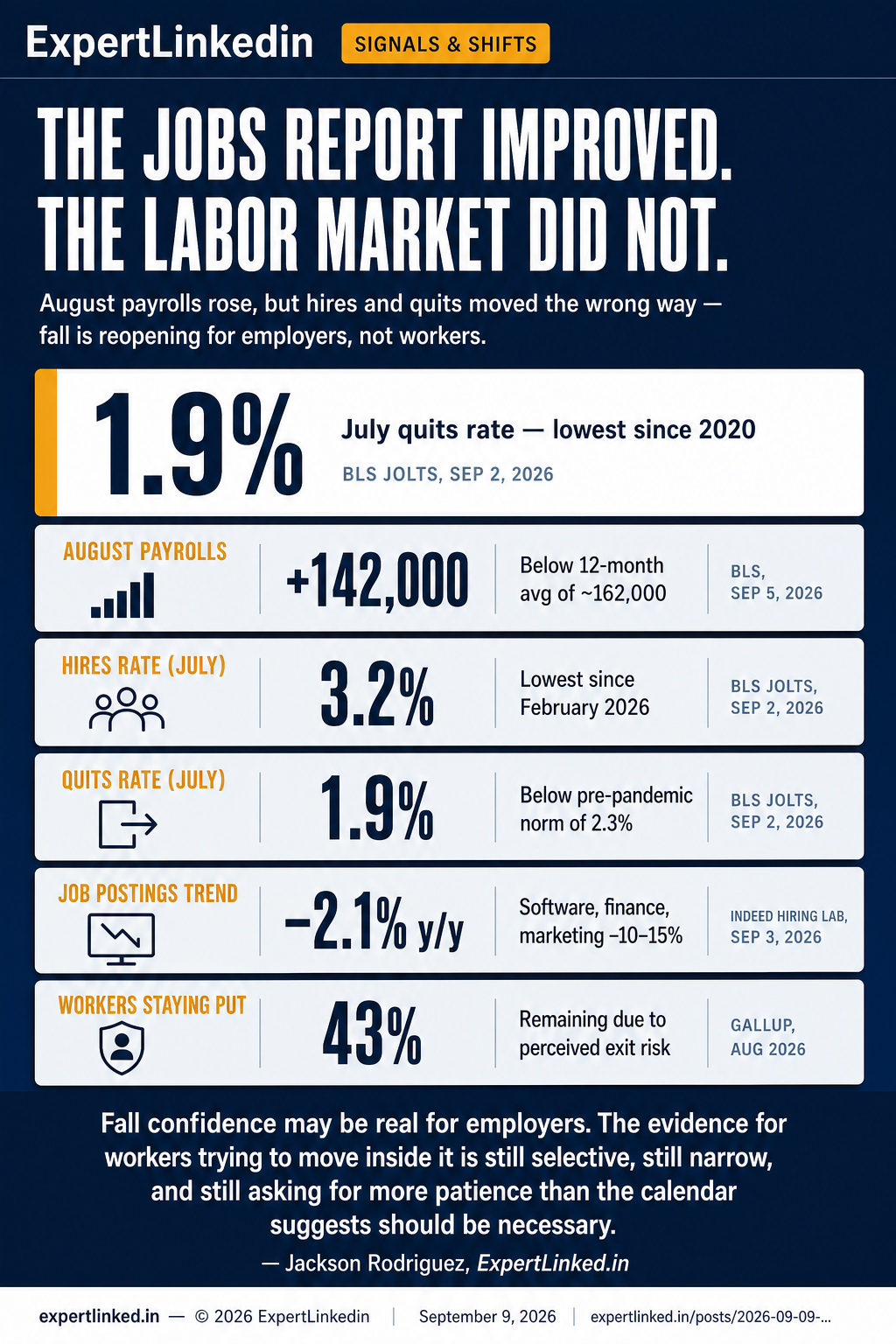
Friday’s Employment Situation release showed nonfarm payrolls up 142,000 in August, the unemployment rate holding at 4.3%, and average hourly earnings rising 3.6% year over year — nominally outpacing the 3.2% August CPI print for the first time since early 2024. June and July were revised up a combined 21,000. On the surface, that is a cleaner picture than most forecasters expected. In the commentary cycle that followed the 8:30 a.m. release, “better than feared” quickly became “fall is back” (U.S. Bureau of Labor Statistics, September 5, 2026).
The July JOLTS report — published three days earlier — did not get the same treatment. It should have.

What JOLTS Actually Showed #
July’s Job Openings and Labor Turnover Survey came in with openings little changed at 7.3 million. That is the number that will survive in a summary paragraph. It is not the number that tells you what is happening inside the market.
The hires rate fell back to 3.2% — the lowest reading since February 2026, and a retreat from the 3.4% reading in June. The quits rate slipped to 1.9%, back below the 2.0% level it briefly touched the prior month, and well below the pre-pandemic norm of 2.3%. Layoffs held at 1.0%, which is where they have been anchored all year (U.S. Bureau of Labor Statistics, September 2, 2026).
In professional and business services — the sector most of my readers work in or are trying to enter — hires fell by 188,000 month over month. Leisure and hospitality job openings were down 187,000 from a year earlier. Indeed Hiring Lab noted on September 3 that the August payroll pickup “has not yet translated into a meaningful broadening of hiring demand on the platform,” with the Job Postings Index still running -2.1% year-over-year and software, finance, and marketing postings down 10–15% compared to a year ago (Indeed Hiring Lab, September 3, 2026).
This is what I called the signal to watch in What the July 2026 JOLTS Report Says About the September Jobs Report: not the headline payroll number, but whether job growth would broaden beyond a few narrow pockets. August answered that question. Health care alone contributed +35,000 of the 142,000 total — roughly one-quarter of all job growth from a sector that employs about 14% of the private workforce. Retail lost 8,000. Financial activities lost 5,000. Temp help within professional services continued to contract.
That is not a broad reopening. That is a labor shortage in one sector being resolved while most of the rest of the market stays guarded.
The Payroll-Flow Divergence #
Here is the precise distinction that keeps getting lost.
BLS payroll counts measure net job additions — a stock metric. JOLTS hires and quits measure actual worker movement — a flow metric. You can have a positive stock number at the same time the flow freezes. You can add net jobs to the economy while simultaneously seeing fewer workers change positions, fewer employers take chances on new hires, and fewer workers bet on a better outside option.
August 2026 looks like exactly that scenario. Payrolls up 142,000; hires rate falling; quits rate falling. The economy is generating enough hiring to replace departures and add modest net growth. It is not generating enough hiring to meaningfully open the door for people trying to get in, change sectors, or move up.
The revision story works the same way. June and July being revised up by a combined 21,000 means the economy was stronger in those months than we initially measured. That is genuinely worth knowing. It does not change what July JOLTS reported about actual employer hiring behavior in that same month, which was measurably slower than June.
The Worker Side Stays Frozen #
The behavioral data continues to validate the flow picture more than the stock picture does.
Gallup’s August tracker found that only 28% of workers say now is a good time to find a quality job — a number unchanged from March and matching a level last seen in 2013. More tellingly, 43% said they remain at their current employer because the cost and risk of leaving is too high, not because they want to stay (Gallup, accessed September 9, 2026).
The quits rate at 1.9% is those workers expressed in one number. Workers quit when the expected value of leaving exceeds the expected cost of staying. When nominal wages move only fractionally above inflation, when job postings in your sector are running 10–15% below year-ago levels, and when only 19% of job seekers are receiving more than two interviews in a recent search, the calculation stays in favor of staying. The quits rate is not measuring satisfaction. It is measuring rational risk assessment in a selective market.
This is the thread running from The Stillness Trap through The Late-August 2026 Labor Market Verdict to now: openings can hold or even tick up without the flow metrics confirming that the market has genuinely reopened. That is not a technical distinction. It is the difference between an economy that can hold itself together and one that is actively creating better options for people who want to move.
The Asymmetric Confidence Problem #
What makes this particular moment harder to read is that both narratives — “the market is improving” and “it still doesn’t feel that way” — are simultaneously true. They describe the same market from two different vantage points.
The Federal Reserve’s September 3 Beige Book reported that six of twelve districts saw modest or slight labor market tightening in knowledge-economy and healthcare sectors. Only two districts — Chicago and Dallas — reported broad-based hiring pickup across multiple industries. Several noted that employers were “extending offer timelines and narrowing candidate pools,” not accelerating (Federal Reserve, September 3, 2026). That is an employer posture of careful selectivity, not confident expansion.
Employers can feel stable — and many do. Low layoffs mean their existing workforces are largely intact. Modest hiring means they are adding carefully where needed. The August payroll print is consistent with a management team that is pleased with its current cost structure and cautiously optimistic about Q4 demand. None of that is bad for employers.
The worker reads the same market differently. Their wages moved slightly above inflation for the first time in over two years, but by only 0.4 percentage points — a margin that rounds to nothing in a household budget. Their sector’s job postings are still depressed. Their interview conversion rate has not recovered. Their colleagues are staying put not because they are thriving, but because the exit calculus still doesn’t pencil out.
Both reads are honest. The asymmetry between them is the story.
What Fall Hiring Actually Looks Like Right Now #
The honest version of the fall labor market, as of September 9, is this:
Employers are somewhat more confident than they were in July. They are adding jobs at the margin — not broadly, but not contracting either. They are being selective about who they bring in, and they are taking their time. Healthcare is the clear exception; it is operating under different rules than the rest of the market, driven by structural shortages that pay cycles and QR codes cannot solve overnight.
For workers trying to make a move — lateral, upward, or across sectors — the data does not yet confirm a reopening. The hires rate tells you employers are not opening the front door widely. The quits rate tells you workers are calculating that the risk still outweighs the gain. The job postings index tells you the opportunity set in high-demand white-collar categories is still meaningfully below where it was a year ago.
Better payroll headlines are real. They matter for macro stability and for employer sentiment. They are not the same thing as a genuine reopening in mobility, switching leverage, and job-search conversion rates.
Fall confidence may be real for employers. The evidence for workers trying to move inside it is still selective, still narrow, and still asking for more patience than the calendar suggests should be necessary.
What is September’s jobs market actually feeling like from where you sit — employer, job seeker, or both? I would like to hear what the numbers look like in your sector.
Email me at jackson.rodriguez@tlnw.uk
References #
- U.S. Bureau of Labor Statistics. (September 5, 2026). “The Employment Situation — August 2026.” https://www.bls.gov/news.release/empsit.nr0.htm (Accessed September 9, 2026)
- U.S. Bureau of Labor Statistics. (September 2, 2026). “Job Openings and Labor Turnover — July 2026.” https://www.bls.gov/news.release/jolts.nr0.htm (Accessed September 9, 2026)
- U.S. Bureau of Labor Statistics. (September 5, 2026). “Real Earnings — August 2026.” https://www.bls.gov/news.release/realer.nr0.htm (Accessed September 9, 2026)
- Indeed Hiring Lab. (September 3, 2026). “August 2026 Jobs Day: Labor Market Update.” https://hiringlab.indeed.com/2026/09/03/august-2026-jobs-day-labor-market-update/ (Accessed September 9, 2026)
- Gallup. (Accessed September 9, 2026). “U.S. Worker Thriving Declines as Job Market Pessimism Grows.” https://www.gallup.com/workplace/703280/worker-thriving-declines-job-market-pessimism-grows.aspx (Accessed September 9, 2026)
- Federal Reserve. (September 3, 2026). “Beige Book — September 2026.” https://www.federalreserve.gov/monetarypolicy/beigebook202609.htm (Accessed September 9, 2026)
- ExpertLinked.in. (September 2, 2026). “What the July 2026 JOLTS Report Says About the September Jobs Report — and the 1 Signal to Watch.” https://expertlinked.in/posts/2026-09-02-what-the-july-2026-jolts-report-says-about-the-september-jobs-report-and-the-1-signal-to-watch/ (Accessed September 9, 2026)
- ExpertLinked.in. (August 26, 2026). “The Late-August 2026 Labor Market Verdict: 3 Signals That Will Shape September Hiring.” https://expertlinked.in/posts/2026-08-26-the-late-august-2026-labor-market-verdict-3-signals-that-will-shape-september-hiring/ (Accessed September 9, 2026)
- ExpertLinked.in. (July 1, 2026). “Signals & Shifts: The Stillness Trap.” https://expertlinked.in/posts/2026-07-01-signals-shifts-the-stillness-trap/ (Accessed September 9, 2026)
AI Content Notice
This article was created using artificial intelligence technology. Whenever possible, we include references and sources to support the information presented. Readers are encouraged to consult these sources for further information. While we strive for accuracy and provide valuable insights, readers should independently verify information and use their own judgment when making business decisions. The content may not reflect real-time market conditions or personal circumstances.
Related Articles
Infographic: What the August 2026 Jobs Report and July JOLTS Still Don't Say About Fall Hiring
The August jobs report sounded better. The July JOLTS data did not. Together, they describe a market …
What the July 2026 JOLTS Report Says About the September Jobs Report - and the 1 Signal to Watch
July JOLTS kept the labor market in low-hire, low-fire mode. The number to ignore is the headline; …
What the June 2026 JOLTS Report Says About Q3 Mobility - Before the August Jobs Report Lands
Openings held steady, but quits and hires didn’t move—the gap between those signals is where …