What the July 2026 JOLTS Report Says About the September Jobs Report - and the 1 Signal to Watch

The fall-rebound story did not get confirmation on Tuesday. It got a warning label.
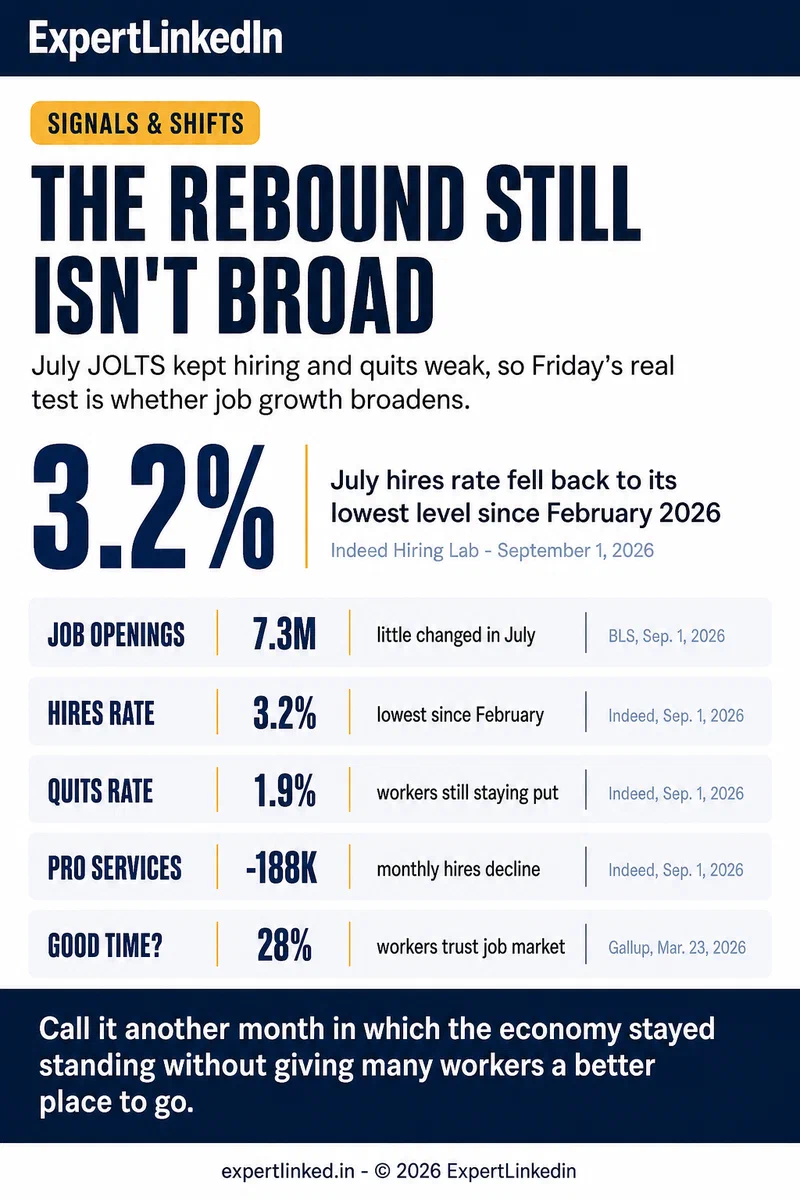
July’s JOLTS release from the Bureau of Labor Statistics showed job openings little changed at 7.3 million, up from a downwardly revised 7.2 million in June. That is the number likely to sound healthy in fast coverage. The numbers that matter more moved the other way: the hires rate fell back to 3.2%, quits slipped to 1.9%, and layoffs edged down to 1.0%. That is not a labor market reopening ahead of Friday’s August Employment Situation release. It is the same low-hire, low-fire market we have been living with all summer, now speaking a little more plainly about how thin the fall optimism really is (U.S. Bureau of Labor Statistics, September 1, 2026; Indeed Hiring Lab, Sneha Puri, September 1, 2026).
Friday’s jobs report arrives at 8:30 a.m. Eastern Time. It will produce a headline payroll number and a predictable flood of September-reset commentary. The July JOLTS report already narrowed the honest range of that commentary. If employers are still hiring this slowly and workers are still this reluctant to quit, one decent payroll print will not prove the market has reopened. It will only prove the economy can still generate a headline without generating much mobility (U.S. Bureau of Labor Statistics, accessed September 2, 2026).

What July JOLTS Actually Changed #
Not everything in Tuesday’s report was weak. That is what makes it easy to misread.
Openings rose modestly. Retail trade and manufacturing were up year over year. On the surface, that looks like an argument for patience: maybe the labor market is soft but still stabilizing. The problem is that openings measure posted intent. Hires and quits measure actual movement. When the surface number improves slightly while the flow numbers deteriorate, the headline flatters the market more than the mechanism does.
The hires rate falling back to 3.2% matters most. Indeed noted that it is the lowest reading since February 2026 and that professional and business services alone saw 188,000 fewer hires month over month. That is not what a broad fall restart looks like. It looks like employers remaining selective precisely in the part of the market many white-collar readers care about most (Indeed Hiring Lab, Sneha Puri, September 1, 2026).
The quits rate ticking down to 1.9% matters almost as much. Workers quit when they believe something better is reachable. A quits rate below 2% says the outside option still does not feel especially real. That extends the same warning I made in The Stillness Trap and then again in What the June 2026 JOLTS Report Says About Q3 Mobility - Before the August Jobs Report Lands: openings can stay elevated long after genuine worker-side movement has stalled.
Layoffs falling to 1.0% matters too, but for a different reason. It tells you this is not a collapse story. Employers are not slamming on the brakes. They are just not reopening the front door widely either. That low-hire, low-fire combination is why the data keeps sounding calmer than it feels. The system remains stable enough to avoid panic and tight enough to frustrate almost everyone trying to move inside it.
Why That Makes Friday Harder to Read #
This is where readers need to be a little more disciplined than the headline cycle will be.
The last monthly jobs report, for July, already showed how easy it is to confuse “not terrible” with “reopening.” Payrolls fell by 23,000. May and June were revised down by a combined 103,000. Labor-force participation held at 61.4%, down 0.7 percentage point since January. Health care added 22,000 jobs, while local government education lost 50,000, retail lost 19,000, and financial activities lost 14,000 (U.S. Bureau of Labor Statistics, August 7, 2026). That was already a market losing breadth.
Now the July JOLTS release gives that narrower payroll picture a mechanism. If hiring fell back in July and quits weakened further, then Friday’s August jobs number has a higher bar to clear than “better than feared.” A single headline payroll gain can happen in a market that still does not offer most workers much real room to move. That is especially true if gains remain concentrated in health care, a few public categories, or other narrow pockets that say more about specific shortages than about a general reopening.
The lived experience data still fits that read uncomfortably well. Gallup found that only 28% of workers say now is a good time to find a quality job, while 43% say they remain where they are because leaving would be too difficult or costly (Gallup, March 23, 2026). Indeed’s August economist survey was only a little less blunt: respondents expected the Job Postings Index to drift 0.5% lower through the end of September, not rebound sharply, while 57% expected downward pressure on college-educated workers’ wages over the next year (Indeed Hiring Lab, Laura Ullrich and Svenja Gudell, August 5, 2026). That is not a population waiting for one Friday morning headline to feel liberated again.
Inflation cooling does not rescue that story on its own. July CPI eased to 3.4% year over year, but BLS real earnings still showed real hourly pay down 0.2% over the year (U.S. Bureau of Labor Statistics, August 12, 2026; U.S. Bureau of Labor Statistics, August 12, 2026). Lower inflation is welcome. It is not the same thing as restored bargaining power.
The 1 Signal to Watch: Breadth Beyond Health Care #
So what should readers actually watch on Friday?
Not the first payroll number on the screen. Watch whether job growth broadens beyond health care and a handful of narrow categories.
That is the cleanest stress test because it is where the July JOLTS warning and the prior jobs report meet. July’s employment report already showed a market leaning too heavily on one steady sector while retail, finance, and public education slipped. July’s JOLTS report then added two more caution lights: leisure and hospitality job openings were down 187,000 from a year earlier, and professional and business services took the biggest month-over-month hit to hires (Indeed Hiring Lab, Sneha Puri, September 1, 2026). If Friday’s gains are again narrow, then the upbeat fall narrative is still getting ahead of the labor market it claims to describe.
Breadth is not a fancy statistic. It is a plain-English question: are more parts of the labor market actually participating?
If August job growth shows up across multiple private sectors - not just health care, not just one seasonal pocket, not just a noisy government swing - then the JOLTS warning softens. If leisure and hospitality, retail, professional and business services, and other cyclical or white-collar categories begin adding jobs together, you can make a more serious case that movement is widening.
If they do not, do not let the headline do too much work. A decent payroll gain carried by one or two sectors is not the same as a better opportunity set for readers. It is just a reminder that the economy can stay mathematically functional longer than it can feel generous.
What This Means for the September Reset #
The through-line from The Stillness Trap, through What the June 2026 JOLTS Report Says About Q3 Mobility - Before the August Jobs Report Lands, to The Late-August 2026 Labor Market Verdict: 3 Signals That Will Shape September Hiring has been consistent: openings can flatter the market for a long time. Movement cannot.
That is why Friday’s report matters, but not in the way most readers will first hear it. If the headline is soft, the story is easy. If the headline is strong, the real question becomes harder and more important: strong where, and for whom?
Professionals should read that answer carefully before upgrading their own expectations. A better payroll headline does not automatically mean easier job switching, stronger wage leverage, or a broader white-collar reset. Those conditions require more workers quitting confidently and more employers hiring broadly. July JOLTS showed neither.
Fall does not begin because the narrative says it does. It begins when more of the labor market starts moving at once. If Friday cannot show that breadth, do not call it a reset. Call it another month in which the economy stayed standing without giving many workers a better place to go.
Seeing this same gap between healthy-sounding headlines and the market you actually feel? I would like to hear what Friday’s sector mix looks like from where you sit.
Email me at jackson.rodriguez@tlnw.uk.
References #
- U.S. Bureau of Labor Statistics. (September 1, 2026). “Job Openings and Labor Turnover - July 2026.” https://www.bls.gov/news.release/jolts.nr0.htm (Accessed September 2, 2026)
- Indeed Hiring Lab, Sneha Puri. (September 1, 2026). “July 2026 JOLTS Report: Little Changed. Again.” https://hiringlab.indeed.com/2026/09/01/july-2026-jolts-report-little-changed-again/ (Accessed September 2, 2026)
- U.S. Bureau of Labor Statistics. (Accessed September 2, 2026). “September 2026 Release Calendar.” https://www.bls.gov/schedule/2026/09_sched.htm (Accessed September 2, 2026)
- U.S. Bureau of Labor Statistics. (August 7, 2026). “The Employment Situation - July 2026.” https://www.bls.gov/news.release/empsit.nr0.htm (Accessed September 2, 2026)
- U.S. Bureau of Labor Statistics. (August 12, 2026). “Consumer Price Index Summary - July 2026.” https://www.bls.gov/news.release/cpi.nr0.htm (Accessed September 2, 2026)
- U.S. Bureau of Labor Statistics. (August 12, 2026). “Real Earnings - July 2026.” https://www.bls.gov/news.release/realer.nr0.htm (Accessed September 2, 2026)
- Gallup. (March 23, 2026). “U.S. Worker Thriving Declines as Job Market Pessimism Grows.” https://www.gallup.com/workplace/703280/worker-thriving-declines-job-market-pessimism-grows.aspx (Accessed September 2, 2026)
- Indeed Hiring Lab, Laura Ullrich and Svenja Gudell. (August 5, 2026). “Economists Expect a Cooled Labor Market and an AI Reshuffling of White-Collar Work.” https://hiringlab.indeed.com/2026/08/05/q2-labor-market-outlook-survey/ (Accessed September 2, 2026)
- ExpertLinked.in. (July 1, 2026). “Signals & Shifts: The Stillness Trap.” https://expertlinked.in/posts/2026-07-01-signals-shifts-the-stillness-trap/ (Accessed September 2, 2026)
- ExpertLinked.in. (August 5, 2026). “What the June 2026 JOLTS Report Says About Q3 Mobility - Before the August Jobs Report Lands.” https://expertlinked.in/posts/2026-08-05-signals-shifts-june-jolts-q3-mobility/ (Accessed September 2, 2026)
- ExpertLinked.in. (August 26, 2026). “The Late-August 2026 Labor Market Verdict: 3 Signals That Will Shape September Hiring.” https://expertlinked.in/posts/2026-08-26-the-late-august-2026-labor-market-verdict-3-signals-that-will-shape-september-hiring/ (Accessed September 2, 2026)
AI Content Notice
This article was created using artificial intelligence technology. Whenever possible, we include references and sources to support the information presented. Readers are encouraged to consult these sources for further information. While we strive for accuracy and provide valuable insights, readers should independently verify information and use their own judgment when making business decisions. The content may not reflect real-time market conditions or personal circumstances.
Related Articles
Infographic: What the July 2026 JOLTS Report Says About the September Jobs Report - and the 1 Signal to Watch
July JOLTS kept the labor market in low-hire, low-fire mode. The number to ignore is the headline; …
What the June 2026 JOLTS Report Says About Q3 Mobility - Before the August Jobs Report Lands
Openings held steady, but quits and hires didn’t move—the gap between those signals is where …
Infographic: What the June 2026 JOLTS Report Says About Q3 Mobility - Before the August Jobs Report Lands
Openings held steady, but quits and hires didn’t move—the gap between those signals is where …