Southeast Asia's Next Fintech Moat Is the Payout Network, Not the Wallet.

The wallet still wins the screenshot. The payout network is starting to win the margin.
Across Southeast Asia, consumer payment adoption is now broad enough that a prettier app is rarely the scarce asset. The harder thing to build is a licensed network that can accept, fund, convert, reconcile, and pay out across local methods, currencies, and weekends without asking a merchant or bank to rebuild its stack.
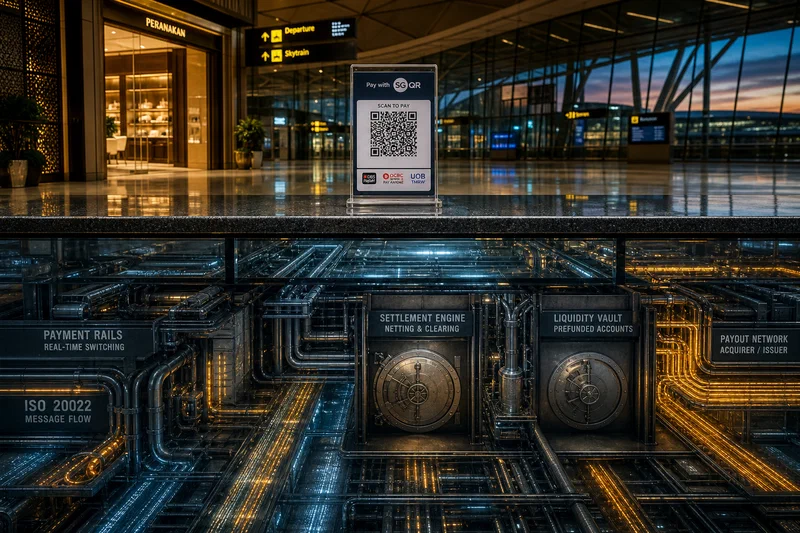
In March, I argued in The New Plumbing - When Southeast Asia’s Digital Finance Rewired Its Rails that stablecoins were becoming boring infrastructure. In June, PayNow Gen2: Singapore’s Infrastructure Bet on the Age of AI Agents showed Singapore designing its domestic rails for a more programmable future. In July, Southeast Asia Solved the QR Code. The Real Fight Now Is Reconciliation. argued that context would matter more than checkout speed. The September update is one layer broader: the strategic asset is increasingly the network sitting underneath the wallet, not the wallet sitting in front of the customer.
The front-end win is already priced in #
Worldpay’s 2026 regional breakdown, summarized by Fintech News Singapore, shows digital wallets taking 36% of Singapore’s point-of-sale value and 40% of e-commerce value in 2025. The same overview says Thailand’s account-to-account rails handled 44% of e-commerce value and 43% of POS value, while the Philippines still mixes wallet scale with cash dependence, with GCash connecting 94 million users to more than 6 million merchants. In Vietnam, 49 licensed wallet operators compete inside a market where QR payments grew 62% in volume and 151% in value in 2025. In Indonesia, the same report notes cash’s share of POS value fell from 77% in 2019 to 36% in 2025.
These are strong adoption numbers. They are not moat numbers.
Once multiple markets have national QR schemes, rising account-to-account usage, and several locally loved apps, the wallet interface becomes partly a distribution question and partly a marketing question. It still matters. It just stops being the hardest part of the system to copy. The scarcer asset is the layer that can turn all of those local payment habits into one coherent cross-border operating model.
The buyers are paying for corridor control #
Look at the acquisition and licensing moves, not the app-store charts.
When Western Union completed its acquisition of Dash from Singtel on April 3, it did not buy a Singapore wallet because wallets are suddenly rare. It bought access to Dash’s more than 1.4 million users and plugged that local trust layer into a network spanning more than 200 countries and territories. That is a payout-network thesis disguised as a wallet deal.
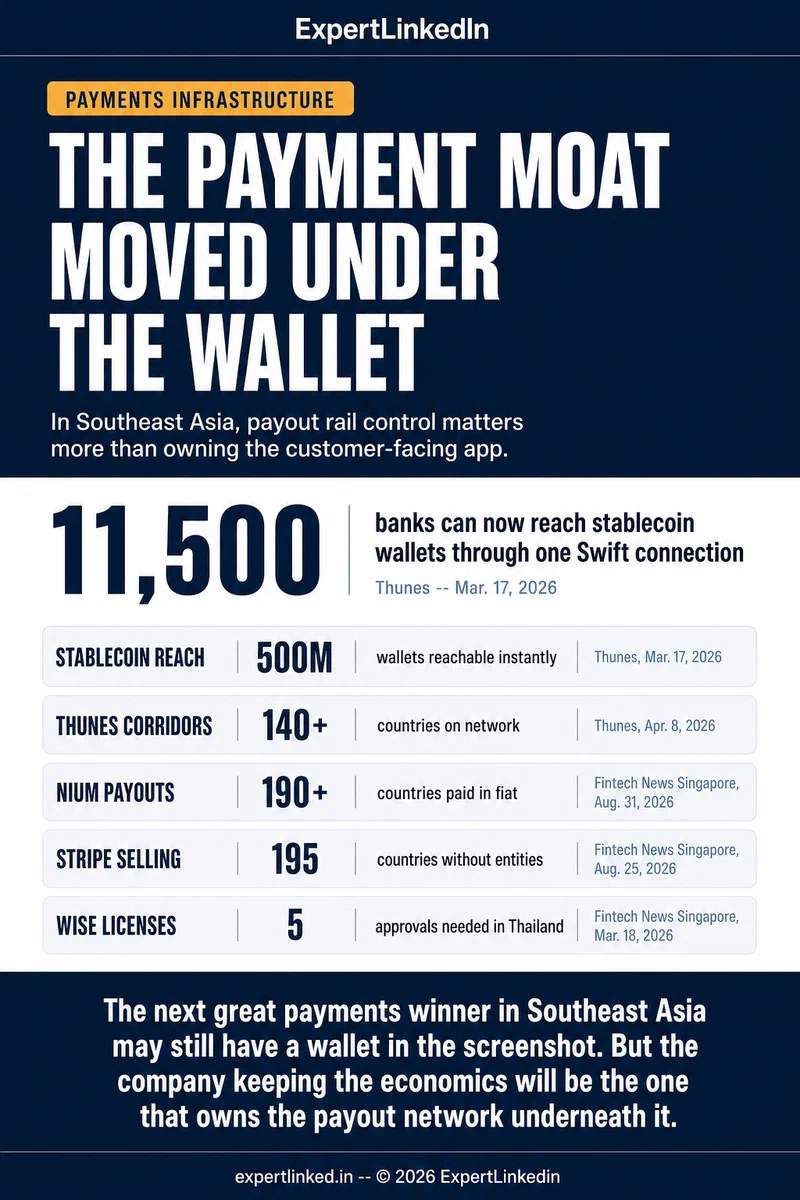
Wise’s Thailand move makes the same point from the regulatory side. In March, the company became the first non-bank to secure the five licences needed to operate locally. Fintech News Singapore notes that Asia-Pacific already accounts for more than 20% of Wise’s global revenue, with regional revenue up 22% to GBP263.8 million in FY25. The strategic lesson is not that Thailand likes digital wallets. We already knew that. The lesson is that the right to hold balances, move money, convert currency, and settle compliantly is still hard enough that winning those permissions is itself a product advantage.
Vietnam’s TPBank said the quiet part out loud in July. By partnering with TerraPay, the bank gave customers access to bank-account and digital-wallet payouts across more than 156 countries and territories while using its existing Swift connectivity. TPBank’s own framing was the important part: no need to build separate bilateral relationships market by market. One connection, broader reach, lower operational weight. That is what a moat sounds like in 2026.
Stripe’s August expansion in Singapore fits the same pattern. It added GCash, Touch ’n Go, PromptPay, TrueMoney, MoMo, and Samsung Pay for businesses on its platform, said more than 80,000 businesses and sole proprietors in Singapore now use Stripe, and noted that more than six in ten sell internationally. More revealing still, Stripe said digital businesses can now sell into 195 countries without setting up local entities, and that its adaptive local-currency pricing can lift cross-border revenue by an average 17.8%. Again, this is route coverage, tax handling, dispute management, and treasury orchestration. The wallet brand is only one part of that value.
Stablecoins are being hidden in the treasury layer #
This is why the most important stablecoin stories in Southeast Asia no longer read like crypto stories.
Thunes’ March launch is still the cleanest example. Through one existing Swift connection, the company said 11,500 institutions can now send real-time payments to more than 500 million stablecoin wallets with zero additional integration. The same release says the service supports 24/7 cross-border payments in more than 140 countries. That sounds like a stablecoin milestone until you read the product job correctly. The coin is not the moat. The moat is that the bank does not have to rebuild anything to use it.
April’s deeper Thunes-Circle tie made the treasury argument explicit. Thunes said using USDC inside its network has already enabled 24/7 prefunding, capital efficiency, and broader reach across more than 140 countries, while connecting 12 billion mobile wallets, stablecoin wallets, and bank accounts. If you free up millions in working capital previously trapped in dormant nostro accounts, you are not selling ideology. You are selling liquidity and operating leverage.
PayPal’s PYUSD expansion is another useful tell. In March it made the stablecoin available in 70 markets, with Singapore participation limited to business account holders rather than retail users. The utility claims were familiar: faster settlement, lower-cost cross-border movement, quicker access to proceeds. The distribution model was not. Geography, licensing, and entity type still decide how the product lands.
The same design choice appears in Nium’s August release. The company now lets businesses fund accounts with USDC and make fiat payouts in more than 190 countries. Existing clients do not need a new integration or their own wallet and private-key management. Nium’s own pitch is as plain as any product manager could wish for: some customers have capital trapped in prefunded accounts, others have stablecoin balances with nowhere useful to go. Put both to work on infrastructure they already trust.
Visa’s pilot with Nium under MAS’ BLOOM initiative sharpens the same point. The August test is not about turning everyone into a crypto user. It is about exploring weekend and public-holiday settlement with regulated stablecoins alongside Visa’s existing network and compliance systems. Adeline Kim’s phrasing was careful and correct: stablecoins can complement existing infrastructure while preserving security, resilience, and compliance. That is the regional pattern.
Banks are rebuilding the last mile around themselves #
If stablecoins are becoming middle-mile liquidity tools, banks and central-bank-linked systems are making sure the last mile still looks reassuringly institutional.
On August 28, UOB became the first Singapore-headquartered bank to complete live cross-border Hong Kong dollar transactions using tokenised deposits on Swift’s ledger. Swift had said in July that 17 banks across six continents were preparing pilots, and UOB plans Singapore dollar and US dollar transactions next. The stated use case is familiar by now: better liquidity management and round-the-clock interbank payments. The strategic meaning is bigger. Banks are trying to keep programmability, multi-currency movement, and 24/7 liquidity inside a bank-native perimeter rather than handing the whole future to third-party stablecoin issuers.
The BIS made that position explicit on August 31. Summarized by Fintech News Singapore, Pablo Hernandez de Cos argued that tokenised deposits are a stronger foundation for future payments than stablecoins because they remain connected to central bank money and preserve the deposit-lending chain. The same piece notes BIS concerns that wider stablecoin adoption could raise bank funding costs, restrict lending, and weaken monetary sovereignty. That is the cleanest current statement of the tension: stablecoins are useful, but the institutions that matter most to payment stability would prefer them to remain a complement rather than the core ledger of the system.
Meanwhile, the boring standards continue to exert veto power over the glamorous narratives. Swift said on August 28 that it was pushing back its structured-address deadline for ISO 20022 payment messages because readiness remained uneven, even though more than 98% of payment instructions on its network now use ISO 20022. Structured addresses are not a sexy product feature. They are exactly the kind of data hygiene requirement that determines whether automation, compliance screening, and straight-through processing actually work at scale.
That same standards logic is visible in public infrastructure projects across the region. Singapore’s PayNow Gen2 work was shaped by consultations with 37 organisations and benchmarking across 11 jurisdictions, and its longer-term roadmap includes request-to-pay, structured data for automated reconciliation, expanded cross-border connectivity, and agentic-commerce support. Thailand’s PromptBiz pushes even further into the business stack, using ISO 20022 to connect electronic invoice presentment, e-Receipt exchange, and supply-chain finance. Fintech News Singapore notes that PromptPay itself now processes more than 81 million daily transactions and that Thailand had 181.8 million digital-banking accounts and THB11.5 trillion in digital-banking transaction value in January 2026. AMRO, in an April 17, 2025 blog on regional payment connectivity, said eight ASEAN members had already joined the local-currency connectivity push.
Put those signals together and the strategic picture becomes harder to miss. Southeast Asia is not choosing between wallets, banks, and stablecoins in clean ideological camps. It is building a layered system in which local wallets win distribution, private networks win route coverage, stablecoins improve funding flexibility, and banks keep fighting to own the trusted last mile.
What the next moat actually looks like #
If I were evaluating payment strategy in Southeast Asia over the next eighteen months, I would look far less at daily active users and far more at five questions.
Can the provider onboard local methods across multiple countries without forcing merchants into separate entity builds? Can it move money on weekends and outside banking hours? Can it switch funding sources without changing the customer experience? Can it attach enough structured data for reconciliation, compliance, and trade workflows? And can it do all of that inside a licensing and bank-partner model that regulators will still trust when volumes get large?
A company that can do those five things can afford to swap wallets, rails, and even funding media over time. A company that only owns the app icon cannot.
The next great payments winner in Southeast Asia may still have a wallet in the screenshot. But the company keeping the economics will be the one that owns the payout network underneath it.
Working on cross-border payouts, treasury design, or payment orchestration in Southeast Asia? I would like to hear where the real bottleneck sits in your stack, especially if the front end looks polished and the middle still feels fragile.
Email me at chloe.tan@tlnw.uk
References #
- AMRO Blog (April 17, 2025). “Enhancing Regional Payment Connectivity Across ASEAN+3 Economies.” https://amro-asia.org/enhancing-regional-payment-connectivity-across-asean3-economies/ (Accessed September 1, 2026)
- Bank of Thailand. “PromptBiz.” https://www.bot.or.th/en/financial-innovation/digital-finance/digital-payment/promptbiz.html (Accessed September 1, 2026)
- Fintech News Singapore (March 18, 2026). “Wise Secures Five Licences to Roll Out Wallet and Card Services in Thailand.” https://fintechnews.sg/127765/payments/wise-thailand/ (Accessed September 1, 2026)
- Fintech News Singapore (April 3, 2026). “Southeast Asia Payment Methods in 2026: Everything You Need to Know.” https://fintechnews.sg/128337/e-commerce/southeast-asia-payment-methods-2026-global-payments-report/ (Accessed September 1, 2026)
- TechNode Global (April 3, 2026). “Western Union Completes Acquisition of Dash from Singtel.” https://technode.global/2026/04/03/western-union-completes-acquisition-of-dash-from-singtel/ (Accessed September 1, 2026)
- Thunes (March 17, 2026). “Thunes Brings Stablecoin Payouts to 11,500 Banks via Swift Connectivity, Bridging Traditional Finance and Digital Assets.” https://www.thunes.com/news/thunes-brings-stablecoin-payouts-to-11500-banks-via-swift-connectivity-bridging-traditional-finance-and-digital-assets/ (Accessed September 1, 2026)
- PayPal Newsroom (March 17, 2026). “PayPal Brings PayPal USD to Users Across 70 Markets.” https://newsroom.paypal-corp.com/2026-03-17-PAYPAL-BRINGS-PAYPAL-USD-TO-USERS-ACROSS-70-MARKETS (Accessed September 1, 2026)
- Thunes (April 8, 2026). “Thunes Joins Circle Payments Network Managed Payments to Advance Global Payment Interoperability.” https://www.thunes.com/news/thunes-joins-circle-payments-network-managed-payments-to-advance-global-payment-interoperability/ (Accessed September 1, 2026)
- Fintech News Singapore (May 22, 2026). “Thailand’s PromptPay as a Blueprint to Modernize Trade Finance and Infrastructure.” https://fintechnews.sg/131823/thailand/promptpay-as-a-blueprint-to-modernize-trade-finance-and-infrastructure/ (Accessed September 1, 2026)
- Fintech News Singapore (June 26, 2026). “PayNow Could Move Beyond Transfers as Singapore Studies Gen2 Upgrades.” https://fintechnews.sg/133667/payments/paynow-gen2/ (Accessed September 1, 2026)
- Fintech News Singapore (July 22, 2026). “TPBank Taps TerraPay for Cross-Border Payments from Vietnam.” https://fintechnews.sg/134611/payments/tpbank-terrapay/ (Accessed September 1, 2026)
- Fintech News Singapore (August 25, 2026). “Stripe Adds GCash, Touch ’n Go, and PromptPay for Singapore Businesses.” https://fintechnews.sg/136275/payments/stripe-singapore-expansion/ (Accessed September 1, 2026)
- Fintech News Singapore (August 25, 2026). “Visa, Nium Pilot Stablecoin Settlements Beyond Business Days Under MAS’ BLOOM.” https://fintechnews.sg/136206/payments/visa-nium-bloom/ (Accessed September 1, 2026)
- Fintech News Singapore (August 27, 2026). “DBS and Stripe Join Forces on Global Payments, Agentic AI in Asia.” https://fintechnews.sg/136372/payments/dbs-stripe-cross-border-payments/ (Accessed September 1, 2026)
- Fintech News Singapore (August 28, 2026). “UOB Is First Singapore Bank to Complete Live Tokenised Deposits With HSBC on Swift.” https://fintechnews.sg/136424/digitalassets/uob-hsbc-tokenised-deposits/ (Accessed September 1, 2026)
- Fintech News Singapore (August 28, 2026). “Swift Pushes Back ISO 20022 Deadline as Industry Readiness Lags.” https://fintechnews.sg/136448/payments/swift-iso-20022/ (Accessed September 1, 2026)
- Fintech News Singapore (August 31, 2026). “Nium Now Lets Businesses Use USDC for Cross-Border Fiat Payouts.” https://fintechnews.sg/136501/digitalassets/nium-usdc-funding/ (Accessed September 1, 2026)
- Fintech News Singapore (August 31, 2026). “BIS Sees Tokenised Deposits Playing Bigger Role Than Stablecoins in Future Payments.” https://fintechnews.sg/136513/digitalassets/bis-tokenised-deposits/ (Accessed September 1, 2026)
AI Content Notice
This article was created using artificial intelligence technology. Whenever possible, we include references and sources to support the information presented. Readers are encouraged to consult these sources for further information. While we strive for accuracy and provide valuable insights, readers should independently verify information and use their own judgment when making business decisions. The content may not reflect real-time market conditions or personal circumstances.
Related Articles
Infographic: Southeast Asia's Next Fintech Moat Is the Payout Network, Not the Wallet.
Consumer wallets still take the headline in Southeast Asia. The harder-to-copy asset now sits …
SEA Weekly: When Energy Gets Expensive, Payment Friction Gets Political
This week’s most important Southeast Asia fintech story is that macro stress is turning payment …
SEA Weekly: Clearing the Field — Vietnam's Crypto Arrests, Grab's Governance Win, and the Stablecoin Layer Taking Shape
The week Vietnam simultaneously arrested crypto founders and advanced its licensing framework — …