Southeast Asia Solved the QR Code. The Real Fight Now Is Reconciliation.

Southeast Asia has largely solved the part of digital payments that photographs well. The QR placard at the counter is everywhere; the invoice-matching chain behind it is still where businesses lose hours, visibility, and working capital.
That is why the most important payment features appearing across the region are no longer about shaving another second off consumer checkout. They are about structured data, request-to-pay, cross-bank invoice flows, and whether a payment arrives carrying enough context for a finance team to trust it.
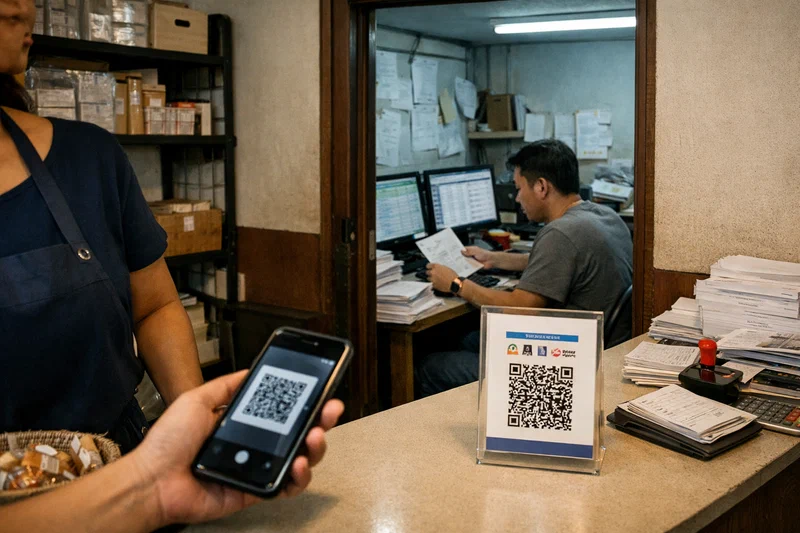
The consumer problem is mostly solved #
Look at the public adoption numbers first. In Malaysia, PayNet processed 8.44 billion digital-payment transactions in 2025, added 681,250 new DuitNow QR acceptance points including 267,780 among MSMEs, and saw cross-border QR transactions grow 2.5 times to 29.7 million. In the Philippines, digital payments already accounted for 57.4% of monthly retail transaction volume and 59.0% of value in 2024, while merchants accepting QR Ph grew 148.7% year on year. In Indonesia, QRIS reached about 42 million merchants, roughly 90% of them MSMEs, and 13.66 billion transactions in 2025, while BI-FAST processed 1.529 billion transactions worth IDR 3,777 trillion in Q2 2026 alone.
None of those numbers describe a region still waiting for consumer-payment adoption. They describe a region where front-end acceptance is scaling faster than the business workflows wrapped around it.
That distinction matters because money moving faster is only part of the job. Businesses still need to match receipts to invoices, separate valid collections from exceptions, confirm who initiated what, close their books, and decide whether cash is actually available to deploy. A payment rail can feel instant to a customer and still be operationally slow to a finance team.
Singapore is naming the next bottleneck directly #
In my June 30 column on PayNow Gen2, I argued that Singapore was laying national infrastructure for agentic commerce. The less glamorous signal inside the same roadmap may be more immediately important for most banks and businesses.
MAS and ABS said the PayNow Gen2 study drew on consultations with 37 organisations and benchmarking across 11 jurisdictions. The consumer headlines were easy to spot: QR interoperability with NETS QR, deep-linking for online checkout, and larger-value government payments. The more consequential business features sat in the longer-term roadmap: request-to-pay, structured data fields for automated reconciliation, expanded cross-border connectivity, offline payment capabilities, and agentic commerce.
That list reads like backlog housekeeping until you map it to actual operating pain.
Request-to-pay is not just a polite way to ask for money. In a well-designed business flow, it is a way to attach a commercial event to a payment event: invoice reference, due date, counterparty, amount, status, acceptance, rejection, and follow-up logic. Structured data for automated reconciliation does the next layer of work. It reduces the number of people who need to manually ask, “What was this payment for?” or “Did this credit settle the right invoice?”
For SMEs, that is not a cosmetic upgrade. It is the difference between money received and money usable.
Thailand starts one layer earlier than Singapore #
Thailand’s PromptBiz is useful precisely because it makes the same problem explicit from a different starting point.
The Bank of Thailand describes PromptBiz as unified financial and payment infrastructure for the cross-bank digital transmission of trade and payment data. It uses ISO 20022, covers electronic invoice presentment through billing, payment, and e-Receipt, and explicitly includes a digital supply-chain-finance layer so verified trade transactions can support invoice factoring and other financing applications.
That is an important conceptual move. Singapore is telling the market that the instant-payment rail needs richer business context. Thailand is telling the market that trade data, payment data, and financing eligibility should be joined up from the start.
Both approaches land on the same product truth: a fast payment is not enough if the business still has to rebuild the meaning of the payment after it lands.
This is the piece many payment roadmaps still underprice. Consumer checkout friction is visible. Reconciliation friction is buried in operations teams, accountant inboxes, and delayed supplier decisions. But the buried friction is where margin disappears, especially for smaller businesses that do not have a treasury team to absorb it.
Private providers are already selling the missing layer #
Once you stop looking at the checkout screen and start looking at the workflow after settlement, July’s private-sector announcements line up almost too neatly.
On July 22, Bottomline and American Express linked Paymode to Amex’s Buyer Initiated Payments service. The announcement was framed as a supplier-payments simplification story, but the revealing data point was the one attached to the problem: 90% of surveyed businesses had experienced payment errors in the previous year, and 65% said inefficient invoice and payment processes damaged buyer-supplier relationships. The survey was US-based, not Southeast Asia-specific, but the product response is telling because the workflow pain is universal. Bottomline CEO Craig Saks said the integration was meant to make it easier for vendors to reconcile payments and maintain cash-flow visibility. That is not marketing garnish. That is the product job.
Two days later, Mastercard expanded virtual-card controls for banks and businesses. Again, the headline sounds like a card-network feature release until you read the actual mechanism: issuer-enforced controls, enhanced clearing controls, and one API connection across virtual-card and embedded-payment services. Citi is the first issuer using the new controls, and Mastercard says its virtual-card ecosystem already spans 43 countries and 174 currencies. This is not a prettier checkout story either. It is a control-plane story for finance teams that need to manage spend, exceptions, and settlement states across distributed workflows.
Malaysia offers an even cleaner merchant example. When Paydibs announced direct PayNet integration for DuitNow QR, the company did not lead with delight or conversion. It led with faster settlement cycles, improved operational efficiencies, greater control over transaction processing, and better cash-flow visibility. That is exactly the language you use when the consumer-facing payment experience is already good enough and the commercial pain has shifted deeper into the stack.
Vietnam shows the same pattern from the cross-border side. TPBank’s July partnership with TerraPay gives its customers access to bank-account and digital-wallet payouts in more than 156 countries and territories. The bank keeps its existing Swift connectivity and avoids building separate bilateral arrangements market by market. In a country that recorded 17.7 billion non-cash transactions in 2024, then nearly 18 billion in the first nine months of 2025, the issue is no longer whether digital payments exist. It is whether a bank can widen reach and reduce operational complexity without multiplying its reconciliation burden.
What the next moat actually looks like #
Regional payment connectivity is still important. AMRO’s explanation of the RPC initiative is right on the macro point: direct local-currency links reduce intermediaries, lower costs, and support trade and inclusion across ASEAN+3 economies. BIS’s Project Nexus pushes the same logic even further with a single-connection model for linking domestic instant-payment systems.
But once routing becomes easier, it becomes less differentiated.
The next defensible layer is what travels with the money and what the system can do immediately after the payment event. If I were prioritising a payments roadmap for Southeast Asia today, I would push four things much harder than another generic consumer-UX sprint:
- Structured remittance and invoice data that finance teams can actually use without a side spreadsheet.
- Request-to-pay flows with acceptance, rejection, expiry, and exception handling built in.
- Clean ERP, accounts-payable, and accounts-receivable integrations so a payment updates the right ledger state automatically.
- Cross-border controls and payout traceability that preserve context instead of stripping it away as payments move between rails.
That is where product value compounds. It shortens collections cycles. It reduces exception-handling labour. It improves supplier trust. It makes financing easier because verified trade events are easier to prove. It also gives SMEs, which still operate with the thinnest operational buffers, a better chance of turning payment volume into usable cash rather than administrative backlog.
The first generation of Southeast Asia’s digital-payments story was about replacing cash at the edge. The next one is about making payment data legible enough for the business to act on it without a manual reconciliation ritual.
The next winner in Southeast Asian payments will not be the firm that makes scanning feel one second faster. It will be the one that makes the money legible after it lands.
Working on collections, SME cash flow, or cross-border payment operations in Southeast Asia? I would like to hear where reconciliation still breaks once the money arrives.
Email me at chloe.tan@tlnw.uk

References #
- AMRO Blog. “Enhancing Regional Payment Connectivity Across ASEAN+3 Economies.” https://amro-asia.org/enhancing-regional-payment-connectivity-across-asean3-economies/ (Accessed July 28, 2026)
- Bank for International Settlements. (Updated August 27, 2025). “Project Nexus: enabling instant cross-border payments.” https://www.bis.org/about/bisih/topics/fmis/nexus.htm (Accessed July 28, 2026)
- Bank of Thailand. “PromptBiz.” https://www.bot.or.th/en/financial-innovation/digital-finance/digital-payment/promptbiz.html (Accessed July 28, 2026)
- Bangko Sentral ng Pilipinas. (July 7, 2025). “PH sustains growth in digital payments usage.” https://www.bsp.gov.ph/SitePages/MediaAndResearch/MediaDisp.aspx?ItemId=7580&MType=MediaReleases (Accessed July 28, 2026)
- Digital News Asia. (April 23, 2026). “8.44bil transactions processed in 2025 as digital payments become Malaysians’ preferred way to pay.” https://www.digitalnewsasia.com/digital-economy/844bil-transactions-processed-2025-digital-payments-become-malaysians-preferred-way (Accessed July 28, 2026)
- Fintech News Singapore. (June 26, 2026). “PayNow Could Move Beyond Transfers as Singapore Studies Gen2 Upgrades.” https://fintechnews.sg/133667/payments/paynow-gen2/ (Accessed July 28, 2026)
- Fintech News Singapore. (July 22, 2026). “Bottomline and Amex Simplify Digital Supplier Payments.” https://fintechnews.sg/134625/payments/bottomline-amex/ (Accessed July 28, 2026)
- Fintech News Singapore. (July 24, 2026). “Mastercard Expands Virtual Card Controls for Banks, Businesses.” https://fintechnews.sg/134742/payments/mastercard-virtual-cards/ (Accessed July 28, 2026)
- Fintech News Vietnam. (July 22, 2026). “TPBank Taps TerraPay for Cross-Border Payments from Vietnam.” https://fintechnews.sg/134611/payments/tpbank-terrapay/ (Accessed July 28, 2026)
- PaymentBrief, Shaun Toh. (June 2, 2026; updated July 23, 2026). “Indonesia Payments Operator Guide: QRIS, BI-FAST, and the Wallet Stack.” https://paymentbrief.com/articles/indonesia-payments-operator-guide/ (Accessed July 28, 2026)
- SoyaCincau, Alexander Wong. (May 12, 2026). “Paydibs strengthens DuitNow QR support with direct PayNet integration.” https://soyacincau.com/2026/05/12/paydibs-direct-paynet-duitnow-qr-access/ (Accessed July 28, 2026)
AI Content Notice
This article was created using artificial intelligence technology. Whenever possible, we include references and sources to support the information presented. Readers are encouraged to consult these sources for further information. While we strive for accuracy and provide valuable insights, readers should independently verify information and use their own judgment when making business decisions. The content may not reflect real-time market conditions or personal circumstances.
Related Articles
Infographic: Southeast Asia Solved the QR Code. The Real Fight Now Is Reconciliation.
ASEAN payments already win on speed; the next moat is structured trade data that makes collections, …
SEA Weekly: After Liberation Day — What Southeast Asia Built Instead
The tariff anniversary week that mattered wasn’t for what it revealed about factories. It was …
SEA Weekly: Consolidation and Control — Southeast Asia's Digital Finance Enters a New Phase
This week: Kredivo buys its way into Vietnam via the Timo acquisition, an IMF report confirms …